

A practical guide to SEO for small business: choose the right pages, fix the real constraint and turn useful search visits into better enquiries.
You do not need another list of 80 things your website should be doing. You need to know why people who want your service are not finding you, or why the people who do arrive are leaving without contacting you. Those are different problems. They deserve different work.
SEO for small business means helping search engines understand your offer and helping the right customers find, assess and act on it. Start with one important service or product page, check that it can be found, make its answer useful and test the enquiry path. Then use search data and actual enquiries to choose the next improvement.
Build one complete path from a customer’s search to a useful enquiry before expanding the whole website. A larger content library cannot compensate for a service page that leaves the buyer confused.
SEO for small business: choose the first priority
Prioritise the weakest evidenced step between discovery and a suitable enquiry. If Google cannot access an important page, fix access. If the page attracts the wrong searches, fix its purpose. If suitable visitors cannot contact you, fix that journey before commissioning more articles.
Google’s SEO starter guide connects search-engine understanding with helping people discover content and decide whether to visit. That is a better working definition than treating SEO as a collection of plugin scores.
| What you notice | Check first | Useful next action |
|---|---|---|
| An important page is missing from Search | URL Inspection, indexing status and selected canonical | Resolve the specific access or indexing issue |
| Impressions arrive for unsuitable searches | Page purpose, query themes and service scope | Align the page with the offer you actually sell |
| Relevant impressions produce few clicks | Search intent, result title, competition and position | Make the page promise clearer where the evidence supports it |
| Useful visits produce few enquiries | Mobile content, contact action and submission delivery | Repair the first confusing or broken step |
| Enquiries arrive but rarely fit | Service, geography, price expectations and qualification | Clarify suitability before chasing more traffic |
A new site may not have enough search data to reveal a pattern. Begin with a service you genuinely deliver and questions customers already ask. An established site can use its existing queries and enquiry records. Neither needs to pretend that every page deserves equal attention.
Make the website useful across the whole buying journey
A search result often starts the investigation rather than finishing it. Your profile, website and contact experience need to tell a consistent story, especially when someone moves between them on a phone.
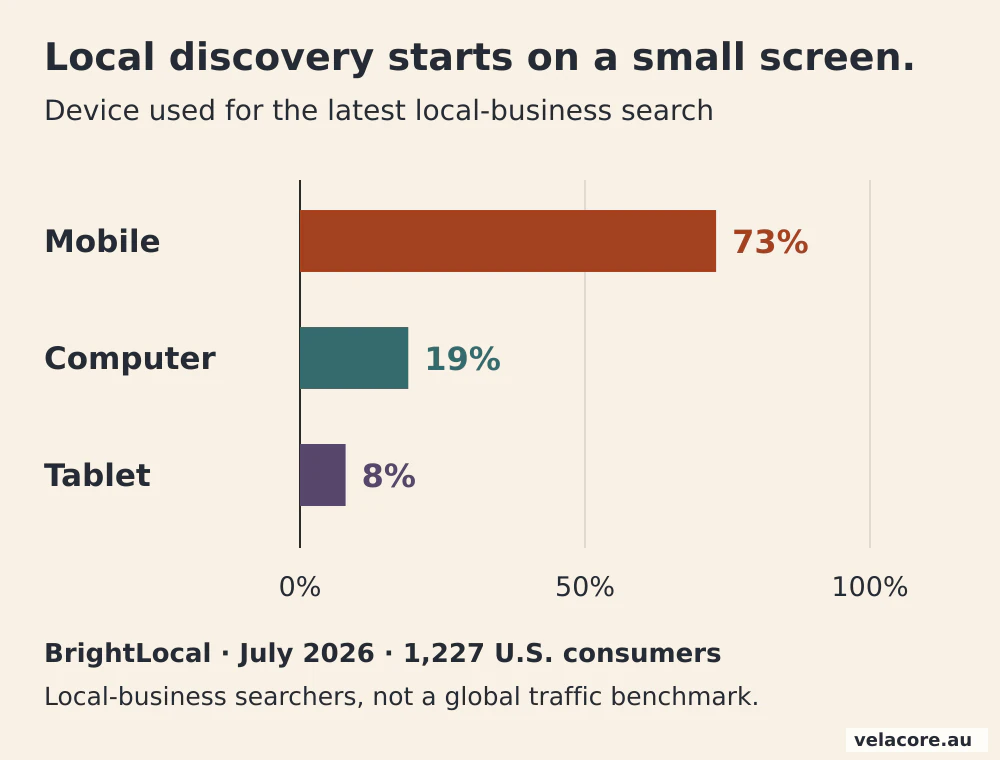
- Mobile matters: BrightLocal’s July 2026 research found that 73% began their latest local-business search on a mobile phone.
- Discovery crosses channels: the same study found that 75% used more than one channel during that search.
- Reviews lead back to websites: in a separate February 2026 survey, 54% said they would visit a business website after reading positive reviews.
The first study surveyed 1,227 US consumers who had recently searched for a local business; the second used 1,002 US adults. These findings describe those panels, not a worldwide forecast of your customers. The practical implication is straightforward: check the handoff between the places people discover you and the page where they decide.
For a local operator, that may mean Google Maps, a service page and a call. For a specialist consultancy selling internationally, it may mean a comparison, a technical explanation and a project enquiry. Start with the journey your buyers actually take.
Choose search questions that match a service you can deliver
Choose a page around a real customer decision, not simply the largest keyword number a tool displays. A good starting question has a clear service behind it, a suitable audience and an answer your business can substantiate.
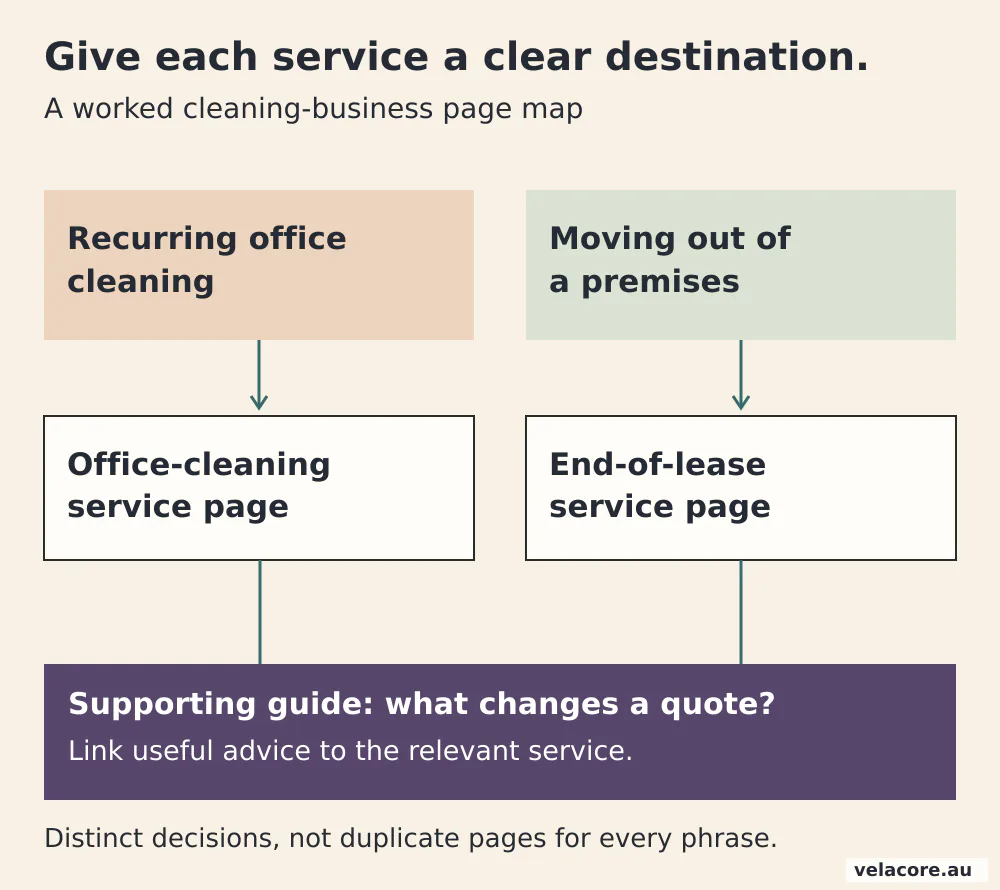
Take a hypothetical commercial cleaner. “Office cleaning for a small premises” is different from “end-of-lease cleaning checklist”. One person may be comparing an ongoing service; the other may need instructions for a one-off task. Sending both to a vague “cleaning solutions” page makes the visitor do the sorting.
Write down the services you actually want to sell, the customers who buy them and the questions that determine fit. Where customers use different words for the same service, one useful page can cover those natural variations. Create a separate page when the service or decision genuinely changes, not for every keyword permutation.
Use customer language from enquiries, sales conversations and support questions. For an existing website, add relevant Search Console query themes. A paid keyword tool can expand the research, but its estimated volume is an input to judgment, not a promise of available customers.
A useful page owns a decision. It does not need to own every phrase.
Find the right improvement in Google Search Console
Google Search Console helps you connect search queries with the pages appearing for them. Use it to inspect one important destination and identify whether the next problem is access, relevance or the search-result promise.
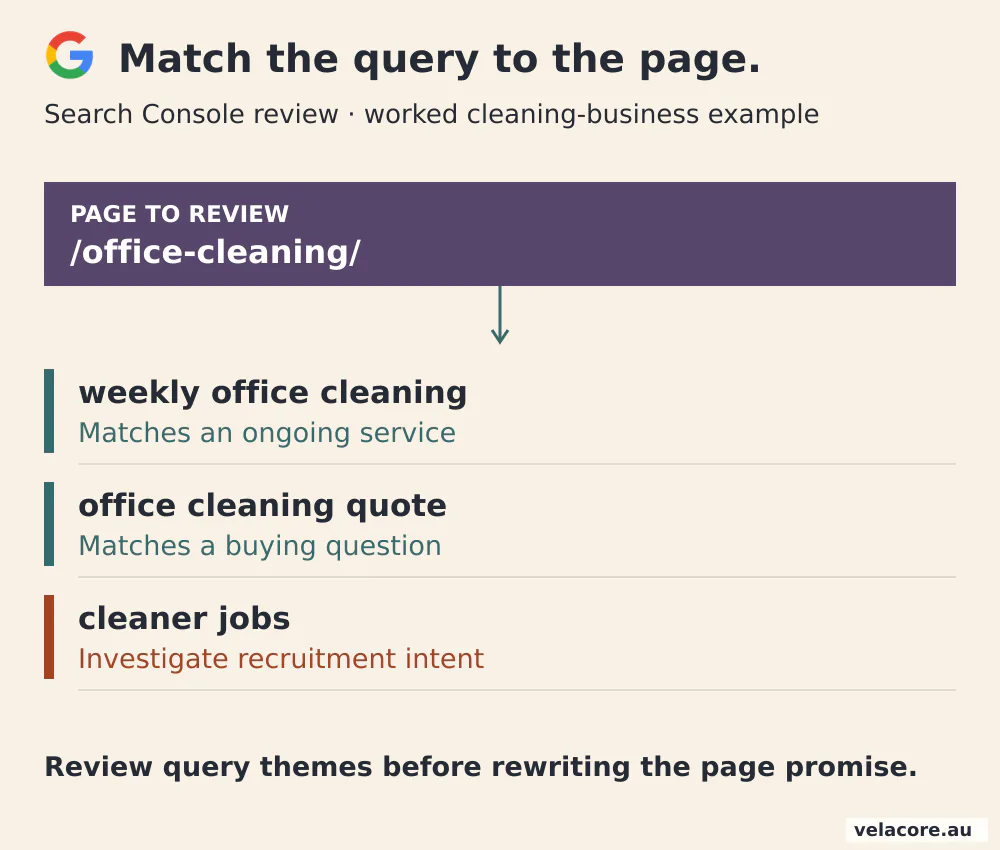
You need access to the correct property. In the Search performance report, choose an appropriate date range and Web search, open the Pages table and select the page you are reviewing. Then examine Queries, with clicks, impressions and CTR visible. Segment by country or device when it changes the decision.
Look for a pattern, not one isolated phrase. Are the queries about the service on the page? Are they branded searches, buying questions or unrelated requests? A commercial cleaner attracting job seekers may need clearer recruitment separation rather than a more enthusiastic sales headline.
For a page missing from Search, use URL Inspection. Read the indexed status and selected canonical, then use the live test to investigate current access or rendering. A successful live test is not confirmation that the page is indexed. If Google reports a specific exclusion, investigate that reason instead of repeatedly requesting indexing.
Record the page URL, intended customer question, relevant query theme and the first issue you can verify. Give that issue an owner and an acceptance check. “Make SEO better” is not a task someone can finish.
Turn a service page into a clear buying decision
A service page should let a suitable customer understand the offer, judge whether it fits and take a sensible next step. Start with that reading task before adjusting headings for keywords.

For the cleaner, the first screen might explain recurring office cleaning, premises served, genuine operating coverage and how to request a site assessment. Lower sections can describe inclusions, access arrangements, scheduling, proof of relevant work and the factors affecting a quote. “We provide exceptional solutions” answers none of those questions.
Check the page against five buyer questions:
- What exactly is the service, and who is it for?
- What is included, and what needs a separate discussion?
- Where or how can the service be delivered?
- What specific evidence helps someone assess the business?
- How can someone enquire, and what happens after they do?
Use one descriptive H1 and sections that follow the reader’s next question. Write a distinct search title and description that accurately promise the page. Add genuine work photographs, a useful process visual or an explanation of the deliverable where it helps. Important details must remain readable text, not only words inside an image.
Then test the contact action on a phone. Follow the link, complete the required fields, submit a clearly marked test and confirm it reaches the team. A reassuring success message is not enough if the enquiry never arrives. A call button should use the correct number and work as expected.
Keep existing URLs stable unless there is a useful reason to move them. When a move is justified, redirect the old address directly to its replacement and update internal links. Our SEO services connect that technical work with page usefulness and conversion tracking.
Use local SEO where geography changes the offer
Local SEO matters when customers choose partly by where you operate. Keep your genuine service coverage, business details and eligible Google Business Profile aligned; do not invent offices to appear local in more places.
Google’s local-ranking guidance describes relevance, distance and prominence. You can improve the accuracy and usefulness of your information, but cannot turn a distant office into a nearby one by changing a page heading.
Check your business category, contact details, opening hours and services. Ask customers for honest reviews through an appropriate request process, respond helpfully and keep photographs current. Do not buy reviews or ask only satisfied customers while screening out others. Google’s review-content policies explain prohibited fake and incentivised engagement.
A location page earns its place when it contains real coverage, availability, logistics or service information for that market. If the only difference is a city name, improve the relevant service page instead. Online or national businesses should organise around the customers and problems they serve, adding geography when it genuinely matters.
Fix technical barriers without chasing a perfect score
Technical SEO makes useful content accessible and the website dependable. Begin with broken important pages, indexing mistakes, poor mobile interaction and failed forms before chasing a small improvement in a lab score.
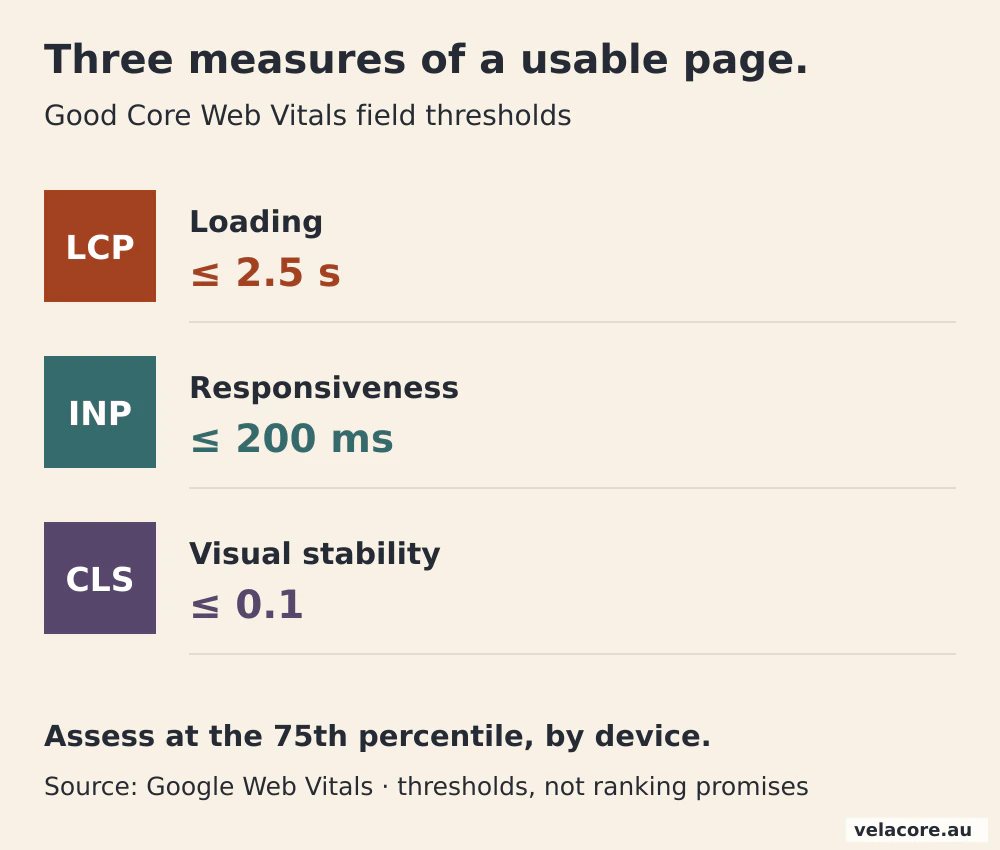
Use PageSpeed Insights on a representative service page and check the real-user section when data is available. Google’s Core Web Vitals guidance defines good field thresholds as LCP at or below 2.5 seconds, INP at or below 200 milliseconds and CLS at or below 0.1, assessed at the 75th percentile. These measure loading, responsiveness and visual stability, not a guaranteed ranking position.
Ask a developer to identify the actual cause of a failure. Large images, blocking resources or a fragile form may need different fixes. Aggressive script delay or stylesheet removal can make a performance score look better while breaking navigation, analytics or enquiries.
Keep a short acceptance checklist: important pages respond normally; the intended canonical and indexing instructions are correct; mobile text and controls work; images load appropriately; the enquiry reaches its destination. Recheck the changed interaction after the fix. A successful technical release should still look and function like your website.
Choose small business SEO tools by the job
A small tool set is enough to establish a useful starting measure. Add a subscription when it answers a question the current setup cannot answer efficiently, not because a dashboard has become part of somebody else’s checklist.
| Tool | Use it for | Important distinction |
|---|---|---|
| Google Search Console | Queries, page visibility, search clicks and indexing investigation | A search click is not automatically a lead |
| GA4 | Website activity and verified important interactions | A button click is not proof of an accepted enquiry |
| Google Business Profile | Accurate eligible local-business information and profile performance | Profile calls and website sessions are different records |
| PageSpeed Insights | Field experience where available and diagnostic lab findings | A lab score and real-user performance are different measures |
| Ahrefs, Semrush or a crawler such as Screaming Frog | Deeper demand, competitor, link or technical investigation when needed | Choose a tool and plan for a specific question; verify current features and limits |
| Your enquiry or CRM record | Whether a contact fits, progresses and becomes business | Record outcomes consistently instead of inferring them from traffic |
For deeper research, compare the official Ahrefs keyword tool, Semrush feature list and Screaming Frog crawler against the question you need to answer. You do not need all three to start.
Google explains events and key events in GA4, including Realtime and DebugView checks. Ask whoever configures the form measurement to verify a successful submission, rather than simply naming a click “lead”. Do not send names, email addresses or message text into Analytics; Google’s personal-information guidance sets that boundary.
DIY SEO: decide where specialist help pays
DIY SEO works best for tasks where you know the business facts and can verify the result. Specialist help is valuable when the work crosses technical dependencies, research depth or risks you cannot assess confidently.

You can usually draft accurate service descriptions, collect customer questions, correct business information, request genuine reviews and keep an enquiry log. Give technical fixes to someone who can investigate and test them. A site move, complex indexation problem or extensive redirect change needs more than instructions to install another plugin.
Buy a defined outcome. For example: inspect why three service pages are excluded, supply a prioritised correction, implement the approved fix and verify the result. For content work, ask which reader decision the page will resolve and what evidence is needed. For links, ask why the publisher and destination are relevant, how outreach works and what is reported.
A useful budget starts with scope, dependencies and available implementation time. Compare proposals on the work included, who performs it, what your team must supply and how progress is judged. A low fee with no delivery capacity is not inexpensive SEO; it is an uncompleted plan.
Measure enquiries without mixing incompatible numbers
Measure search visibility, site activity and suitable enquiries as connected but distinct records. The next action changes depending on which part of the path is weak.
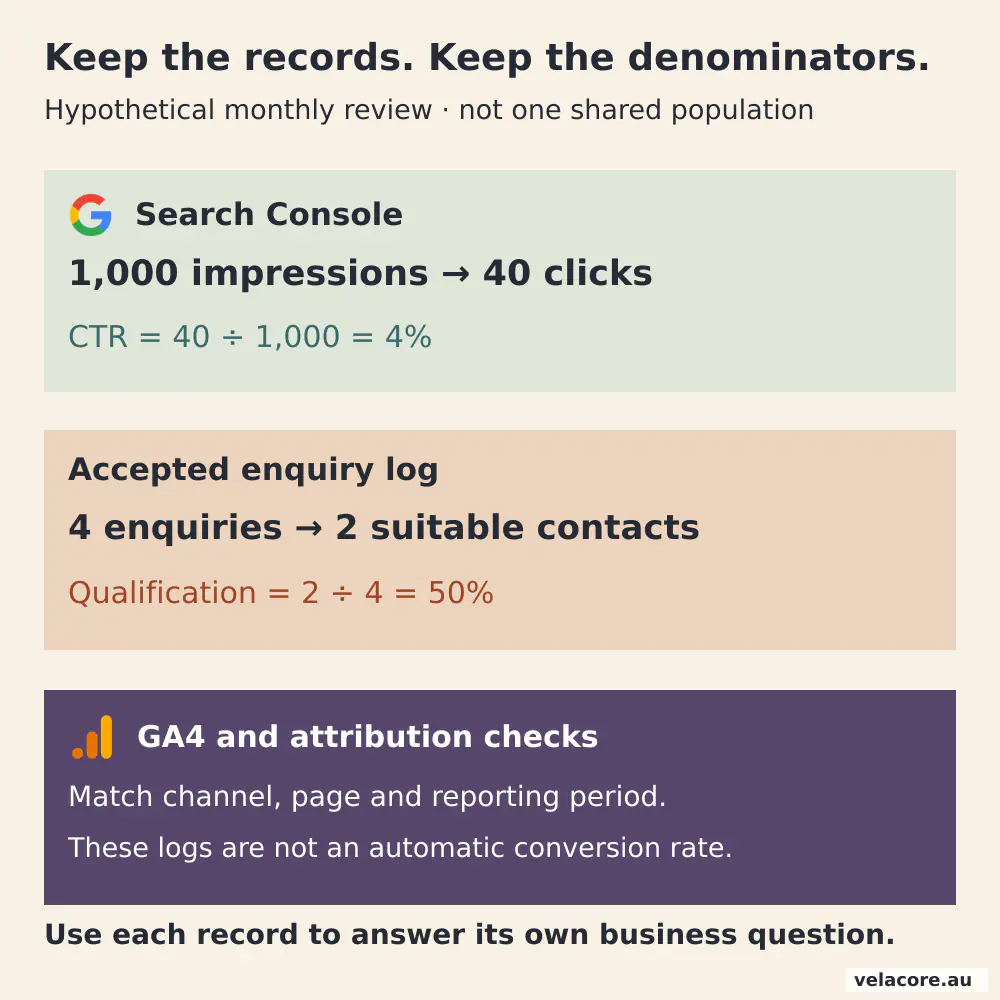
Here is a hypothetical monthly review for the cleaner’s service page. Search Console records 1,000 impressions and 40 clicks, so CTR is 40 ÷ 1,000 = 4%. Separately, a submission log records four accepted enquiries for that page, of which two meet the agreed service and coverage criteria. The qualification rate within that log is 2 ÷ 4 = 50%.
Do not divide those enquiries by Search Console clicks and call the result a verified conversion rate. The enquiry log may include other traffic sources, repeat visits or contacts outside the reporting window. Match channel, landing page, period and attribution definitions before calculating a channel-specific rate.
The number is only as useful as the decision it supports. Relevant impressions with weak CTR call for a different investigation from accepted enquiries with poor fit. Keep a record of the change, its expected effect and what you observed afterward. Our website measurement guide develops that distinction.
Add AI search work without rebuilding the whole strategy
AI-assisted search adds discovery opportunities, but your first job remains a clear, accessible and credible answer. Do not abandon useful service pages to produce a second library of generic AI-targeted summaries.
Google’s generative-AI search guidance connects this work to SEO fundamentals. Check current inclusion controls and reporting where relevant, keep business facts consistent, and use accurate authorship and evidence. A special file or a block of schema is not a substitute for a useful page.
For the specific steps and report distinctions, read the small-business AI Overview roadmap and the guide to getting featured in Google AI Overviews. Those are deeper investigations; this guide keeps the overall small-business priorities in order.
Your small business SEO checklist for the next improvement
Choose a manageable piece of work with a clear finish. The sequence below creates a reviewable result without pretending that rankings follow a fixed timetable.
- Select: choose one important service page and the customer decision it should resolve.
- Inspect: record access, indexing, relevant query themes and the existing enquiry path.
- Improve: repair the strongest evidenced constraint, with an owner and acceptance check.
- Test: check the saved page on mobile and verify the contact action reaches the business.
- Review: record what changed, then compare suitable search and enquiry measures before expanding the work.
Avoid the common detours: buying links by quantity, cloning location pages, writing a blog for every phrase, treating a plugin score as a business result or making several unrecorded changes at once. Each creates activity. None tells you whether the customer journey improved.
Frequently asked questions
Can I do small-business SEO myself?
Yes, particularly service explanations, customer-question research, accurate business information and basic performance reviews. Get specialist help when the change involves technical dependencies or risks you cannot verify. Keep ownership of the business facts and enquiry outcomes even when someone else implements the work.
Does every small business need a blog?
No. Start with useful service or product pages and a working contact path. Add articles when they answer a real research question, support an important buying decision or provide something worth referencing. A publishing schedule is not a reason to create interchangeable posts.
How much should a small business spend on SEO?
Build the budget around the defined work, implementation capacity and value of suitable customers. Compare scope, responsibilities, evidence and reporting across proposals. An indexation repair, a catalogue restructure and ongoing local visibility work have different requirements, so one universal monthly figure is not a useful starting point.
How long does SEO take to produce results?
The starting problem, competition, site history and implementation affect the timeline. Agree delivery milestones and review search and enquiry data consistently. Fixing a broken form can be verified immediately; discovering, processing and ranking revised content follow a different timetable. Avoid a guaranteed ranking or lead deadline.
Why is my page not indexed even though it opens normally?
A working page is not automatically selected for Google’s index. Inspect the URL in Search Console, including the reported reason and selected canonical. Investigate access, indexing instructions, duplication and the page’s usefulness as appropriate. Requesting indexing repeatedly does not resolve the underlying issue.
Should I focus on Google rankings or AI visibility?
Start with where suitable customers research and the pages that help them choose. Maintain the technical and content foundations, then measure traditional search and AI-feature visibility within their reporting limits. Judge business value through useful contacts and outcomes rather than substituting citation counts for customers.
Make the next SEO task worth doing
Good SEO for small business begins with a specific customer question and a useful destination. Find the weakest step, fix it properly and verify what happened. That gives your next investment a reason, rather than another item on an endless checklist.
If you need help deciding which work deserves priority, explore Velacore’s SEO services or contact the team about your search and enquiry goals.