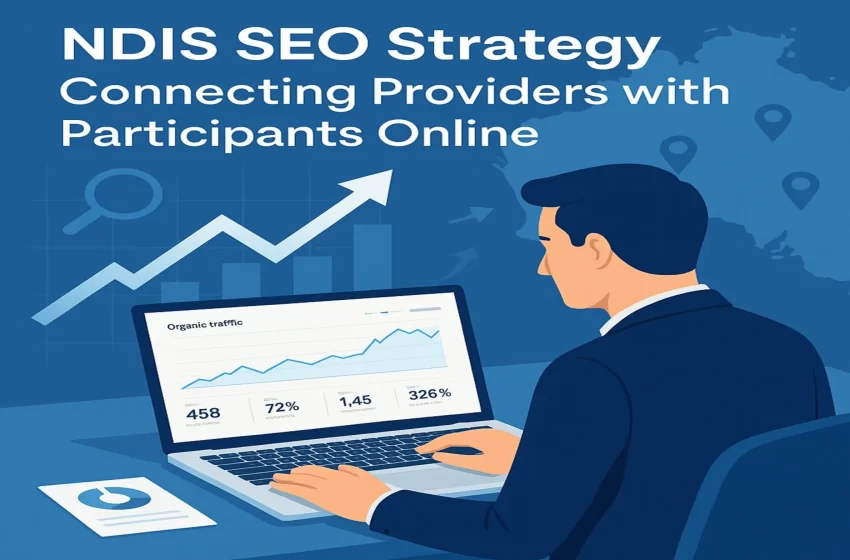
If your NDIS business isn’t visible on Google, participants may never find you no matter how great your service is.
With over 97% of Australians online and 94% using Google as their primary search engine, digital visibility has become the new credibility. And in a market serving 739,000+ active NDIS participants being discoverable is no longer optional.
A well-planned NDIS SEO strategy ensures you appear where participants are searching, builds trust, and turns clicks into meaningful connections.
In this guide, you’ll learn practical, data-backed SEO steps tailored for NDIS providers, so you can rank higher, attract the right participants, and grow with confidence.
Understanding SEO for NDIS providers
Search Engine Optimisation (SEO) helps your NDIS website appear on the first page of Google when people search for disability services. But for NDIS businesses, SEO isn’t just about ranking, it’s about visibility with purpose.
For NDIS providers, SEO carries a deeper purpose. It ensures that when families or support coordinators search “NDIS respite care near me” or “disability housing Sydney”, your organisation appears as a trustworthy, local, and compliant provider.
Unlike general businesses, NDIS providers operate in a regulated, trust-driven environment. That means your NDIS SEO strategy must be tailored—not just to Google’s algorithm—but to participant needs and industry standards.
A good SEO plan for NDIS providers focuses on:
- Local search visibility (appearing in “near me” results).
- Website accessibility (WCAG-compliant, easy to navigate).
- Reputation building (through reviews and participant stories).
- Consistent information across your website, NDIS directory, and Google Business Profile.
According to research, 88.6% of Australians use search engines monthly, and nearly half of all Google searches are local. For NDIS providers, that means your potential participants are online right now, looking for exactly what you offer.
A strong NDIS SEO strategy bridges that gap between your services and their search. It’s not just about traffic, it’s about helping real people find real support.
How participants actually search
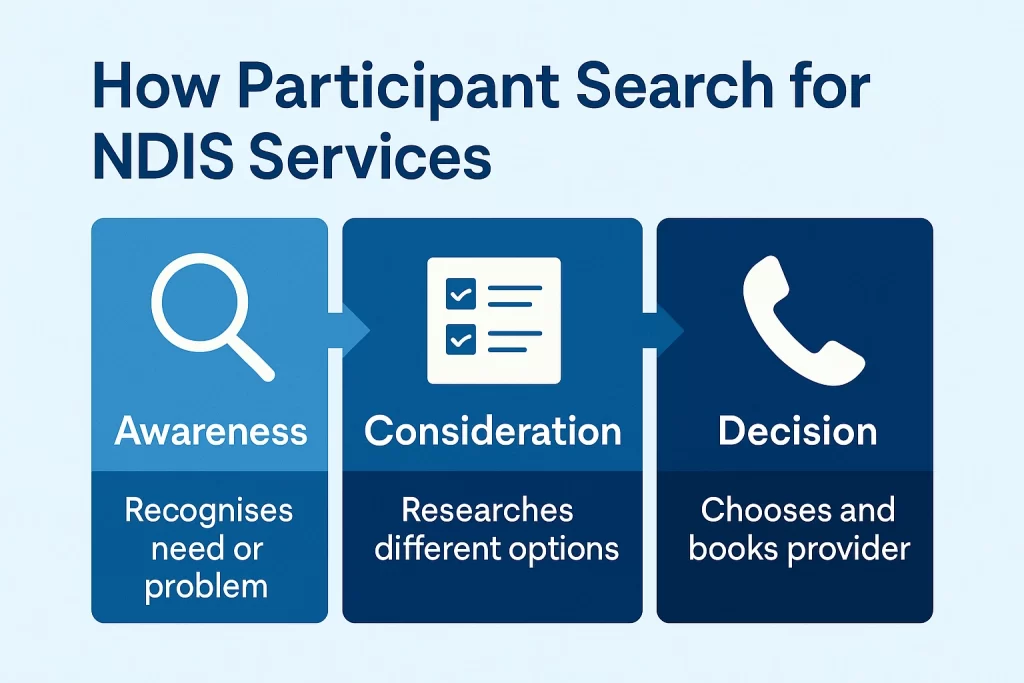
To create a winning NDIS SEO strategy, you must first understand how participants and their families search for services online; and what drives their trust.
Participants don’t type “NDIS providers” at random. Their searches are emotional, urgent, and specific. For instance,. a mother might search, “NDIS speech therapy for children in Adelaide” or “best NDIS support coordinator near Parramatta”. These are intent-based searches, and Google’s algorithm prioritises providers that match both the keywords and the intent behind them.
What this means for you
Participants searching for NDIS services are not browsing casually; they’re searching with intent. They’re ready to act once they find a provider that feels local, credible, and relevant.
That’s why your NDIS SEO strategy should target high-intent, location-specific keywords like:
- “NDIS plan manager Sydney”
- “NDIS SIL accommodation Perth”
- “NDIS community activities Gold Coast”
- “Support coordination near me”
Each phrase tells Google who you serve, where you operate, and how relevant you are to the participant’s need.
Below is a refined participant journey map along with deeper insights.
Participant search journey and keywords
| Phase | Search Intent | Keyword Examples | What They Care About | SEO Opportunity |
| Awareness / Research | Learning about NDIS supports | “What is NDIS support coordination?”, “Types of NDIS services” | Clarity, trust, legitimacy | Blog posts, educational content |
| Consideration / Comparison | Comparing providers in their area | “NDIS provider in Brisbane”, “plan manager Melbourne reviews” | Reviews, service types, staff quality | Local landing pages, testimonials |
| Decision / Contact | Ready to pick and call | “NDIS provider near me”, “book assessment NDIS” | Contact ease, responses, trust signals | Clear CTAs, contact forms, schema, local SEO |
A well-crafted SEO plan doesn’t just help you appear in those searches, it helps you become the trusted answer participants are looking for.
Core elements of a winning NDIS SEO strategy
Building a strong NDIS SEO strategy means focusing on what truly drives visibility; not gimmicks or shortcuts, but the real foundations that make your website trusted, discoverable, and participant-friendly.
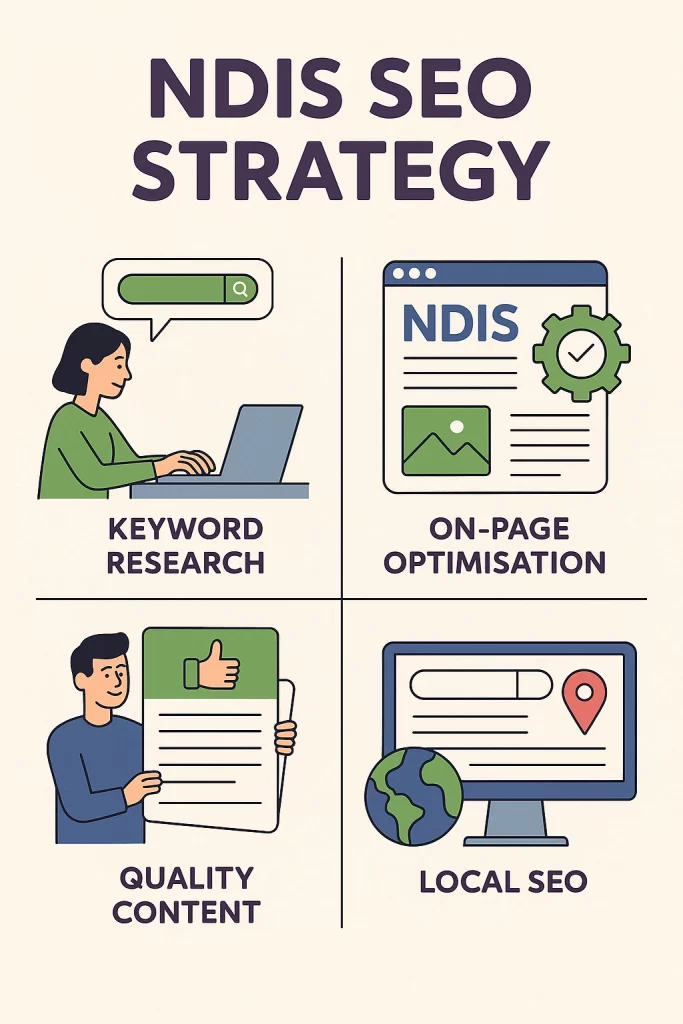
Below are the six key pillars every NDIS provider should master to rise above the competition and reach the right participants.
1. Keyword strategy: speak the participant’s language
The heart of every successful NDIS marketing strategy starts with understanding how your audience searches.
Participants don’t search for jargon, they search for solutions. Instead of “NDIS provider,” they type “support coordination in Perth” or “NDIS respite care near me.”
Here’s how to get it right:
- Use a mix of broad and long-tail keywords (e.g. “NDIS therapy” + “occupational therapy for autism in Sydney”).
- Map keywords to search intent: informational, comparative, or action-oriented.
- Use SEO tools like Google Keyword Planner or Ahrefs to find actual search volume in your region.
- Optimise your NDIS website pages around real participant needs, not marketing buzzwords.
2. Local SEO: be found in your suburb
Effective local SEO for NDIS providers ensures you appear in suburb-based searches and local map results. For most participants, location is everything. According to reports, 46% of all Google searches are for local businesses, and service providers with optimised Google Business Profiles receive more calls than those without.
If your NDIS website isn’t showing up in your suburb or city searches, you’re losing local trust.
Here’s how to fix that:
- Claim and optimise your Google Business Profile (GBP): use your registered NDIS number, service categories, contact details, and high-quality photos.
- Build suburb-specific pages like “NDIS support services in Parramatta” or “NDIS plan management Newcastle.”
- List your business consistently across directories (e.g., NDIS portal, Yellow Pages, local councils).
- Encourage reviews: respond to every one of them. Reviews improve your local ranking and your credibility.
3. On-page optimisation: make every page count
Once participants land on your website, the experience should feel seamless, trustworthy, and accessible.
Your NDIS SEO strategy should include:
- Clean, descriptive titles (H1s): e.g., “NDIS Support Coordination in Sydney”
- Meta descriptions that invite clicks: “Get tailored NDIS support coordination in Sydney. Fully registered, local, and participant-focused.”
- Alt text for all images: (crucial for accessibility compliance).
- Fast loading times: participants will leave if your page takes more than 3 seconds to load.
- Internal links: between services (e.g., from “Support Coordination” to “Plan Management”).
4. Content strategy: build trust through value
Content isn’t filler, it’s your voice, your credibility, and your conversion engine.
Your NDIS content strategy should answer participant questions and position you as a trusted source of information; This means publishing content that solves real participant questions:
- “How to choose an NDIS plan manager?”
- “What is the difference between SIL and SDA?”
- “How does NDIS transport funding work?”
Practical tips:
- Create educational blog posts, FAQs, and case studies.
- Use storytelling; share participant experiences (with consent).
- Add videos or infographics explaining NDIS processes visually.
- End every post with a call-to-action (e.g., “Contact our NDIS team in Melbourne for a free consultation.”)
5. Technical SEO: build a fast, accessible, and secure foundation
Google’s algorithm rewards well-built websites that provide a smooth and inclusive experience.
Checklist for NDIS website optimisation:
- Use HTTPS for security
- Enable mobile-first design
- Keep page load time under 3 seconds
- Add a clear XML sitemap and robots.txt file
- Ensure your site meets WCAG 2.1 accessibility standards
- Use schema markup for NDIS services (e.g., “SIL Accommodation,” “Plan Management,” “Therapy”)
Technical SEO is the quiet backbone of every NDIS SEO strategy; when ignored, even great content can go unseen.
6. Authority building: earn google’s trust
In the disability services sector, trust is currency; and search engines feel the same way.
Build authority through:
- Collaborations with local councils, health organisations, or disability advocacy groups.
- Publishing guest posts or thought-leadership pieces on Australian health and NDIS blogs.
- Earning backlinks from credible sources (e.g., government portals, media outlets).
- Consistent, positive engagement on social platforms linked to your website.
6 Pillars of a Winning NDIS SEO Strategy
| Pillar | Focus Area | Key Outcome |
| Keyword Strategy | Use participant-first terms | Better relevance |
| Local SEO | Google Business & suburb pages | Local trust & visibility |
| On-Page SEO | Accessibility & fast load time | Higher engagement |
| Content | Participant education | Authority & conversion |
| Technical SEO | Secure, fast, structured site | Stable rankings |
| Authority Building | Backlinks & reputation | Long-term trust |
Advanced NDIS SEO tactics: how to outrank competitors and stay ahead
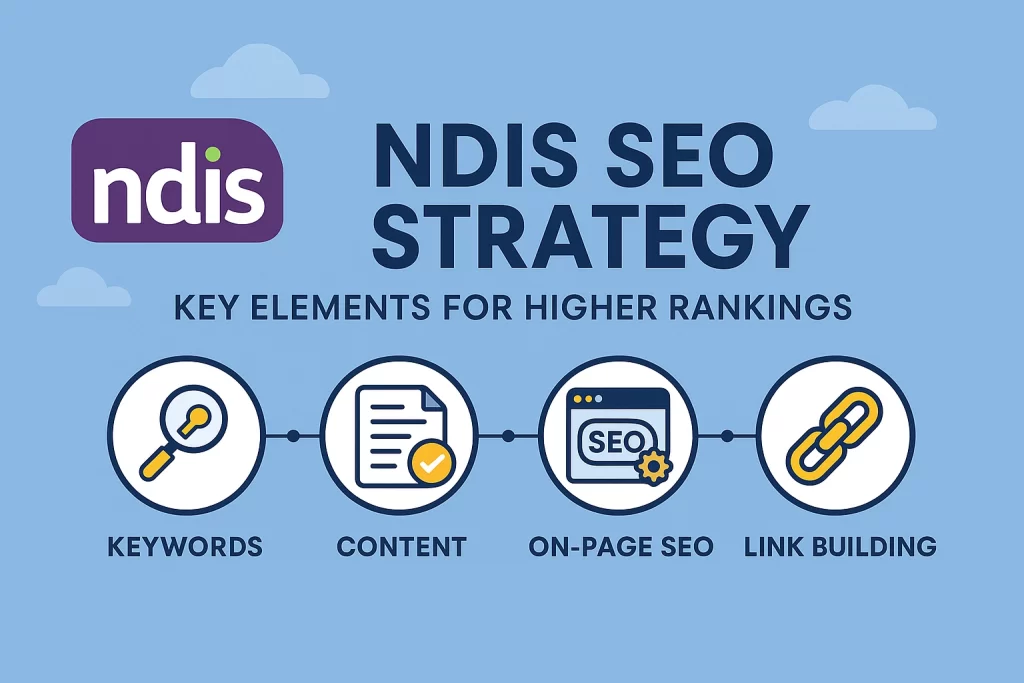
Once you’ve built the foundation of your NDIS SEO strategy, it’s time to level up. Advanced SEO isn’t about chasing algorithms, it’s about creating a technically strong, data-informed, and participant-focused ecosystem that works even as Google evolves.
Here’s how forward-thinking NDIS providers can stay ahead of the competition.
1. Leverage structured data (schema markup)
Google uses structured data to understand what your website offers. Adding schema helps your pages stand out with enhanced search results (rich snippets).
For NDIS providers, that means:
- Implementing LocalBusiness schema (so Google recognises your name, location, phone, and NDIS registration).
- Using Service schema for pages like “NDIS plan management” or “Support coordination in Brisbane.”
- Adding FAQ schema so your participant questions appear directly in Google results.
This makes structured data a quiet but a powerful advantage.
2. Monitor key seo metrics that matter
You can’t improve what you don’t measure. Tracking your SEO performance helps you identify what’s working and what needs attention.
Essential SEO metrics for NDIS providers include:
- Organic traffic: number of visitors from Google.
- Click-through rate (CTR): how many people click your page after seeing it in search results.
- Keyword rankings: your position for key NDIS-related search terms.
- Bounce rate: percentage of visitors leaving after one page (high bounce = poor experience).
- Conversion rate: how many visitors take action (contact form, phone call, enquiry).
Use free tools like Google Search Console, Google Analytics 4 (GA4), or Ahrefs Webmaster Tools to track these metrics monthly.
3. Use content clusters to build topical authority
Google rewards websites that demonstrate depth and expertise in a niche. This is especially relevant in NDIS, where participant education and service clarity matter.
A great NDIS SEO strategy uses the content cluster model:
- Create one pillar page (like “NDIS SEO Strategy” or “NDIS Plan Management”).
- Support it with several cluster articles on related subtopics (e.g., “Choosing a Plan Manager,” “Understanding Your NDIS Budget,” “Top 5 Funding Mistakes”).
- Interlink them internally to show Google you’re a subject matter expert.
4. Optimise for voice search and mobile experience
With over 95% of Australians accessing the internet on mobile, and nearly 30% of all Google searches now voice-based, mobile-first SEO isn’t optional.
Adapt your NDIS website optimisation for these behaviours:
- Use conversational keywords that match voice queries (e.g., “Where can I find NDIS support near me?”).
- Ensure mobile-first design: responsive layouts, quick buttons, easy navigation.
- Keep answers concise for voice snippets (40–50 words).
Voice search and mobile-friendly sites are Google’s future, and the providers who adapt early will dominate local visibility.
5. Combine SEO with paid search for strategic visibility
SEO takes time to mature, but pairing it with Google Ads, social media ads, or Local Service Ads accelerates your visibility, especially in competitive areas.
- Run Google Ads targeting service-based keywords (e.g., “NDIS occupational therapy Sydney”).
- Use SEO insights to refine ad targeting and landing page quality.
- Track which channels bring the highest participant conversions.
This integrated approach ensures you rank both organically and via ads, dominating more real estate on the search results page.
Excellent — let’s tighten it up while keeping that same confident, insightful tone.
Here’s a concise, high-impact conclusion (about 90–110 words) that closes the article smoothly and keeps your focus keyword prominent.
Conclusion
A strong NDIS SEO strategy does more than enhance rankings, it builds trust. It ensures that when participants search for support, they find your services and feel confident reaching out.
For NDIS providers, visibility is impact. With the right SEO foundation, you can turn your website into a steady source of genuine enquiries and growth. Improving your NDIS online visibility ensures the people who need you can find you first.
Velacore helps you make that happen with data-driven, compliant, and human-centred SEO that connects you to the people who matter most. Get in touch for a consultation!
Is Your Website Working for You?
Most websites don't generate leads. We fix that with custom designs that look great and deliver measurable results for your business.
Get Started With Velacore