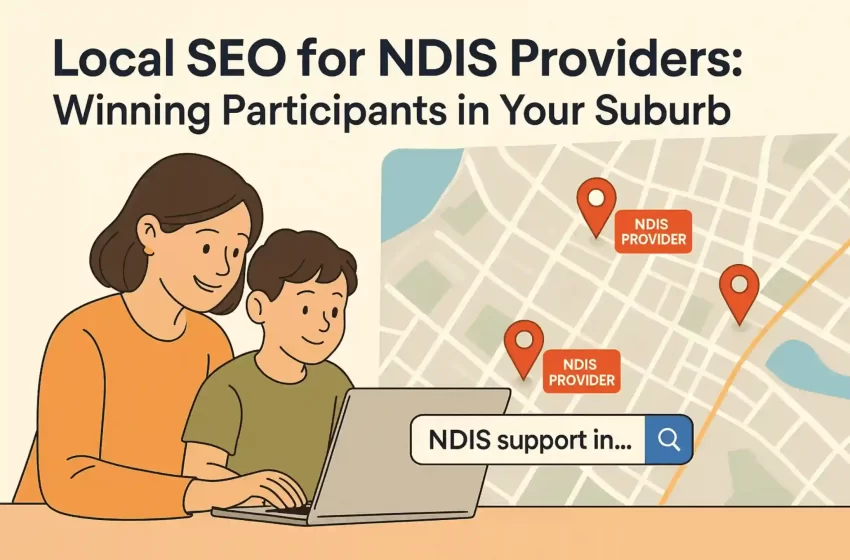
Local SEO for NDIS providers isn’t just a nice-to-have, it’s the difference between being seen or being invisible in your own community. Research shows that 46% of all Google searches are local, and over 50% of people contact a business within 24 hours of finding it in a “near me” search. For NDIS providers, that means the participants you want are already searching online; but only those who invest in suburb-specific visibility will win their attention.
In essence, If you’re not showing up in searches like “NDIS services in [Suburb]” or “NDIS provider near me,” you’re missing out on participants right on your doorstep.
In this article, we’ll take a deep dive into suburb pages, Google Business Profile optimisation, and review strategies; all with a focus on how to win participants in your local areas and suburb.
Why local SEO matters for NDIS providers
Local SEO for NDIS providers is about more than rankings; it’s about trust and accessibility. A well-optimised suburb page reassures families that you understand their community. A responsive Google Business Profile signals that you’re active and available. Fresh reviews tell them, “others like me have had good experiences here.”
Providers who ignore local SEO risk being overshadowed by larger organisations, even in their own neighbourhood. But those who embrace it? They become the “go-to” provider in their suburb; not just on Google, but by reputation.
Many NDIS providers incorrectly treat SEO like a generic strategy. But local SEO is a specialised subset: it focuses on relevance, proximity, and trust in the eyes of Google and your community.
In summary: local SEO is marketing where your prospective participants live. Let’s make it count.
In the next sections we will discuss critical strategies to enhance local SEO for NDIS providers.
Suburb pages: Your digital front door
One of the most powerful local SEO strategies for NDIS providers is to build suburb-specific landing pages (also called “service area pages” or “neighbourhood pages”). These pages act like hyperlocal storefronts in the digital world.
Why suburb pages work
- Keyword relevance & intent: People often add suburbs or postcodes to their searches (“NDIS provider in Glenroy”), and a well-optimised page for that suburb gives you a shot at ranking.
- Improved conversions: When participants land on a page mentioning their suburb, local cues build trust and increase the chance they’ll reach out.
- Keyword coverage & reach: Instead of trying to rank one page for all suburbs, you can build many suburb pages, which together cover a wide range of localized queries.
- Authority and internal linking: These pages give you structure to link from central service pages or blog posts, distributing ranking power and reinforcing relevance.
What to include on a good suburb page
Here’s a checklist to make your suburb pages effective:
| Element | Purpose / Best Practice |
| Title tag & H1 with suburb + service | e.g. “NDIS Support Services in [Suburb]” |
| Opening paragraph with mention of suburb & services | Use the focus keyword + suburb variant early |
| Services offered in that area | Specific supports (occupational therapy, in-home care, etc.) |
| Local testimonials / case studies | If you have clients in that suburb, even anonymised |
| Google Maps embed & service radius map | Visually show that you serve this suburb |
| Accessibility info and transport / area relevance | Helps SEO and participant trust |
| Contact form & call to action | Make it easy to convert |
| Local schema / structured data markup | Use LocalBusiness or Health & Medical schema and include areaServed with the suburb |
| Internal links to other relevant pages | e.g. central “Services” pages, blog, about us |
| Reviews or ratings (if possible) | Pull a few recent reviews relevant to that suburb |
Tip: Don’t create dozens of low-quality suburb pages. Start with a few high-priority suburbs near your main operations, get them ranking, then expand.
Google Business Profile optimisation
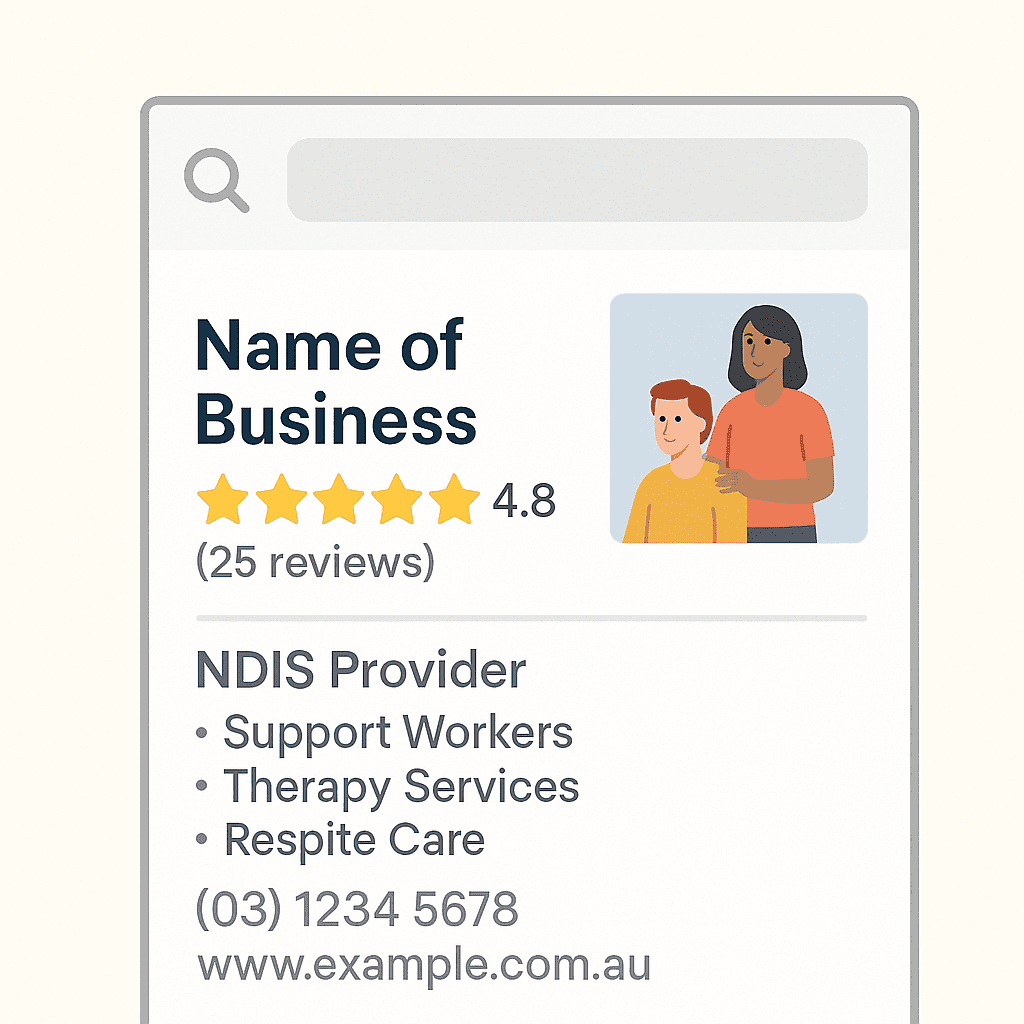
Your Google Business Profile (GBP) is your “free billboard” in local search and maps. It’s often the first thing participants see when they search for NDIS services near them.
Key optimisations for GBP
- Accurate NAP (Name, Address, Phone): Ensure your business name, address, and phone number are consistent across all listings.
- Service categories: Use the most relevant categories like “NDIS Provider”, “Disability Service”, or more specific ones (e.g. “Occupational Therapist”) depending on your services.
- Service areas / service radius: If you don’t have a physical office in every suburb, you can still define “service areas” in GBP. Make sure you include the suburbs you serve.
- Business hours & special hours: Always keep these up to date (holidays, unforeseen closures) inconsistency confuses users and may hurt ranking.
- Photos / virtual tours: Showcase your facility, team, accessibility features, service vehicles. GBP listings with photos get more engagement.
- Posts & updates: Use Google Posts to share news, events, promotions, or blog links ; it keeps your profile active and signals freshness to Google.
- Questions & Answers: Proactively seed and answer common questions (e.g. “Do you provide in-home therapy in [Suburb]?”)
- Review responses: Regularly respond (especially to negative feedback). It shows you care, improves engagement, and gives positive ranking signals.
- Attributes & accessibility details: Use attributes like “Wheelchair accessible”, “Disability support”, etc., if available. This helps users and can influence relevance.
Reviews & reputation: Building trust with participants
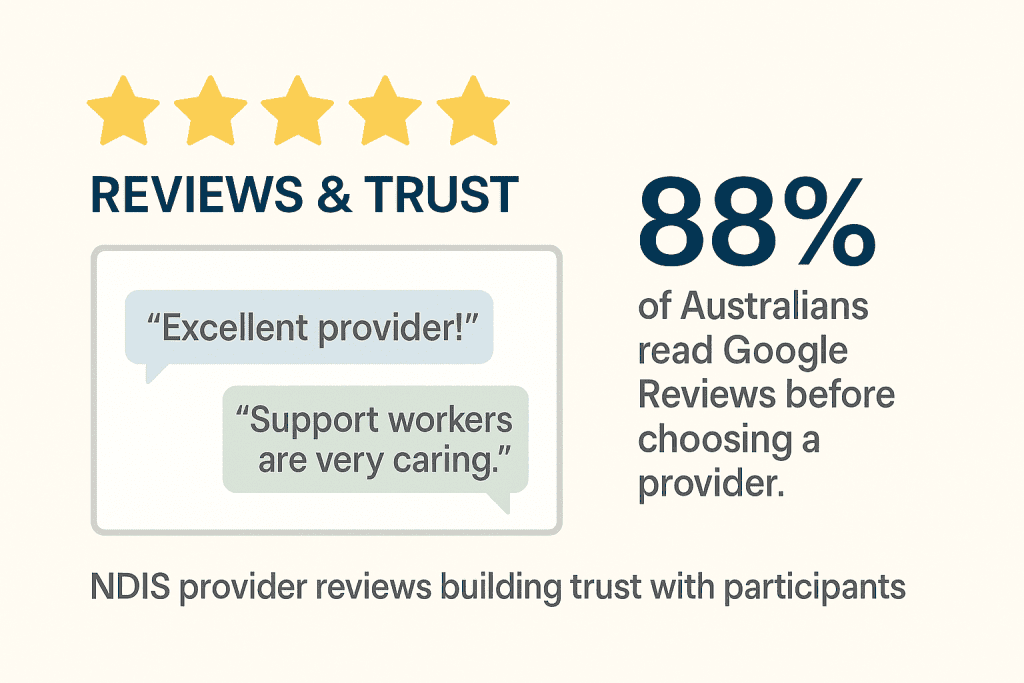
Consider this: two providers in the same suburb both rank in Google’s top three. One has 4.8 stars with 80 reviews, the other has 3.2 stars with 12 reviews. Which one do you think families will call?
It’s no surprise that over 90% of customers read reviews before choosing a business. But beyond numbers, the content of reviews influences perception. A participant writing, “They really helped me navigate my plan in Parramatta” reinforces suburb relevance and builds both SEO and trust.
Review strategy for NDIS providers
- Request reviews ethically: After service delivery, ask participants (or guardians) if they’d be comfortable leaving a review. Provide simple instructions or a link to your GBP review page.
- Diversify your review sources: Don’t rely solely on Google — also aim for reviews on disability directories, social media, or specialist industry portals.
- Showcase reviews on your website: Pull the best ones into suburb pages, homepage, or service pages (with attribution). This amplifies trust.
- Respond to reviews actively: Thank for positive feedback, address negative complaints respectfully, and show you’re willing to improve. This signals that you value clients.
- Incentivise (legally and ethically): Make it as frictionless as possible for participants to leave reviews: send direct links, instructions, or follow-up reminders (without pressure).
- Maintain a steady flow: Aim for consistent monthly reviews rather than a flurry once. This keeps your profile fresh and active.
When your reviews mention suburbs or services (“We engaged [Your Provider] in [Suburb] for in-home therapy…”) that helps reinforce your geo-relevance.
Advanced local SEO tactics for NDIS providers
Once you have the basics in place (suburb pages, GBP, reviews), the difference lies in advanced tactics.
- Accessibility as SEO: Accessibility isn’t just compliance, it’s now part of Google’s ranking signals. Adding clear alt text, readable fonts, strong colour contrast, and keyboard navigation makes your site friendlier for participants and more visible in search.
- Voice search optimisation: With voice now powering 1 in 4 searches globally, families are asking Google: “Who’s the best NDIS provider near me?” To capture this traffic, use conversational FAQs, natural language in your content, and schema markup to boost your chances of being the spoken answer.
- Community backlinks: Local authority comes from local connections. Partner with councils, disability groups, or sponsor events in your suburb, then request backlinks. These not only improve rankings but also place your name where participants already look for trusted providers.
Monitoring & signal adjustments
- Use GBP Insights, Google Analytics, Search Console to track metrics like clicks, calls, direction requests, impressions per suburb.
- Identify under-performing suburb pages and test improvements — e.g. new headings or content refresh.
- Monitor competitor pages in your suburb — see what content they include, how they structure pages, what keywords they target.
Measuring success & KPIs
To know if your efforts are working, track:
| Metric | What to Watch | Why It Matters |
| Impressions & clicks (in SERP / maps) | Are more people seeing you? | Visibility growth |
| Click-through rate (CTR) | Are your titles/snippets compelling? | Helps refine meta tags |
| Calls & direction requests (from GBP) | How many people are contacting you? | High-intent actions |
| Suburb page conversions (form submissions, calls) | Which pages are producing leads? | Refine content / CTA |
| Review volume + average rating | Is reputation improving? | Trust & ranking |
| Bounce rate & time on site | Are visitors staying and exploring? | Content relevance & UX signals |
| Rankings (SERP positions) for suburb + service keywords | Are you climbing? | SEO traction indicator |
Expect local SEO to take 3–6 months before you see strong ROI. A research data shows the average time to ROI is ~4.76 months.
Sample structure: How a real NDIS provider could use this
Let’s imagine you run an NDIS provider in Melbourne’s northern suburbs. You might:
- Create suburb pages: “NDIS Support in Preston”, “NDIS Therapy in Heidelberg”, “NDIS In-home Care Brunswick”.
- Optimise your GBP listing, setting service areas to include those suburbs.
- Request reviews from past participants in each suburb (e.g. “We engaged their therapy services in Preston…”).
- Write content like “NDIS therapy options in Preston: What to expect” or “How to choose an NDIS provider in Heidelberg”.
- Build backlinks from local council disability pages, community health forums, or local blogs.
- Monitor which suburb pages convert best and invest more in high-performing ones.
Over time, you may outrank larger, generic providers for queries like “NDIS provider in Preston”.
Conclusion
Local SEO for NDIS providers gives you a direct path to participants in your own backyard. By leveraging suburb pages, optimising your Google Business Profile, and building review-driven trust, you can position your services where prospective participants are looking right now.
Want help with implementation? At Velacore, we specialise in NDIS marketing, local SEO and growth strategies tailored for providers. Let’s chat about how we can bring participants to your suburb pages.
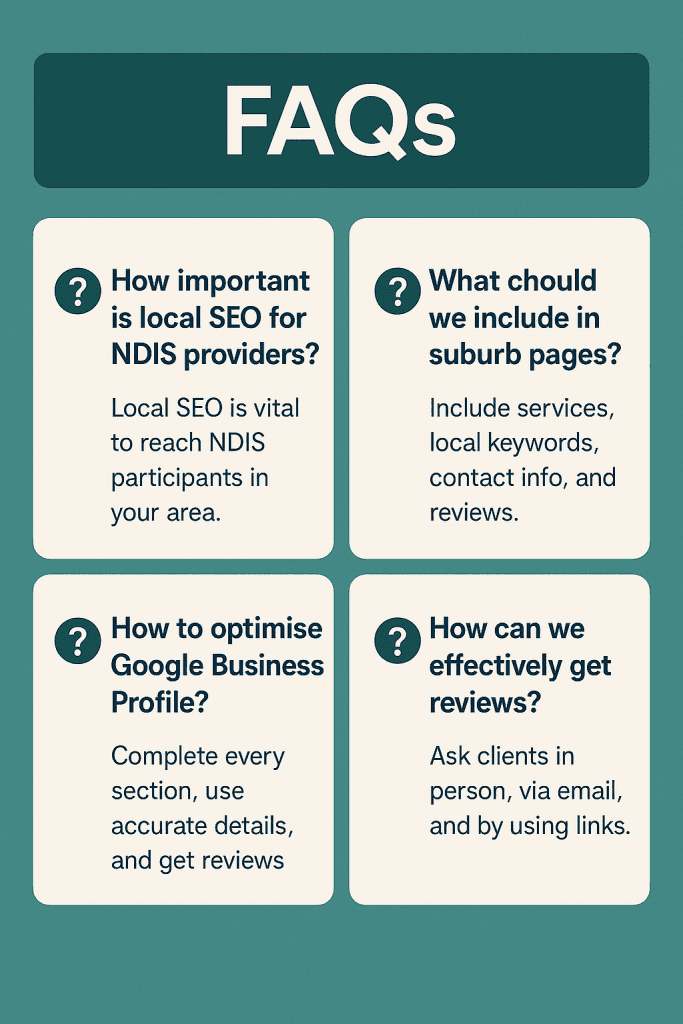
Frequently Asked Questions (FAQs)
1. What is Local SEO for NDIS providers?
Local SEO for NDIS providers is the process of making your services more visible in suburb-based Google searches like “NDIS provider near me” or “NDIS services in [Suburb].” It includes suburb pages, Google Business Profile optimisation, and building local trust with reviews.
2. Why are suburb pages important for NDIS providers?
Suburb pages allow you to rank for location-specific searches, which are common among participants and carers. Instead of a generic services page, suburb landing pages show families that you serve their exact community, which increases both visibility and enquiries.
3. How does Google Business Profile help NDIS providers?
Your Google Business Profile (GBP) acts like a digital shopfront. Families often see your GBP before they visit your website. An optimised GBP with accurate service areas, up-to-date details, photos, and reviews helps you rank higher in Google Maps and local search results.
4. How long does it take for Local SEO to show results?
Local SEO is not instant. On average, providers see measurable results in 3–6 months, depending on competition and how consistently they update suburb pages, reviews, and their Google Business Profile.
5. Can small NDIS providers compete with larger organisations using Local SEO?
Absolutely. Local SEO levels the playing field. While large providers may dominate nationally, suburb pages, local backlinks, and community reviews allow smaller providers to own their suburb cluster and consistently win local participants.
6. Is voice search relevant for NDIS services?
Yes. With voice powering more than 1 in 4 searches worldwide, carers are increasingly asking Google things like “Who is the best NDIS provider near me?” Optimising your content with FAQs and conversational answers helps you capture this growing traffic source.
Is Your Website Working for You?
Most websites don't generate leads. We fix that with custom designs that look great and deliver measurable results for your business.
Get Started With Velacore