If you’re running a café in Melbourne, a plumbing service in Sydney, or a fitness studio in Brisbane, chances are your ideal customers live or work within 5km of your door. Yet, despite this, most small businesses in Australia still treat SEO as a “big picture” strategy competing with nationwide or even global players.
That’s where Local SEO for Australia comes in. When done right, it’s the digital equivalent of putting your signpost directly on the main street, but online.
In this guide, we’ll break down what local SEO is, why it matters for Australian businesses, and the exact steps you can take today to attract high-intent customers in your area.
What is local SEO (and why is it critical in Australia?)
Local SEO is the process of optimising your online presence so that people nearby can easily find your business when searching on Google.
Think of it this way: if someone types “best coffee near me” or “emergency plumber Bondi” into their phone, Google uses local SEO signals (like your Google Business Profile, reviews, website location keywords, and proximity) to decide who shows up at the top.
Google uses signals like:
- Proximity → how close the searcher is to your business.
- Relevance → how well your profile matches the search query.
- Prominence → how well-known and trusted your business appears online.
Why it matters in Australia:
- Over 90% of Australians search online for local businesses.
- 46% of all Google searches are local in intent
- 72% of local searches lead to a store visit within 5 miles (~8km).
- Yet, over 50% of Aussie businesses haven’t claimed their Google Business Profile (GBP).
That gap means there’s still a massive opportunity for smart local operators to stand out.
It’s not enough to simply know that local SEO matters, you need a strategy that actually puts your café, gym, clinic, or tradie business in front of local customers when it counts most.
Let’s break it down into five practical steps you can start applying today, beginning with the foundation of all local search visibility: your Google Business Profile (GBP).
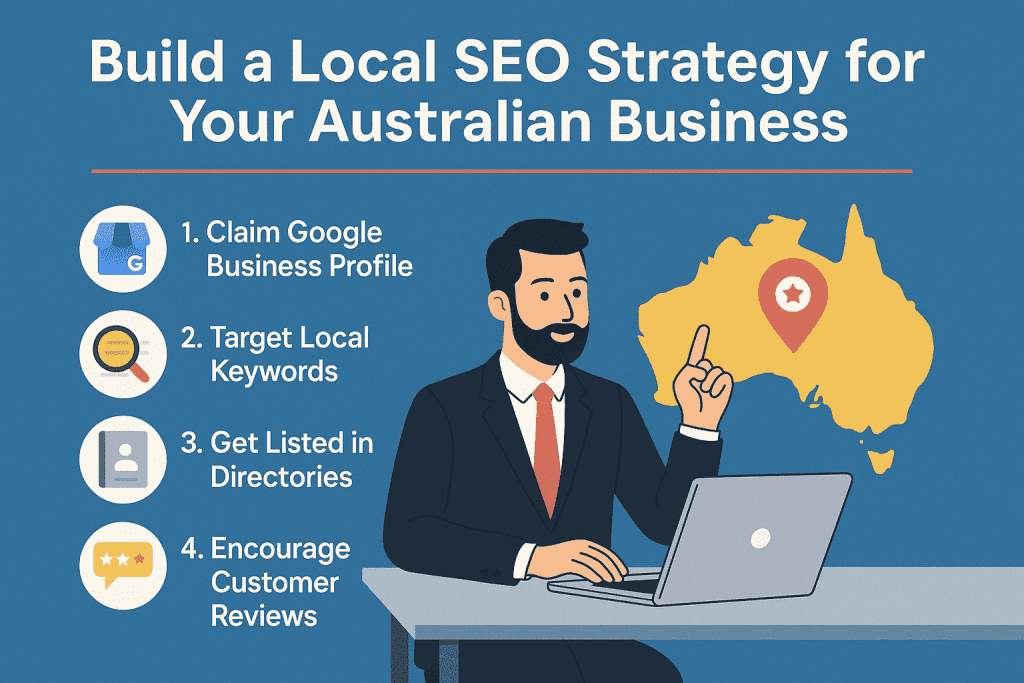
Step 1: Master Google Business Profile optimization
Your Google Business Profile (GBP) is the #1 ranking factor for local SEO in Australia. It’s free, but most businesses never fully optimise it.
Here’s what a fully optimised GBP should include:
| Optimisation Task | Why It Matters | Aussie Example |
| Claim & Verify Profile | Google favours verified businesses | A Gold Coast tradie gets instant “verified” badge |
| Add Exact NAP (Name, Address, Phone) | Consistency boosts trust & ranking | Clinic in Adelaide avoids “wrong number” issues |
| Upload 10–15 High-Quality Photos | Listings with photos get 35% more clicks | Perth café shows daily menu shots |
| Collect & Respond to Reviews | 88% of consumers trust online reviews as much as personal recommendations | Melbourne gym responds to every review |
| Post Weekly Updates | Google rewards active profiles | Local yoga studio posts events and classes |
| Add Services, Attributes & FAQs | Helps customers filter faster | “Wheelchair accessible” tag for Brisbane dentist |
| Track Insights | Calls, direction requests, website clicks | A Sydney bar learns 70% of clicks come Fri/Sat nights |
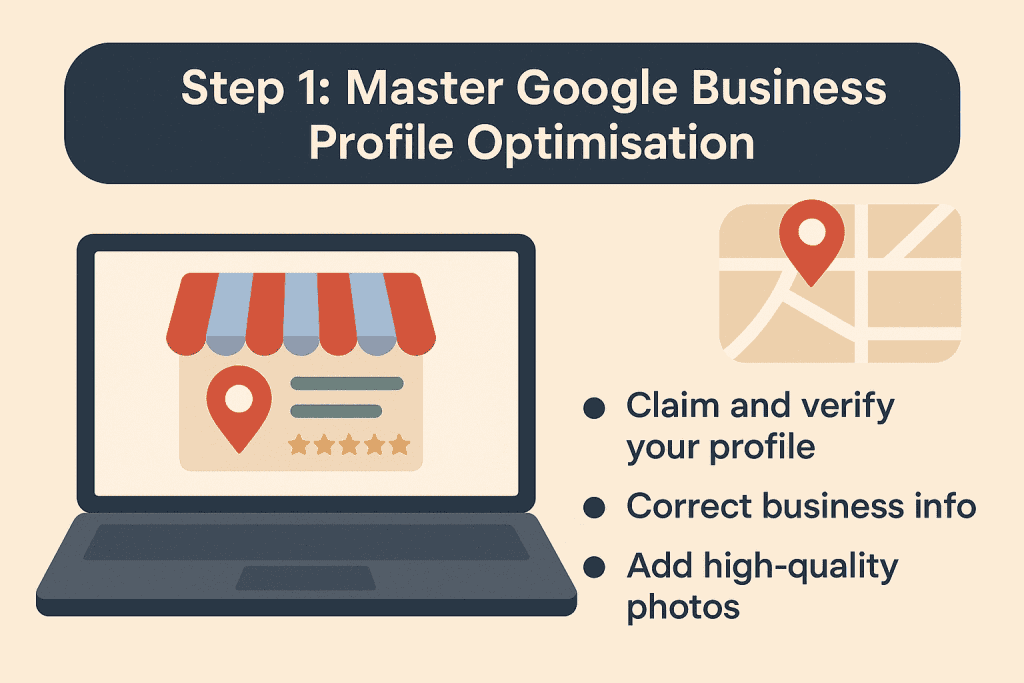
Pro Tip: Encourage customers to leave reviews at the point of service. For example, a café can print a QR code on receipts linking directly to their review page.
Step 2: Target local keywords your customers actually use
When people search “tradie” in Sydney, they don’t want a US blog, they want someone in Marrickville who can show up today.
How to build a local keyword strategy:
- Use Google’s Autocomplete & “People Also Ask” to find what locals type.
- Example: “emergency plumber Bondi”, “best café in Fitzroy”, “childcare near Parramatta”.
- Example: “emergency plumber Bondi”, “best café in Fitzroy”, “childcare near Parramatta”.
- Optimise for ‘near me’ searches. Google automatically localises results if you’re optimised.
- Add suburb & city modifiers in your site’s headings and meta tags.
- Example: Instead of “Personal Training Services”, write “Personal Training in Surry Hills, Sydney”.
- Example: Instead of “Personal Training Services”, write “Personal Training in Surry Hills, Sydney”.
- Use schema markup (LocalBusiness) so Google can “read” your local details better (Google Schema Docs).
Step 3: Build local authority & consistency
Local SEO isn’t just about your website; it’s about everywhere your business appears online.
- NAP consistency: Ensure your Name, Address, Phone are identical across directories (e.g., Yellow Pages, Yelp, TrueLocal, StartLocal).
- Local backlinks: Get links from nearby blogs, local news, or sponsorships. Example: Sponsor a Brisbane footy club → get a backlink from their site.
- Mobile-first design: Most of all Google searches in Australia is mobile. If your site isn’t mobile-friendly, you’re invisible to almost half your market.
Step 4: Leverage reviews & social proof
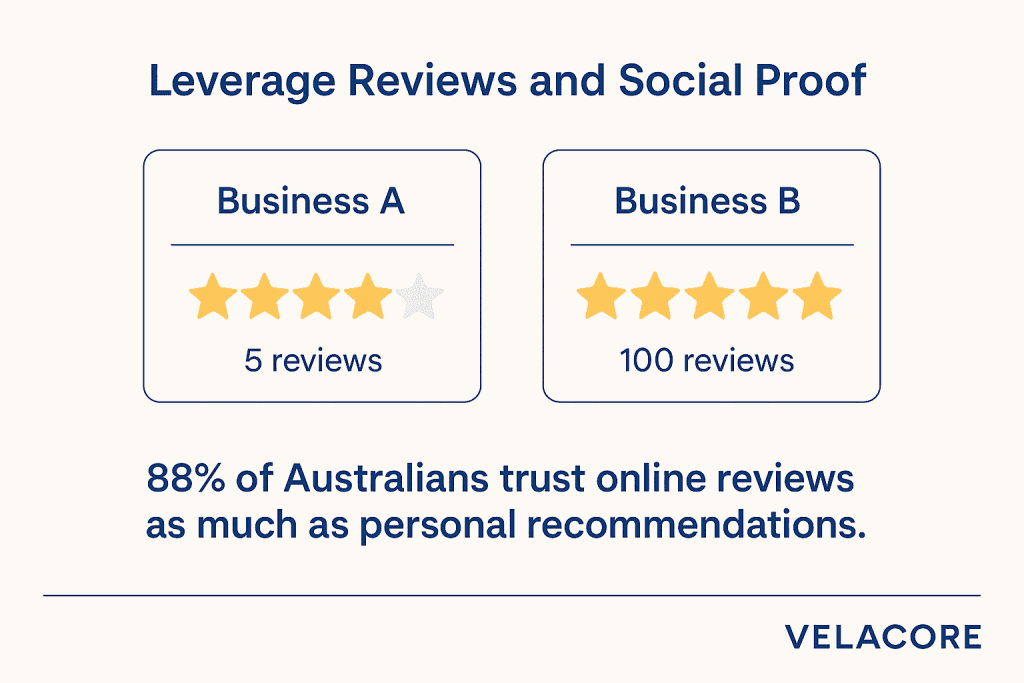
In Australia, reviews directly impact both rankings and conversions. Businesses with more than 50 recent reviews rank higher in the Google Map Pack.
- Respond to every review, even negative ones. A calm, professional reply can actually increase trust by 30%.
- Highlight testimonials on your site (embed Google reviews).
- Use industry-specific review platforms (e.g., Zomato for restaurants, HealthEngine for clinics).
Step 5: Measure, Refine & Stay Updated
Local SEO success is not achieved through a one-time effort. It requires consistent monitoring, analysis, and refinement to adapt to shifting consumer behaviour and Google’s evolving algorithms.
Key metrics to track
- Google Business Profile Insights: Monitor calls, direction requests, website clicks, and photo engagement.
- Google Analytics 4 (GA4): Assess where visitors are located, which channels drive local traffic, and how many of those visits convert into enquiries or sales.
- Keyword Rankings: Tools such as BrightLocal or Whitespark allow businesses to track performance for suburb-specific and “near me” search.
Set aside at least 1 hour per week to update GBP, check keywords, and monitor reviews.
Google frequently adjusts local ranking factors. For instance, review recency gained greater importance in 2024, placing value on continuous customer feedback rather than older ratings. Businesses that adapt quickly maintain visibility.
Final Thoughts: Why Local SEO is Your 5km Superpower
Oftentimes, the path to growth is not always about going bigger; it’s about getting closer. Most customers will decide which business to patronise based on proximity. Maybe within just a few kilometres of where they live or work. Local SEO ensures your business is visible at the exact moment those decisions are made.
At Velacore, we believe local SEO is not just about rankings. It is about building trust, visibility, and long-term community loyalty. Whether you are a café in Fitzroy, a dental clinic in Perth, a gym in Brisbane, or a tradie in Sydney, the principles remain the same: own your local presence, and you own your growth.
Ready to see how your business can dominate search results within 5km of your doorstep?
Contact Velacore today for a tailored Local SEO Audit and start converting local searches into loyal customers.
Is Your Website Working for You?
Most websites don't generate leads. We fix that with custom designs that look great and deliver measurable results for your business.
Get Started With Velacore