
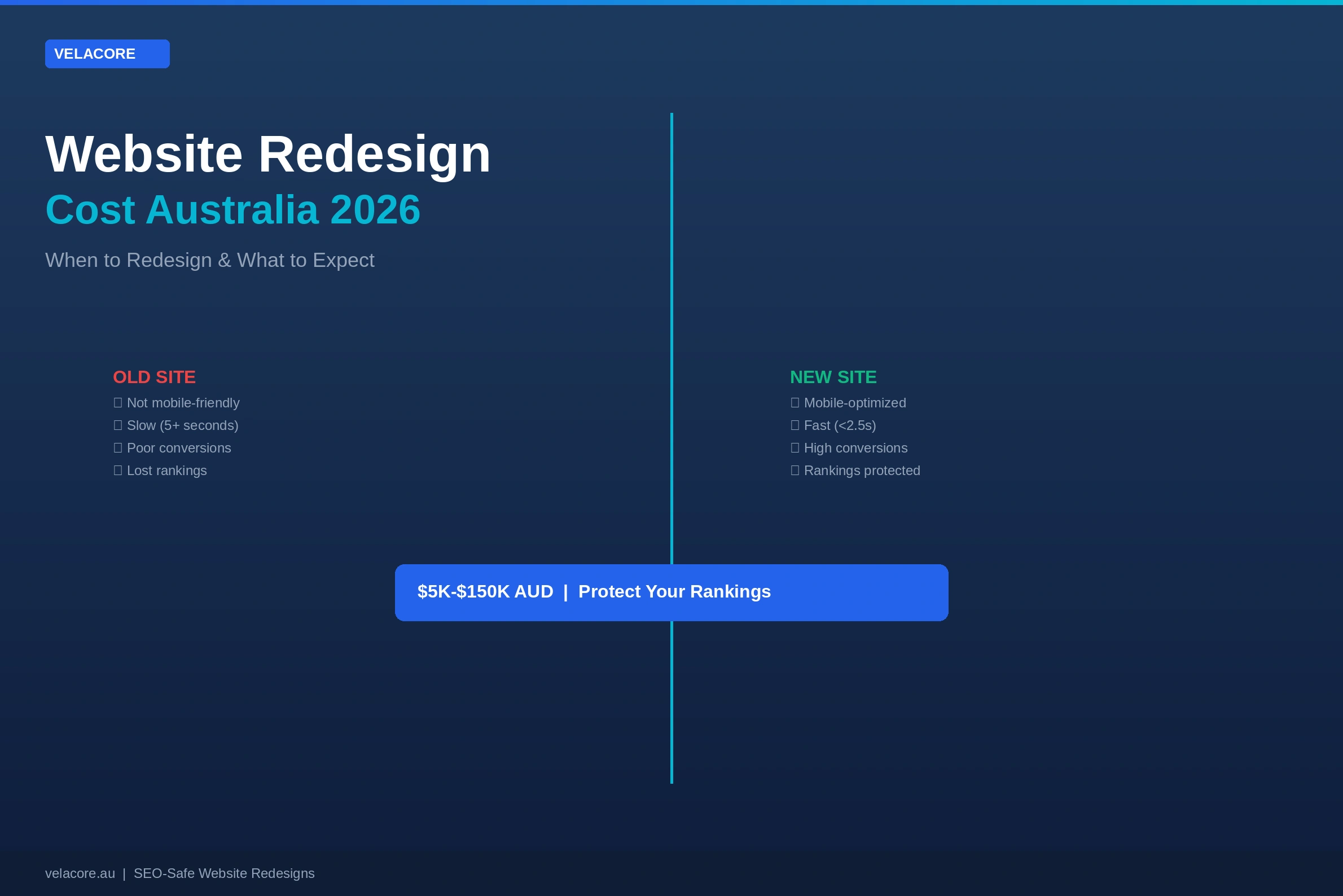
Your website is outdated. Traffic is declining. Conversions are terrible. You know you need a redesign, but when you start researching website redesign cost, the quotes range from $2,000 to $150,000. The massive variation makes no sense. What are you actually paying for? What should a professional redesign cost in 2026? And most critically, how do you redesign without losing the Google rankings you spent years building?
This guide breaks down real website redesign costs in Australia and globally, explains what separates a $5,000 redesign from a $50,000 one, and covers the critical SEO migration strategy that most agencies ignore. Whether you are in Sydney, Melbourne, London, or Los Angeles, you will learn exactly what to expect, what to demand, and how to avoid the costly mistakes that tank rankings and waste money.
5 Signs You Actually Need a Website Redesign (Not Just a Refresh)
Not every struggling website needs a full redesign. Sometimes you just need fixes. Here is how to know if you truly need a redesign versus minor updates.
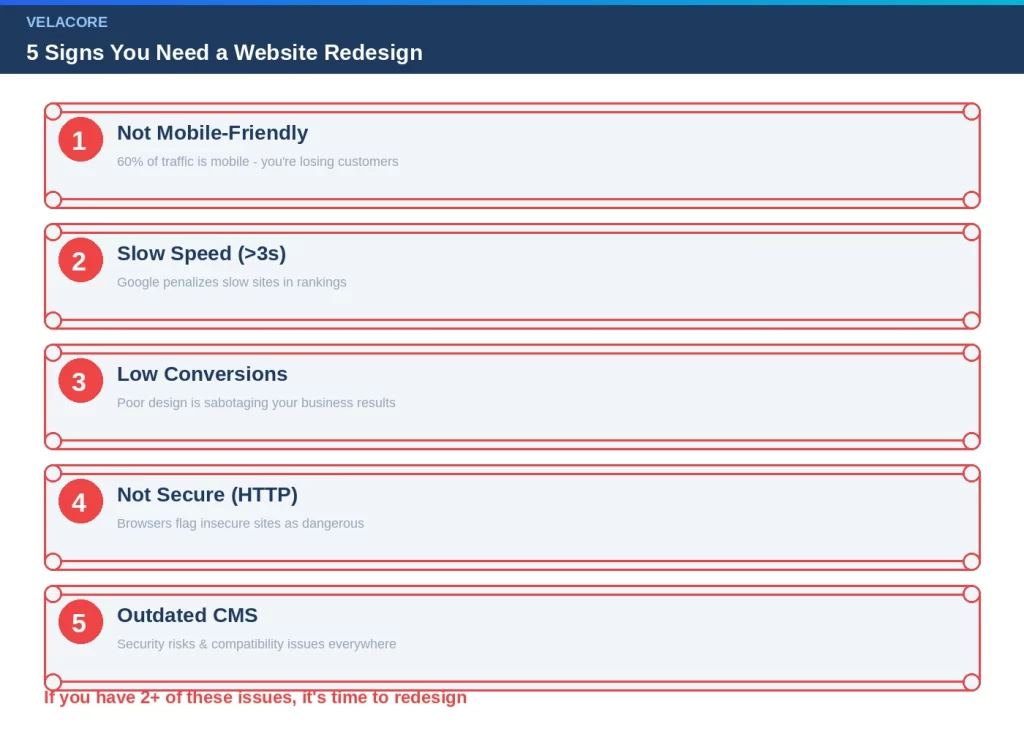
1. Your Site is Not Mobile-Friendly
Over 60% of web traffic is now mobile. If your site does not work perfectly on phones, you are losing more than half your potential customers. Google also uses mobile-first indexing, meaning your mobile site determines your rankings. If your site was built before 2018 and is not responsive, redesign is essential.
2. Load Speed is Over 3 Seconds
Google’s Core Web Vitals now heavily influence rankings. If your site takes more than 3 seconds to load, you are bleeding traffic and conversions. Test your site with Google PageSpeed Insights. Scores below 50 on mobile indicate you need more than optimization fixes, you need a rebuild on modern infrastructure.
3. Conversion Rate is Below Industry Average
If your conversion rate is under 2% for ecommerce or under 5% for lead generation, poor design is likely sabotaging your business. Hard-to-find CTAs, confusing navigation, lack of trust signals, and outdated aesthetics all kill conversions. A strategic redesign focused on conversion optimization can double or triple your results from the same traffic.
4. Your Site is Not Secure (HTTP vs HTTPS)
Every modern website must run on HTTPS, not HTTP. Google penalizes insecure sites in rankings and browsers flag them as dangerous, destroying trust. If your site still uses HTTP in 2026, immediate redesign to a secure platform is critical. This is non-negotiable for credibility and SEO.
5. Your CMS is Outdated or Hacked
If you are running WordPress 4.x, Joomla 2.x, or any CMS that is no longer supported, you have massive security vulnerabilities and compatibility issues. Sites built on Flash, outdated PHP versions, or deprecated frameworks need complete rebuilds on modern tech stacks. The cost of getting hacked (data loss, customer distrust, Google blacklisting) far exceeds redesign costs.
Website Redesign Cost Breakdown 2026
Website redesign costs vary dramatically based on complexity, features, and who does the work. Here is what you can realistically expect in Australia and comparable markets globally.
| Business Size | Cost Range (AUD) | Cost Range (USD) | Timeline | What’s Included |
| Small Business | $5,000 – $15,000 | $3,300 – $10,000 | 4-8 weeks | 5-15 pages, responsive design, basic SEO, CMS setup |
| Mid-Size Business | $15,000 – $40,000 | $10,000 – $27,000 | 8-12 weeks | 15-50 pages, custom design, advanced features, full SEO migration |
| Enterprise | $40,000 – $150,000+ | $27,000 – $100,000+ | 12-24 weeks | 50+ pages, custom functionality, integrations, multi-language |
| DIY (Template) | $500 – $2,000 | $330 – $1,300 | 2-6 weeks | Template customization, basic setup, DIY content migration |
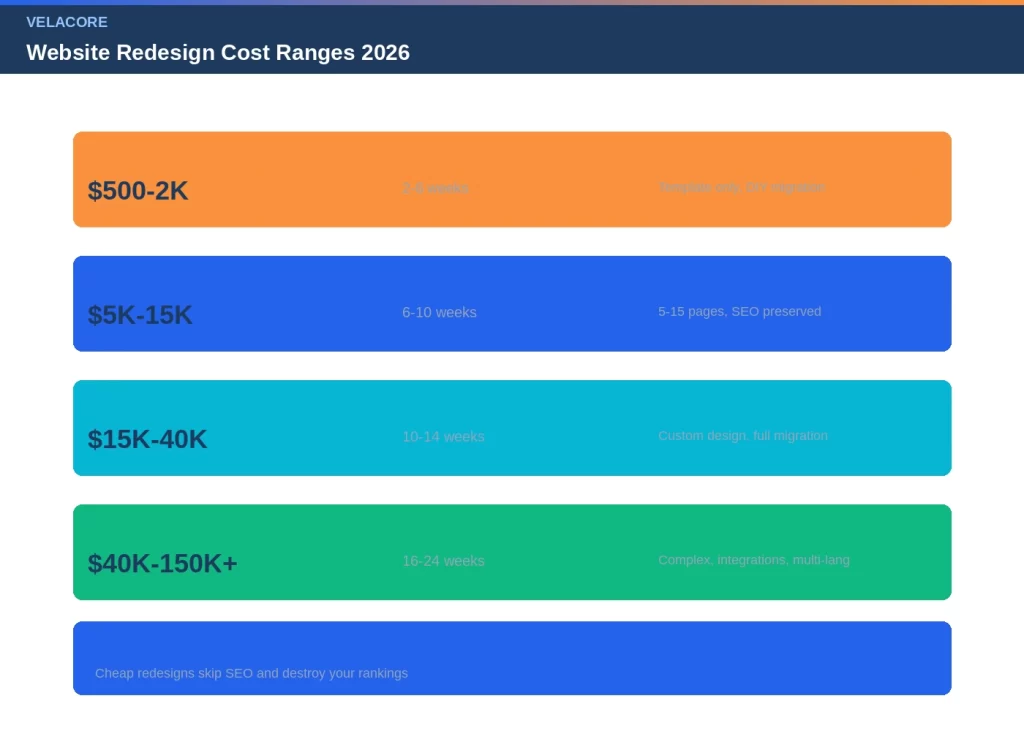
These ranges reflect professional agency work in Australia, United States, United Kingdom, and Canada. Costs are higher in major cities (Sydney, Melbourne, New York, London) and lower in regional areas or with offshore teams.
What Drives Cost Differences
A $7,000 redesign and a $70,000 redesign look identical to untrained eyes. The differences are in discovery depth, custom functionality, content strategy, SEO preservation, integrations with existing systems, accessibility compliance, security hardening, and post-launch support. Cheap redesigns use templates and ignore SEO migration. Professional redesigns involve strategy, custom work, and rank protection.
The Critical Part Most Agencies Ignore: SEO Migration Strategy
Here is the nightmare scenario: you spend $25,000 on a beautiful redesign. Launch day arrives. Within two weeks, your Google traffic drops 60%. Your rankings tank. Leads dry up. You just paid to destroy your business.
This happens constantly because agencies treat redesigns as design projects, not SEO projects. A website redesign without an SEO migration strategy is sabotage. Here is how to redesign without losing rankings.
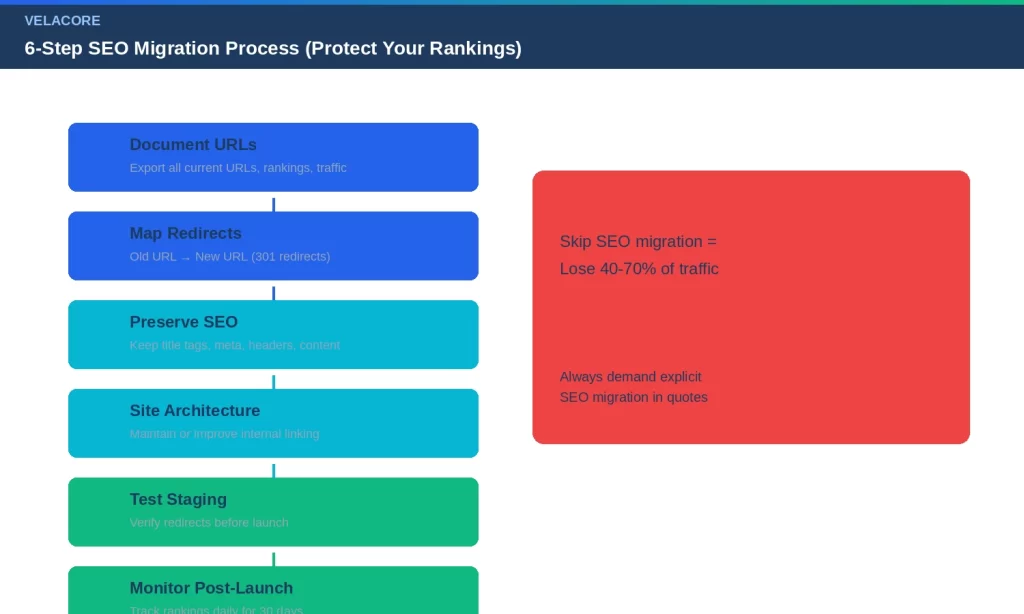
Step 1: Document Every URL Before Redesign
Export a complete list of every URL on your current site. Use Screaming Frog SEO Spider or your CMS sitemap. You need a master spreadsheet showing: current URL, page title, meta description, target keywords, monthly traffic, and current Google ranking position. This baseline lets you measure what you lose or gain post-launch.
Step 2: Map Old URLs to New URLs (301 Redirects)
Every old URL must redirect to the equivalent new URL using 301 permanent redirects. If you change from /services/web-design to /web-design-services, you need a 301 redirect from the old URL to the new. If you have 100 pages, you need 100 redirect mappings. Miss one redirect and that page loses all its accumulated SEO value and inbound links.
Most template redesigns skip this entirely. They launch the new site, delete the old URLs, and wonder why traffic collapses. Professional agencies create detailed redirect maps before touching a single line of code. This alone justifies higher redesign costs because it protects years of SEO investment. If an agency quote does not explicitly mention 301 redirect mapping, walk away.
Step 3: Preserve (or Improve) On-Page SEO
Every important page on your old site has optimized title tags, meta descriptions, header tags, and keyword-focused content. The redesign must preserve these elements or improve them. Too often, designers create beautiful pages with terrible SEO. New title tags missing keywords. Content reduced for aesthetics. Headers not structured hierarchically. The new site looks better but ranks worse.
Step 4: Maintain or Improve Site Architecture
If your current site has a clear structure where important pages are three clicks from the homepage, the new site must maintain or improve that. Burying key pages deep in menus or eliminating internal linking destroys rankings. Site architecture is SEO. Treat it as seriously as visual design.
Step 5: Test Before Launch
Stage the new site on a development server. Test every redirect. Verify every meta tag. Check mobile responsiveness. Run it through Google PageSpeed Insights and fix Core Web Vitals issues before launch. A staged, tested launch prevents disasters.
Step 6: Monitor Post-Launch Rankings
After launch, track rankings daily for the first month using Google Search Console and rank tracking tools. Minor ranking fluctuations (5-10 positions) are normal. Major drops (page 1 to page 5) indicate broken redirects or SEO issues that need immediate fixes. Most ranking issues from redesigns surface within 2-4 weeks and are fixable if caught quickly.
This SEO migration process is why professional redesigns cost more. It requires SEO expertise, meticulous planning, and testing. Cheap redesigns skip it entirely. For businesses with established Google traffic, protecting existing rankings is more valuable than the visual redesign itself.
What a Professional Website Redesign Includes
Professional redesigns involve far more than making your site look modern. Here is what you should expect from a quality agency working in Australia or internationally.
Discovery and Strategy: The agency audits your current site, interviews stakeholders, analyzes competitors, reviews analytics data, and creates a strategic plan before designing anything. Discovery typically takes 1-2 weeks and defines success metrics, user personas, content strategy, and technical requirements.
Custom Design: Not template customization. A designer creates mockups specifically for your brand, audience, and goals. You see wireframes, visual designs, and prototypes before development starts. This includes desktop and mobile designs because they are different layouts, not automatic scaling.
Content Strategy and Migration: Professional agencies do not just move content verbatim. They audit existing content, identify what to keep, update, combine, or delete. They rewrite for clarity and SEO. They create content plans for missing pages. Content migration with strategy prevents the bloated, outdated content that accumulates over years.
Development on Modern Tech: Sites built on current versions of WordPress, React, or other modern frameworks. Clean, semantic code. Fast hosting infrastructure. Security hardening. Accessibility compliance (WCAG standards). API integrations with your CRM, email marketing, or ecommerce platform.
SEO Preservation: As covered earlier, complete URL mapping, 301 redirects, on-page optimization, and technical SEO implementation. This protects your existing Google rankings while improving technical foundations for future growth.
Testing and Quality Assurance: Cross-browser testing (Chrome, Firefox, Safari, Edge), device testing (phones, tablets, desktops), form testing, broken link checks, speed optimization, security scanning. Launch only happens after everything works perfectly.
Training and Documentation: Your team learns how to update content, add pages, manage media, and handle common tasks. Documentation ensures you are not dependent on the agency for minor changes.
Modern Website Features to Include in 2026 Redesigns
A 2026 website redesign should include capabilities that were optional or impossible in 2020. Here are the modern must-haves.
AI Chatbots and Live Chat: Visitors expect instant answers. AI-powered chatbots handle common questions 24/7, qualify leads, and escalate to humans when needed. This technology matured significantly in 2024-2025 and is now cost-effective for small businesses.
Core Web Vitals Optimization: Google ranks sites partially based on speed and user experience metrics. Your redesigned site must score well on Largest Contentful Paint (under 2.5 seconds), First Input Delay (under 100 milliseconds), and Cumulative Layout Shift (under 0.1). This requires technical expertise beyond basic design.
Accessibility Compliance: Websites must be usable by people with disabilities. This is a legal requirement in many countries including Australia, and impacts SEO. Proper heading structure, alt text on images, keyboard navigation, sufficient color contrast, and screen reader compatibility are all essential.
Privacy and Security: GDPR and privacy laws require clear cookie notices, privacy policies, and data handling procedures. Security includes HTTPS, regular updates, strong passwords, two-factor authentication for admin access, and protection against common attacks.
Voice Search Optimization: With increasing use of voice assistants, content needs to target conversational queries. FAQ sections, natural language writing, and structured data markup help sites appear in voice search results.
Realistic Website Redesign Timeline
How long does a professional website redesign actually take? Here are realistic timelines based on project size.
Small Business Redesign (5-15 pages): 6-10 weeks total. Week 1-2: Discovery and strategy. Week 3-4: Design mockups and revisions. Week 5-7: Development. Week 8-9: Content migration and testing. Week 10: Launch and monitoring.
Mid-Size Redesign (15-50 pages): 10-14 weeks total. Additional time for more complex functionality, extensive content migration, integrations with CRM or marketing tools, and more thorough testing across devices and browsers.
Enterprise Redesign (50+ pages): 16-24 weeks or longer. Large sites require detailed content audits, complex migrations, custom functionality, multiple stakeholder approvals, and extensive quality assurance.
These timelines assume clear scope, prompt client feedback, and no major scope changes mid-project. Delays happen when clients take weeks to provide content, request major changes after design approval, or add features not in the original scope.
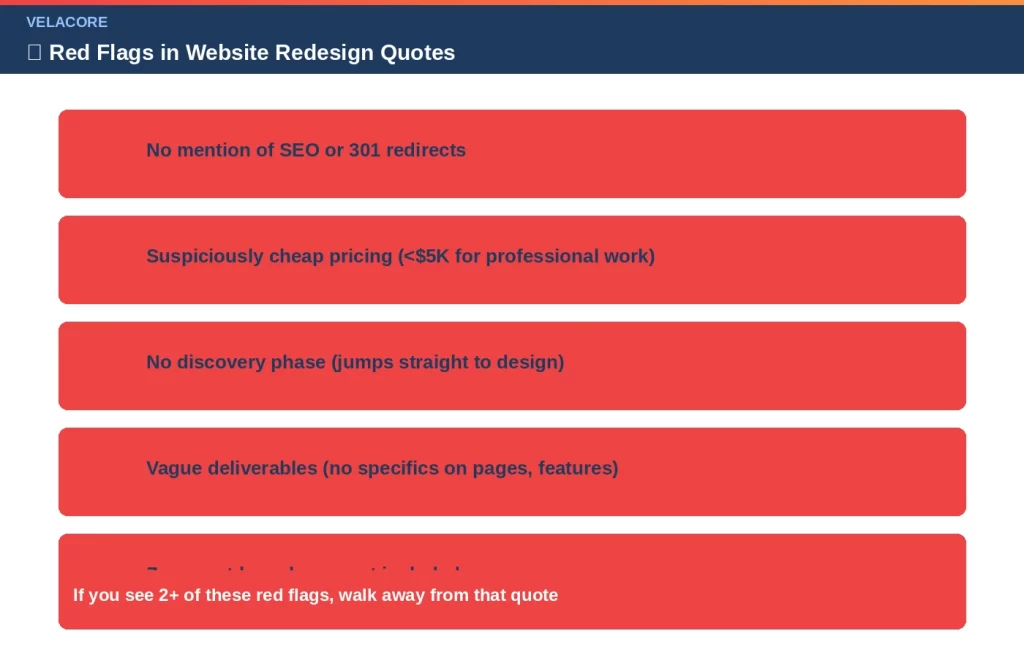
Red Flags in Website Redesign Quotes
Not all redesign quotes are honest. Watch for these warning signs that indicate you will get poor results or hidden costs.
No mention of SEO or redirects: If the proposal does not explicitly address SEO migration, URL redirects, and ranking preservation, the agency does not understand SEO. Your rankings will tank post-launch.
Suspiciously cheap pricing: A professional $15,000 redesign cannot be done well for $3,000. Cheap quotes mean template work, offshore labor with no quality control, or hidden costs that surface mid-project. You get what you pay for.
No discovery phase: Agencies that skip discovery and jump straight to design do not understand your business, audience, or goals. They are guessing. Discovery is essential for strategic redesigns that actually improve business results.
Vague deliverables: Proposals should specify exactly what you get. How many pages? How many design revisions? What functionality? What happens after launch? Vague proposals lead to scope disputes and surprise charges.
No post-launch support: Launches always reveal issues. Reputable agencies include 30-90 days of post-launch support for bug fixes and minor adjustments. Quotes with zero post-launch support leave you stranded.
Conclusion: Invest in Redesign That Protects Your Rankings
Website redesign costs in 2026 range from a few thousand for template work to over $100,000 for enterprise projects. The key is not finding the cheapest option but finding the right balance of design quality, technical excellence, and SEO preservation for your business size and goals.
Most businesses should budget $10,000-$25,000 AUD for a professional redesign that actually improves results and protects rankings. Anything less typically means cutting corners on SEO migration, security, or quality. If you are ready to redesign your website properly, get in touch with Velacore for a quote that includes the SEO migration strategy your rankings depend on.
Frequently Asked Questions
Should I redesign my entire site or just refresh the design?
If your site is mobile-friendly, fast, secure, and converting decently, a visual refresh might be enough. If it has structural problems (not mobile-friendly, slow, insecure, terrible conversion rate), full redesign is needed. Most sites over 5 years old need full redesigns because technology has changed too much for surface-level fixes to work.
How often should I redesign my website?
Major redesigns every 4-6 years, with minor updates annually. Technology, design trends, and user expectations evolve. A 2020 site still works in 2026 if you have kept it updated, but a 2016 site looks and feels ancient. Plan for a full redesign every 4-6 years to stay competitive.
Can I redesign in phases to spread costs?
Yes, but be strategic. Phase 1 might be homepage and key service pages. Phase 2 adds blog and resources. Phase 3 adds ecommerce or advanced features. This works if each phase delivers standalone value. Phasing purely to spread costs without strategic milestones often means paying more overall for a disjointed result.
What happens to my Google rankings during a redesign?
With proper SEO migration (301 redirects, preserved URLs, maintained on-page SEO), rankings typically hold steady or improve slightly due to better technical performance. Without SEO migration, rankings can drop 40-70% permanently. This is why choosing an SEO-competent agency is critical, not just a design-focused one.