
You have three proposals sitting in your inbox. One quotes $4,500, one quotes $12,000, and one quotes $18,500. They all promise “a modern, mobile-responsive website that represents your brand.” The portfolios all look professional. The reviews are all positive. So how do you actually decide?
This is the exact position thousands of Australian business owners find themselves in every year. And most of them get it wrong. Not because they are careless, but because they are asking the wrong questions and evaluating agencies on surface-level criteria that have almost nothing to do with whether the site will actually work six months after launch.
If you are trying to figure out how to choose a web design agency in Australia, this guide will show you how to cut through the noise, ask the questions agencies hope you will not ask, and identify the partner who will actually deliver a site that drives business results instead of just looking good in screenshots.
We will cover the 8-question framework that separates serious agencies from template mills, what a real discovery process should look like, how to evaluate proposals side by side, and the red flags that predict problems long before they surface. Most importantly, we will show you the questions that reveal whether an agency sees your website as a revenue-generating asset or just another build job.
According to auDA research, three in four Australian consumers will only purchase from a business online if it has a website. But having any website is not enough. The difference between a site built by the right agency and one thrown together by the cheapest bidder can mean tens of thousands of dollars in lost revenue every single year.
Let’s make sure you choose wisely.
Why Most Australian Businesses Choose the Wrong Web Design Agency
Before we get into how to choose the right agency, it helps to understand why so many businesses get this decision wrong. It rarely comes down to bad luck. The problem is systematic and it stems from three common evaluation mistakes that feel logical but lead to terrible outcomes.
The first mistake is price-first thinking. When you get multiple quotes and one is significantly cheaper than the others, the temptation is strong to assume the expensive agencies are just padding their margins. In reality, cheap quotes usually mean one of three things: offshore outsourcing, template-only work with no customisation, or an inexperienced freelancer who has drastically underestimated the scope. Six months later, when your cheap site is slow, breaks on mobile, ranks nowhere on Google, and costs another $8,000 in fixes, that bargain does not look so good anymore.
The second mistake is portfolio-only evaluation. Yes, you should absolutely review an agency’s past work. But a beautiful portfolio screenshot tells you nothing about whether the site actually performed, whether the client was happy with the process, or whether the agency delivered on time and on budget. It definitely does not tell you if the site is still working well two years later or if it needed constant fixes. Portfolios show you what an agency can design. They do not show you how they work or whether they understand strategy.
The third mistake is not understanding what discovery means. Most business owners hear the word discovery and think it sounds like consultant jargon for billing extra hours. In reality, discovery is the difference between a site built on assumptions and one built on actual strategy. Agencies that skip discovery are building blind. They are guessing at your audience, guessing at your value proposition, and guessing at what conversion paths will work. When an agency does not ask hard questions about your business model, competitors, and customer journey before they start designing, that is a red flag the size of Sydney Harbour.
These three mistakes account for most of the web design horror stories you hear at business networking events. The good news is they are completely avoidable once you know what to look for.
The 8-Question Framework: How to Choose a Web Design Agency in Australia
Choosing the right web design agency in Australia comes down to asking the right questions before you sign anything. Not generic questions like “how long will it take” or “what is your process,” but specific, tactical questions that force an agency to either demonstrate real expertise or reveal that they are winging it.
These eight questions form a framework that works whether you are evaluating agencies in Sydney, Melbourne, Brisbane, or regional Australia. They work for small business websites and enterprise builds alike. Most importantly, they cut through marketing fluff and get to the substance of how an agency actually operates.
Here is what to ask, why it matters, and what answers you should be listening for.
| Question | Why It Matters | Green Flag Answer |
| Can you walk me through your discovery process? | Separates strategy-driven agencies from order-takers | Detailed multi-stage process with deliverables |
| Who will actually be building my website? | Reveals if work is outsourced offshore | In-house team or disclosed partner locations |
| How do you approach SEO from day one? | Shows if SEO is strategic or an afterthought | Technical checklist built into architecture |
| What happens if I want changes after launch? | Reveals lock-in tactics and ownership issues | Full code access, exportable, flexible CMS |
| Show me 3 sites live from 2+ years ago | Proves they build for longevity not just launch | Current, fast, maintained client sites |
| What is your policy on scope changes? | Prevents surprise bills and scope creep fights | Clear written policy with revision allowances |
| How do you measure success after launch? | Shows if they see site as tool vs deliverable | Analytics setup and post-launch reporting |
| Can I speak to 3 recent clients? | Validates claims with actual client experiences | Recent references within 12 months |
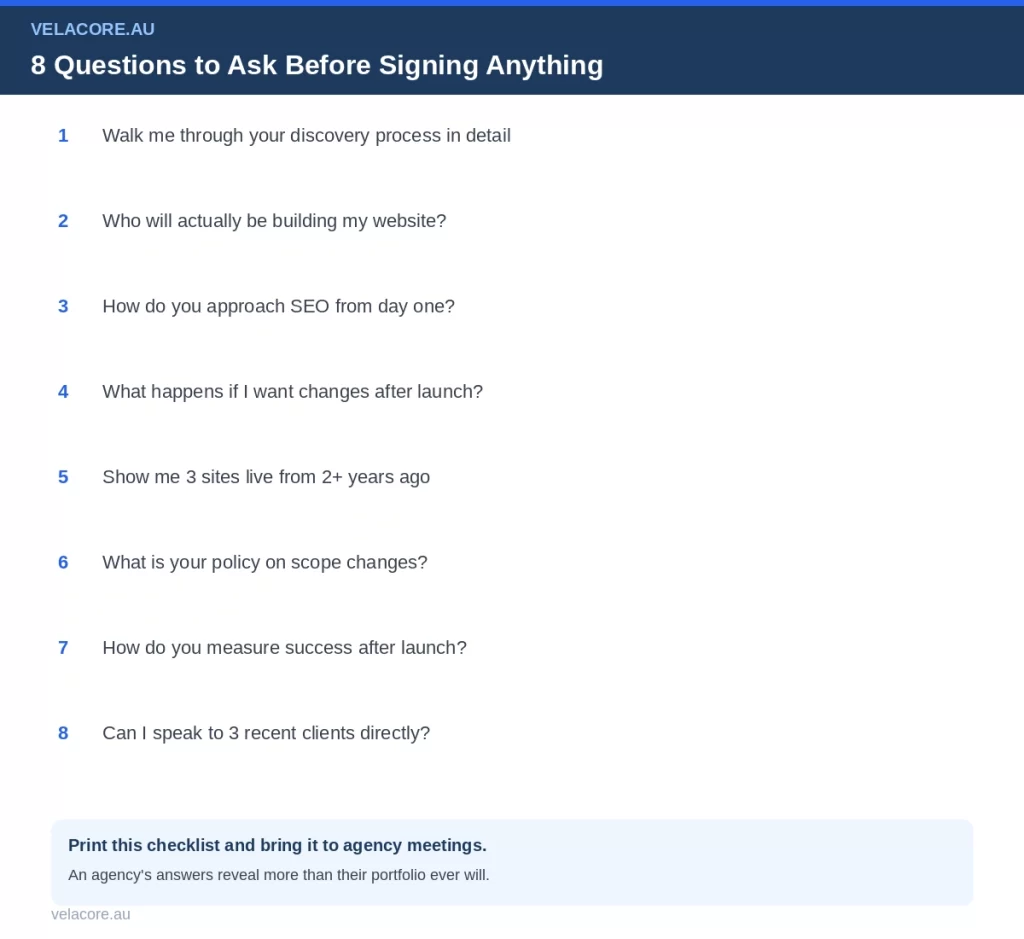
Usage: Article body (question framework section), printable PDF download
1. Can you walk me through your discovery process in detail?
This question separates agencies who understand strategy from those who just push pixels. A good discovery process should include stakeholder interviews, competitor analysis, audience research, and a deep dive into your business model and goals. If an agency tells you “we will have a kickoff call and then start designing,” that is not discovery. That is just a briefing. Real discovery takes time and it costs money because it requires research, not just a conversation.
2. Who will actually be building my website?
Many Australian agencies outsource development offshore to cut costs. There is nothing inherently wrong with global teams, but you deserve to know. If your project manager is in Melbourne and your developers are in the Philippines or India, that creates timezone issues, communication delays, and quality control challenges. Ask directly: who is writing the code, where are they located, and will I have direct access to them if needed?
3. How do you approach SEO from day one?
SEO is not something you bolt on after launch. It needs to be baked into the site architecture, URL structure, page speed optimisation, and content from the beginning. If an agency treats SEO as an optional add-on service, they do not understand how modern websites work. Ask them to explain their technical SEO checklist and how they handle things like schema markup, Core Web Vitals, and mobile-first indexing.
4. What happens if I want to make changes after launch?
This question reveals whether you will own your site or be locked into dependency. Some agencies build sites on proprietary platforms or with locked-down code that makes it impossible to move or modify without paying them forever. Ask: will I have full access to the codebase? Can I export my site and move it to another host if needed? What CMS are you using and why?
5. Can you show me three client sites that are still live and performing well two years after launch?
Anyone can build a site that looks good at launch. Fewer agencies build sites that still work well years later. Ask for live URLs (not screenshots) of sites they built 18-24 months ago. Then actually visit them. Check the page speed. Try the forms. Browse on mobile. Look at whether the content is updated or if the site looks abandoned. This tells you if the agency builds for longevity or just for launch-day screenshots.
6. What is your policy on revisions and scope changes?
Every project has scope creep. The question is how the agency handles it. Do they charge hourly for every tiny change? Do they include a revision allowance? How do they define what is in scope versus out of scope? Agencies with clear, written policies on this tend to be professional. Agencies who are vague about it tend to surprise you with bills later.
7. How do you measure success after launch?
If an agency does not talk about analytics, conversion tracking, or performance metrics, they see the website as a deliverable, not a tool. Ask what analytics they set up by default, how they track goals and conversions, and whether they provide any post-launch reporting. The best agencies treat launch as the beginning, not the end.
8. Can I speak to three of your past clients directly?
References matter, but only if they are real. Some agencies cherry-pick testimonials or use outdated references from years ago. Ask to speak with recent clients (within the last 12 months) who had similar project scopes to yours. Then actually call them. Ask about communication, timelines, hidden costs, and whether they would hire the agency again.
What a Real Discovery Process Actually Looks Like
Discovery gets mentioned a lot, but most business owners have never actually seen what a proper discovery process looks like. If you have only worked with cheap agencies or freelancers before, you might think discovery just means a kickoff meeting where you explain what you want. That is not discovery. That is a briefing.
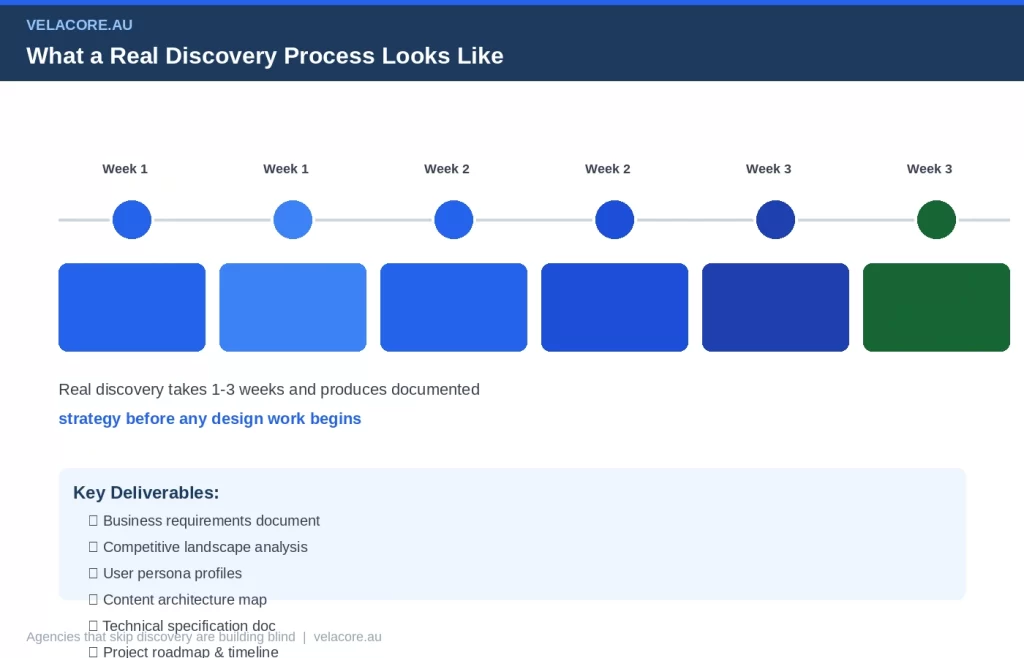
Real discovery is a structured research phase that happens before any design work begins. It typically takes one to three weeks and involves multiple stakeholders, detailed documentation, and deliverables that form the strategic foundation for everything that follows. Agencies that do discovery well will produce artifacts like audience personas, competitor analysis reports, content architecture maps, and technical requirements documents before a single wireframe gets created.
Here is what the process should look like, step by step. If an agency is skipping any of these stages, they are building on assumptions instead of strategy.
| Stage | Activities | Deliverable | Duration |
| Stakeholder Interviews | Deep dive with key decision makers about goals, challenges, audience | Interview summary and business requirements doc | 3-5 days |
| Competitor Analysis | Audit 5-10 direct competitors for positioning, messaging, UX patterns | Competitive landscape report with screenshots | 2-3 days |
| Audience Research | Define personas, user journeys, pain points, and decision triggers | Persona profiles and journey maps | 2-4 days |
| Content Audit | Review existing content, identify gaps, plan new structure | Content inventory and architecture map | 2-3 days |
| Technical Requirements | Define hosting, integrations, CMS, security, performance needs | Technical specification document | 1-2 days |
| Discovery Presentation | Present findings, validate assumptions, align on strategy before design | Strategy deck and project roadmap | 1 day |
A good discovery process should feel thorough, almost uncomfortably so. The agency should be asking questions that make you think hard about your business model, your competitive position, and what success actually looks like. If the questions feel superficial or the agency seems to accept everything you say at face value without pushing back, that is a warning sign. The best agencies challenge assumptions and force clarity.
How to Evaluate Web Design Proposals Side-by-Side
When you have three proposals in front of you and they all use slightly different terminology, cover different scopes, and present information in different formats, comparing them objectively becomes nearly impossible. Most business owners default to comparing price, which is exactly the wrong way to evaluate.
Here is a simple scoring rubric you can use to compare proposals on factors that actually matter. Rate each agency on a scale of 1 to 5 for each criterion, then total the scores. The highest score wins, regardless of price. You can weight certain criteria more heavily if they matter more to your specific situation.
| Criterion | What to Look For | Weight |
| Discovery depth | Do they ask hard questions before designing? Is discovery budgeted and scoped? | x2 |
| Technical capability | Can they explain technical SEO, performance, security without jargon? | x2 |
| Strategic thinking | Do they challenge assumptions or just say yes to everything? | x2 |
| Portfolio relevance | Have they done similar projects in your industry or complexity level? | x1 |
| Clear communication | Is the proposal clear, detailed, and easy to understand? | x1 |
| Ongoing support | Do they offer maintenance, training, and post-launch support? | x1 |
| Timeline realism | Is the timeline achievable or overly optimistic? | x1 |
| Contract clarity | Are deliverables, scope, ownership, and terms clearly defined? | x2 |
Notice what this rubric does not include: how nice their office is, how big their team is, or how many awards they have won. Those things do not correlate with results. What matters is strategic thinking, technical capability, clear communication, and whether they see your website as a business tool or just a design project.
The Questions Australian Web Design Agencies Hope You Won’t Ask
There are certain questions that make agencies uncomfortable because they expose the gap between marketing claims and operational reality. These are the questions that separate agencies who genuinely understand digital strategy from those who are just good at sales. Most business owners never ask them because they do not know these questions exist.
We collected these questions by interviewing Australian business owners who had gone through multiple agency relationships and learned the hard way what to ask. Some of these questions will feel confrontational. That is intentional. An agency’s reaction to a tough question tells you more than their answer. Good agencies welcome scrutiny because they have nothing to hide. Mediocre agencies get defensive or try to change the subject.
Here are the questions agencies hope you will not ask, why they matter, and what good versus bad responses look like.
| The Question | Why Agencies Fear It | Good Response | Bad Response |
| What is your developer turnover rate? | High turnover means inconsistent quality and lost project knowledge | Low turnover (under 15% annually) with senior devs on staff | Evasive answer or high churn rate |
| Can I see your actual contract before we start? | Reveals hidden fees, ownership issues, cancellation terms | Provides sample contract upfront with clear terms | Says you will see it after commitment or deposit |
| What percentage of projects finish on time and on budget? | Most agencies overpromise and underdeliver on timelines | Honest answer (70-80%) with reasons for delays | Claims 100% or refuses to answer |
| Who owns the copyright to designs and code? | Some agencies retain ownership to lock you in | You own everything upon final payment | Agency retains rights or shared ownership |
These questions work because they cannot be answered with rehearsed sales pitches. They require agencies to either demonstrate real capability or admit limitations. Both responses are valuable. An agency that honestly says “we are not the best fit for enterprise integrations but we can recommend someone who is” is infinitely more trustworthy than one that oversells their capabilities and underdelivers later.
If you want more context on website pricing before you start evaluating agencies, read our detailed breakdown on how much a website costs in Australia in 2026. It covers pricing tiers, hidden costs, and what you should actually expect to pay for quality work.
Red Flags That Predict Problems 6 Months After Launch
Some warning signs are obvious at contract signing. Things like no written contract, vague timelines, or an agency that cannot explain their process. But the red flags that matter most are the subtle ones that predict problems months down the track when your site is live and you are stuck with an agency you cannot easily leave.
These are the patterns we see repeatedly in post-mortems of failed agency relationships. Business owners look back and realise the warning signs were there from the beginning but they did not know what they were looking at.
| Red Flag | What It Predicts |
| No written contract or vague statement of work | You will have no recourse when scope disputes arise later |
| Cannot explain their SEO process in detail | Your site will rank poorly and need expensive fixes |
| Promises unrealistic timelines | Rushed work means bugs, poor UX, and missing features |
| Locked into proprietary CMS or platform | You cannot leave without rebuilding from scratch |
| No staging or testing environment mentioned | Bugs go straight to production where customers see them |
| Offshore dev team not disclosed upfront | Communication breakdowns and timezone delays |
| No post-launch support plan offered | When something breaks, you are on your own |
| Portfolio sites are mostly offline or broken | They build for launch-day screenshots, not longevity |
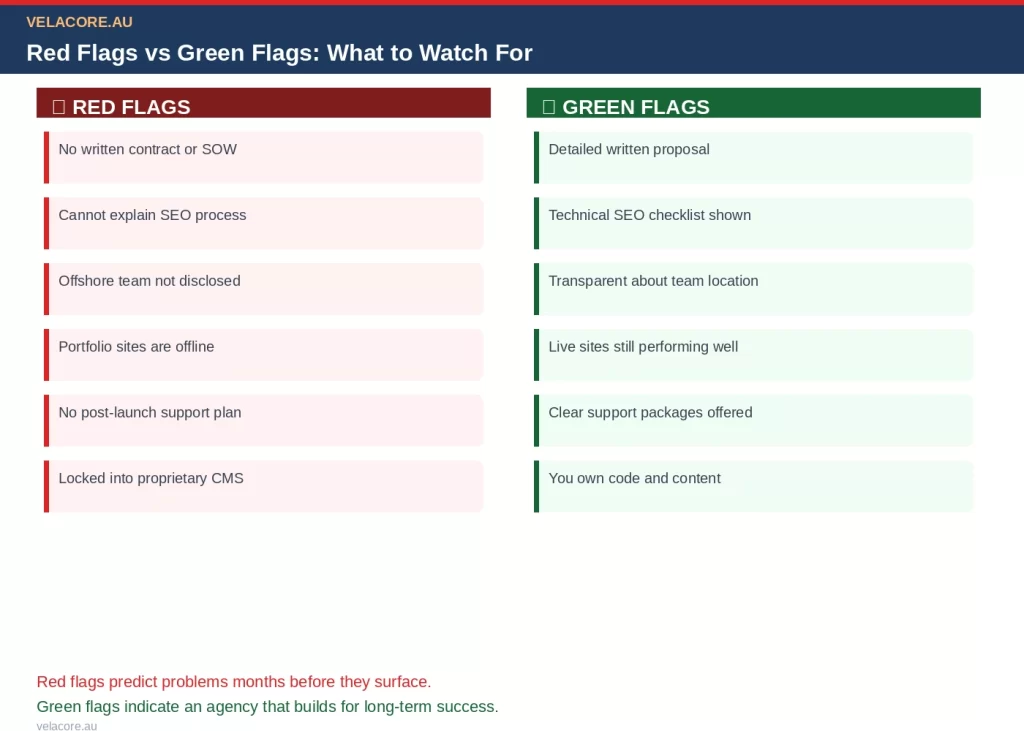
Usage: Article body (red flags section), social media warning post, Pinterest pin
City-by-City Web Design Agency Landscape in Australia
The Australian web design market is not uniform across cities. Sydney agencies tend to be larger, more expensive, and more corporate-focused. Melbourne agencies skew creative and design-driven. Brisbane and Perth offer better value but with smaller talent pools. Regional agencies are often cheaper still but may lack experience with complex builds.
If you are evaluating agencies across multiple cities, understand that location affects pricing but not necessarily quality. A Melbourne agency charging $15,000 for a small business site might deliver exactly the same result as a Brisbane agency charging $9,000. The difference is overhead, not skill. Remote work has also blurred geographic lines significantly since 2020.
Frequently Asked Questions: Choosing a Web Design Agency
Should I hire a freelancer, small agency, or large agency?
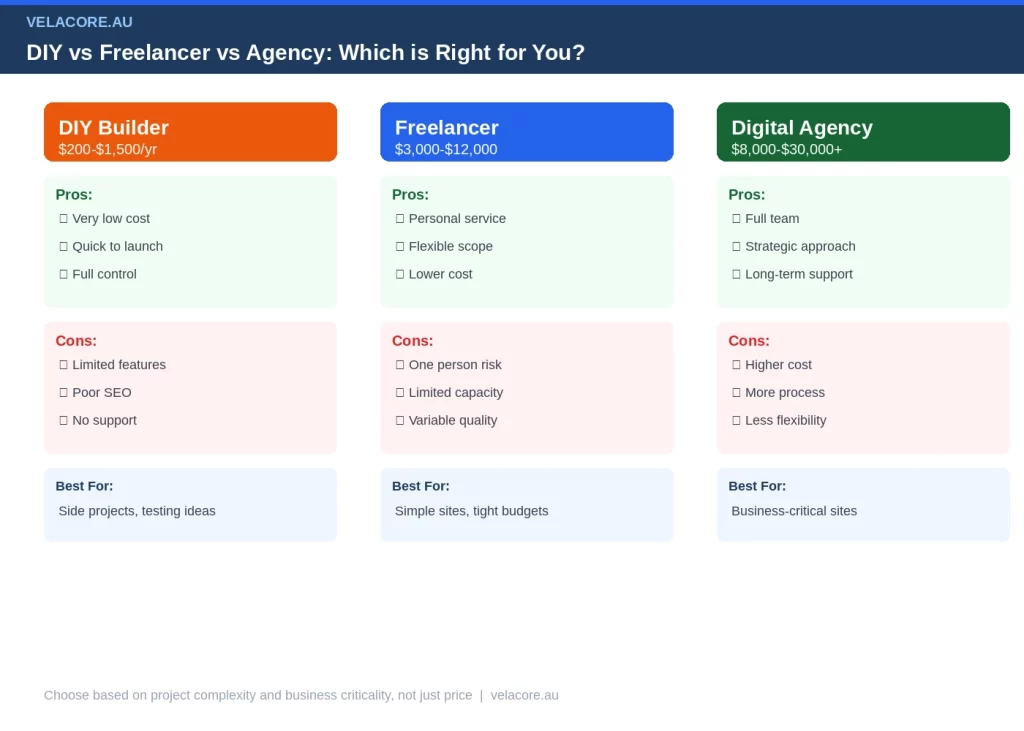
Freelancers work well for simple sites with limited budgets. Small agencies (under 10 people) offer good value and personalised service but may lack specialised expertise. Large agencies have deep benches and can handle complex projects but cost more and you may not get senior attention. Choose based on project complexity and budget, not agency size alone.
How much should I budget for a professional website in Australia?
For a professionally designed small business website, budget $5,000 to $15,000. For eCommerce, expect $10,000 to $30,000+. Anything quoted under $3,000 is almost certainly templated work with minimal customisation. Remember that ongoing costs (hosting, maintenance, updates) add $1,500 to $5,000 per year.
What is the typical timeline for a website project?
A small business website takes 6 to 10 weeks from contract signing to launch. eCommerce sites take 10 to 16 weeks. Enterprise builds can run 4 to 6 months. Agencies promising faster timelines are either very small projects or cutting corners on discovery and testing.
Do I need to be in the same city as my web design agency?
Not anymore. Remote collaboration tools have made location mostly irrelevant. However, some businesses prefer in-person meetings for major projects. If that matters to you, prioritise local agencies. Otherwise, expand your search nationally to find the best fit regardless of location.
Can I move my website to another agency later if needed?
Only if you own the code and hosting. Always ensure your contract specifies that you own all source files, design assets, and content. Avoid proprietary platforms that lock you in. WordPress, Shopify, and other mainstream CMS platforms make switching agencies relatively straightforward.
What should I ask about ongoing maintenance and support?
Ask what is included in their maintenance packages, how quickly they respond to issues, and what happens if something breaks outside business hours. Good agencies offer tiered support plans with clear SLAs. Avoid agencies that insist you must use their support exclusively or that do not provide direct access to your site.
Conclusion: Choose Based on Strategy, Not Screenshots
Choosing a web design agency in Australia is not about finding the cheapest quote or the prettiest portfolio. It is about identifying a partner who understands your business model, asks hard questions, builds with strategy and technical excellence, and sees your website as a revenue-generating tool instead of just a project to complete.
Use the 8-question framework. Demand to see a real discovery process. Evaluate proposals on substance, not surface. Ask the uncomfortable questions. Watch for the red flags. And remember that the goal is not to get a website built but to get a website that works for your business long after launch day.
If you are ready to start the conversation with an Australian agency that treats web design as business strategy, not just visual design, get a quote from Velacore or use our website cost calculator to get an instant estimate for your project.