
A practical guide to Google Maps, genuine service areas and the enquiries that turn into local customers.
A customer around the corner needs exactly what you sell. They search, compare a few businesses and contact someone else. Before you buy another tool or publish twenty suburb pages, find out where that decision went wrong.
Local SEO for Australia means making your business easy to find and choose when location matters. Start with an accurate Google Business Profile, a useful website destination and a reliable way to contact you. Then measure suitable enquiries and bookings alongside your visibility in Google Maps and Search.
The goal is not to own an arbitrary five-kilometre circle. It is to become a credible, convenient choice for customers you can actually serve.
- Google’s ranking guidance describes relevance, distance and popularity. Listing another suburb is not the same as moving your business closer to a searcher.
- Google permits up to 20 service areas. That is a profile limit, not a target or a promise to rank in every area.
- In BrightLocal’s 2026 survey of 1,002 US adults, 54% said they would visit a business’s website after positive reviews. This is US consumer research, not an Australian conversion benchmark, but it makes the website handoff worth checking.
1. Start local SEO for Australia with the customer you can serve
Choose the service, customer and area together. A café needs to help people decide whether to visit. A mobile electrician needs to establish coverage and job fit. A specialist clinic may attract people willing to travel farther. The same radius does not describe all three businesses.
Write one useful starting brief: “We want more switchboard-upgrade enquiries from homeowners in the suburbs our team can reach, during the hours we actually operate.” That gives you a service page, an enquiry qualification question and a way to judge progress.
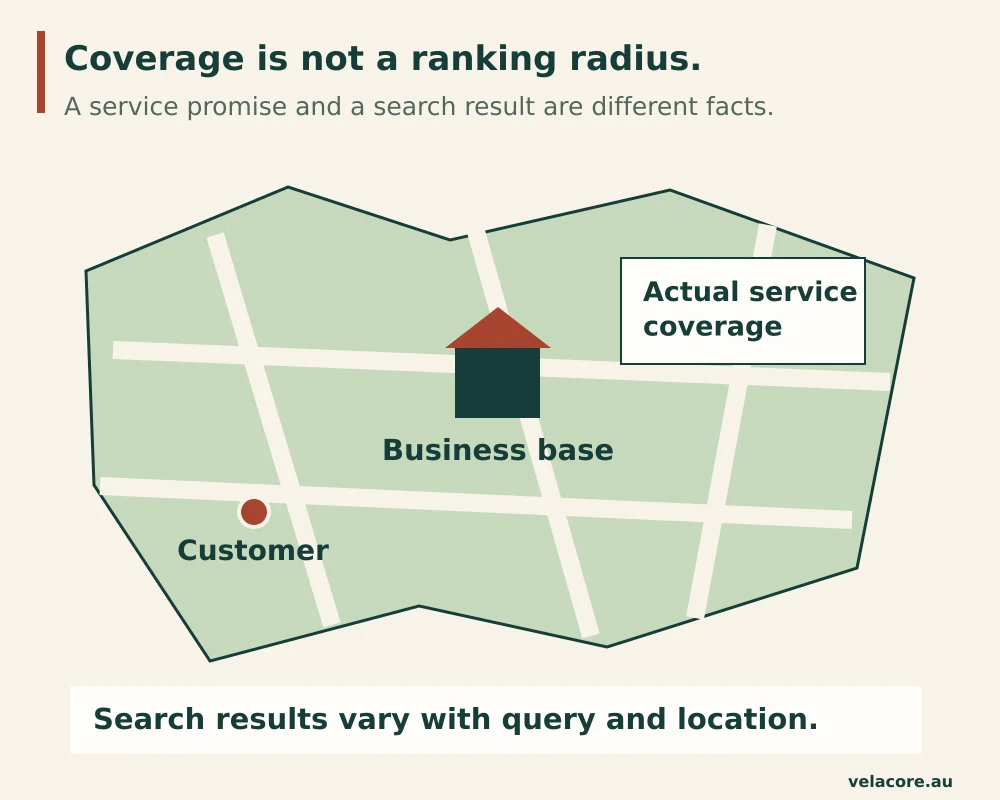
Separate these three facts before changing anything:
- Business location: where the eligible business operates.
- Service coverage: where you genuinely travel, deliver or receive customers.
- Search visibility: where and for which searches your business appears.
Google’s local ranking explanation connects relevance with the match to a search, distance with the searcher’s location, and popularity with how well known a business is. You can improve the evidence around your offer. You cannot edit distance away.
Test the result from more than your office. Search the same service from a few meaningful customer locations and record the date, query and location. A local rank-grid tool can make this repeatable; its coordinates and settings must stay comparable. One good result on your own phone is a starting observation, not proof of coverage.
For priorities beyond local discovery, use our small-business SEO guide. This article concentrates on the local journey from finding you to contacting you.
2. Match Google Business Profile optimisation to your real business
Set up the profile around how customers interact with the business. An accurate storefront, service-area or hybrid model is more useful than an impressive-looking address customers cannot visit.
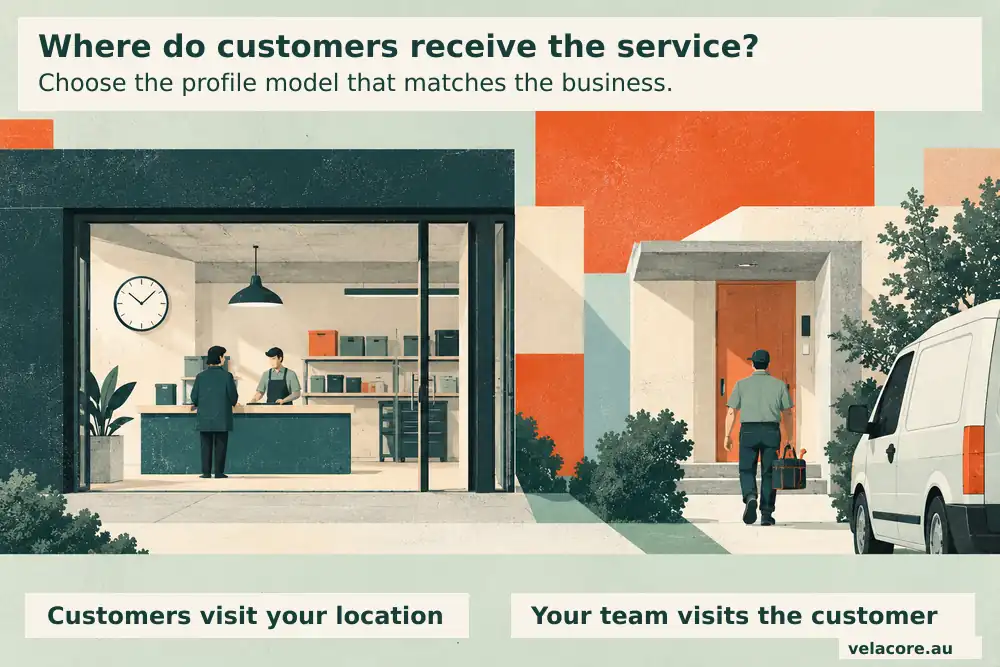
| Business model | What customers do | Profile setup |
|---|---|---|
| Storefront | Visit your staffed business location during its stated hours | Show the eligible address and accurate opening information |
| Service-area business | Receive the service at their own location | Hide an address where customers are not served and specify genuine coverage |
| Hybrid | Visit your location or receive a service elsewhere | Show the eligible customer-facing location and actual service areas |
Google’s business representation guidelines explain eligibility, names, categories and address requirements. An online-only business does not become eligible by renting a virtual address. Keep the business name as it is used in the real world, rather than adding services and suburbs for keywords.
Start with the primary category that describes the main business. Add genuinely applicable categories, services, contact information, normal hours and special hours. Use your own current photographs to show the entrance, workspace, work or products that customers will actually encounter. These details should reduce uncertainty, not decorate an incomplete listing.
For a service-area profile, Google currently allows named cities, postcodes or other areas rather than a radius. Its service-area guidance gives a limit of 20 and generally describes an overall area within about two hours’ driving time of the base. Choose coverage you can deliver. Do not fill all twenty slots simply because they are available.
The business should retain ownership. Give an agency or worker the access needed for their role instead of sharing the owner’s password. Keep recovery details current and make one person responsible for checking public edits and closure or suspension notices.
3. Make the website answer the local buying decision
Send customers to the page that matches the service or location they are evaluating. The first screen should explain what you do, where it is available and how to take the next step.
For the electrician example, a useful page might explain switchboard upgrades, who performs the work, the actual service area, what information is needed for a quote and how an appointment works. A paragraph that merely repeats “electrician” and a suburb name does none of that work.
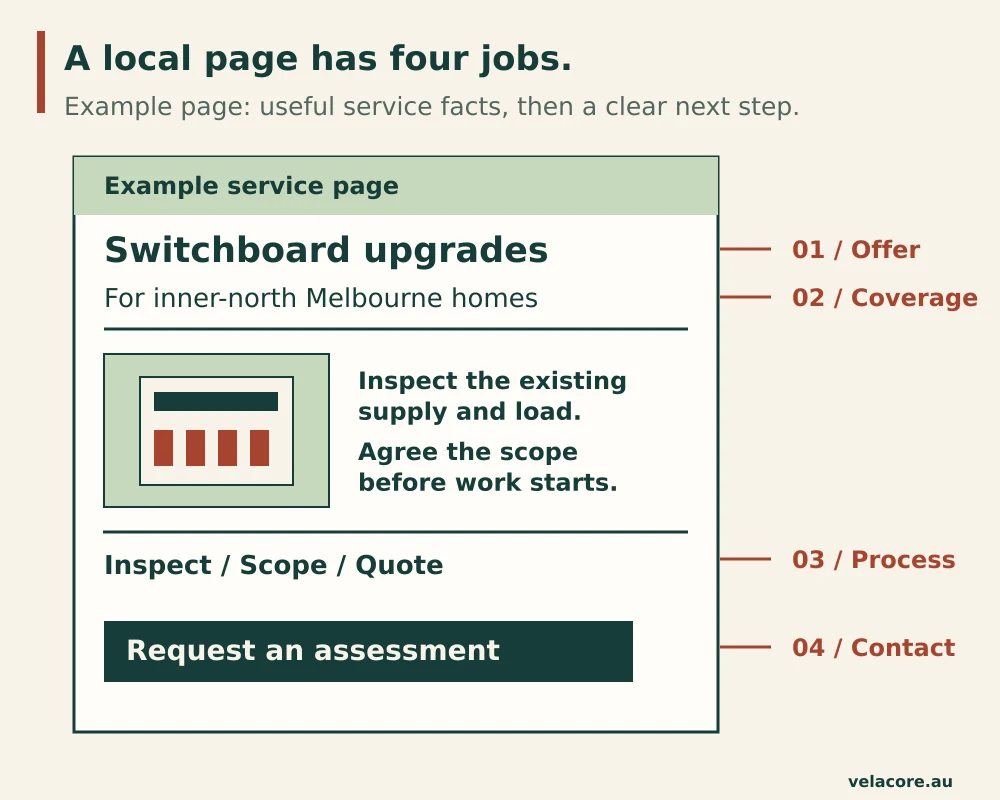
Build the page around four questions:
- Can you provide the specific thing I need?
- Do you serve my location, or can I reach yours?
- What should I know about suitability, access, timing or the process?
- How do I call, request a quote, book or get directions?
Use accurate local detail where it changes the answer: parking and access for a clinic; travel coverage for a trade; collection information for a shop; or the team and services at a genuine branch. Link the relevant service and location pages so someone can move between them without starting again.
Do not turn every suburb into a near-identical landing page. Google’s doorway abuse policy covers pages made for similar searches that funnel people to the same destination. A separate page earns its place through a useful, distinct answer, not a postcode swap.
Keep the mobile journey simple: legible content, a usable call link, visible opening information and a form that works. Test an actual submission and confirm someone receives it. A polished page that loses enquiries after the submit button has a business problem before it has an SEO problem.
NDIS providers need additional care around real delivery catchments, support information and reviews. Our local SEO guide for NDIS providers covers that specialist context.
4. Earn local trust without manufacturing reviews
Ask genuine customers for honest feedback and give them an easy route to leave it. Apply the request consistently, rather than inviting only people who first say they are happy.
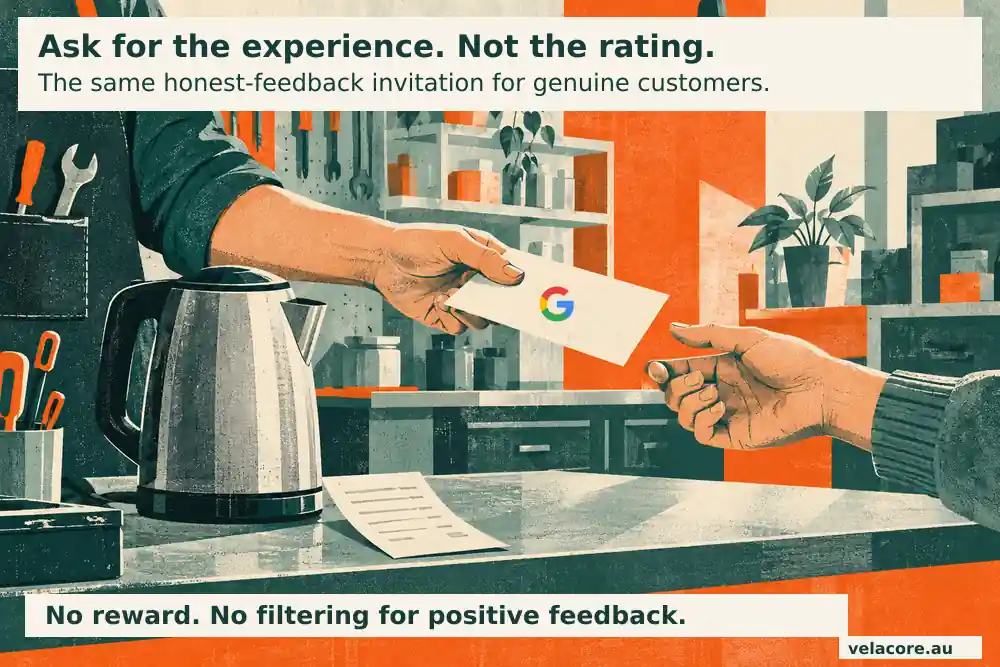
Google’s review content policy prohibits incentives and selectively soliciting positive reviews. A discount, gift or promised reward is not a sensible shortcut. Neither is asking someone to include a target keyword, a staff name or a particular rating.
A straightforward invitation works: “Thanks for choosing us. If you would like to share your experience, here is our Google review link.” Send it through a channel the customer has agreed to use. Let them decide what to write.
Reply to the actual feedback. Thank the reviewer, address the issue where appropriate and move private details to a suitable direct conversation. Do not turn the reply into another place to repeat your city keywords. For sensitive services, a courteous public response need not confirm that someone is a customer or disclose their circumstances.
There is no universal “50 reviews unlocks the map pack” rule. Google explains that review volume and positive ratings can contribute to local prominence; it does not publish that threshold. A real, current body of feedback is more useful than chasing an arbitrary count.
5. Connect reviews, local references and the next step
Make it easy to verify the business across the places customers use. Keep your name, contact details, relevant address and website consistent on important listings, supplier pages and professional or industry directories.
Start with listings people might genuinely consult, then fix wrong phone numbers, moved addresses and duplicates. A relevant local reference can send useful visitors as well as explain who you are. Buying a long list of unrelated directory entries is a different proposition.
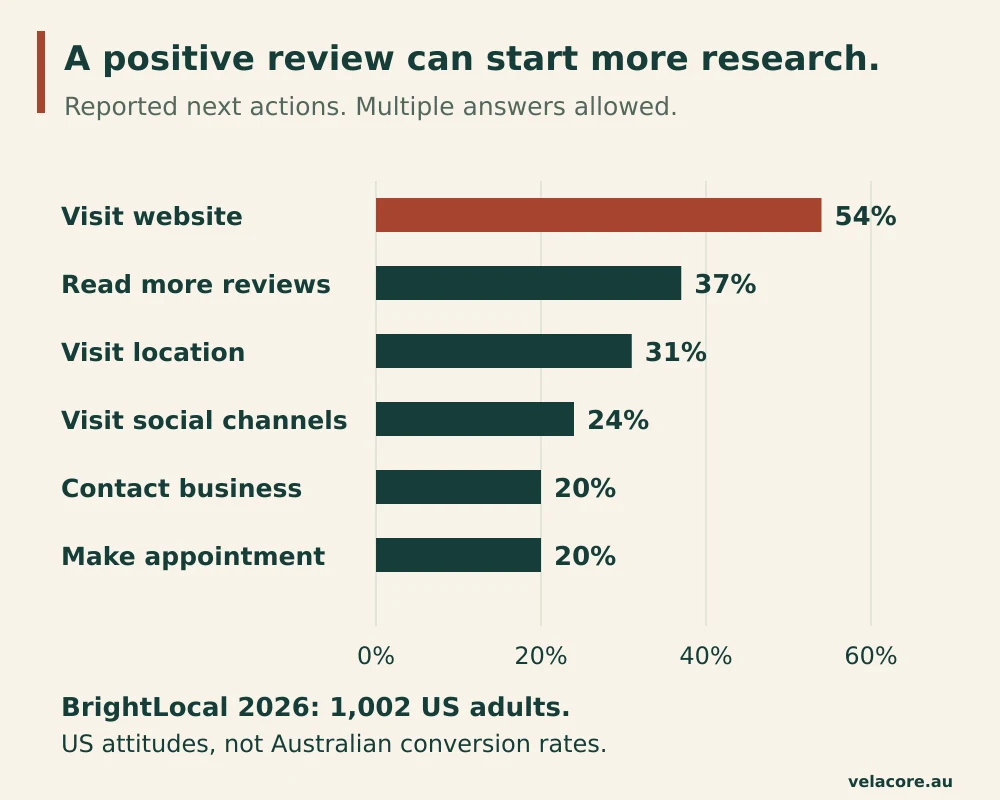
The website still matters after a good review. BrightLocal’s February 2026 survey asked 1,002 US adults about actions after positive reviews. Respondents could select more than one action, so these percentages overlap and should not be added into a funnel.
| Action | Respondents | Practical check |
|---|---|---|
| Visit the business website | 54% | The page matches the service and gives a useful next step |
| Read more reviews | 37% | Feedback is genuine, accessible and reasonably current |
| Visit the business location | 31% | Address, opening hours and arrival details are accurate |
| Visit its social channels | 24% | Profiles describe the same business and current offer |
| Contact the business | 20% | Calls and messages reach someone responsible |
| Make an appointment | 20% | Booking availability and confirmations work |
Use the research to inspect the handoff, not to forecast Australian sales. Customers can read, compare, return and contact you through different routes. The next page needs to continue the promise that attracted them.
6. Measure Google Maps SEO without counting clicks as customers
Track discovery, website behaviour and received enquiries as separate measures. They answer different questions and rarely share a clean one-to-one denominator.
In Business Profile performance, the calls metric counts clicks on the call button, not answered conversations. Website clicks count interactions with the profile’s website link. Direction requests do not prove a completed visit.
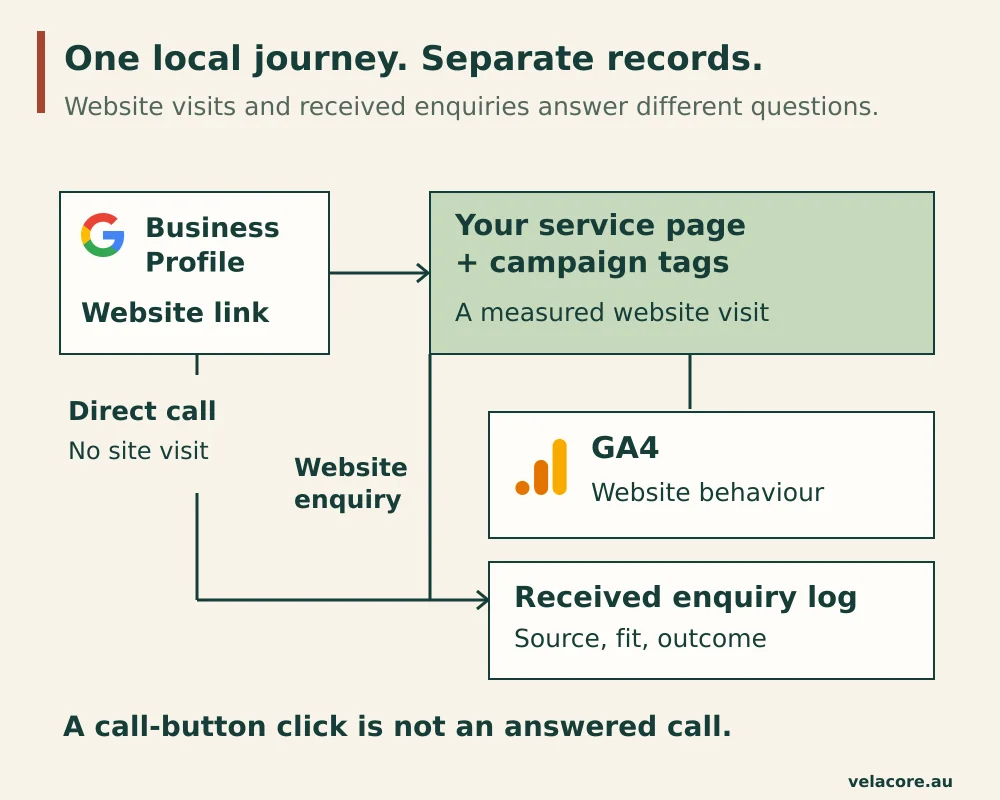
For website visits, use a consistent tagged destination such as:
https://example.com.au/service/?utm_source=google&utm_medium=organic&utm_campaign=business_profileGoogle’s campaign URL guidance explains these parameters and the Traffic acquisition report. With GA4 installed and consent or browser conditions allowing measurement, test that your final landing URL retains the tags. Keep personal information out of the URL. Do not add campaign tags to internal website links.
Then test the actual handoff: a form reaches the right inbox, a booking receives confirmation, and a phone call can be answered or returned. Your customer system or a simple enquiry log should record the source when known, the service requested, service-area fit and outcome. A call made directly from the profile will not automatically appear as a website visit in GA4.
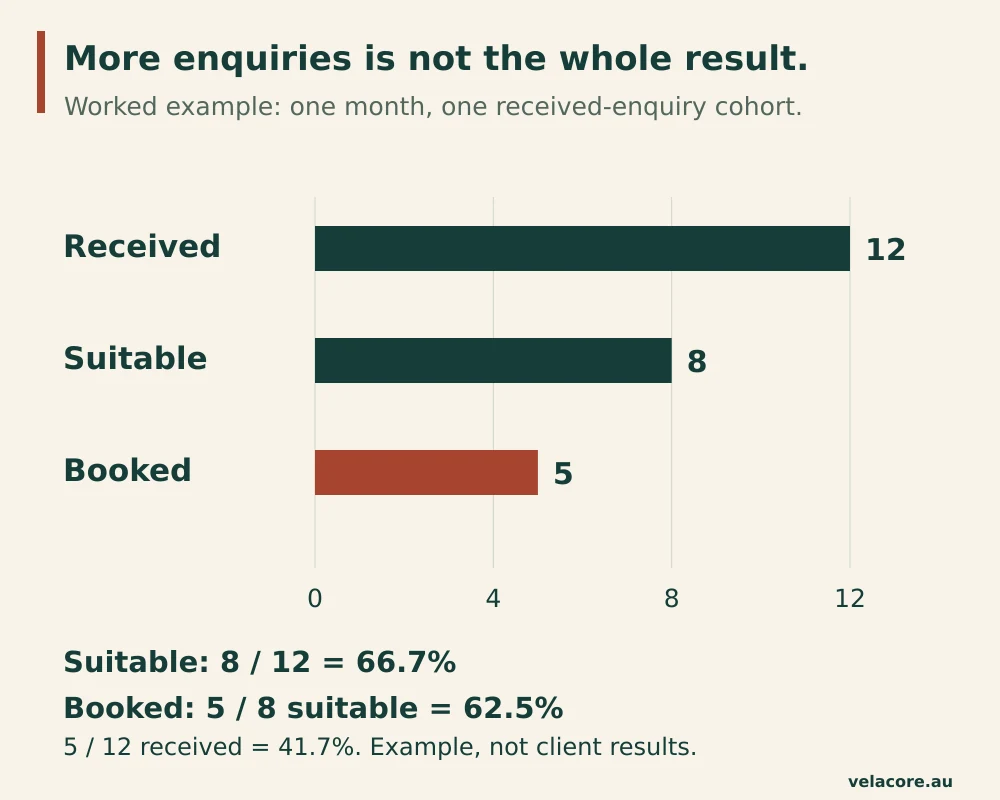
| Recorded outcome | Count | Calculation |
|---|---|---|
| Received enquiries | 12 | Distinct enquiries entered in the log |
| Suitable enquiries | 8 | 8 ÷ 12 = 66.7% of received enquiries |
| Booked jobs | 5 | 5 ÷ 8 = 62.5% of suitable enquiries; 5 ÷ 12 = 41.7% of all received enquiries |
Those numbers are a planning example, not a performance target. The useful question is why four enquiries were unsuitable and why three suitable enquiries did not book. Coverage, timing, pricing, capacity or follow-up might explain the outcome. More map views will not automatically fix any of those issues.
7. Give the monthly local SEO review a decision to make
Review the same service-and-area combinations over comparable periods, then choose a specific next action. Keep a short change log so a seasonal shift, a closure or an advertising campaign is not mistaken for the result of an SEO edit.
| What you see | Check next | Possible action |
|---|---|---|
| Weak visibility for relevant local searches | Eligibility, category, accurate information and search location | Correct the real mismatch and repeat the same observation |
| Profile interest, few useful website actions | Destination page, mobile experience and contact path | Fix the first confusing or broken step |
| Enquiries outside your service fit | Coverage, service descriptions and profile information | Make the actual scope clearer before expanding traffic |
| Suitable enquiries, few bookings | Response, availability, price expectations and sales follow-up | Resolve the operational constraint with the responsible team |
Google Search Console helps you inspect website search queries and pages. Business Profile performance describes profile interactions. GA4 describes measured website behaviour. Keep those reports alongside the enquiry log instead of blending them into one impressive but untraceable number.
If your customers use AI-assisted recommendations, make the same business facts available on crawlable pages: services, real coverage, opening information, evidence and a useful contact route. Google’s AI search guidance says existing SEO fundamentals apply and no special AI markup is needed. Record actual brand mentions or referral visits separately; do not relabel ordinary Maps growth as AI performance.
A local SEO checklist you can actually finish
Start with one important service and its genuine customer area. Complete the path before multiplying pages.
- Confirm the business controls the eligible profile and recovery access.
- Correct the model, category, contact details, hours and coverage.
- Choose a useful destination that answers service, location, suitability and next-step questions.
- Fix relevant public listings and ask genuine customers for honest feedback.
- Test a call, submission or booking from a mobile device.
- Separate profile clicks, measured website actions and actual enquiry outcomes.
- Assign one owner and one next action to the monthly review.
A local ranking is an opportunity to be chosen. The business still has to make that choice easy. If the problem is wider than local discovery, our SEO services connect technical health, useful content and enquiry measurement.
Frequently asked questions about local SEO for Australia
Does local SEO only work within five kilometres?
No. Visibility varies with the search, the searcher’s location and the business. A neighbourhood shop and a specialist destination have different customer patterns. Plan around real delivery coverage and test relevant locations rather than promising a universal radius.
Can a business without a public shop appear on Google Maps?
An eligible service-area business can have a profile when it visits customers at their locations. Hide an address where customers are not served and provide genuine service areas. Online-only operation or a rented virtual address does not establish eligibility.
Should we make a page for every suburb?
Only where each page gives a useful, distinct answer. Real services, locations, access information or coverage differences can justify separate pages. Swapping the suburb name across otherwise identical text creates little value and can lead to doorway-style pages.
Will posting weekly or reaching fifty reviews guarantee better local rankings?
No. Keep information current and collect genuine feedback, but neither a weekly posting schedule nor a fixed review count is a published ranking guarantee. Focus on relevance, accurate details, credible evidence and the experience customers find.
How long should we give local SEO before judging it?
Separate a correction from a growth campaign. A wrong phone number or broken form should be fixed and tested immediately. Judge visibility and enquiry changes over comparable periods, accounting for seasonality, competition and customer decision time. No single timeline fits every local market.
Can we manage local SEO ourselves?
Yes, many owners can maintain profile information, request honest reviews and test enquiries. Specialist support helps with persistent visibility problems, multi-location structure, website fixes and measurement. Keep ownership of the profile, domain and customer records whichever delivery model you choose.
Do we need a separate strategy for AI recommendations?
Start with the same accurate business facts, crawlable explanations and credible references. Add relevant AI query and referral observations to your review. A new markup type or an “AI-ready” label is not a substitute for useful, trustworthy information.
Make your next local enquiry easier to win
Choose one service, correct the information customers see and test the route from search to a real conversation. That is a practical starting point for local SEO for Australia, whether customers visit your shop or your team visits them.
If that path is still losing suitable customers, talk with Velacore about your local search priorities. Start with the problem you can observe, then choose the work that will change it.