Launching an online store can be exciting until you don’t make any sales. The website looks professional, the products are great, and maybe you even run a few ads, yet customers never seem to arrive.
Many new Australian businesses experience this frustration, and it’s rarely because their products aren’t good enough. The real issue? Visibility, customers just can’t find you.
Simply having a website isn’t enough. With thousands of e-commerce sites competing for attention, customers won’t just stumble across your brand by chance. You need to make sure they can actually find you. That’s where Search Engine Optimisation (SEO) comes in.
SEO is about making your website easy for Google to understand and irresistible for potential buyers. In this guide, we’ll discuss SEO for new ecommerce websites in Australia; simple, beginner-friendly strategies you can start using today to get found, get noticed, and start making sales.
What is SEO (and Why Does It Matter for E-commerce)?
Search Engine Optimisation (SEO) is the practice of making your website more visible in Google’s search results. Think of it as helping both Google and your customers understand why your store is worth visiting.
Here’s why it matters;
When people search online, they rarely click past the first page. If your store doesn’t show up near the top, most potential buyers won’t even know you exist.
At its core, SEO does two things:
- Helps Google understand your site: Through the right keywords, well-structured pages, and a smooth technical setup, making it easier to match your store with the right searches.
- Makes your site more appealing to shoppers: Clear product descriptions, fast load times, and helpful content keep people browsing and buying.
Why does this matter for e-commerce?
SEO helps you show up when someone types your products into a search bar. For instance,
- If someone searches “buy organic skincare online Australia”, SEO decides whether they land on your site or your competitor’s.
- It’s not paid ads. You don’t pay Google for these results and clicks. Instead, you earn your spot by optimising your site.
Besides, with over 65% of online experiences starting with a search engine and Australians spending $63 billion on online retail in 2024 (Australia Post), visibility isn’t optional.
In essence, SEO is about more than rankings; it’s about getting your products in front of the right people at the exact moment they’re ready to buy.
SEO for New Ecommerce websites in Australia: Tips and Strategies
Now that you know what SEO is and why it matters, let’s look at the core strategies that will make the biggest difference for new e-commerce websites in the Australian market. These steps are practical, beginner-friendly, and tailored to help you attract the right shoppers.
1. Local SEO: Be found where it matters
Visibility isn’t just about being found; it’s about being found by the right people. For your online store, this may mean appearing in local searches where buyers are actively looking for products nearby.
Australians love supporting businesses that feel close and relevant. People often include a location in their search. That’s why one of the simplest, yet most effective, SEO strategies for beginners is optimising your site for local intent.
This is where geo-targeted keywords come in. They’re just regular keywords with a location added. For example:
- Instead of “eco-friendly candles,” use “eco-friendly candles Sydney.”
- Instead of “wedding photographer,” try “wedding photographer Melbourne CBD.”
Pro Tip: Adding your city, region, or even “Australia” to product keywords makes your site more relevant for local shoppers, and Google rewards relevance.
Set up Google Business Profile (GBP):This free Google tool makes your business appear on Google Maps and local searches. Here’s how:
- Visit Google Business Profile.
- Sign in with your Gmail.
- Add your business name, address, and category.
- Verify your business (Google sends a code via mail, email, or phone).
- Add opening hours, photos, and your website link.
Businesses with a complete GBP are 2.7x more likely to be considered reputable.
2. Technical SEO: Setting up your store the right way
Even the best-looking store won’t succeed if it’s difficult for Google to crawl or frustrating for visitors to use. That’s why technical SEO should be one of your first priorities—it sets up your site to perform well from day one.
Here are the essentials to cover:
- Google Search Console (GSC): Sign up, verify your site, and monitor for crawl errors. It also shows you the search terms people use to find you.
- Google Analytics (GA): Free and powerful. Tracks where visitors come from, what they do, and which products drive revenue.
- Sitemaps & Robots.txt: These help Google index your site. Shopify generates one automatically (yourstore.com/sitemap.xml), while WordPress users can install plugins like Yoast or RankMath.
- Site Speed & Mobile-Friendly Design: Over 65% of online shopping in Australia happens on mobile. A slow, clunky site will cost you sales.
If all this feels too technical to set up on your own, Velacore can help. We’ve guided dozens of e-commerce stores through the essentials; optimising speed, fixing crawl errors, and setting up analytics—so you can focus on running your business. Talk to us today
Remember, a one-second delay in page load time can reduce conversions by 7%. That’s thousands of dollars lost for many stores.
3. Do smart keyword research
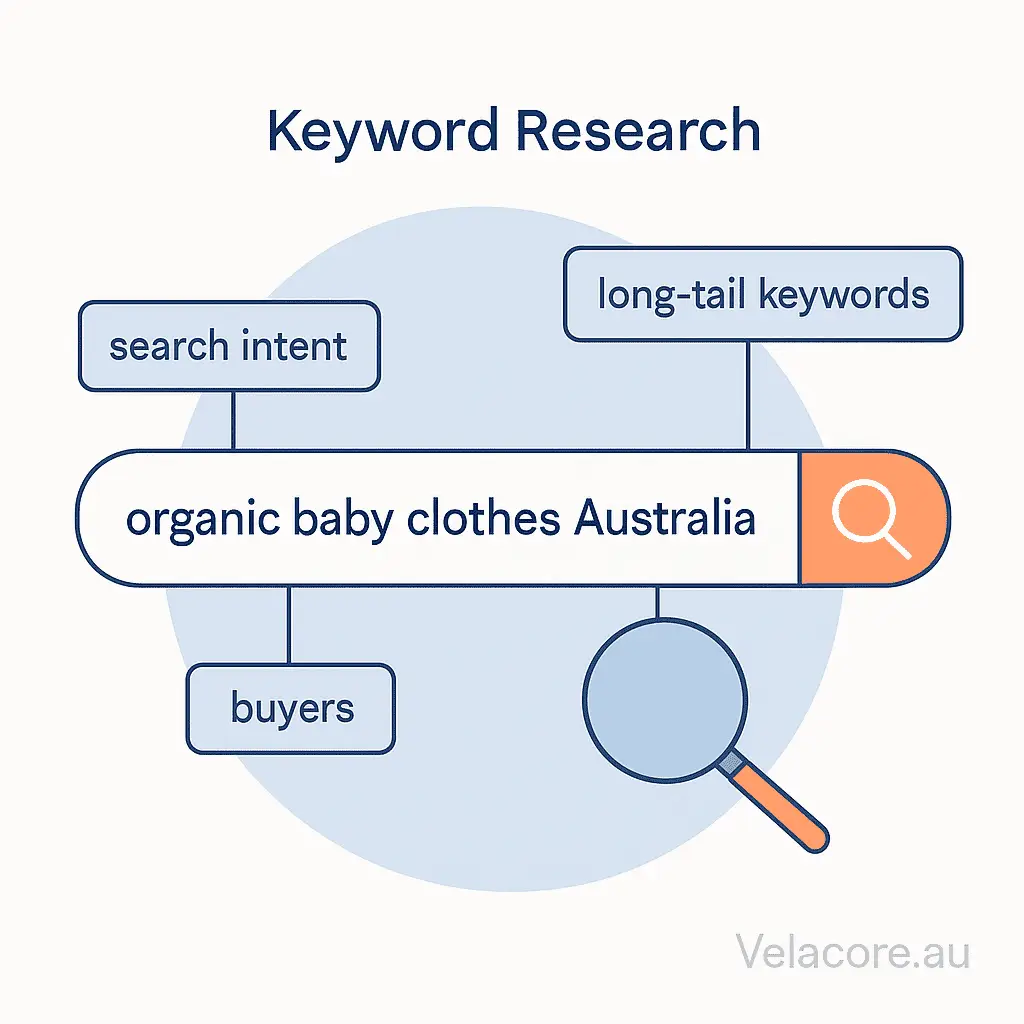
Not all website traffic is valuable. You don’t just want visitors, you want buyers. That’s why keyword research is the backbone of SEO for e-commerce.
When starting out, focus on:
- Long-tail keywords: These are longer, more specific phrases such as “organic baby clothes Australia online.” They’re less competitive and usually bring in higher-quality traffic. Research shows that Long-tail keywords account for 70% of all searches and often convert better than broad, generic terms
- Search intent: Ask yourself: is the shopper just browsing, comparing, or ready to buy? Prioritise keywords that show purchase intent.
- Tools for research: Google Keyword Planner (free), Ubersuggest (affordable), or SEMrush/Ahrefs (advanced).
4. Optimise your product pages
Your product pages are where sales happen. They’re not just digital shelves, they’re your 24/7 salespeople. If they aren’t optimised, visitors won’t buy.
Key steps:
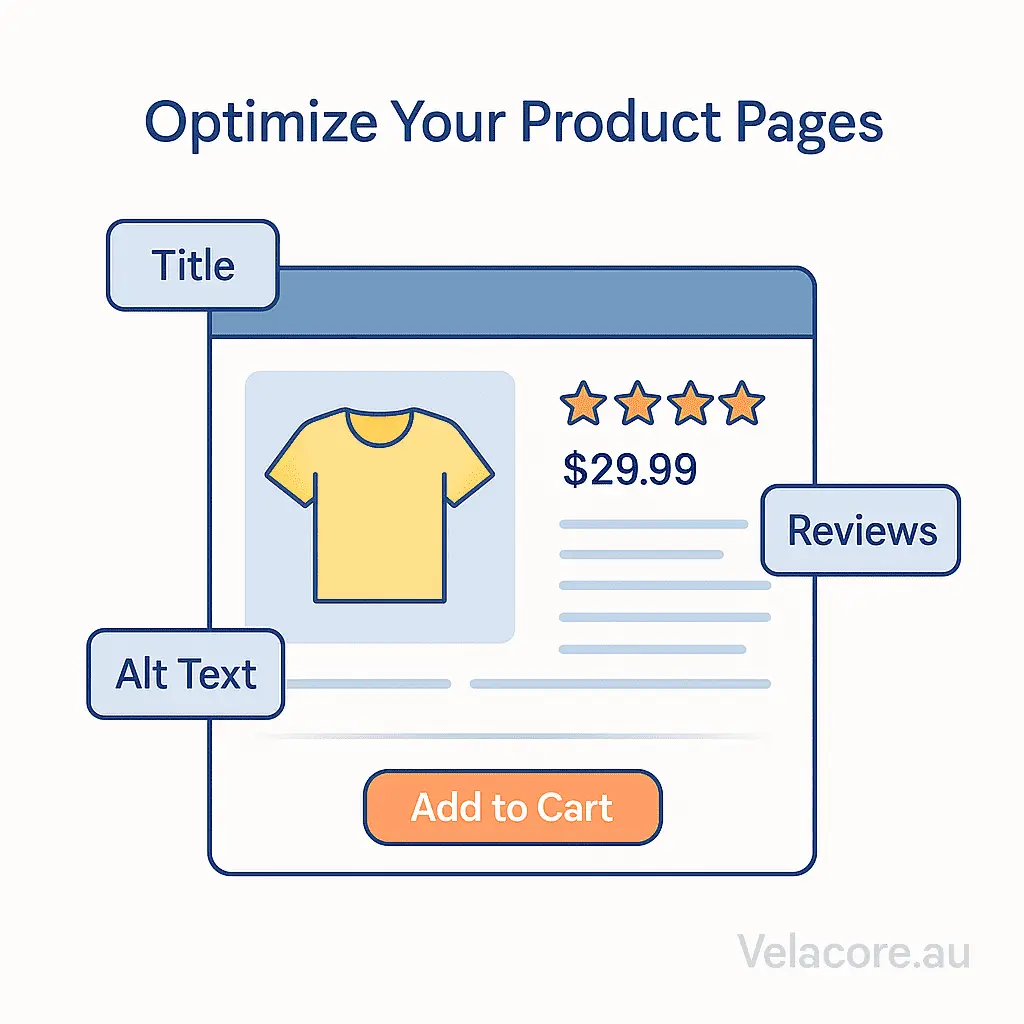
- Use descriptive titles: Go beyond “Blue Shirt.” Instead, write “100% Cotton Blue Shirt – Made in Australia.”
- Write story-driven descriptions: Tell shoppers why the product matters. Example: “Made with breathable Aussie cotton, this shirt keeps you cool during summer BBQs.”
- Add high-quality images with alt text: Google can’t see images, so describe them with alt tags (e.g., “women’s eco-friendly tote bag Australia”).
- Encourage reviews: over 90% of shoppers say reviews influence their purchase decision.
Pro Tip: Use schema markup so Google can display star ratings, prices, and availability directly in search results.
5. Build off-page authority
SEO doesn’t just depend on what happens on your site. Google also looks at how other websites view and reference you. This is where off-page SEO comes in, especially backlinks.
How to build credibility in Australia:
- Get listed on local directories like Yellow Pages, Yelp AU, and TrueLocal.
- Collaborate with Australian bloggers or influencers in your niche.
- Write guest posts for established websites .au domains carry extra local weight.
Warning: Avoid buying backlink packages. Spammy links can tank your rankings and take months to fix.
6. Publish relevant, useful content
A blog isn’t just “extra content.” It’s one of the best ways to attract shoppers, answer their questions, and improve your rankings. Google favours websites that regularly publish relevant content. Infact, a HubSpot research shows Websites that blog consistently generate 55% more traffic than those that don’t
Strong content ideas for Australian e-commerce sites include:
- Seasonal guides: “Top Christmas Gifts in Australia 2025”
- How-to posts: “How to Choose the Right Surfboard for Bondi Waves”
- Sustainability posts: “Why Eco-Friendly Packaging Is Taking Over Aussie Retail”
7. Track and Adjust Regularly
SEO is never set and forget. Algorithms change, competitors adjust, and customer behaviour shifts. Regularly monitoring your results ensures your efforts keep paying off.
Keep an eye on:
- Google Analytics: Which products or pages generate the most revenue.
- Google Search Console: Which keywords bring people to your site.
- Rank tracking tools: Monitor whether you’re climbing or dropping for your target keywords.
Most new websites take three to six months before SEO results become visible. The key is consistency.
Wrapping Up
For new e-commerce sites in Australia, SEO isn’t just a marketing trick; it’s the backbone of growth. By focusing on local visibility, technical foundations, smart keywords, and engaging content, you’ll build trust with both Google and your customers.
Want expert help to launch and scale your online store with confidence? Velacore specialises in SEO for new e-commerce businesses in Australia. Let’s get you seen, trusted, and selling. Get in touch!
Quick Recap: Your 7-Step SEO Checklist for Australia
- Start local: Use geo-targeted keywords and set up your Google Business Profile.
- Lay the technical foundations: Analytics, sitemaps, speed, and mobile optimisation.
- Do smart keyword research: Focus on long-tail, purchase-ready terms.
- Optimise product pages: Descriptive titles, detailed copy, images, reviews.
- Build off-page authority: Get local backlinks and directory listings.
- Publish fresh content: Blog posts, guides, and seasonal articles.
Is Your Website Working for You?
Most websites don't generate leads. We fix that with custom designs that look great and deliver measurable results for your business.
Get Started With Velacore