
NDIS marketing strategies that connect genuine service capacity, useful information and suitable participant enquiries.
Your team has room to provide support, but enquiries keep arriving for the wrong service, an unreachable suburb or a time you cannot offer. More promotion can make that problem bigger. Useful NDIS marketing strategies begin with a deliverable offer and make it easier for participants, families and referrers to assess the fit.
Build an NDIS marketing plan around the supports you genuinely provide, the places and times you can serve, a clear enquiry path and a responsible follow-up process. Choose search, referral relationships, social content or paid advertising according to the problem you need to solve. Measure suitable conversations and service starts separately from views and clicks.
An enquiry is only a growth opportunity when the service can follow through.
- Know the scale without confusing it with local demand. The NDIA’s June 2026 dashboard records 782,013 active participants with approved plans, excluding children accessing early connections, and 280,258 active providers in that quarter. “Active providers” is not the same measure as registered provider organisations.
- Make the actual offer clear. The ACCC’s provider guidance addresses misleading advertising, including claims that products or services are NDIS approved or funded.
- Review the data journey as well as the advertisement. The OAIC’s tracking-pixel guidance explains why collection, disclosure and sensitive information need deliberate configuration and review.
The national figures describe the Scheme, not the number of suitable customers near your office or a forecast of what your marketing will generate. For local planning, use the NDIA’s participant datasets alongside actual service capacity, catchment knowledge and enquiry records.
1. Make NDIS marketing strategies fit the support you can deliver
Start with a current service-and-capacity brief. Name the support, intended participant needs, relevant staff capability, genuine delivery area, available times and the process for discussing suitability. Marketing and intake should use the same approved information.
A broad promise such as “all NDIS services across Perth” is difficult to assess and maintain. A useful page describes the actual service, the catchment, how availability is discussed and who will respond. If capacity changes, update the public information and campaign rather than letting the intake team repeatedly explain the mismatch.
Work from bookable delivery capacity rather than total rostered hours. In a planning example, 24 bookable hours a week could accommodate eight weekly three-hour support allocations. That arithmetic assumes the days, worker skills, travel and participant requirements fit; the available-hours calculation should already allow for non-delivery work.
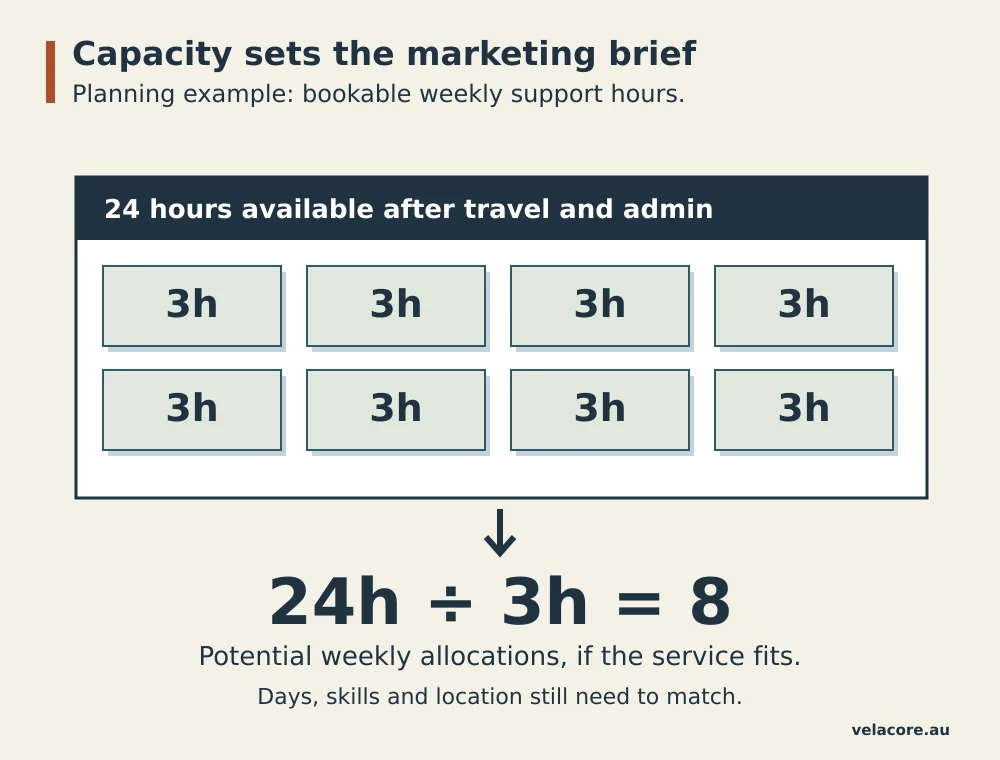
This makes growth a connected operational decision. If staff availability or service fit is the constraint, increasing lead volume alone is unlikely to resolve it. The separate 90-day NDIS growth plan turns capacity, marketing and intake into an execution sequence.
2. Make your website answer the questions that block an enquiry
Give each important service enough space to explain what it involves, who it may suit, where it is available and how someone can start a conversation. Use plain language without removing distinctions between supports or suggesting that every service is available to every person.

- Explain the support and the situations it is intended to help.
- Describe genuine service areas, delivery settings and how availability is confirmed.
- Show relevant team experience and accurate registration or service information.
- Make the phone and enquiry route easy to find and use on a mobile.
- Tell the visitor what happens after contact, including who responds and the next discussion.
Test one complete enquiry with the people responsible for intake. Check that the form submits, a receipt is clear, the message reaches the right place and a staff member owns the response. A form that looks successful in a browser can still fail at the email or workflow handoff.
Keep the first form proportionate. Service of interest, contact details, broad location and the preferred contact method may be enough to begin. Collect detailed participant, health or plan information through the appropriate intake process instead of asking for it in a public marketing form.
The NDIS website feature guide covers the accessibility, content and delivery checks in more depth. Your marketing page should make the service easier to understand, not require someone to navigate your internal organisational structure.
3. Connect local search with real service coverage
Use local SEO to help people find a relevant service and understand where it operates. Keep your website and eligible Google Business Profile information accurate, including the business name, contact details, categories, hours and appropriate location or service-area information.
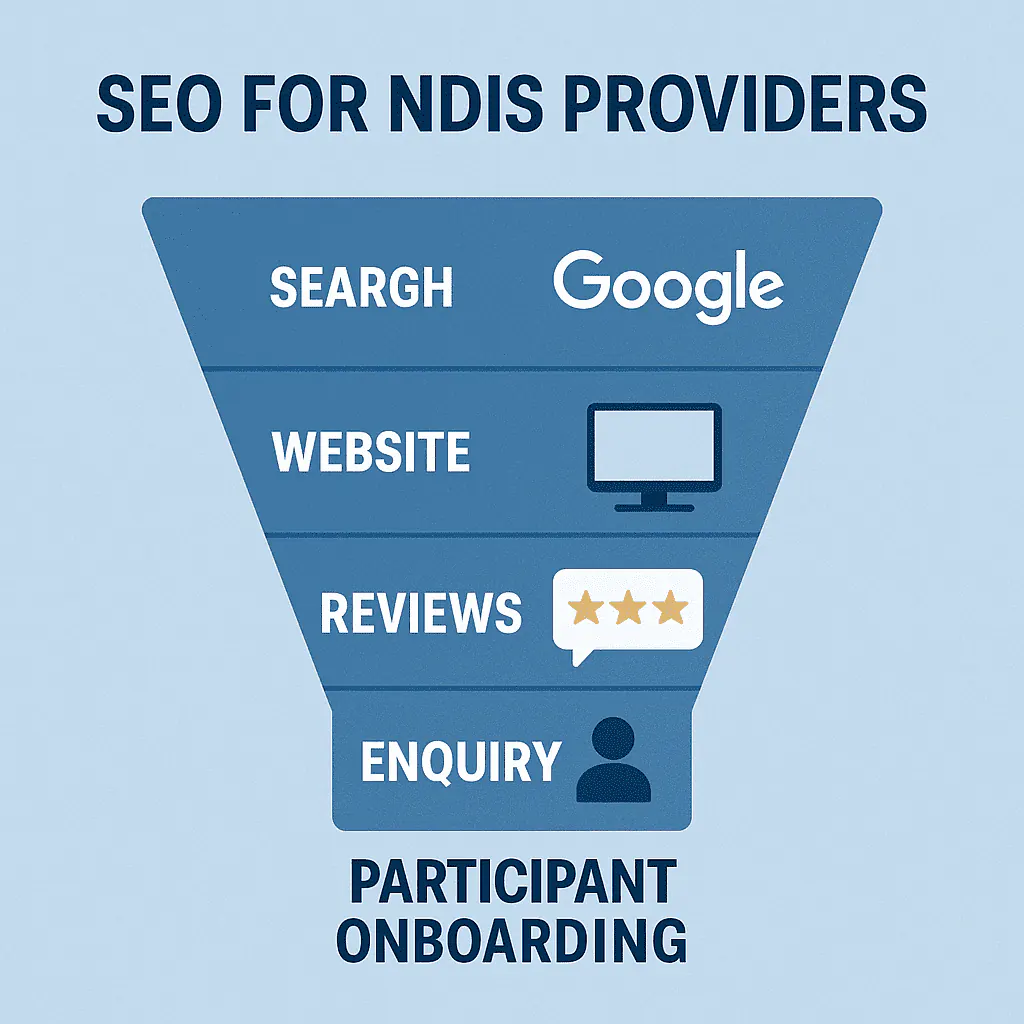
Google’s local ranking guidance names relevance, distance and prominence. Adding every suburb to a profile does not remove distance or establish an office in those places. Create location pages when the area changes useful service information, rather than swapping suburb names into repeated copy.
Keep service scope and real delivery areas visible for AI-assisted search as well. Google’s AI feature guidance points to the same search foundations. Clear service facts can help a reader or answer system understand the offer; no format guarantees a citation.
Use the local SEO guide for NDIS providers for profile eligibility, service areas, review requests and local measurement. Use the broader NDIS SEO strategy to prioritise service pages and the wider search journey.
4. Give referral contacts useful facts, without treating choice as a sales pipeline
Make it straightforward for a participant, family member, support coordinator or community contact to understand the service and discuss an enquiry. A concise service-information pack should contain current service scope, genuine coverage, relevant capability, availability process and contact details.
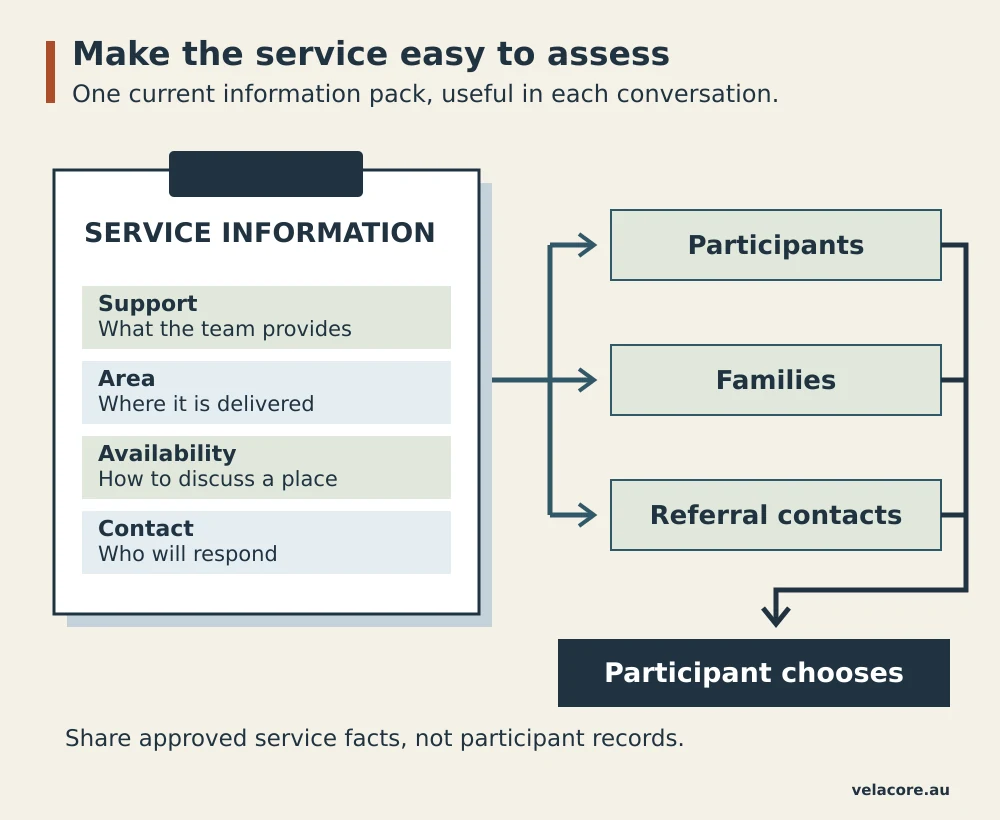
A useful introduction explains the work you can provide and invites the contact to retain or share the information when relevant. It does not promise referrals, request a person’s plan without a suitable reason or make an intermediary the owner of the participant’s choice.
Keep relationships practical: respond to questions, explain changes in availability and follow up on an agreed enquiry. Do not build a growth forecast around guaranteed access to another organisation’s participants. The NDIA’s provider responsibilities include managing actual and perceived conflicts of interest.
Track the source of an enquiry where it is appropriate and useful, then review suitability and service starts. A contact list is not evidence that a referral relationship is working, and a warm introduction does not remove the need to explain scope and fit.
5. Use social media and content to explain the work
Publish material that helps someone recognise the service and decide what to ask next. Explain what a first conversation covers, introduce actual staff and their roles, answer common service questions and show useful community information. Keep the content connected to a relevant page or contact route.
Use real stories only with the necessary permission and review. A participant should not have to become a marketing example to receive support. Check whether a story, photograph, location or combination of details could identify someone beyond what they agreed to share.
Keep a sustainable content plan around questions that recur in intake. An explanation of service availability, a useful preparation checklist or an accessible description of what happens next can serve people better than another generic awareness post.
The NDIS social-media guide develops the channel work. For the visual and language foundations, use the NDIS branding guide. Keep the actual service promise consistent across the website, profiles, ads and referral information.
6. Give paid advertising a defined job and a stopping rule
Use paid advertising when there is a clear service offer, an appropriate audience, a working destination and capacity to respond. A focused campaign is easier to assess than a general advertisement for every support the organisation might provide.
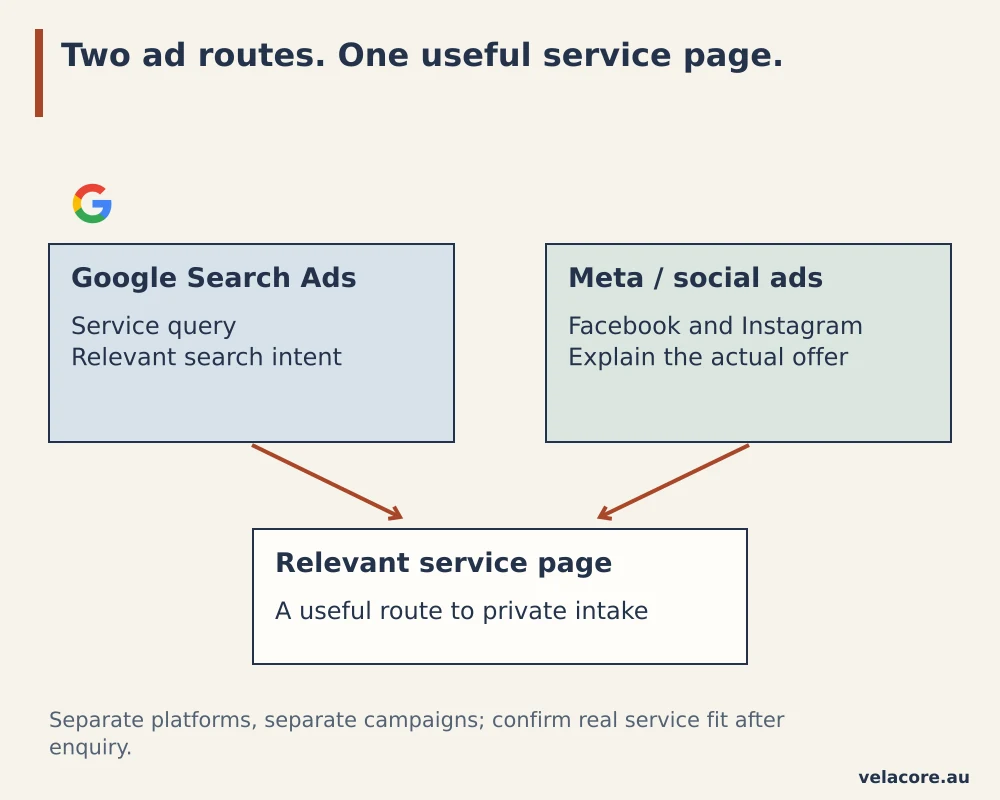
Search ads can answer an existing service query. Social advertising can introduce relevant public service information, but the creative and targeting should not make personal assumptions about someone’s disability or support history. Check current platform policies and the actual proposed campaign before launch.
Set a fixed test budget, its owner, the intended service and the evidence that will trigger a pause or change. Review search terms, locations, destination behaviour and unsuitable enquiries early enough to correct an obvious mismatch. More impressions do not compensate for an unavailable service.
| What is missing? | Potential next route | What must work first |
|---|---|---|
| People searching for a specific support cannot find you | Relevant service pages, eligible local presence or a focused search-ad test | Clear scope, genuine coverage and a useful destination |
| Referral contacts do not know what you provide | Current service information and relevant professional conversations | Accurate capability, availability and contact details |
| People recognise the name but do not understand the work | Accessible service explanations and useful social content | Consistent facts and permission for any personal story |
| Campaign clicks do not reach intake | Repair and test the enquiry journey | Submission delivery, contact ownership and recovery |
| Enquiries arrive but cannot be served | Review the offer, geography, availability or channel selection | A current capacity brief and suitability review |
The NDIS Google and Facebook advertising guide covers budget and return calculations. Keep pricing and funding statements accurate: the ACCC warns against misleading NDIS approval and funding claims, not just obviously false promises.
7. Measure suitable enquiries and service starts separately
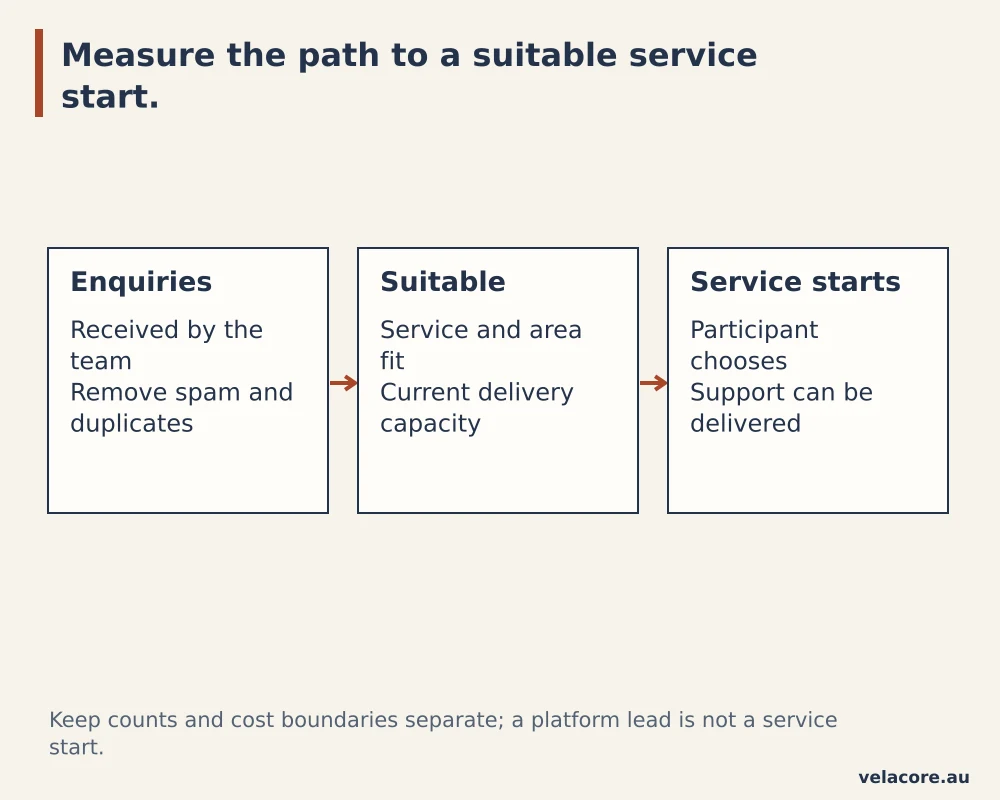
Agree what counts as a relevant enquiry before comparing channels. Keep the sequence from discovery to first contact, suitable conversation and service start visible. A website visit, call-button click, connected call and new support arrangement are different events.
| Measure | What it tells you | What to investigate |
|---|---|---|
| Relevant search visits | Whether the intended pages attract interest | Service queries, locations and the destination page |
| Received enquiries | Whether someone successfully reached the team | Form delivery, connected calls and follow-up ownership |
| Suitable enquiries | Whether the service, location and timing can fit | Offer clarity, availability and channel selection |
| Service starts | Whether an agreed enquiry became delivered support | Intake progress, scheduling and agreed next actions |
| Delivery capacity | Whether promotion remains appropriate | Available hours, staff capability and changing service scope |
In a hypothetical advertising test, $1,200 of spend produces 12 enquiries, four suitable enquiries and two service starts. That is $100 per enquiry, $300 per suitable enquiry and $600 per service start. The same campaign can look excellent or poor depending on which denominator you show.
Those costs do not establish return on investment. Review the actual cost of delivery, the agreed support, cancellations, the period being measured and the reliability of the source information. A dashboard should help the provider make a service decision, not turn every contact into a claimed outcome.
The cheapest lead can still be the most expensive conversation if your team cannot provide the support.
Keep sensitive intake information out of general advertising and analytics event payloads. The OAIC’s pixel guidance supports data minimisation and ongoing review; a consent banner alone is not proof that a tracking setup is appropriate. Let the authorised intake or service system hold the information it needs, and use suitable limited measures for marketing.
8. Keep the marketing promise aligned as the business grows
Growth should not make public information less dependable. Assign an owner to service facts, website updates, active campaigns and enquiry follow-up. When staff, catchments or availability change, give the marketing and intake teams the same current brief.
Review one short set of decisions each week: which service has capacity, which channels produced suitable conversations, where enquiries stalled and which public detail needs correcting. Use an occasional wider review for resourcing, delivery quality, channel budgets and the next service priority.
Can a suitable person understand the offer, contact the team and receive a useful next step? Can the team provide the support being promoted? Fix the weaker answer before buying more exposure.
Keep the planning cycle practical. Confirm the offer and repair the enquiry path first; test a focused channel next; then assess suitable enquiries and service starts. The 90-day growth roadmap gives that sequence a working timetable without duplicating every specialist guide here.
Your NDIS marketing checklist
- The advertised service, staff capability, area and availability are current.
- Important service pages answer suitability and next-step questions.
- The website, profiles, ads and service-information pack agree.
- A test enquiry reaches the responsible team.
- Personal stories and photographs have appropriate permission and review.
- Campaign claims, targeting and tracking have been checked for the actual use.
- Qualified enquiries, starts and capacity inform the next marketing decision.
Frequently asked questions
Which NDIS marketing strategy should a new provider start with?
Start with an accurate service offer, a useful website or service-information destination and a working contact process. Choose the first discovery channel from your actual catchment and service. A new profile or campaign cannot compensate for unclear scope or an enquiry nobody owns.
Is SEO or paid advertising better for NDIS providers?
They do different work. SEO builds useful discovery around service information; paid advertising can support a bounded test of an offer and audience. Choose from your timeline, capacity, budget and current website, then assess suitable enquiries rather than declaring one channel universally better.
How much should an NDIS provider spend on marketing?
Set a budget the organisation can fund through the test period and connect it with service capacity, expected delivery costs and follow-up resources. Include the website, content, management and measurement work, not just ad spend. A national percentage or another provider’s lead cost is not your budget.
Can support coordinators guarantee participants or referrals?
Do not build the plan around a guarantee. Give relevant contacts accurate information, respond to appropriate enquiries and respect participant choice. Keep relationships and any proposed arrangements subject to the organisation’s conflict-of-interest responsibilities and the actual service context.
Should NDIS providers use remarketing pixels?
Review the actual pages, data collected, provider terms and privacy implications before using them. Sensitive information can be revealed by page activity as well as a form field. The OAIC recommends deliberate configuration and continuing review; adding a banner does not establish that the whole data flow is appropriate.
How do we know whether NDIS marketing is working?
Track received and suitable enquiries, service starts, costs and delivery capacity. Use clicks and reach to explain discovery, not as substitutes for those outcomes. Review what happened after contact and correct mismatches between the public offer and what the team can deliver.
Make the next enquiry a better fit
Effective NDIS marketing strategies make the service easier to find, understand and assess, then connect the enquiry with a team that can act on it. For help aligning your website, local discovery and enquiry journey, discuss your NDIS marketing priorities with Velacore.
Sources and further reading
| Source | What it supports |
|---|---|
| NDIA June 2026 dashboard | Active participants and active-provider measures with their period and definitions. |
| NDIA participant datasets | Location-aware market planning. |
| ACCC provider obligations | Accurate NDIS advertising and funding claims. |
| NDIA provider responsibilities | Provider responsibilities and conflicts of interest. |
| Google local ranking guidance | Relevance, distance, prominence and accurate business information. |
| Google AI feature guidance | Search foundations for Google AI discovery. |
| OAIC tracking-pixel guidance | Data minimisation, sensitive information and continuing tracking review. |