
NDIS digital advertising isn’t just about being visible online, it’s about making every dollar of your ad spend count. With more than 21,000 registered providers across Australia, competition is fierce, and participants are becoming more selective about who they choose to trust. Google and Facebook Ads are powerful tools for cutting through the noise, but only if they’re used strategically.
Too often, providers waste money on ads that attract clicks but no enquiries, or worse, ads that don’t meet compliance standards. This guide unpacks how NDIS providers can target smarter, retarget effectively, measure the right metrics, and keep ads compliant, so every campaign drives genuine growth.
Why NDIS digital advertising matters
For most Australians, the search for services begins online. In fact, over 80% of people research a business online before making a decision. This shift in behaviour means that participants, carers, and support coordinators are no longer relying solely on referrals or word of mouth, they’re actively comparing providers on the internet.
This is where digital advertising becomes crucial. Organic SEO is important, but ranking naturally can take months. Paid ads, on the other hand, give providers immediate visibility and control over who sees their message. More importantly, ads ensure you’re in front of participants at the very moment they’re researching support options.
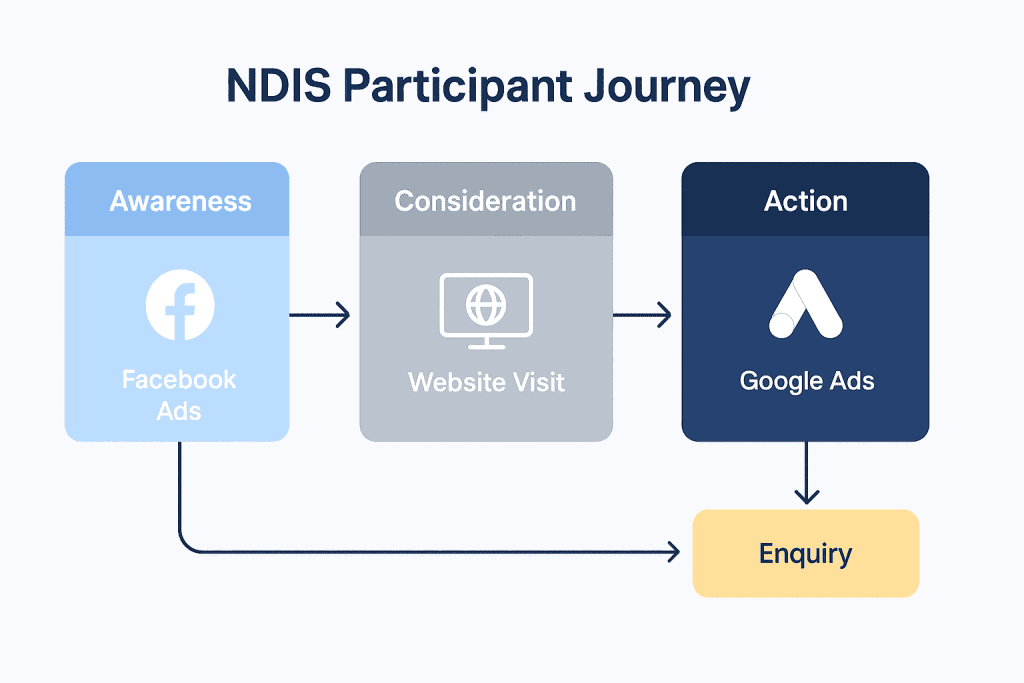
Among the available platforms, Google Ads and Facebook Ads stand out because they cover two different but complementary opportunities:
- Google Ads reach participants who are actively searching for services.
- Facebook Ads engage carers and families who may not be searching yet but are open to exploring and engaging when the right message appears
| Platform | Best Use | Example | Strength |
| Google Ads | High-intent searches | “NDIS support worker Sydney” | Captures participants ready to act |
| Facebook Ads | Awareness & trust | Local community ad about support programs | Builds brand familiarity |
From basics to strategy
Running ads is easy, but running them profitably is not. Too many providers create campaigns without clear targeting, tracking, or compliance, and then wonder why enquiries don’t come.
To unlock consistent ROI, NDIS advertising needs structure. The following strategies show how to run campaigns that generate not just clicks, but meaningful participant relationships.
Getting the targeting right
The success of digital advertising often comes down to one thing: who sees your ads. With proper targeting, you cut wasted spend and focus only on the audiences that matter most. For NDIS providers, that means narrowing in on the right people, locations, and behaviours instead of casting a wide net.
Here are a few tips to help;
1. Audience segmentation
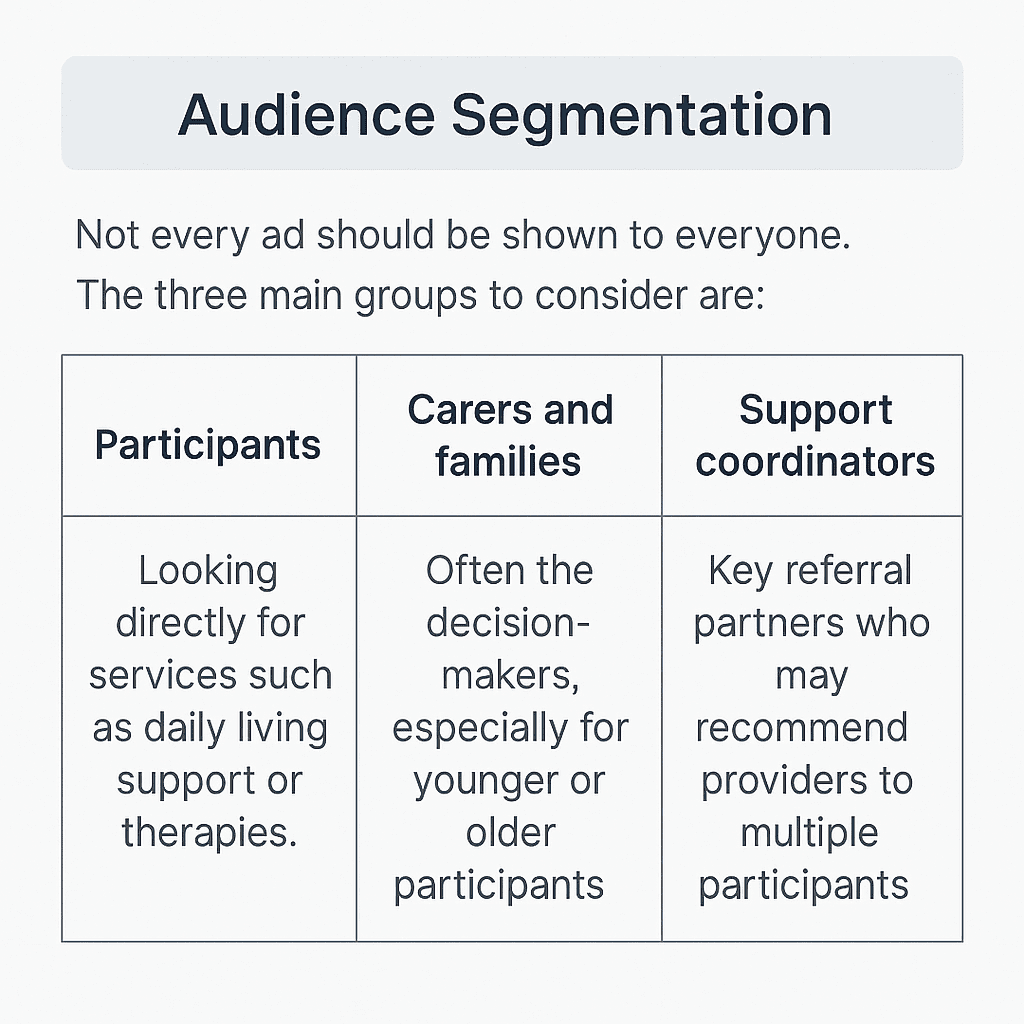
Not every ad should be shown to everyone. The three main groups to consider are:
- Participants – looking directly for services such as daily living support or therapies.
- Carers and families – often the decision-makers, especially for younger or older participants.
- Support coordinators – key referral partners who may recommend providers to multiple participants.
How to do it in practice
Not every ad should be shown to everyone. For NDIS providers, segmentation is about delivering the right message to the right group. Here’s a breakdown of how to do it:
| Audience Group | How to Target Them (Google & Facebook) | Ad Focus / Example Copy |
| Participants(people living with disability looking for services) | – Google Ads: High-intent keywords (“NDIS daily living support Sydney”, “occupational therapy NDIS Melbourne”)- Facebook Ads: Target disability-related interests, health communities, assistive tech engagement | “Support to help you live independently at home — available in Brisbane now.” |
| Carers & Families(parents, spouses, children making decisions) | – Google Ads: Broader family keywords (“respite care NDIS Perth”, “support for NDIS families”)- Facebook Ads: Demographics (30–60 years), parenting & caregiving interests | “Caring for someone with an NDIS plan? We’re here to support both you and your loved one.” |
| Support Coordinators(professionals referring participants to providers) | – LinkedIn: Job titles (“NDIS Support Coordinator”)- Google Ads: Search terms like “NDIS provider for support coordinators”– Facebook Ads: Community services & disability sector targeting | “Trusted by support coordinators across Victoria — participant-focused care with fast onboarding.” |
By tailoring your ad copy and imagery to each group, you build relevance and trust.
2. Geographic targeting
Most NDIS services are location-specific. Someone in Perth won’t engage with an ad for a provider in Melbourne. That’s why suburb-specific targeting is critical.
- Use Google Ads location settings to narrow campaigns down to the suburbs you actually service.
- On Facebook, you can target ads by postcode, city radius, or even specific community groups.
- Providers who invest in suburb-targeted ads have been shown to generate over 50% more local enquiries than those using broad targeting.
3. Device targeting
Mobile searches dominate. More than 70% of local service searches in Australia happen on mobile devices, meaning your ad landing pages must load fast, be easy to read, and have one-click enquiry options. Consider running mobile-preferred ads that show different copy or calls-to-action optimised for small screens.
4. Behavioural targeting
Platforms like Facebook allow you to target people based on interests, demographics, and behaviours. For NDIS, that might include carers’ groups, disability advocacy pages, or people engaging with health-related content. This helps you reach families before they even start searching.
When targeting is precise, ad spend works more efficiently. Fewer wasted clicks, more qualified leads, and a stronger return on investment.
Retargeting for higher ROI
Even the best-targeted ads won’t convert everyone on the first click. In fact, research shows that up to 92% of people who visit a service website for the first time don’t take action immediately. For NDIS providers, that means most participants and carers will browse, compare, and leave,unless you bring them back. That’s where retargeting comes in.
How retargeting works
Retargeting lets you re-engage people who visited your website, viewed a service page, or clicked an ad but didn’t complete an inquiry. Using tools like:
- Facebook Pixel – tracks website visitors and allows you to show them follow-up ads on Facebook and Instagram.
- Google Tag Manager – creates custom audiences based on site behaviour and re-engages them across Google Display and YouTube.
Why retargeting is essential for NDIS providers
- Multiple touchpoints build trust: Participants and carers often need to see your brand several times before enquiring. Retargeting keeps your services top-of-mind.
- Higher conversion rates: Retargeted ads can deliver up to 150% more conversions compared to first-time ads.
- Cost-efficient: Since the audience is already “warm,” CPL (Cost Per Lead) is usually lower.
Practical Examples
- A participant browses your “therapy services” page but doesn’t enquire. Later, they see a Facebook ad reminding them of available sessions, with a direct link to book.
- A carer downloads a resource from your site. A week later, they see a Google Display ad offering a free consultation, nudging them towards making contact.
Measuring Cost Per Lead (CPL) & ROI
Running ads without measuring results is like driving blind. For NDIS providers, one o the most important metrics to track is Cost Per Lead (CPL),how much you’re paying for each enquiry.
What is CPL?
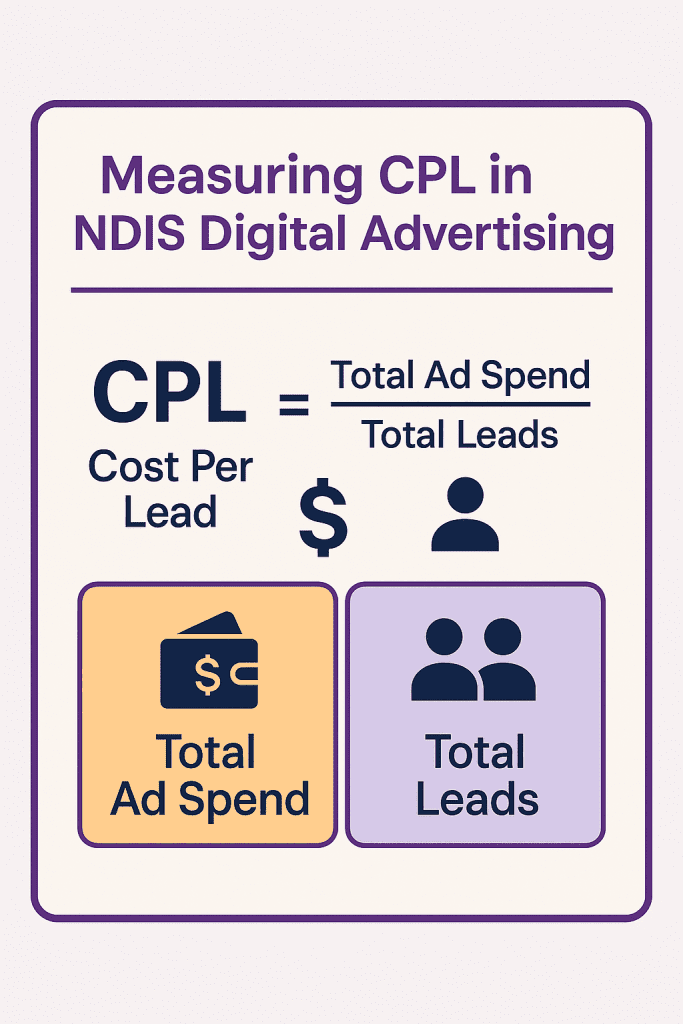
CPL is calculated by dividing your total ad spend by the number of leads generated.
Example: If you spend $1,000 on Google Ads and receive 20 enquiries, your CPL is $50 per lead.
Why CPL matters for NDIS providers
- It shows whether your ads are profitable.
- It helps you compare performance across platforms (Google vs Facebook).
- It ensures you’re not overspending on ads that don’t convert into actual participants.
Beyond CPL: ROI and CPA
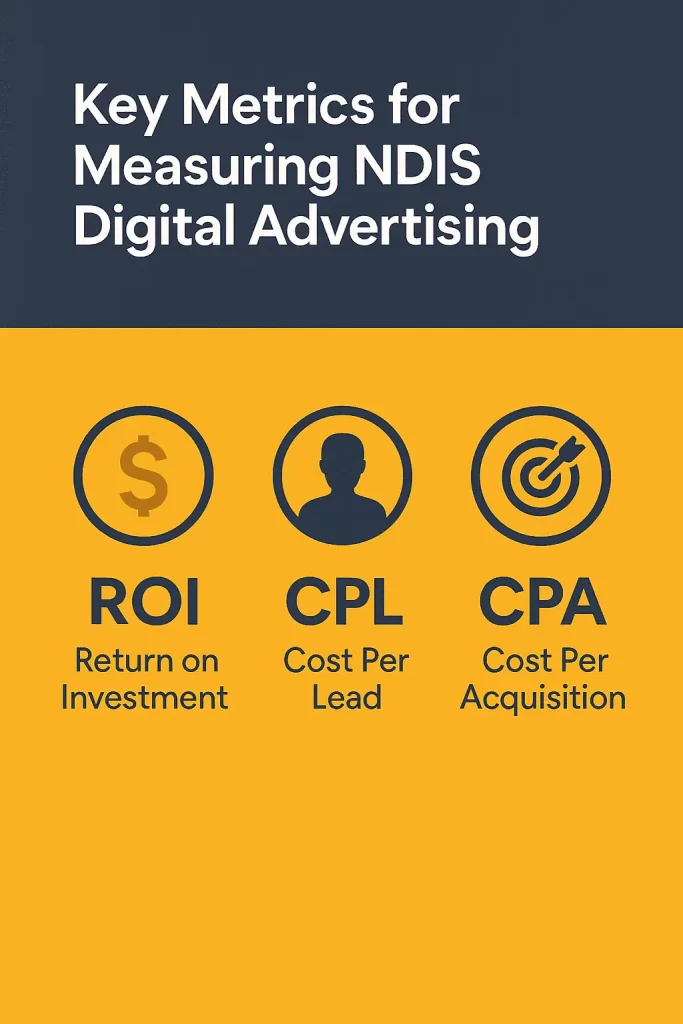
While Cost Per Lead (CPL) gives you a snapshot of efficiency, it doesn’t tell the full story. To understand whether your ad spend is truly sustainable, providers should also measure deeper metrics that reflect long-term value.
- ROI (Return on Investment): Looks at the revenue generated compared to ad spend. Example: If one $50 CPL lead becomes a long-term participant worth $5,000 annually, the ROI is significant.
- CPA (Cost Per Acquisition): A deeper metric that measures the cost of converting a lead into a paying participant. This is where tracking participant sign-ups is critical.
Tools for tracking
Numbers only matter if you can capture them reliably. The right tools help NDIS providers see where enquiries come from and how ads influence participant decisions.
- Google Analytics 4 (GA4): Tracks website conversions, form fills, and user behaviour.
Facebook Ads Manager: Provides detailed breakdowns of ad performance, audience engagement, and CPL. - Call tracking software: Essential if many enquiries come by phone — it links calls back to specific ads.
Key insight
NDIS providers who measure CPL consistently can cut wasted ad spend by 30–40%, simply by reallocating budget from underperforming campaigns to high-converting ones.
For NDIS providers, retargeting is not just about persistence — it’s about reassurance. Every follow-up ad should build confidence, highlight your reliability, and remind participants that support is only a click away.
Ensuring compliance in NDIS advertising
Unlike retail or lifestyle brands, NDIS providers must balance persuasive messaging with strict compliance. Every ad you run reflects not just your business but also the standards set by the NDIS Code of Conduct. Getting it wrong can damage trust, or worse, breach regulations.
1. Use plain english: Participants and carers come from diverse backgrounds, so accessibility starts with language. Avoid jargon like “capacity building interventions.” Instead, use clear terms such as “help with daily living” or “support to build independence.”
2. No misleading claims: NDIS ads must reflect what you can actually deliver. Promising “guaranteed results” or “the best provider in Australia” can be seen as misleading. Instead, focus on transparent offers like “Our support workers are available 7 days a week in Melbourne’s northern suburbs.”
3. Respectful, participant-focused messaging: Always frame ads in a way that empowers participants. Rather than highlighting limitations, focus on abilities and outcomes. For example:
❌ “We care for people who can’t manage daily tasks.”
✅ “We support participants to live more independently and achieve their goals.”
4. Accessibility in Ad creatives
Just as your website should be WCAG-compliant, your ads should be inclusive too. That means:
- Adding captions to video ads.
- Using high-contrast images and fonts.
- Avoiding imagery that stereotypes disability.
5. Link to trusted resources
Where possible, reinforce credibility by linking to your NDIS registration page or official resources (e.g. NDIS Code of Conduct). This reassures participants that your ads are both legitimate and trustworthy.
Why Compliance Boosts ROI
Providers who consistently use compliant, respectful messaging often see higher engagement rates, as participants and carers are more likely to trust their brand. In digital advertising, trust isn’t just ethical, it directly improves conversions.
Advanced strategies for better ROI
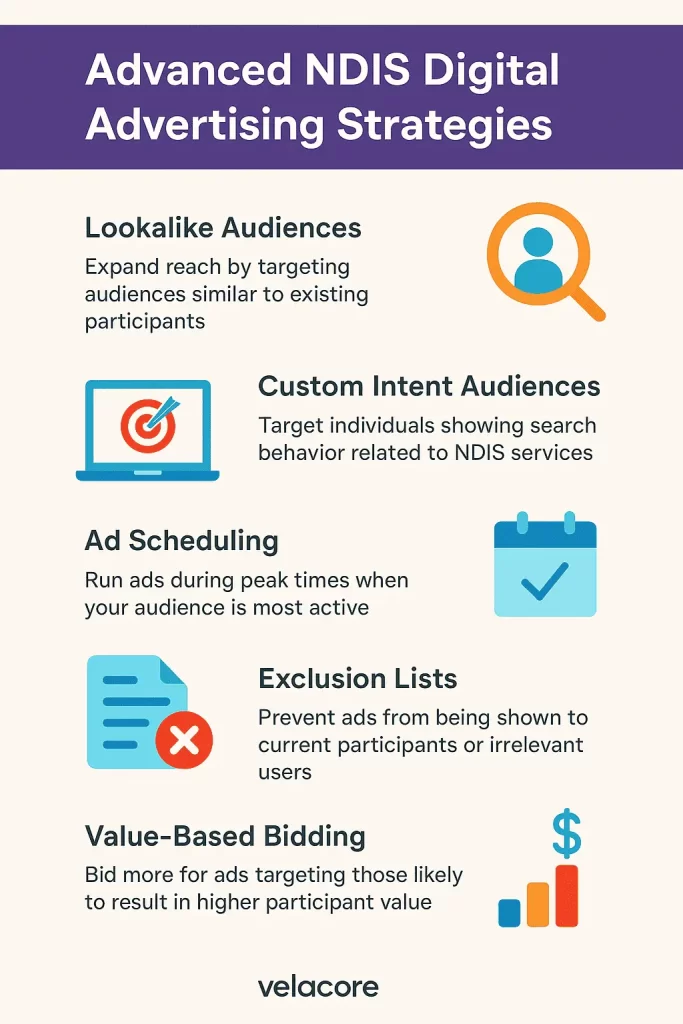
Many NDIS providers stop at the basics; setting up ads, choosing a location, and waiting for results. But those who go further often see a significant lift in enquiries and reduced CPL. Here are advanced strategies that can make your campaigns stand out.
1. A/B Testing for continuous improvement: Don’t assume your first ad will be the best performer. Run A/B tests with different headlines, images, or call-to-actions (CTAs). Even small changes, like switching “Book Now” to “Start Your NDIS Journey Today”, can improve click-through rates by bb
2. Leverage Video advertising: Video ads are not only more engaging but also more accessible when paired with captions. For NDIS providers, short videos showing real support settings or staff can build trust faster than text alone. Facebook and YouTube prioritise video content, often delivering lower costs per view compared to static ads.
3. Optimise for voice Search: With the rise of smart speakers and voice assistants, people increasingly search in conversational phrases like, “Hey Google, find an NDIS provider near me.” By aligning ad keywords with natural speech patterns, you capture participants who are using voice search; a segment growing year on year in Australia.
4. Build Local authority with community content
Beyond ads, partner with local councils, disability advocacy groups, or community events. Running ads that highlight these partnerships (“Proud supporter of Newcastle Disability Expo”) not only strengthens your message but also boosts trust. Local relevance can be the difference between being ignored and being chosen.
5. Smart budget allocation
Split your ad spend strategically, allocate more to high-converting suburbs or services, and less to experimental campaigns. Reviewing performance weekly helps ensure you’re funnelling money into what actually works.
When combined, these strategies move digital advertising from being a simple visibility tool to a sustainable, measurable growth driver.
Take the next step with your NDIS digital advertising
Digital ads can either drain your budget or fuel your growth, the difference lies in strategy. By combining precise targeting, smart retargeting, careful CPL tracking, and compliance-friendly messaging, you turn clicks into genuine enquiries and lasting participant relationships.
At Velacore, we specialise in helping NDIS providers make the most of their digital advertising. From suburb-targeted Google Ads to compliance-driven Facebook campaigns, we ensure every ad dollar works harder.
Ready to maximise your ROI? Book a strategy session with Velacore today.