NDIS business branding is not just about fonts, logos, or fancy taglines. It’s about trust. When a participant or their family scrolls through your page, they’re not just looking at your colours or your services. They’re asking a deeper question: “Can I rely on this provider?”
Participants and support coordinators are becoming increasingly selective. Your brand is more than a design; it’s a promise. A promise that you’ll show up with empathy, that you understand what matters most, and that your services are safe, reliable, and human.
This means your logo, tone, and storytelling can either invite trust or create distance before the first call is ever made. And in a sector with 21,734 registered NDIS providers across Australia, standing out is not about shouting louder or being colourful. It’s about sounding real.
In this guide, we cover how to create an NDIS brand that connects, converts, and consistently communicates trust, plus a practical audit checklist you can use to assess where your brand stands right now.
What makes NDIS branding different
Branding in the NDIS space isn’t like branding a gym, café, or retail store; it operates in a completely different trust economy. Participants aren’t just buying a service; they’re choosing who to depend on.
That decision isn’t transactional; it’s emotional, ethical, and deeply personal.
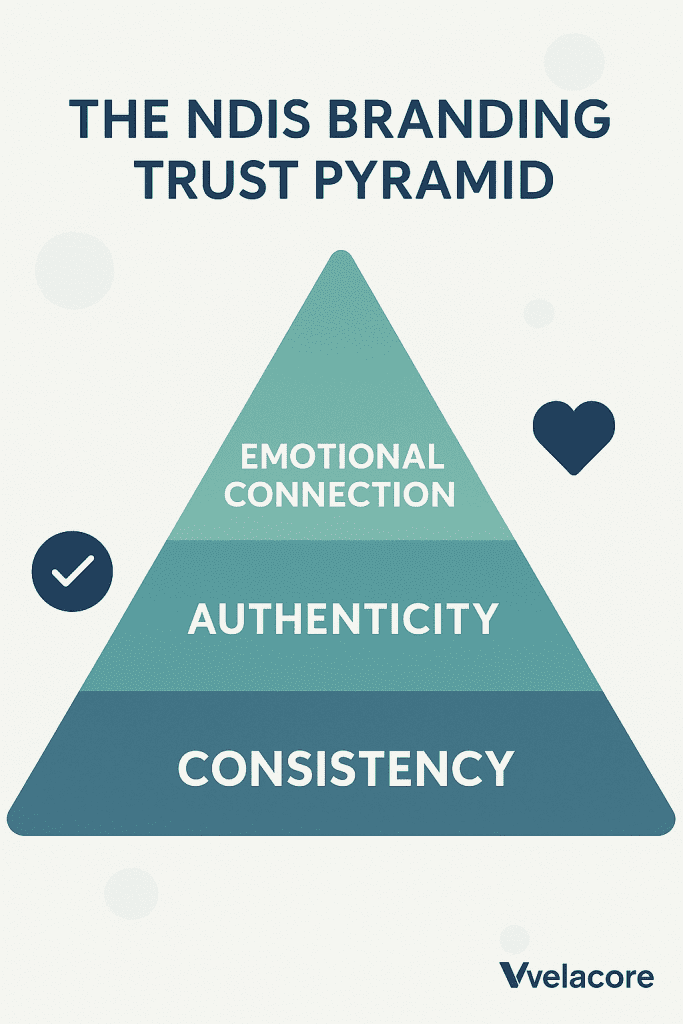
The National Disability Insurance Scheme (NDIS) is built on care, inclusion, and consistency. So, an effective NDIS brand must communicate those same values, not through slogans, but through the way it looks, sounds, and behaves.
Let’s break down the key ways NDIS branding differs from traditional business branding:
- It’s built on empathy, not hype
In most industries, branding is about persuasion. In the NDIS, it’s about assurance.
Participants and families are seeking providers who feel safe and genuine, not flashy. According to the Edelman Trust Barometer, 81% of consumers say trust is a “deal-breaker” when choosing who to work with or buy from. For NDIS providers, that means the tone of your brand matters more than your tagline.
If your messaging feels rushed, overly promotional, or inconsistent, people notice, and they move on.
A strong NDIS brand communicates calm, clarity, and care. That’s what earns loyalty in a sector where relationships outlast transactions.
- It’s driven by values, not just visuals
A beautiful logo doesn’t mean much if it doesn’t represent something. Participants and coordinators want to feel your purpose; your “why.”
The most successful NDIS brands anchor every message and image around their values: inclusion, dignity, empowerment, and reliability.
That doesn’t mean plastering those words everywhere; it means proving them through actions, tone, and transparency.
For example:
- If your brand says “inclusive,” are your photos diverse and authentic?
- If your tagline promises “empowerment,” do your stories showcase participant achievements?
- If you claim “transparency,” is your website clear about pricing and services?
Branding is the alignment between what you say and what you show.
- It must be consistent across every touchpoint
NDIS participants don’t interact with your business once, they experience it repeatedly:
on your website, through your social posts, in your emails, and during service delivery.
If your logo looks different on each platform, or your voice shifts from warm on Facebook to robotic on your website, trust erodes.
According to a study, businesses with a unified brand presentation see up to 23% more revenue growth than those with inconsistent branding.
Consistency doesn’t just build recognition, it signals professionalism and reliability. And in disability services, reliability is everything.
- It’s regulated, yet personal
Unlike most industries, NDIS providers operate under strict compliance rules. But within those boundaries lies an opportunity: to humanise compliance.
Your policies, processes, and documentation can either read like bureaucracy, or reassurance. By translating formal compliance into friendly, accessible language, you make participants feel both safe and seen.
Now that we understand what makes NDIS branding uniquely emotional and trust-led, let’s get practical, starting with how to design a visual identity that reflects care, inclusion, and credibility at every glance.
Building a strong visual identity for NDIS businesses
In the NDIS space, your brand’s visual identity isn’t just a design choice. Participants often form an opinion about your service in under just 7 seconds. In that brief moment, your logo, colours, and imagery communicate whether you’re professional, inclusive, and approachable; or not.
That’s why NDIS business branding must balance clarity with warmth. Your visual presence should reassure, not overwhelm; invite, not intimidate.
Your logo: the first layer of trust
A logo is more than a graphic, It’s what appears on every participant form, every staff shirt, and every post that carries your name.
Great NDIS logos share three traits:
- Simplicity: Avoid complex icons or overcrowded designs. Simplicity scales better across print and digital assets.
- Meaning: Choose symbols or shapes that reflect your values — not generic disability icons.
- Balance: A logo that feels balanced in shape and spacing subconsciously communicates reliability and calm.
Colour psychology: The emotions you evoke
Colours influence perception before words ever do. In NDIS branding, they play a deeper role, shaping feelings of trust, empathy, and inclusion.
| Colour | Emotional Association | Best Used For |
| Blue | Safety, trust, stability | Primary brand colour, logos |
| Green | Growth, calmness, support | Backgrounds, icons |
| Purple | Compassion, creativity, dignity | Highlight elements or secondary palette |
| Yellow | Optimism, warmth, friendliness | Call-to-actions and accent areas |
| Soft Neutrals (beige, grey) | Approachability and professionalism | Backgrounds and typography support |
Accessibility matters too; Use tools like WebAIM’s Contrast Checker to ensure your text and backgrounds meet WCAG 2.1 compliance standards.
A colour palette that looks good but excludes even a small group of participants isn’t inclusive design, it’s missed connection.
Typography: Your voice in visual form
Typography sets tone. The wrong font can make a caring provider look clinical, or worse, outdated.
Best practices for NDIS branding:
- Use accessible fonts: Choose clear sans-serif typefaces like Lato, Open Sans, or Montserrat.
- Keep hierarchy simple: One font for headings, one for body text. Consistency signals professionalism.
- Avoid tiny text: Minimum 16px for web readability, especially for older audiences or low-vision users.
- Mind your kerning: Proper spacing improves readability and comfort.
Tip: Think of your typography as your tone of voice — steady, kind, and clear. It should feel like how you’d speak to a participant: warm and easy to follow.
Imagery: Showing, not just saying
Authenticity in imagery is where many NDIS providers go wrong. Stock photos of staged smiles and sterile clinics do more harm than good.
Participants respond to realness.
That means using genuine images; real staff, real settings, real participants (with consent).
Imagery checklist:
- Represent diversity across age, ability, and culture.
- Use natural light and candid settings where possible.
- Include interactions — support in action, not posed “care” photos.
- Avoid cluttered or overly edited visuals.
Fact: Campaigns featuring real imagery receive 35% higher engagement on social media compared to stock imagery.
Creating a cohesive visual system
Consistency is what transforms good visuals into a brand identity. Develop a brand style guide that documents your colours, logo usage, typography, and imagery tone. It ensures everyone, from your social media manager to your print vendor presents your brand the same way.
Include in your guide:
- Primary and secondary logo variations (horizontal, stacked, monochrome)
- Colour codes (HEX, CMYK, RGB)
- Font hierarchy (headings, body, captions)
- Approved photography examples
- Spacing and margin rules
Storytelling in NDIS branding
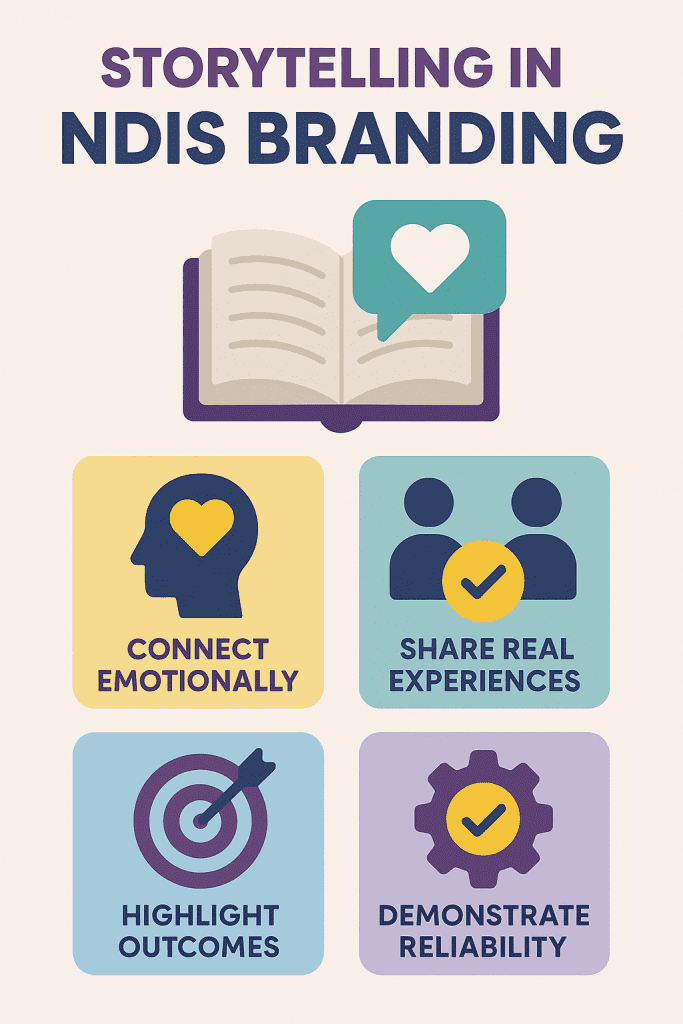
People remember stories far longer than they remember statistics and that’s why storytelling sits at the heart of every successful NDIS business branding strategy.
You can have the perfect logo, beautiful colours, and consistent visuals, but without a story, your brand feels hollow. Because participants don’t just want to know what you do; they want to understand why you do it.
Why Storytelling matters for NDIS providers
Storytelling is more than a marketing tactic. It’s how your brand earns emotional credibility.
Participants and their families are often navigating sensitive, life-changing decisions. In that moment, your story helps them see your heart before your service brochure.
According to the Stanford Graduate School of Business, information shared through story is 22 times more memorable than facts alone. That’s why the most trusted NDIS providers aren’t just describing their services, they’re telling human stories about impact, progress, and care.
Example:
Instead of saying, “We provide supported employment,” tell the story of how James, a participant, started a part-time job at a café through your support, and how it changed his confidence.
That’s not a sales pitch. That’s connection.
Crafting Your Brand Narrative: From Mission to Meaning
Every NDIS brand should have a core narrative; the thread that ties your mission, values, and participant outcomes together.
Here’s a simple Velacore storytelling framework you can follow:
| Stage | Focus Question | Practical Application |
| Origin | Why did your organisation start? | Share your founder’s motivation or the problem that inspired your journey. |
| Mission | What change are you creating? | Express the impact you aim to have in participants’ lives. |
| Proof | How are you making that impact real? | Showcase participant stories, testimonials, or milestones. |
| Vision | What future are you working toward? | Communicate your commitment to inclusion, independence, and growth. |
Your story doesn’t have to be dramatic, it just has to be honest.
Participants can sense when a brand is authentic. The way you talk about your team, your community, and your challenges shows more humanity than any “About Us” page full of buzzwords.
Using storytelling across touchpoints
Your brand story should echo across every platform, not just live in one section of your website.
Here’s how to integrate storytelling seamlessly:
- On your website: Turn your “About” page into a short documentary of your journey, not a résumé of services.
- On social media: Share weekly snapshots of real participants (with consent), your team behind the scenes, or small wins from daily support work.
- In emails and brochures: Use conversational language. Tell one clear story per message rather than listing services.
- In recruitment: Share what it’s like to work with you. Employees who resonate with your story become your best brand ambassadors..
When participants see your story repeated in tone and visuals everywhere, it doesn’t feel like marketing; it feels like identity.
Tone and language: Writing that builds inclusion
NDIS communication should be plain, positive, and inclusive. Your tone of voice is the emotional mirror of your brand.
Velacore’s golden rules for NDIS tone of voice:
- Clarity over cleverness: Write in plain English; no jargon or internal acronyms.
- Warmth over formality: You’re speaking to people, not at them.
- Respect over pity: Empowering language uplifts; avoid phrases that sound patronising.
- Confidence over caution: Participants want capable providers, not hesitant ones.
Example rewrite:
❌ “We cater to individuals with disabilities.”
✅ “We support people of all abilities to live confidently and independently.”
The second statement feels more human, more empowering, and more aligned with NDIS values.
Storytelling as internal culture
Your brand story shouldn’t just live on your website, it should live inside your team.
Every support worker, coordinator, and admin staff member should understand the “why” behind your work.
When staff see themselves as part of the brand story, they communicate it naturally through every phone call, visit, or email. That’s what turns branding from an external exercise into an internal culture.
In the next section, we’ll look at how to maintain brand consistency across every digital and physical channel, so participants always see the same message: you care, and you can be trusted.
Maintaining brand consistency across channels
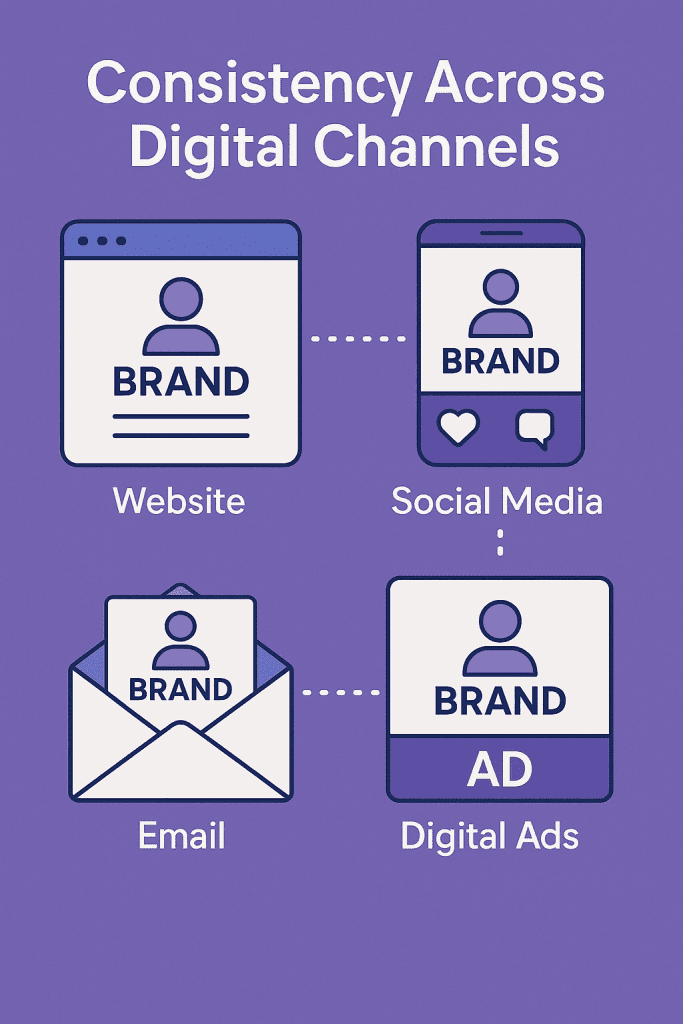
Once your story and visuals are defined, the real work begins: keeping them consistent.
Inconsistent branding confuses people. It makes your service feel unreliable. For NDIS participants, that inconsistency can quietly translate to a loss of trust.
According to the Lucidpress Brand Consistency Report, brands that present themselves consistently across all channels see up to 23% higher revenue growth and significantly greater audience recall. In the context of NDIS, that consistency doesn’t just build recognition, it builds reassurance.
Why consistency matters more in the NDIS sector
Participants and their families engage with your business in multiple ways; a Facebook post, your website, a flyer at a local community centre, or even a staff email. If those experiences feel disconnected, it sends mixed signals about your reliability and structure.
NDIS decisions are high-trust and high-stakes. So even small inconsistencies, a different tone on social media, an outdated logo on a brochure, or confusing copy on your service page can make families hesitate.
Consistency does three critical things:
- Reinforces professionalism: your organisation looks structured and dependable.
- Improves memory recall: participants remember your colours, tone, and promise.
- Builds emotional safety: predictability signals stability, which matters deeply in care-based relationships.
The NDIS brand consistency framework
To manage consistency effectively, think in terms of systems, not guesswork. Here’s a framework for maintaining brand harmony across every touchpoint:
| Channel | Common Pitfall | Fix / Action Step |
| Website | Mismatched logos or outdated fonts | Audit every 6 months. Keep your style guide embedded in your CMS. |
| Social Media | Tone shifts between posts (formal one day, casual the next) | Build a tone guide with 3 example captions that represent your brand voice. |
| Google Business Profile | Old photos or inconsistent service descriptions | Refresh quarterly with new team photos and verified info. |
| Print Collateral | Flyers or forms using old colour palettes | Store approved templates in a shared drive. Train all staff to use only branded materials. |
| Email Signatures | Different formats across staff | Use a company-wide signature template. Include logo, title, and NDIS provider number. |
Tone and messaging consistency
Your brand’s voice should sound like the same friendly, knowledgeable person; whether someone is reading your Facebook caption or your brochure.
The best NDIS brands maintain three tone pillars:
- Warm: Communicate empathy without over-familiarity.
- Clear: Use short, confident sentences — plain English builds inclusion.
- Encouraging: Speak to strengths, not limitations.
Example: Instead of saying,
“We’re sorry for any inconvenience while we update our services.”
Try,
“We’re making a few updates to make your experience even better — thank you for your patience.”
Same message. Different energy. The second builds reassurance and optimism.
Empowering your team as brand ambassadors
Brand consistency doesn’t start in your marketing department, it starts with your people.
Train every staff member from intake coordinators to support workers on what your brand stands for and how to represent it. When frontline staff echo your tone of care, consistency naturally extends beyond your website into every interaction.
Building a brand hub for NDIS teams
Create a digital brand hub where all assets and resources live. Include:
- Logos (various formats and orientations)
- Colour and typography guide
- Tone of voice manual
- Canva templates for social media and print
- Example captions and email scripts
Platforms like Canva Pro, Notion, or Google Drive work perfectly for small-to-medium NDIS providers.
That one folder can save countless hours, and ensure no one ever uses the wrong logo again.
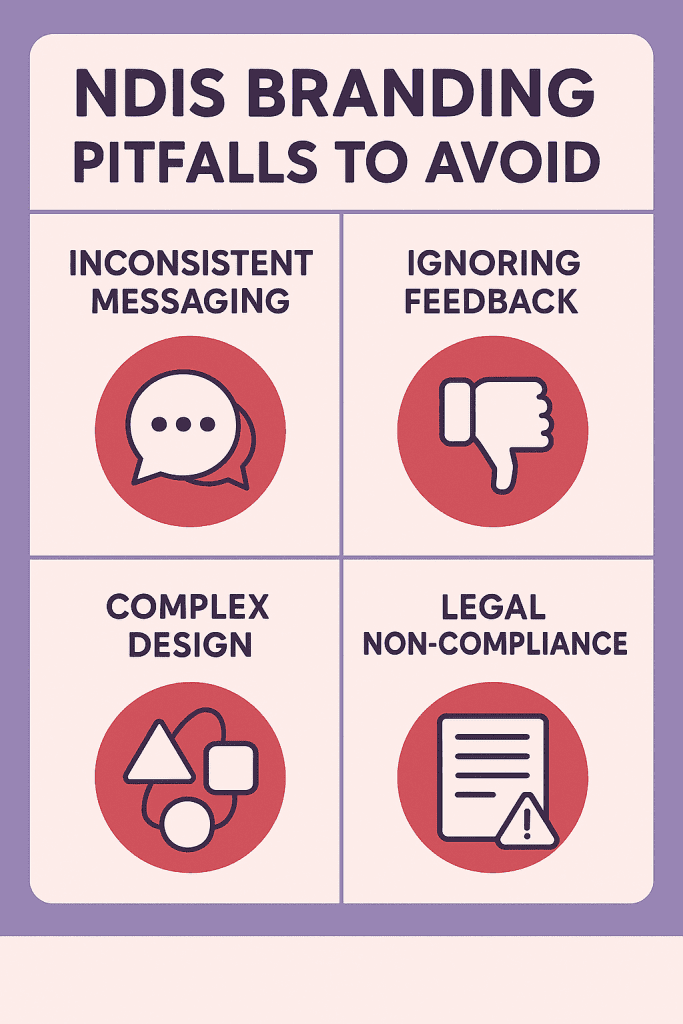
Your NDIS brand audit checklist: where do you stand right now?
Before you refresh your brand or build from scratch, it helps to know where you actually stand. Work through this checklist to identify your strongest areas and the gaps most likely to be costing you participants.
1. Visual identity
☐ Our logo is professional, simple, and scales well across print and digital.
☐ We have a consistent colour palette with defined HEX and CMYK codes.
☐ Our typography is accessible (sans-serif, minimum 16px on web).
☐ Our imagery features real people in authentic settings, not generic stock.
☐ We have a brand style guide that all staff can access.
2. Online presence
☐ Our website clearly explains who we support, what we offer, and how to get started.
☐ Our Google Business Profile is complete, current, and has recent reviews.
☐ Our social media profiles use consistent logos, bios, and tone.
☐ Our website is mobile-friendly and loads in under 3 seconds.
☐ Our contact page is easy to find and has multiple ways to reach us.
3. Messaging and tone
☐ Our website copy is written in plain English with no unnecessary jargon.
☐ Our messaging focuses on participant outcomes, not just our services.
☐ We have a clear “why we exist” statement that staff can articulate easily.
☐ Our language is empowering, not patronising.
☐ Our tone is consistent across website, social media, and email.
4. Storytelling and trust signals
☐ We share genuine participant stories (with appropriate consent).
☐ We have visible testimonials or case studies on our website.
☐ Our team is visible: photos, names, and roles are shown on our website.
☐ We have an “About” page that tells our story, not just lists our services.
☐ We link to or display our NDIS registration and relevant certifications.
5. Conversion and enquiry
☐ Every key page has a clear, single call to action.
☐ Our contact form or booking process takes fewer than 3 steps.
☐ We respond to website enquiries within 24 hours.
☐ We track where our enquiries come from (website, Google, referral, social).
☐ Our Google reviews average 4 stars or above with recent responses.
How to use this: If you have 4 or more unchecked boxes in any section, that section is likely contributing to low enquiry rates. Prioritise the areas with the most gaps before investing in new marketing activity.
How Velacore helps NDIS providers build brands that convert
Working with Velacore: We design and build brand identities specifically for Australian NDIS providers, from logo and visual system development to website design, content strategy, and Google Business Profile optimisation. Every element is designed to be accessible, compliant, and built to attract participants searching for services online.
Most NDIS providers we work with have strong services but a brand that undersells them. A participant landing on your website should feel within seconds that you are professional, approachable, and the right fit for them. That first impression is designed, not accidental.
If your brand is not generating consistent enquiries, get in touch with the Velacore team and let’s look at where the gaps are.
Conclusion
At its heart, NDIS business branding isn’t about design trends, every logo, colour, and story you share either reassures participants or raises questions.
In a sector built on empathy and reliability, branding is more than marketing it’s a reflection of your promise to care, communicate, and deliver with integrity.
When your visuals are consistent, your story is clear, and your tone is human, your brand becomes one that participants remember and recommend.
So whether you’re building from scratch or refreshing an established identity, let your brand do what your work already does best: make people feel seen, supported, and safe.
If you’re ready to elevate your NDIS brand with clarity, creativity, and credibility, Velacore helps providers design authentic, accessible brands that build lasting trust and stronger participant engagement. Let’s talk!
Is Your Website Working for You?
Most websites don't generate leads. We fix that with custom designs that look great and deliver measurable results for your business.
Get Started With Velacore