
Your NDIS business has outgrown spreadsheets
What began as a human-centred mission to support participants has become one of Australia’s most data-driven sectors, where funding, records, and service delivery must align with precision. Yet many providers still manage that complexity with patchwork tools built for small offices, not for national-scale accountability.
As audits tighten and participant expectations rise, ERP for NDIS providers is becoming more than a tech upgrade. It’s a survival tool. It unifies finance, compliance, and operations into one system, giving you real-time visibility and control.
78% of organisations report improved productivity after ERP implementation, and 75% say it strengthens compliance. In a sector built on trust and accountability, that kind of clarity is not just helpful; it’s essential.
This guide covers how ERP systems are transforming NDIS provider operations, which platforms to consider, what they cost, and how to choose the right one for your organisation.
What Is an ERP system (and why It matters for NDIS providers)
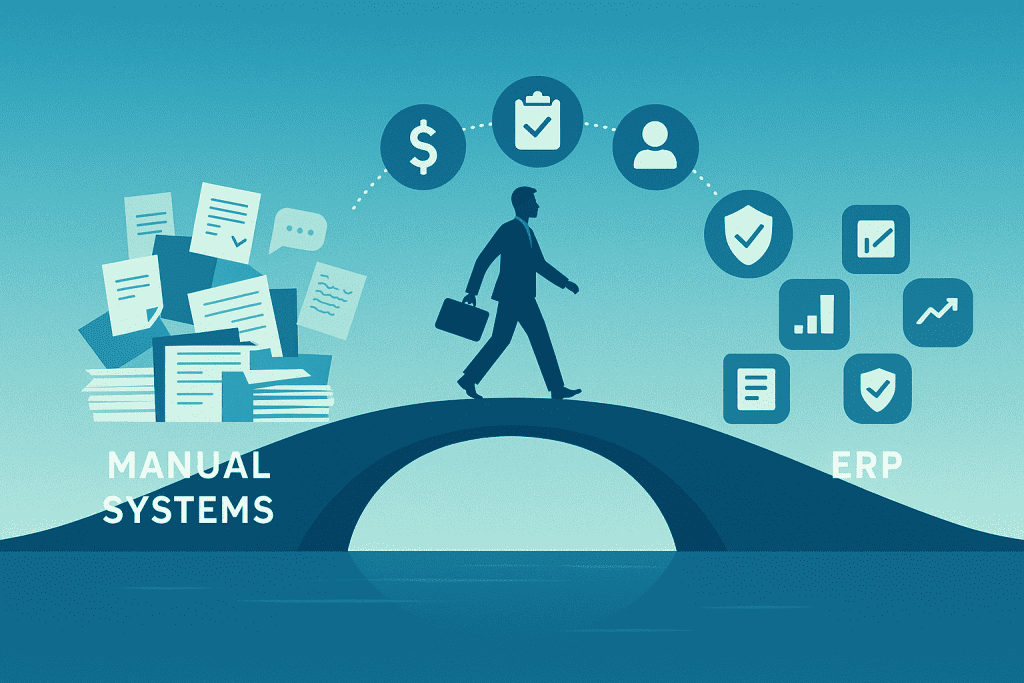
An ERP system short for Enterprise Resource Planning, is a central hub that connects the moving parts of an organisation: finance, HR, rostering, participant management, payroll, reporting, and compliance. Instead of juggling five different tools or manually updating spreadsheets, everything runs from one source.
For NDIS providers, that single source is game-changing. The NDIS operates on strict accountability, every dollar, hour, and outcome must be tracked, justified, and reportable. An ERP brings that precision, automating what once took endless admin hours.
Imagine logging in and seeing your full organisation in one dashboard:
- Which participants have upcoming plan reviews.
- Which shifts are understaffed.
- Which claims are pending payment.
- Which compliance documents are due.
The benefits go beyond administration. With ERP, NDIS businesses gain:
- Transparency: Everyone works from the same live data.
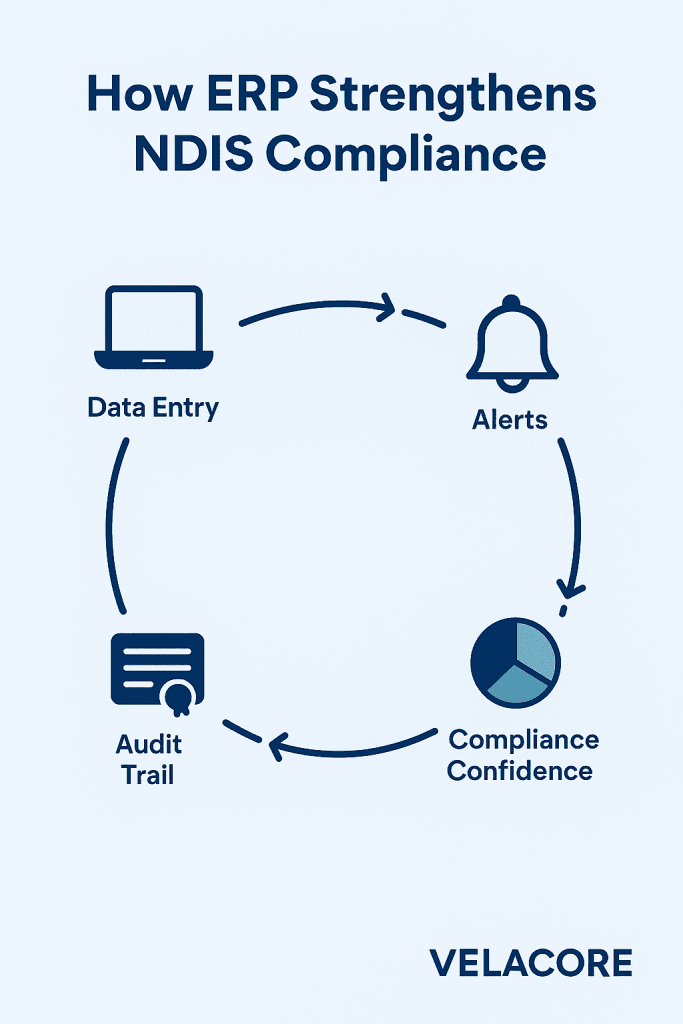
- Compliance confidence: Built-in audit trails and automated reporting reduce errors.
- Efficiency: Manual entry, double-handling, and miscommunication disappear.
- Scalability: As your services expand, your systems grow with you.
And with cloud-based ERP systems now tailored for the NDIS environment, small to mid-sized providers can access enterprise-level capability without enterprise-level cost.
In essence, an ERP helps providers focus less on running the business and more on delivering care.
Key Benefits of ERP for NDIS providers
Implementing an ERP for NDIS providers isn’t just about upgrading software, it’s about upgrading how your organisation thinks and operates. When data, finance, HR, and compliance all flow through one system, the results are tangible.
Here’s what that transformation actually looks like:
1. Automated compliance and reporting
Over 73% of organisations have reported improved compliance after adopting an ERP system. Compliance under the NDIS Commission is no small feat. Every claim, staff qualification, and participant record must meet strict reporting standards. ERP systems automate much of this process, from generating audit-ready reports to flagging missing documentation in real time.
2. Real-time financial clarity
With ERP, every transaction from plan claims to payroll, flows into one financial dashboard. That means no more reconciling between platforms or chasing receipts. Managers can see exactly where funds are allocated, track plan utilisation, and identify cost leakages before they escalate.
3. Streamlined rostering and workforce management
Rostering is one of the biggest pain points for providers. ERP systems sync rosters, timesheets, and payroll automatically, reducing double entry and ensuring staff are rostered according to both participant needs and NDIS funding rules.
4. Data-driven decision making
An ERP doesn’t just store data, it transforms it into insights. Whether you’re forecasting demand, evaluating service performance, or identifying gaps in delivery, ERP analytics help leaders make faster, evidence-based decisions.
5. Better participant experience
Ultimately, efficiency behind the scenes leads to smoother participant interactions. Accurate scheduling, timely billing, and clear communication create a service that feels more professional and trustworthy.
Core features every NDIS ERP should have
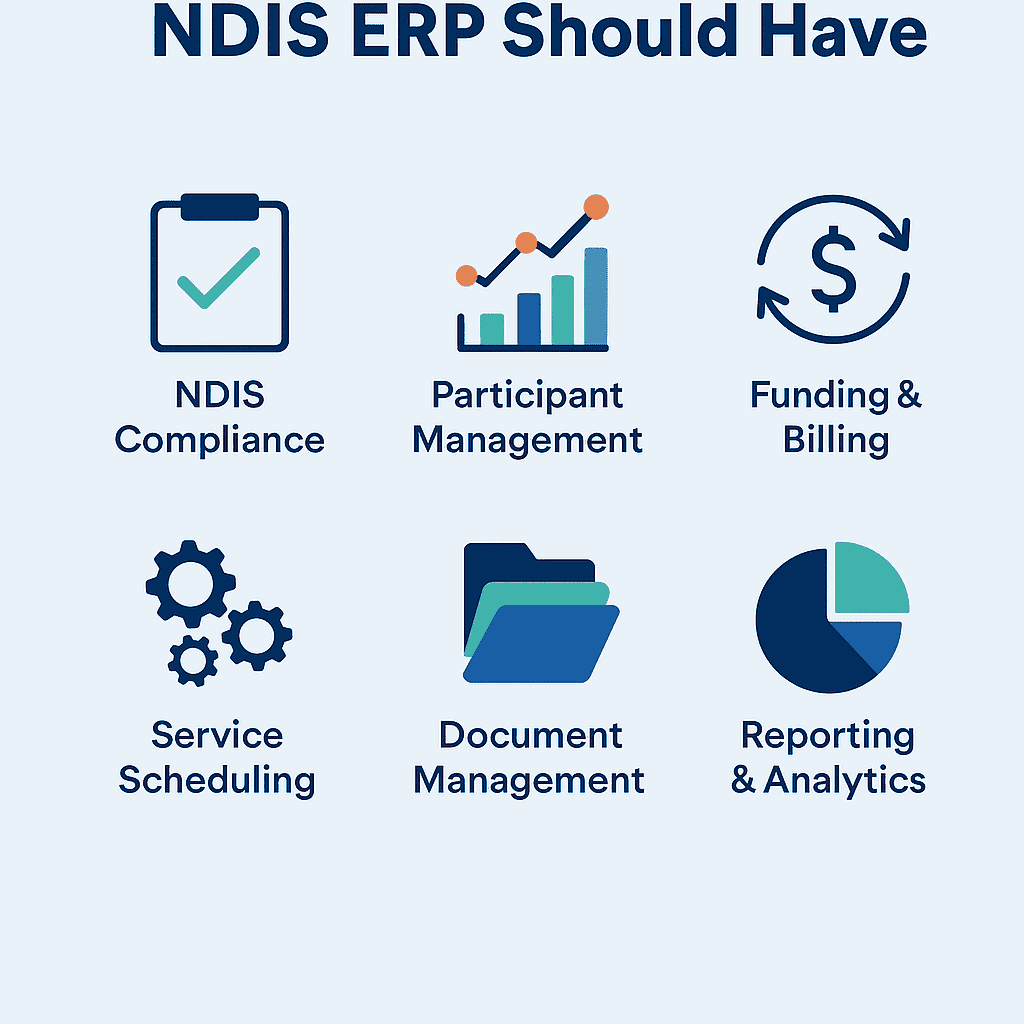
Not every ERP system is built with the NDIS in mind. Some are designed for manufacturing or retail and while they claim to “fit any industry,” they often miss the nuances of compliance, participant management, and funding claims.
A good ERP for NDIS providers should feel like it understands your daily operations because it’s built around them.
Here’s what to look for before signing any contract:
| Feature | Why It Matters for NDIS Providers |
| NDIS-Compliant Finance & Claims Module | Automates plan management, integrates with PRODA, and ensures each claim aligns with NDIS pricing arrangements. |
| Participant Management Dashboard | Centralises participant data — plans, goals, progress notes, and communication history — for better continuity of care. |
| Workforce & Rostering Integration | Links staff availability, compliance checks (like WWCC and police checks), and payroll into one seamless process. |
| Compliance Tracker | Flags expired certifications, incomplete documentation, and audit requirements, reducing risk of non-compliance. |
| Incident & Risk Management Tools | Captures, categorises, and reports incidents with built-in workflows to meet NDIS Practice Standard requirements. |
| Analytics & Reporting Engine | Converts raw data into visual reports for decision-making and NDIS audits. |
| Cloud Accessibility | Enables remote access for coordinators, support workers, and admins while maintaining data security. |
| Integration Capability | Connects easily with accounting tools (e.g. Xero, MYOB) and CRM systems. |
| Mobile App Support | Allows staff to log notes, update shifts, and capture evidence of support in real time from the field. |
Tip: Think long-term
Before you commit, assess how customisable the ERP is. Regulations and pricing arrangements under the NDIS change frequently; your system should be flexible enough to evolve with them.
The right ERP doesn’t just meet a checklist, it makes your everyday work easier. At Velacore, we help NDIS providers tailor ERP systems that genuinely fit the way they operate. From mapping workflows to simplifying compliance, our goal is to make the tech feel intuitive, and adaptive.
If you’re exploring ERP options and want an honest, practical perspective, have a chat with the Velacore team. We’ll help you figure out what works.
What does NDIS ERP software actually cost?
Cost is usually the first question providers ask, and understandably so. The honest answer is that pricing varies significantly based on organisation size, the number of users, and which modules you need.
Here is a realistic cost breakdown for 2026:
| Provider Size | Typical Monthly Cost | What Is Usually Included |
| Solo or micro (1 to 5 staff) | $50 to $150/month | Basic rostering, participant records, invoicing |
| Small (5 to 20 staff) | $150 to $600/month | Rostering, NDIS billing, compliance tracking, payroll integration |
| Medium (20 to 100 staff) | $600 to $2,500/month | Full ERP suite, analytics, HR, custom reporting, multi-site |
| Large (100+ staff) | $2,500+/month or custom | Enterprise-level ERP with NDIS API, dedicated support, automation |
Entry-level tools like Brevity start from as low as $6.99 per user per month, making them accessible for sole traders and small registered providers. Mid-tier platforms like ShiftCare start from $9 per user per month with more comprehensive NDIS features. Larger platforms like Lumary and Wiise use custom pricing and are best suited for organisations with complex, multi-service operations.
It is also worth factoring in implementation costs (which can range from a few hundred dollars for self-setup tools to $10,000 or more for enterprise ERP deployments) and staff training time. The NDIS pricing arrangements do not directly subsidise software costs, so ERP is an operational investment you need to plan for as part of your overhead budget.
ROI benchmark: According to ERP research, 83% of organisations that conducted an ROI analysis before implementation and went live for over a year reported meeting their ROI expectations. Running the numbers before you commit is time well spent.
NDIS ERP implementation checklist: What to look for before you buy
Choosing an ERP for NDIS providers isn’t just about features, it’s about finding a system that fits your compliance, operational, and participant needs seamlessly.
Use this quick checklist before you commit to any platform:
1. Compliance and NDIS standards
☐ Integrates directly with PRODA or NDIS API
☐ Supports automatic claim validation against NDIS pricing arrangements
☐ Generates audit-ready reports in required formats
☐ Tracks expiry dates for worker screening, insurance, and certifications
☐ Includes role-based access control to protect participant data
2. Participant management
☐ Centralises participant profiles, plans, goals, and documents
☐ Supports case notes and incident reporting linked to each participant
☐ Enables secure communication between coordinators, staff, and families
☐ Offers visual dashboards for progress tracking and goal outcomes
3. Workforce & rostering
☐ Integrates with payroll (Xero, MYOB, etc.)
☐ Matches staff availability with participant needs automatically
☐ Prevents rostering of non-compliant staff (expired checks or training)
☐ Allows mobile check-in/out and real-time timesheet updates
4. Financial management
☐ Provides live budget tracking and cost allocation
☐ Consolidates invoices, funding claims, and expense management
☐ Supports NDIS-specific billing codes and service categories
☐ Offers reporting for profitability, utilisation, and cash flow
5. Data & reporting
☐ Generates compliance reports with one click
☐ Tracks KPIs like plan utilisation, incident resolution times, and cancellations
☐ Offers visual analytics and exportable data
☐ Ensures full audit trails for every action
6. Accessibility & integration
☐ Cloud-based with secure login for multiple users
☐ Mobile-friendly for field staff
☐ Integrates with CRMs, accounting tools, and HR systems
☐ Scalable modules that grow with your business
7. Support & customisation
☐ Local Australian support and onboarding assistance
☐ Customisable workflows to match your internal processes
☐ Regular software updates to stay aligned with NDIS changes
☐ Training materials and helpdesk access for staff
Tip: Before purchase, ask for a sandbox or demo environment to test real workflows, from creating a participant plan to generating an invoice. The best ERP vendors for NDIS providers will always allow you to trial the system before signing long-term.
Choosing the right ERP for your NDIS business
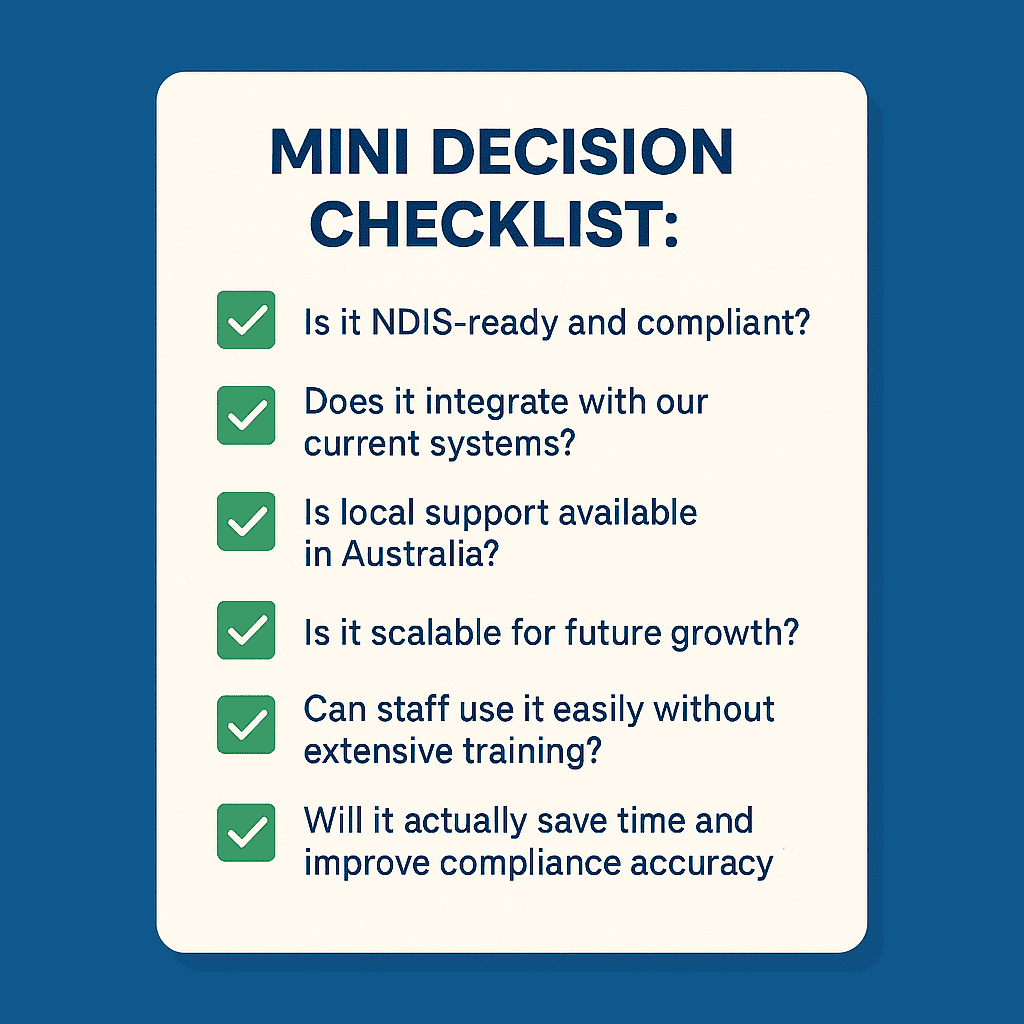
With dozens of ERP options in the market, choosing the right one can feel overwhelming especially when most vendors promise the same things: “integration,” “automation,” and “compliance-ready.” But for NDIS providers, the difference between a good ERP and the right ERP comes down to one thing: alignment with your business reality.
Here’s how to make the right call
1. Start with your pain points, not the features
Don’t get distracted by fancy dashboards or AI buzzwords. Begin by listing your biggest operational headaches; maybe it’s compliance tracking, disjointed rostering, or claim reconciliation delays. The right ERP should solve those, not just look impressive in a demo.
2. Ask: “Is it built for NDIS?”
Many ERP systems were designed for manufacturing, retail, or healthcare, not community care. If the software doesn’t speak your language (participant plans, PRODA, NDIS claims), you’ll end up paying for endless customisation.
Look for: NDIS-specific modules, Australian-based vendors, and local support teams familiar with NDIS Practice Standards.
3. Check integration flexibility
A great ERP plays well with others; your payroll, accounting, CRM, and even rostering tools. Seamless integration prevents double handling and ensures your data stays consistent across systems.
Ask: Can this ERP connect to our existing systems without third-party workarounds?
4. Prioritise scalability and cloud access
As your organisation grows, your ERP should grow with you. Cloud-based systems allow remote access for coordinators, mobile workers, and regional branches; a must-have for distributed teams.
Tip: Cloud ERPs with tiered pricing help small providers scale without massive upfront investment.
5. Evaluate the support and onboarding experience
Even the best ERP fails if your team doesn’t understand it. Training, onboarding, and ongoing support determine how successful adoption will be.
Ask: What support do we get after go-live; local helpdesk, online training, or dedicated account management?
6. Measure ROI Early
Within the first 3–6 months, track improvements, time saved on admin, fewer claim rejections, and reduced audit prep hours. This helps you gauge whether the ERP is truly delivering value or just running in the background.
Conclusion: Building a smarter, stronger NDIS business with ERP
The future of NDIS operations won’t be defined by who has the biggest team or the most funding, it’ll be shaped by who runs smarter. And that’s exactly what ERP for NDIS providers enables: a connected, compliant, and data-driven organisation that can scale without losing its human touch.
When your compliance, finance, and participant data live in one intelligent system, you gain more than efficiency, you gain clarity. The kind that lets you make decisions confidently, reduce administrative pressure, and focus on what matters most: delivering quality support.
But technology alone isn’t the answer. The right partner turns that technology into results.
At Velacore, we help NDIS providers modernise their operations through ERP integration, process automation, and data-driven strategy, ensuring every system you use is built for compliance, scalability, and care.
Because in the NDIS world, success isn’t just about staying compliant, it’s about staying ahead.
Ready to Streamline Your Operations?
Let’s talk about how Velacore can help you choose, implement, or optimise the right ERP system for your NDIS business.