

Understanding content marketing costs is becoming essential as more local businesses shift their budgets towards SEO, long-form content, and video. The rise is clear: 63% of marketers increased content budgets in 2024, and Australian digital advertising spend continues to grow, reaching $4.6bn for the September 2025 quarter, an increase of 9.7% on the September 2024 quarter
Content remains one of the highest-ROI marketing channels. McKinsey reports that businesses that use structured, high-quality content and personalisation see 5–15% revenue uplift
But the big question remains: How much should you actually budget for content marketing in Australia?
Content marketing costs in Australia vary widely; from $1,500 to over $80,000 per month, depending on business size, industry competitiveness, and the level of strategy required.
This guide breaks down exactly what Australian businesses should expect to budget in 2025–2026, using real data, real agency pricing, and real industry benchmarks.
Average content marketing costs in Australia (2025–2026 Overview)
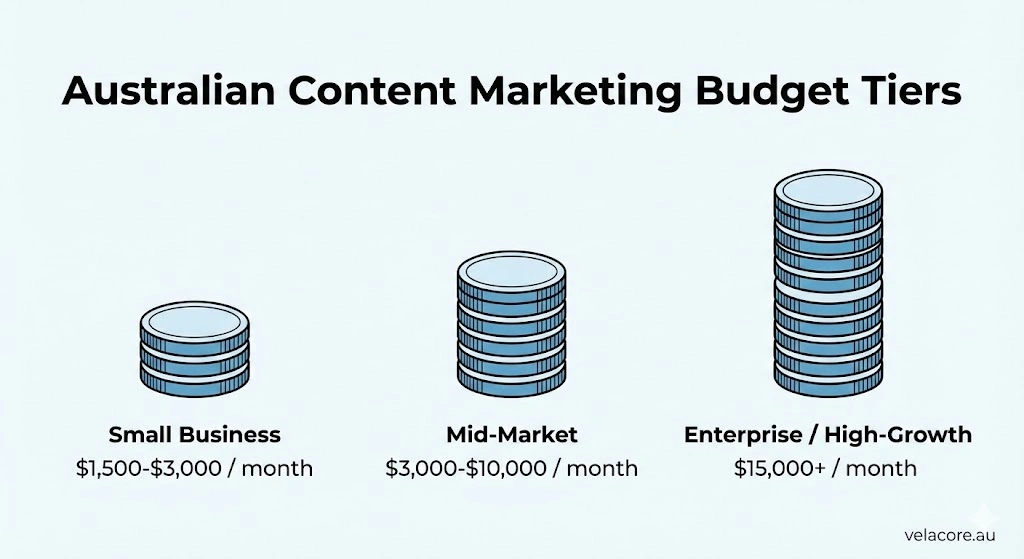
Content marketing costs in Australia vary widely, but most businesses fall into three tiers depending on their size, competitiveness, and growth goals. 86% of Australian marketers say content demand has risen sharply over the last two years, according to Adobe’s 2025 Content Demand Survey. 63% expect their organisation’s content needs to increase fivefold by 2027, with content and SEO among the fastest-growing categories (
To give a realistic overview of what companies spend, here’s what Australian businesses typically invest in content marketing per month:
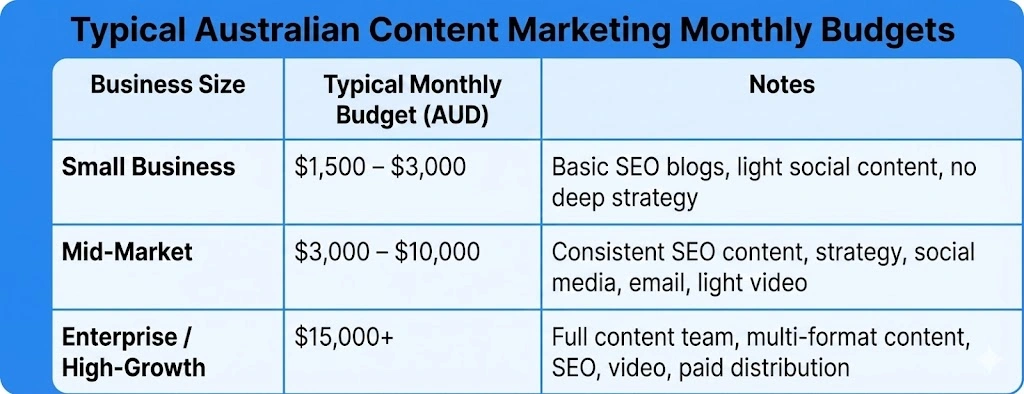
These brackets align with industry averages. Most importantly, these numbers represent actual operating costs observed across Australian agencies, boutique studios, and experienced freelancers.
Content marketing pricing models explained (Australia 2025–2026)
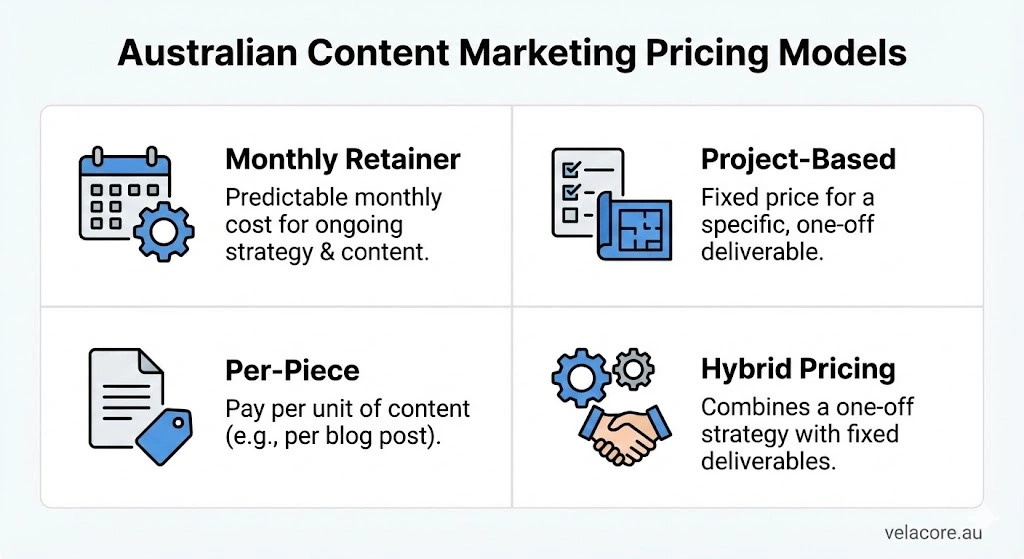
Understanding how content marketing is priced in Australia is just as important as knowing the actual dollar amounts. Most agencies, freelancers, and hybrid teams use one of four pricing models. Each affects your budget differently depending on your goals, content volume, and level of strategy needed.
Below is a clear breakdown of the models you’ll see across the Australian market.
Monthly retainers (Most Common)
A monthly content marketing retainer is the standard model used by Australian agencies and experienced freelancers. This covers strategy, content creation, SEO work, reporting, and ongoing optimisation.
Why Australian businesses choose this model:
- Predictable monthly expenses
- Consistent content output (blogs, social posts, videos, etc.)
- Access to a full content team without hiring in-house
- Stronger ROI due to long-term strategy
Retainers typically range from $2,000 to $15,000+ per month, depending on business size and industry competitiveness.
Project-based pricing
Project pricing is used for once-off pieces of work such as:
- Website copywriting
- A full content strategy
- A batch of SEO-optimised blogs
- A video series
- Email sequences or sales funnels
This model suits businesses who:
- Need one-off deliverables
- Are launching a new product or website
- Want to test an agency before committing to a retainer
Project-based content work in Australia normally ranges from $1,500 to $30,000+, depending on project scope and complexity.
Per-piece pricing
Some freelancers and smaller agencies charge per unit of content.
Typical examples include:
- Per blog (e.g., $250–$800 for freelancers; agencies charge more)
- Per landing page
- Per email sequence
- Per video minute
This pricing model is best for businesses that:
- Need occasional content
- Have clear internal strategies and just need production
- Manage distribution internally
However, the downside is that per-piece pricing rarely includes strategy, which is why it’s cheaper upfront but usually less effective long-term.
Hybrid pricing
A hybrid model combines:
- A one-off strategy
- A fixed number of content deliverables
- A light monthly management fee
This is becoming more popular in Australia, especially among mid-market companies that want strategy, quality, and flexibility without the full cost of a premium retainer.
Hybrid models usually cost between $3,000 and $12,000, depending on the complexity of the strategy and volume of output.
Which model should you choose?
- Small businesses often start with per-piece or hybrid pricing.
- Growing SMEs benefit most from monthly retainers.
- Enterprises & competitive industries (legal, finance, SaaS, NDIS) almost always use retainers or dedicated in-house content teams.
For a broader look at how these pricing models connect to strategy, distribution and channel planning, see our Content Marketing Full Strategy Guide
The next section breaks down actual Australian pricing for each type of content, with real, current benchmarks and comparison tables.
Full breakdown of content marketing costs in Australia (2025–2026)
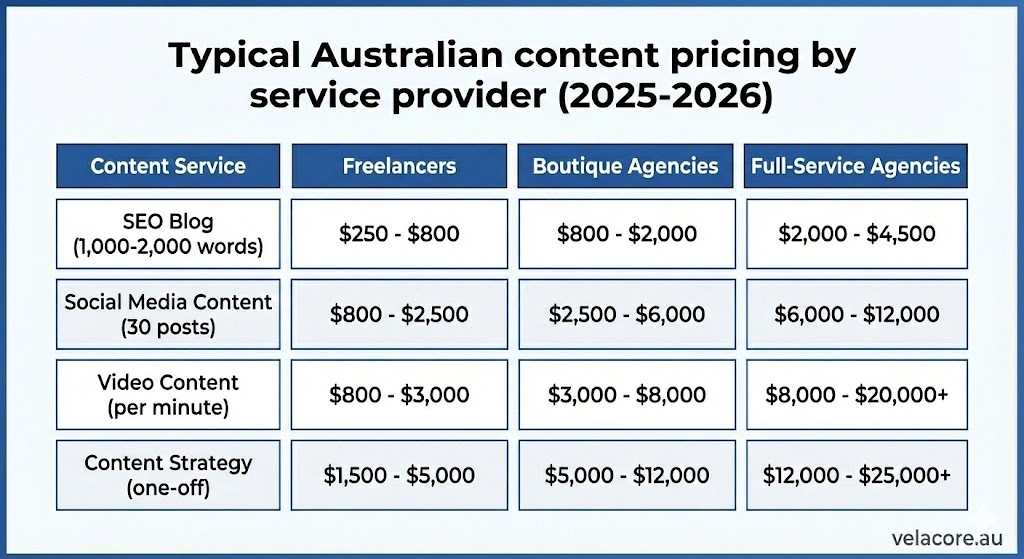
Content marketing costs Australia can vary significantly depending on whether you hire a freelancer, boutique agency, or full-service agency. Below is a consolidated view of what Australian businesses are currently paying across key content types.
Typical Australian content pricing table (2025–2026)
Important pricing notes
- Technical industries (finance, cybersecurity, law, NDIS, health, SaaS) sit at the top end of pricing due to complexity.
- Short-term projects cost more per piece than monthly retainers.
- Video prices vary the most due to equipment, scripting, editing, and animation.
- Agencies charge more because you’re paying for a team: strategist, SEO specialist, writer, editor, designer, and sometimes video editors.
- GEO-friendly content (structured, schema-supported, high E-E-A-T) costs more but ranks faster and appears more often in AI-generated answers.
Agency vs freelancer vs in-house: cost comparison in Australia (2025–2026)
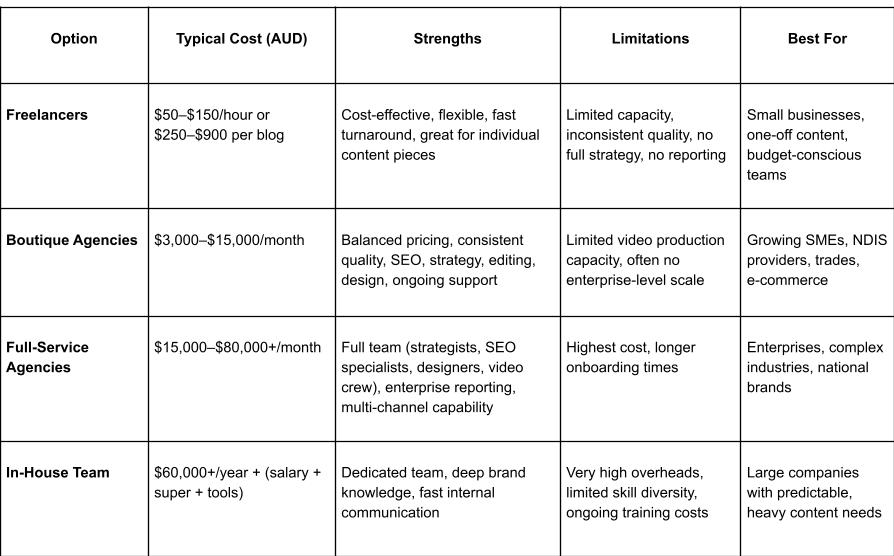
Choosing between a freelancer, boutique agency, full-service agency or building an in-house team has one of the biggest impacts on your overall content marketing costs Australia. Each option offers different levels of expertise, capacity, and long-term value.
Below is a practical comparison based on real Australian market norms.
Hidden costs most australian businesses forget
When calculating content marketing costs, many businesses only consider the visible line items; blogs, social posts, strategy, or video. But real-world budgets almost always expand once the hidden costs appear. These aren’t “optional extras”; they’re essential parts of modern content production, SEO, and distribution.
Here are the cost factors businesses frequently underestimate (or overlook entirely).
SEO and content tools
Creating high-performing, GEO-ready content requires more than writing. Agencies and in-house teams often rely on tools such as:
- SEMrush
- Ahrefs
- Surfer SEO
- Canva Pro
- Grammarly Premium
These tools can cost anywhere from $50 to $600+ per month per user, which is why agency retainers include tool access, saving businesses from paying individually.
Visual assets and photography
Even when content writing is covered, businesses often forget that high-quality visual assets add extra cost:
- Custom graphics
- Infographics
- Stock images
- Photoshoots for brand content
Visual assets are essential for SEO, social media engagement, and AI visibility, but they increase both time and cost.
Video production add-Ons
Raw footage isn’t enough. Businesses frequently forget to budget for:
- Scripting
- Storyboarding
- Editing
- Animation
- Subtitles
- Voiceover
These elements can add 30–70% to the base video price depending on complexity.
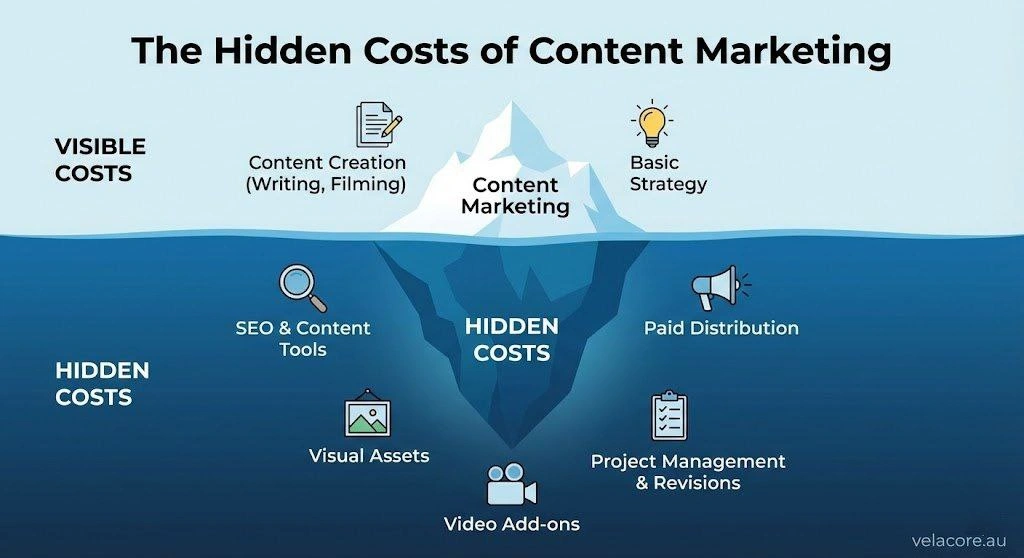
Paid distribution and boosting
Even the best content needs distribution. Paid boosts through Meta, LinkedIn, Google Discovery, or YouTube often cost $300–$2,000+ per month, depending on audience size and goals. Without this, content reach can be significantly limited.
Revisions, approvals and project management time
If your business has multiple layers of approval, legal checks, or compliance reviews (e.g., NDIS, health, finance), expect extra:
- Editing rounds
- Project management hours
- Extra meetings
Agencies typically include one or two revision rounds; additional rounds may incur cost.
CMS, Hosting & Technical Costs
Many businesses overlook the technical expenses behind content publishing:
- Website hosting
- CMS upgrades
- Plugin renewals
- Landing page builders
These may seem small individually, but together they add several hundred dollars per year.
AI automation tools
Modern content workflows increasingly rely on AI tools for efficiency, editing, planning, and formatting. Examples include:
- Jasper
- Notion AI
- OpenAI tools
These introduce new monthly or annual costs.
Understanding these hidden costs helps businesses plan a more realistic content marketing budget. The next section walks through how to build a practical 2025–2026 content marketing budget based on your goals and growth stage.
How to build your content marketing budget (step-by-step)
Setting a realistic content marketing budget in Australia isn’t just about looking at price lists, it’s about aligning spend with your goals, industry, and the level of growth you expect over the next 12–24 months. A budget that’s too small won’t move the needle; a budget that’s misallocated wastes money.
Below is a simple framework Australian businesses can use to build a practical, ROI-focused content budget.
Step 1: clarify your growth stage and goals
Your growth stage determines how aggressive your content investment should be.
- Start-ups & micro businesses: focus on foundational content (website copy + SEO blogs).
- Growing SMEs: focus on consistent multi-channel content (blogs, emails, social, light video).
- High-growth or competitive industries: require a formal content strategy, SEO architecture, and regular video content.
- Enterprises: invest heavily in multi-format content, performance SEO and brand storytelling.
Your goals which may include; visibility, leads, NDIS participant acquisition, e-commerce sales, or authority building, determine your content mix.
Step 2: allocate a percentage of revenue
Globally, businesses spend 5–15% of total revenue on marketing, depending on growth stage.
Of this, content usually accounts for 25–40% of the total marketing budget; especially for digital-first businesses.
This gives a realistic starting point:
- Conservative growth: 2–5% of revenue into content
- Moderate growth: 5–10%
- Aggressive growth: 10–20%
Step 3: identify how much content you actually need
Your required content volume affects cost more than anything.
Ask:
- How many SEO blogs per month?
- Do you need video?
- How many social posts?
- Do you need a content strategy? (You’ll definitely need this)
- Do you need email marketing?
- Will you need paid distribution?
A small business may need 2–4 SEO blogs/month, while a mid-market business may need 8–12 pieces of multi-format content to stay competitive.
Enterprises often need 20–60 pieces/month across channels.
Step 4: choose your delivery model (freelancer, agency, hybrid, in-house)
Use the comparison from Section 6:
- Freelancers → lowest cost, lowest strategy
- Boutique agencies → ideal for SMEs
- Full-service agencies → best for enterprise
- In-house → highest cost, best for daily output needs
Your delivery model determines your monthly baseline.
Step 5: build your budget using typical benchmarks
Use the guide from Section 4:
- Basic presence: $1,500–$3,000/month
- Growth-focused SMEs: $3,000–$10,000/month
- Competitive industries: $10,000–$25,000/month
- Enterprise: $25,000–$80,000+/month
This aligns with real-world pricing from Australian agencies, CMI global benchmarks, and Australian freelancer surveys.
Step 6: reserve funds for distribution & tools
This is the most overlooked part.
Budget for:
- SEO tools (SEMrush, Ahrefs, Surfer)
- AI writing/editing tools
- Canva Pro or Adobe Suite
- Social media scheduling tools
- Paid boosts ($300–$2,000+/month depending on goals)
- Stock photos or video editing support
This typically adds 10–20% to your core content budget.
Step 7: review and optimise quarterly
Content performance should be reviewed every 90 days:
- Which formats are working?
- Which channels are generating the best ROI?
- Do you need more SEO?
- Should you increase video?
- Are you ranking in Google AI Overviews and SGE?
This ensures your budget stays aligned with both performance and algorithm changes.
Red flags when choosing a content marketing partner in australia
Not all content providers operate at the same level, and choosing the wrong partner can inflate your content marketing costs without delivering meaningful ROI. Whether you’re considering a freelancer, boutique agency or full-service firm, these warning signs indicate that the provider may not deliver the strategy, quality or structure required for modern SEO and AI-driven search environments.
No clear content strategy or SEO framework
If a provider jumps straight into writing content without:
- keyword research,
- competitor analysis,
- audience profiling, or
- a structured content plan,
it’s a major red flag. Effective content marketing requires strategy first, execution second.
No transparency in pricing or deliverables
Be cautious of providers who can’t clearly explain:
- what’s included in their retainer,
- what each deliverable costs,
- how many revisions are allowed, or
- how performance will be measured.
Ambiguity almost always leads to cost overruns or low-impact output.
Content is not SEO or GEO ready
Modern content must be structured for both:
- SEO (Google search rankings)
- GEO (visibility in AI-driven search engines like Google SGE & Perplexity)
If the provider doesn’t mention schema, semantic structure, internal linking, factual density or AI visibility, they’re likely using an outdated module.
Outsourced, low-cost writers without quality control
If the agency heavily relies on unvetted offshore writers without expert editing or fact-checking, expect:
- inconsistent tone,
- accuracy issues,
- compliance risks (especially for NDIS, finance, health),
- weaker SEO performance.
Quality control matters more than price when your brand reputation is involved.
No reporting or performance tracking
If a provider cannot show:
- traffic trends,
- ranking improvements,
- lead quality changes, or
- content engagement patterns…
then you cannot measure ROI. Reporting is not optional; it is essential.
Overpromising or unrealistic guarantees
Guranteed rankings are simply impossible; Google penalises manipulation
Be wary of anyone claiming:
- “Guaranteed first-page rankings in 30 days”
- “Viral content every month”
- “Instant ROI”
Content marketing is long-term, consistent, and strategic, not magic.
No experience in your industry
High-stakes sectors like:
- NDIS,
- finance,
- legal,
- healthcare,
- property, and
- SaaS
require industry-aware writers who understand terminology, compliance considerations, and audience nuances. If they’ve never worked in your space, expect a long learning curve.
Choosing the right partner can drastically improve results and save money by preventing misfires, rewrites and strategy gaps.
Conclusion: what you should really budget for content marketing in Australia
Content marketing costs Australia can vary widely, but the principles remain consistent: the more strategic, structured and multi-channel your content is, the stronger your long-term ROI. Whether you’re investing $2,000 a month or $20,000+, the real value comes from consistent execution, a data-driven strategy, and content that is built for both traditional SEO and modern AI-driven search environments.
Australian businesses that invest steadily in high-quality, GEO-ready content not only outperform competitors in Google rankings, they earn greater visibility across AI Overviews, Perplexity, and emerging generative search engines. That visibility translates directly into stronger organic traffic, better-qualified leads, and a more resilient digital presence.
If you want clarity on exactly what your business should budget, and how to get the highest ROI for your spend, Velacore can help.
Book a Content Marketing Audit with Velacore; We’ll review your current content, competitors, SEO gaps, and AI visibility, then give you a personalised, strategy-first budget plan tailored to your industry.
Ready to grow smarter, not harder? Let’s build a content engine that actually delivers.