
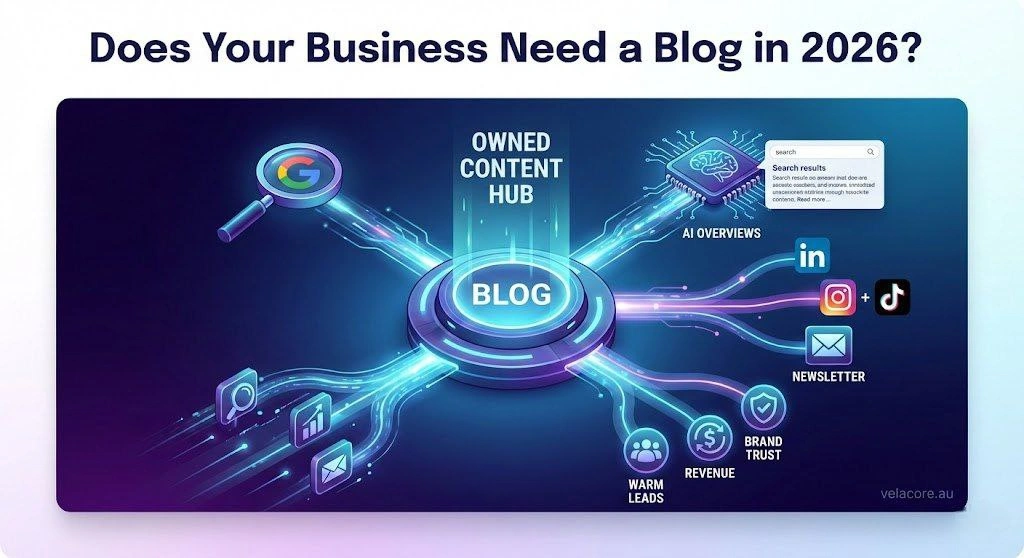
Does Your Business Need a Blog in 2026? Absolutely; Here’s the Truth.
If you’re asking does your business need a blog in 2026, the short answer is yes; more than ever.
But the long answer is more interesting.
Blogging in 2026 isn’t what it was in 2016. Search behaviour has shifted. AI Overviews are rewriting how people discover brands. And competition is no longer “who can write the longest article?” it’s who can publish content that search engines trust AND humans love?
Here’s why Australian businesses that blog strategically are pulling ahead, and why ignoring this channel in 2026 is like turning down free traffic and warm leads.
The “blogging is dead” myth
Every year since 2014 someone declares blogging dead.
They said it when Instagram launched.
They said it when TikTok exploded.
They’re saying it again now with the launch of Google AI summaries, and other AI engines.
As a result, many business owners are asking a familiar question again: Is blogging still relevant in 2026?
Recent study found that pages with regular, high-quality blog content rank higher and get 3x more traffic on average than those without; even in the age of SGE/AI Overviews.
Why? Because Google still needs sources it can trust to train its AI. And right now, fresh, authoritative, long-form content from real brands is gold.
Backlinko analysed 912 million blog posts and found longer, high-quality blogs earn significantly more backlinks, one of Google’s strongest ranking signals.
Below are fully verifiable stats:
| Metric | Why It Matters |
| Companies with blogs generate 55% more website visitors. | Blogs still outperform all other content types for discovery. |
| Businesses that blog get 68% more leads than those that don’t. | Proof that blogs directly support revenue. |
| Google holds over 93% of search engine market share in Australia. | Meaning: search-optimised blog content reaches almost everyone. |
| High-quality blog posts earn significantly more backlinks than other formats. | Backlinks remain a top ranking factor in 2026. |
| AI Overviews favour structured, expert-authored blog pages. | Shows blog pages with strong structure are cited up to 4× more. |
In summary, Yes, blogs are still relevant in 2026. Independent studies from HubSpot, Backlinko, etc, all confirm that blogs continue to outperform most other formats in traffic, leads, backlinks, and AI visibility.
This is exactly why business blogging in Australia remains so effective: it meets customers at the research stage, not the sales stage.
When a blog is 100% worth it in 2026
Blogging isn’t for every business, but for many Australian brands, it remains one of the most powerful growth levers in 2026. Here are the five specific situations where a blog delivers immediate and long-term ROI.
These are also the exact triggers Google (and now AI Overviews) rely on to decide whether your business deserves visibility.
1. Your customers research before buying
If you operate in a considered-purchase industry, a blog is no longer optional, it’s a trust engine.
This includes:
- NDIS services
- tradies (plumbers, sparkies, HVAC, roofers)
- accountants, financial planners, mortgage brokers
- healthcare practices
- real estate & property services
- SaaS and B2B consulting
Australians don’t often buy first, they Google first.
2. You need strong local SEO visibility
Service-based businesses in Melbourne, Sydney, Brisbane, Perth, Geelong, Adelaide, and regional areas rely heavily on local discovery.
Blogs help you rank for:
- suburb-based searches
- “near me” queries
- pre-purchase questions
- comparison and options-based searches
Your competitors who publish answers will outrank those who don’t.
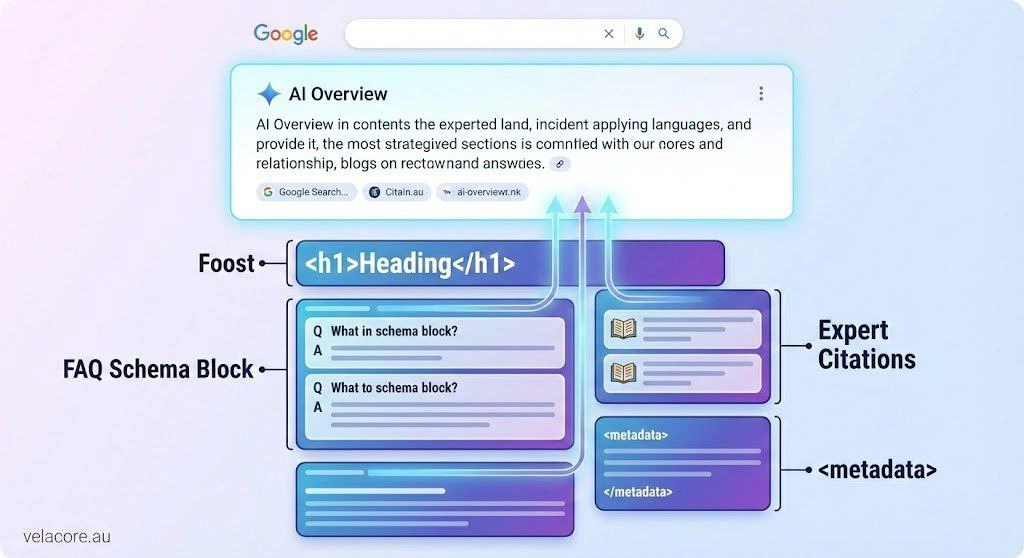
3. You want to appear in Google’s ai overviews
AI Overviews (formerly SGE) pull from:
- well-structured content
- semantic HTML
- expert-attributed insights
- frequently updated blog pages
If you’re not publishing high-quality answers, AI simply has no reason to display your brand.
4. You want higher-quality leads
A blog pre-educates your buyer before they ever call, book, or enquire.
It handles:
- objections
- comparisons
- pricing nuance
- process explanations
- safety, compliance, and accreditation details
By the time they reach your sales team, they’re warmer, which means higher conversion and fewer tire-kickers.
5. You want to reduce ad spend while increasing visibility
Paid ads stop the moment you stop paying.
Blogs compound:
- older posts continue ranking
- internal links increase your topical authority
- updates boost freshness and performance
- each post builds long-term equity
For many local Australian businesses, 3–6 strong blog articles outperform thousands in ad spend.
When you can (mostly) skip it
Let’s be real, blogging is powerful, but it’s not mandatory for every business. Here are the three legitimate scenarios where you can mostly skip a blog in 2026 without hurting your growth.
1. You sell low-consideration, impulse-buy products
If your sales come mainly from:
- TikTok trends
- Instagram Reels
- impulse gifting
- novelty or fashion items under $30
Your audience isn’t researching via Google. They’re scrolling and buying. A blog won’t move the needle as much as strong social content and paid creative.
2. Your audience does not search for what you sell
This is rare, but it applies to a few categories, such as:
- hyper-local, word-of-mouth-only services
- weekly markets and pop-up stalls
- communities with minimal online behaviour
If search demand is genuinely tiny, a blog won’t generate meaningful traffic.
3. You’re not ready to invest in quality (yet)
Modern blogging isn’t “write 500 words and hit publish.” If you’re not ready to invest in:
- expert insights
- structured content
- GEO formatting
- topic clustering
- consistent updating
then it’s better to wait.
Poor-quality blogs harm SEO in 2026 more than having no blog at all; especially now that Google’s spam policies and AI-generated content filters are stricter than ever.
How blogging has actually evolved in 2026 (do this, not that)
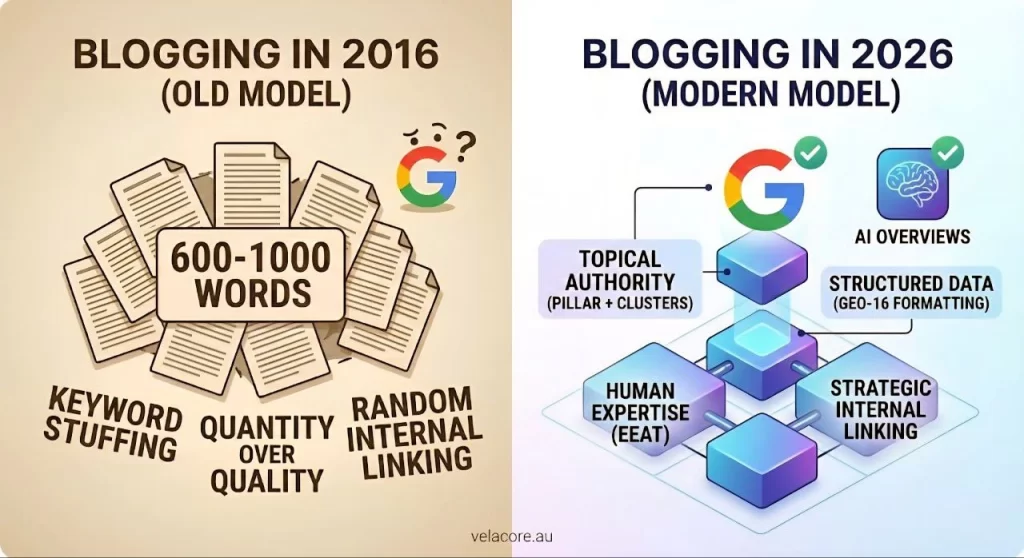
Most people who say “blogging doesn’t work anymore” are thinking of the old version of blogging; the version that worked in 2016.
But blogging didn’t die; it evolved. The shift explains why blog vs social media for business is no longer a competition. Blogs now power social content rather than compete with it.
Besides, what stopped working was the outdated approach.
Here’s exactly how the shift happened:
Blogging in 2016 vs blogging in 2026 (side-by-side table)
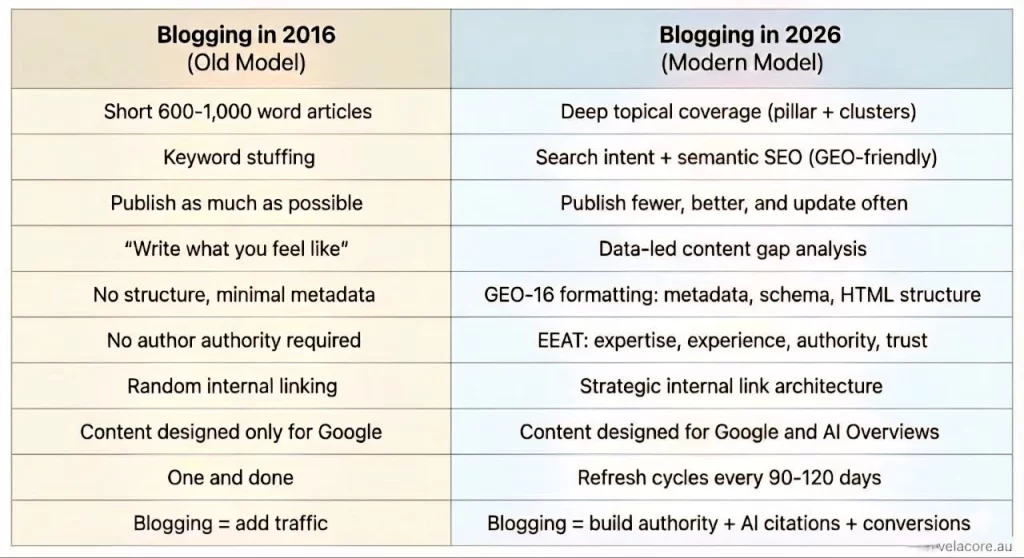
Key insight
In 2026, blogging is no longer about “writing articles.” It’s about building a topic ecosystem that:
- signals expertise
- feeds AI answer engines
- strengthens your authority
- lowers acquisition cost
- compounding your organic traffic
Benefits of blogging for businesses (what most brands still undervalue)
When many business owners think blogging, they often think only about rankings or traffic. In reality, the strongest benefits of blogging for business now sit deeper; in efficiency, decision-making, and long-term commercial leverage.
Below are benefits many businesses feel, but rarely measure.
1. Blogging reduces sales friction (shorter, better sales conversations)
A well-built blog answers questions before a prospect speaks to your team; pricing logic, processes, comparisons, risks, and expectations.
Gartner research shows that B2B buyers now spend only 17% of their buying journey meeting with potential suppliers, preferring to self-educate first.
For Australian service businesses, this means blogs quietly pre-qualify leads, reducing time wasted on low-intent enquiries and improving close rates.
2. Blogging improves decision confidence (not just awareness)
Modern buyers don’t just want options, they want reassurance they’re making the right choice.
Edelman’s Trust Barometer consistently shows that expertise-based content is one of the strongest drivers of trust in businesses.
This is where business blogging Australia-wide excels: blogs allow you to demonstrate competence, not just claim it.
3. Blogging lowers long-term customer acquisition costs
Unlike ads, blogs don’t reset every month.
According to HubSpot, content marketing delivers lower cost per lead over time, because content continues generating value after publication.
This is a major reason blog ROI for small business in Australia often improves year-on-year; even with modest publishing schedules.
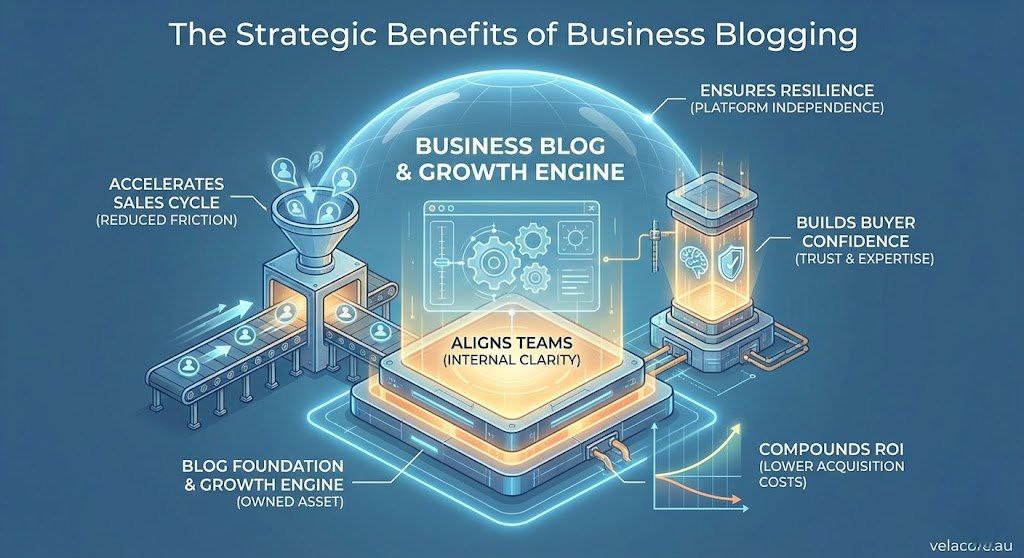
4. Blogging creates internal business clarity
An underrated benefit: writing clarifies thinking.
Teams that document processes, explanations, and positioning publicly tend to align faster internally; sales, marketing, and leadership all reference the same source of truth.
In addition, the discipline of regular content creation contributes to measurable business success. Businesses that prioritize blogging are 13 times more likely to experience a positive ROI from their marketing efforts. Furthermore, companies with blogs generate 67% more leads per month compared to those without.
Blogs often become that shared knowledge base.
5. Blogging increases brand resilience against platform changes
Social platforms change algorithms. Ad costs rise. Marketplaces tighten rules.
A blog lives on your domain.
This is why the blog vs social media for business debate is increasingly one-sided: blogs are owned assets, while social platforms are rented attention.
Search engines, AI systems, and future discovery tools still rely on independent, authoritative web sources and blogs remain the most adaptable format.
The 2026 blog system that actually works for Australian businesses
Most businesses don’t need “more content.” They need a content engine, a repeatable, predictable system that turns search demand into traffic, and traffic into warm, sales-ready leads.
Here is the exact 5-step Velacore uses for Australian clients across NDIS, trades, SaaS, professional services, finance, and healthcare.
1. Identify your content gaps (real demand, not guesswork)
We begin by analysing:
- what your audience is actually searching
- what competitors rank for that you don’t
- where AI Overviews already provide answers
- which queries signal buying intent
- the questions customers ask before they convert
This ensures you’re not writing “topics”, you’re writing answers people are actively looking for.
2. Build pillars + topic clusters (your authority framework)
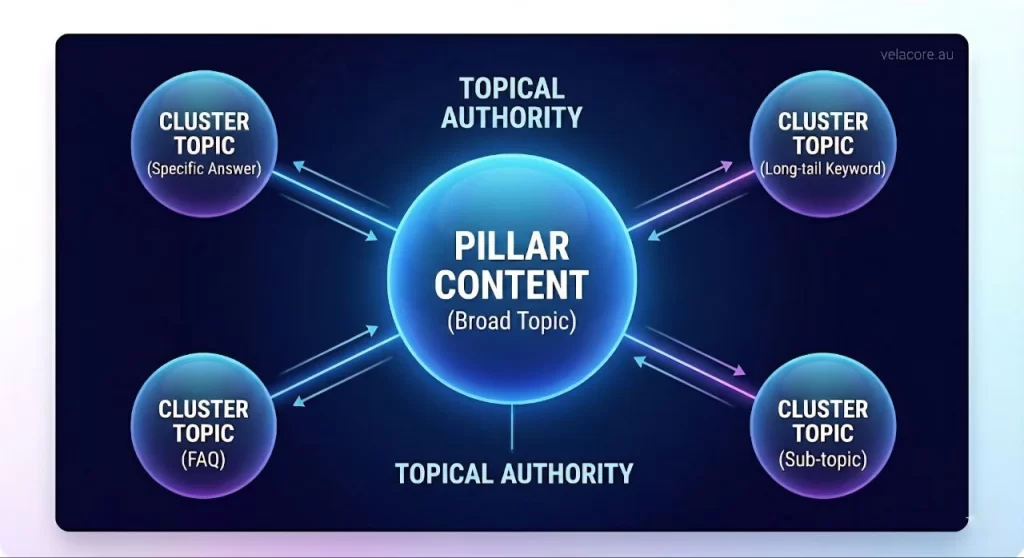
Instead of publishing random blogs, you organise content into topic ecosystems.
Example:
- Pillar: “NDIS Provider Costs in Australia”
- Clusters: “How Pricing Works”, “Travel Charges Explained”, “What Plan Managers Cover”, etc.
Google sees this structure as topical authority, and AI systems see it as expert consistency. This is what gets you cited and ranked.
3. Publish using geo-16 formatting (how you get visibility in 2026)
This step ensures your blog is recognised by both Google Search and AI Overviews.
GEO-16 best practice includes:
- semantic HTML structure
- metadata clarity
- strong headings
- clean internal linking
- FAQ blocks
- evidence, citations, and clarity markers
- schema markup for articles
This isn’t “nice to have” anymore, it’s the difference between being visible and being invisible.
4. Repurpose every blog into 12+ content assets
A modern blog isn’t just a blog. It becomes:
- a LinkedIn carousel
- short-form posts for Facebook, Instagram, TikTok
- newsletter content
- sales email scripts
- talking points for webinars
- snippets for AI assistants
- internal training material
- downloadable guides or lead magnets
One strong blog powers your entire content ecosystem for weeks.
5. Refresh your high-value pages every 90–120 days
Google rewards freshness.
AI Overviews prioritise consistently updated content.
Refreshing a blog doesn’t mean rewriting it. It means:
- updating stats
- adding clarifications
- restructuring headings
- tightening insights
- improving examples
- adding schema
- strengthening internal links
This is the secret to sustained rankings and long-term organic growth.
Why this works
It compounds.
- Each new piece strengthens the previous ones.
- Each update boosts your authority.
- Each cluster increases your probability of being cited in AI answers.
This is the version of blogging that leads to: more organic traffic, more enquiries, lower ad spend, stronger brand trust, and better AI engine visibility
Bottom line: yes, you (probably) still need a blog in 2026
So, does your business need a blog in 2026?
If your business depends on search visibility, trust, warm leads, and long-term growth, the answer for most Australian companies is still yes.
But you don’t need 100 mediocre posts.
You need 10–20 absolute bangers that you ruthlessly repurpose everywhere.
Stop thinking “blog” and start thinking “owned content hub that feeds every channel and ranks forever”.
P.S. If you think AI is just going to write all this for you and win, remember Google can already detect 96% of pure AI content and is quietly de-ranking it throughout 2025–2026. Human expertise still wins.
Ready to build a blog that actually makes you money in 2026?
Frequently Asked Questions
1. Is blogging still relevant in 2026?
Yes. Blogging remains one of the strongest ways to attract organic traffic, build authority, earn backlinks, and appear in AI-generated answers. Quality, structure, and expertise matter more than ever.
2. Do Australian small businesses really need a blog?
Yes, if your customers research before buying. A blog helps your business appear in search results, answer key questions, and build trust before a customer contacts you.
3. How long should a blog post be in 2026?
There’s no fixed length anymore. The ideal blog post is as long as needed to fully answer the topic. Depth, clarity, and structure outperform word count.
4. Does blogging help with AI Overviews?
Yes. Structured, expert-led blog content is more likely to be cited in AI-generated answers. Well-organised blog posts increase your chances of being included in AI Overviews.
5. How often should my business publish blogs in 2026?
Most businesses only need one or two high-quality posts per month, as long as they’re strategic and refreshed every 90–120 days.
6. Can a blog reduce my ad spend?
Yes. Blog content captures organic search demand, generates passive traffic, and warms up leads; reducing reliance on paid ads over time.
7. Can AI write blogs for my business?
AI can assist with drafting, but ranking content still requires human expertise, clarity, topical depth, and trustworthy insights. Human-reviewed content performs best.
8. How do I know what topics to blog about?
Start by identifying what your audience searches for, what competitors rank for, and where your content gaps are. Build topics around those areas to capture meaningful demand.
9. Does every industry need a blog?
No. Industries that rely mostly on impulse purchases or social media virality may not need one. But any industry where customers research before buying will benefit significantly.
10. How long does it take for a blog to rank?
Typically three to six months. It depends on your domain authority, internal linking, topical authority, and how frequently you update your content.