

If you’re an Australian business trying to get more leads in 2026, you’ve probably realised one uncomfortable truth: having a blog, a LinkedIn page, and a few SEO articles is no longer a content marketing strategy. Not when your competitors are pumping out AI-generated content at record speed.
The numbers paint the same picture. According to the Content Marketing Institute, more than half of B2B marketers plan to increase their content output in 2026, yet only 29% say their efforts are effective.
Meanwhile, HubSpot’s State of Marketing Report shows that content marketing remains a top growth lever globally, but only 29% of marketers can confidently measure ROI from it; a gap that heavily affects service businesses and B2B firms.
In other words: Businesses are creating more content than ever, but earning less from it.
And the demands are getting stiffer.
Google’s ongoing updates to its Helpful Content System, the rise of AI Overviews, and the explosion of “thin” AI articles mean that ranking, visibility, and trust now depend on strategic depth; not volume. Buyers are also more sceptical, decision cycles are longer, and regulated sectors (NDIS, healthcare, finance) face stricter compliance and accuracy demands.
This guide shows you exactly how to build a content marketing strategy that acts as a revenue engine, one that consistently generates qualified leads, supports sales conversations, and compounds over time instead.
Why most content marketing efforts fail
Even though more Australian businesses are investing in digital channels than ever before, most content programs still fail to produce consistent revenue. Not because content marketing doesn’t work, but because the approach is broken.
Below are the core reasons Australian businesses struggle, backed by real, verifiable insights from industry research and local buyer behaviour.
1. Content is being created without a commercial strategy
Most businesses produce blogs, social posts, and newsletters without a defined content marketing strategy, meaning:
- no revenue goals
- no buyer-journey mapping
- no alignment with sales
- no distribution plan
A recent report notes that only 29% of marketers can confidently measure content ROI, which means most teams are producing content without strategic commercial alignment.
2. Marketing and sales are misaligned
A common Australian challenge: the marketing team creates content, but the sales team doesn’t use it; or even know it exists.
The consequence?
- Buyers receive inconsistent messaging
- Sales cycles stretch longer
- Leads fall through the cracks because content doesn’t support objections or decision-making
LinkedIn’s 2024 B2B Benchmark Report found that 87% of B2B buyers expect sales and marketing teams to operate with unified messaging, yet most companies don’t achieve it.
3. Content Is optimised for traffic, not revenue
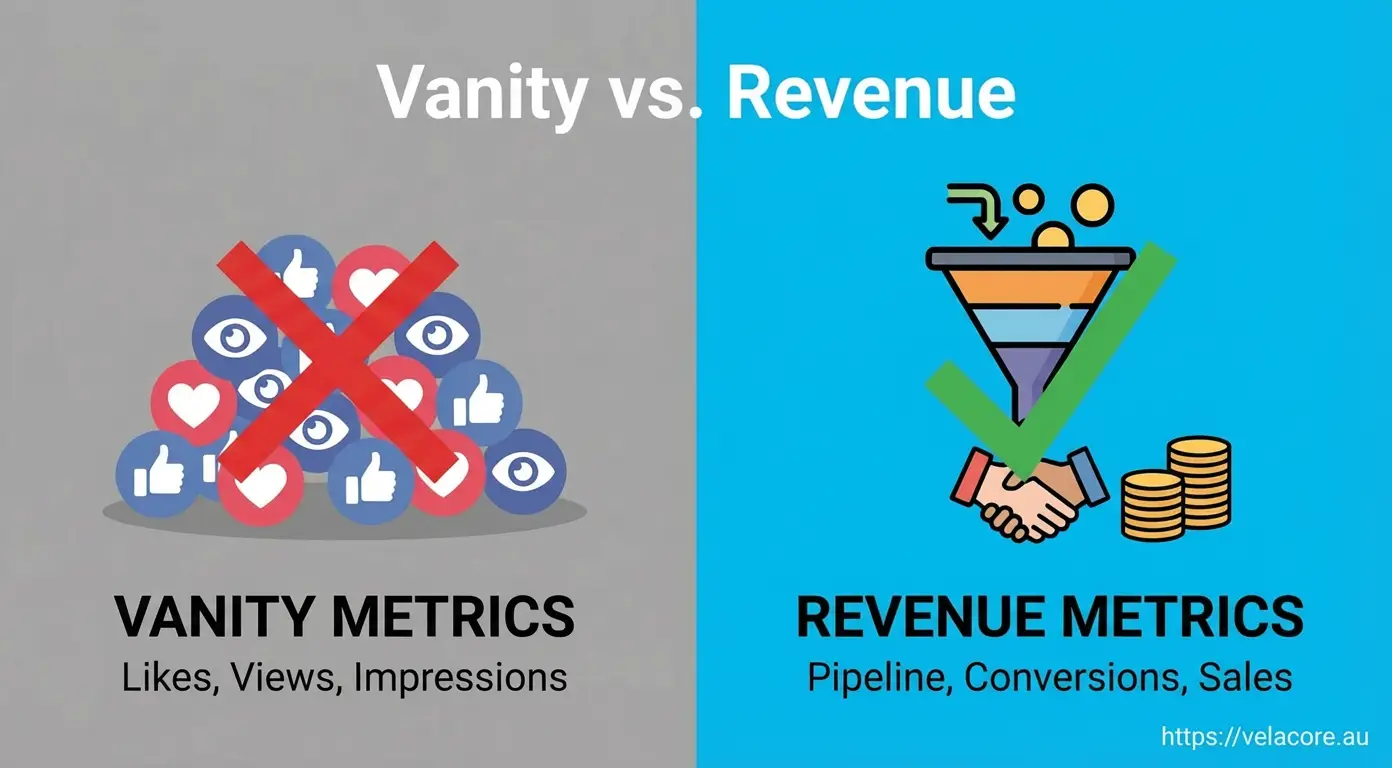
Many Australian businesses still judge performance using vanity metrics:
- impressions
- likes
- views
- raw traffic
The problem?
None of these contribute directly to sales.
Remember ranking #1 for a keyword that never converts is expensive vanity. Most B2B buyers take 7–15 touchpoints before becoming a lead, if your content doesn’t move them down-funnel, you’re leaking mone
4. Overreliance on AI without oversight
AI has made content production easier, but also more dangerous.
Many brands often publish:
- thin, generic articles
- inaccurate posts
- content with poor structure
- SEO-only content with no depth
This leads to:
- low rankings
- AI Overview exclusion
- reduced trust
- potential compliance issues (especially in NDIS, finance, healthcare)
Google’s Search Liaison team continues to emphasise that expertise, factual grounding, and original insight are required for visibility in 2026; especially with AI Overviews pulling data from high-quality sources.
5. No distribution strategy “post and pray” syndrome
Australian businesses often rely solely on:
- publishing on their website
- posting once on LinkedIn
- sending an occasional email
But modern buyers require multi-touch, multi-channel exposure.
The 2024 Edelman–LinkedIn B2B Thought Leadership Impact Report found that 55% of decision-makers won’t engage a vendor if their content is not visible or consistent across channels.
6. Ignoring compliance, local search behaviour & sector nuances
Australian industries, especially regulated ones require higher accuracy, correct terminology, and sector-specific content.
Businesses often fail to consider:
- ACCC advertising guidance
- Australian Privacy Act 1988
- NDIS Practice Standards
- Local search queries (“near me”, suburb-based terms, local spellings)
This makes content less trustworthy, less visible, and in some cases, non-compliant.
7. No Clear Positioning in a Crowded Market
Most businesses sound identical. “Leading provider of innovative solutions” could describe half the companies on Seek Business. Without a sharp “One Thing” you’re invisible in Google AI Overviews and buyer conversations.
Most content fails not because the business is doing “too little”, but because they are doing too much of the wrong thing. It could be content without a strategy, without revenue alignment, and without a framework designed for how Australians actually research, compare, and buy.
The revenue engine framework
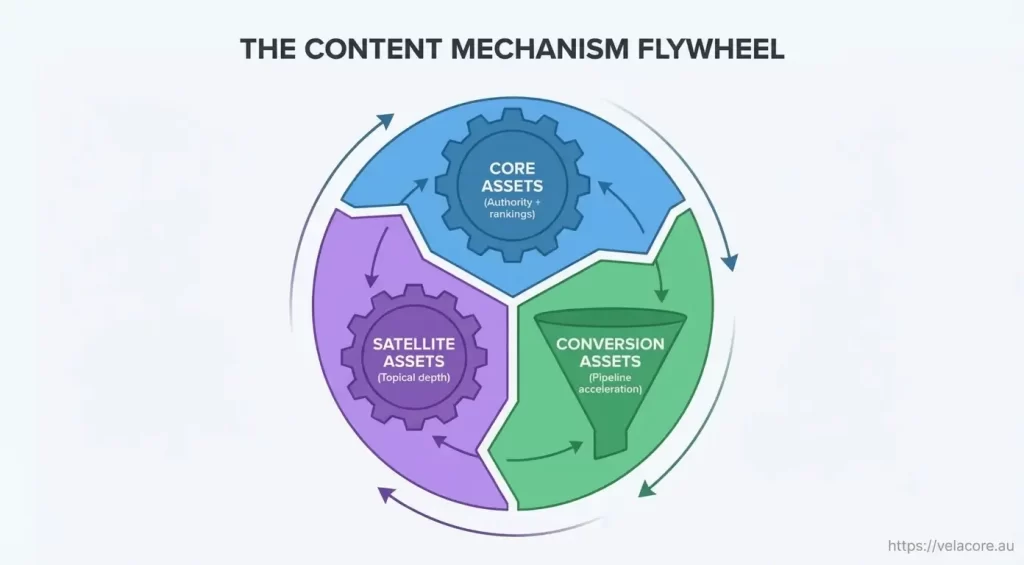
Most Australian businesses don’t struggle because they lack content. They struggle because their content floats around in isolation; a blog here, a LinkedIn post there, with nothing tying it all together. In a crowded digital landscape, a successful content marketing strategy behaves less like a publishing calendar and more like a revenue engine.
Velacore’s Australian Revenue Engine Framework was built from working with local businesses across SaaS, NDIS, finance, trade, and professional services. It reflects how Australians actually buy: slower, more risk-aware, more research-driven, and far more influenced by trust and credibility than other markets.
The framework has five components that constantly reinforce each other.
1. Strategy and Positioning: the anchor that makes content make sense
Every revenue engine begins with clarity. Without a sharp promise and a defined point of difference, even the smartest content becomes background noise.
This matters because Australians buy from brands they trust. Edelman’s Trust Barometer consistently shows trust as a non-negotiable factor in buying behaviour: 81% of people need to trust a brand before considering a purchase.
Instead of asking, “What should we publish?”, this stage asks:
- What do we want to be known for?
- Why should buyers listen to us first, not last?
- What unique insight are we defending in the market?
Once this clarity exists, content starts hitting with precision.
2. Audience and Offer Architecture: content that meets buyers where they are
Australian business purchases rarely involve one person. LinkedIn’s B2B Benchmark Report found that most B2B buying cycles involve 6–10 stakeholders, each with different priorities.
This means your content marketing strategy must reflect multi-layered buying behaviour, not a one-size-fits-all persona.
A strong architecture answers:
- What triggers a search for a provider?
- What specific anxieties stall decisions?
- What information reduces perceived risk?
- What offers (audits, calculators, demos, checklists) convert interest into action?
Here, content stops being “informative” and starts being commercially useful.
3. The content mechanism
High-performing brands don’t chase trends; they build flywheels. A flywheel is a system where content compounds; every piece strengthens the next.
Recent marketing reports found that compounding content generates 3x more leads at 60% lower cost than outbound tactics.
A modern Australian content system blends three asset types:
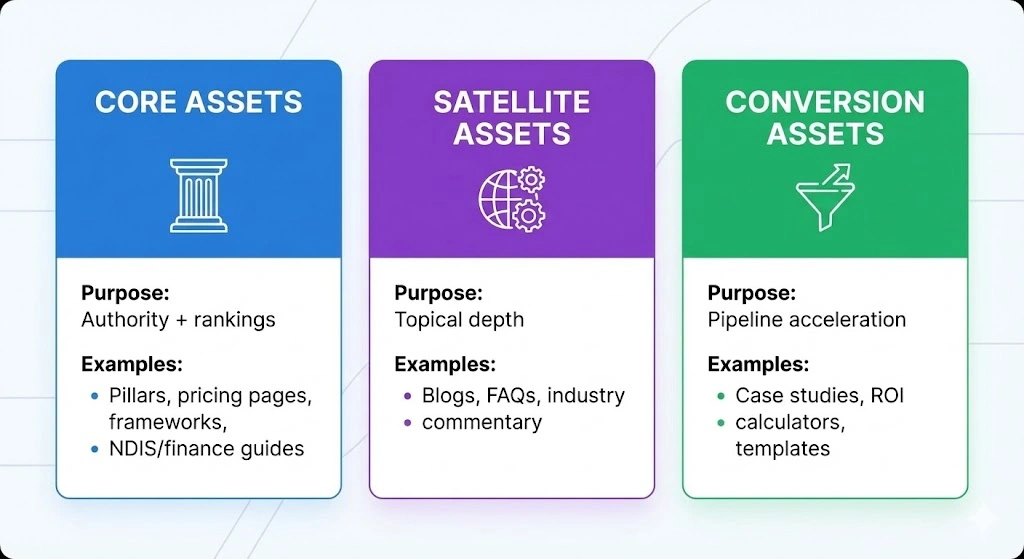
This structure helps content perform in both SEO and GEO, making it eligible for Google rankings and AI Overviews.
4. Multi-Channel Distribution: designed for Australian buyer behaviour
You don’t win by publishing everywhere. You win by showing up where trust is formed.
In 2026, the strongest trust and discovery channels remain:
- Google: still the number one channel for credibility validation.
- LinkedIn: 80% of global B2B leads originate here; Australian decision-makers rely on it heavily.
- Email: delivers an average ROI of $36 for every $1 spent.
- Industry circles: associations, trade groups, NDIS communities, professional networks.
- Partnerships & webinars: Australians place high value on peer learning and expert-led sessions.
5. The Measurement Loop: connecting content to pipeline
A revenue engine isn’t complete until it becomes measurable. In 2026, impressions are irrelevant unless they influence pipeline.
So instead of tracking vanity numbers, the revenue engine tracks:
- What content starts conversations
- What content removes objections
- What content shows up in AI Overviews
- What content influences proposals, demos, and decisions
This loop allows your content marketing strategy to improve every quarter, adapting to market behaviour, algorithm shifts, and sales feedback. You want to know what metrics to measure and how to do it? Check out this guide
The Core Insight
When these five components work together, a business stops chasing clicks and starts building trust, demand, and deal velocity. Your content begins selling long before your sales team speaks to a buyer and continues selling even when you’re offline.
That is what makes it an engine, not just a calendar.
4. Your 90-day revenue engine launch plan
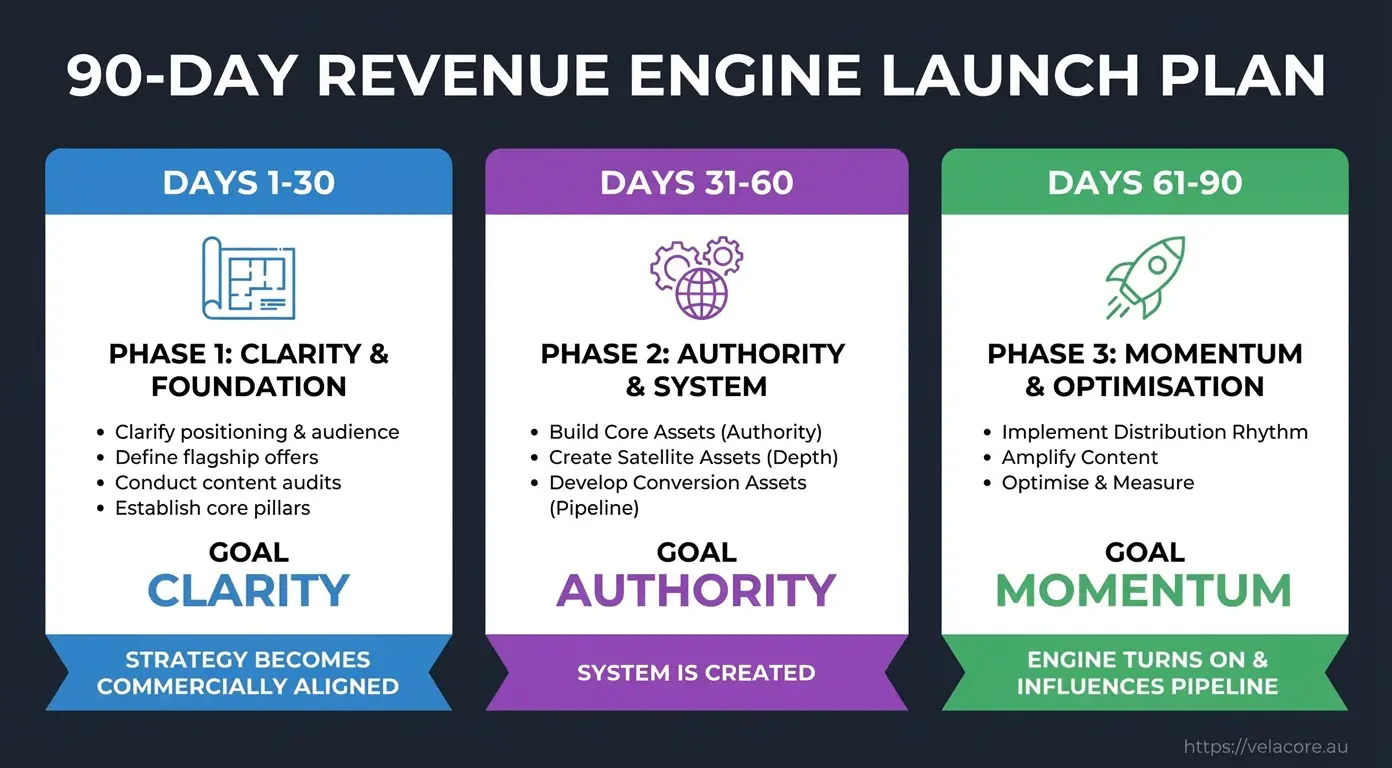
A content marketing strategy only works when it escapes the slide deck and becomes a living system. To make this practical for Australian businesses of any size, Velacore uses a simple 90-day rollout that takes you from “good intentions” to a functioning, revenue-aligned engine.
This isn’t a checklist. It’s a sequence designed to build momentum quickly while laying foundations that compound over time.
Phase 1 (Days 1–30): build the foundation
The first month is all about clarity, alignment, and assembling the pieces that will power the engine. Most businesses rush into publishing this is why their content never compounds. You should start slower, but smarter.
Your focus areas:
- Clarify positioning and core message.
- Define the flagship offers that your content will ultimately drive (e.g., revenue audits, discovery sessions, NDIS compliance check-ins, cost-saving calculators).
- Map real buying behaviour using Australian context stakeholder groups, approval layers, risks, objections, and triggers.
- Identify 3–5 core content pillars that reflect search demand and commercial value.
- Audit existing content for reuse, repurposing, or upgrading.
By the end of Month 1, you know exactly who you’re speaking to, what they care about, and what your content must achieve commercially, not just educationally.
Outcome:
A tight, validated content marketing strategy with clear revenue alignment.
Phase 2 (Days 31–60): build a content system
Month 2 is about creating the “hard-working” assets, the ones that establish authority, earn rankings, and feed your entire system for years.
We focus on three asset groups:
1. Core assets
These are the heavy lifters. They establish credibility, rank in search, and feed your broader topical authority.
Examples:
- A definitive pillar page for your primary category
- A pricing page or methodology page
- Comparison resources (“X vs Y in Australia”)
- Regulatory or compliance-focused guides (NDIS, Aged Care, financial services, workplace safety)
2. Satellite assets
Supportive, topical pieces that build depth around your primary themes. These help both SEO and GEO understand your expertise.
Examples:
- Blogs
- FAQs
- commentary pieces
- sector-specific “how-to” articles
3. Conversion assets
Tools that help buyers take the next step.
Examples:
- Case studies
- ROI calculators
- Playbooks
- Templates
- Sales-enablement explainers
During this period, you’re not just “posting” — you’re building infrastructure.
Phase 3 (Days 61–90): turn the engine on
With positioning clarified and your assets published or in motion, Month 3 is where distribution, amplification, and measurement begin.
Your focus areas:
- Roll out a structured LinkedIn distribution rhythm; thought leadership, insights, frameworks, commentary.
- Activate email sequences designed around trust, education, and low-friction calls-to-action.
- Amplify key content through webinars, partnerships, or industry communities.
- Implement reporting dashboards that connect content to pipeline influence.
- Refresh and optimise early assets based on real search and behavioural data.
Australians respond strongly to consistency and this month is where consistency becomes your advantage.
Outcome:
A functioning revenue engine producing visibility, trust, and early pipeline signals.
A Simple Snapshot of the 90-Day System
Conclusion: your content marketing strategy is no longer just “marketing” it’s infrastructure
Customer appeal has shifted over the years. Buyers are researching more deeply, relying on trusted channels, and expecting brands to demonstrate clarity, credibility, and competence long before a sales conversation ever takes place.
A modern content marketing strategy in this era is a must-have. it is the infrastructure that shapes first impressions, builds trust at scale, and quietly accelerates every stage of the buying journey.
When you combine positioning, buyer insight, a structured content systeml, intentional distribution, and continuous optimisation, you create something far more powerful than content: You create a revenue engine. A system that works in the background, attracts the right buyers, educates them, handles objections for you, and supports sales long before anyone picks up the phone.
This is the advantage your brand need in 2026; especially in markets where trust, regulation, and expertise matter.
If you’re ready to move beyond scattered content and build a system that delivers visibility, authority, and pipeline, Velacore can help you design and deploy the entire engine, from strategy to execution.
Frequently Asked Questions
1. What is a content marketing strategy?
A content marketing strategy is a structured plan that defines who you’re creating content for, what problems you’re solving, and how that content drives commercial outcomes. It connects positioning, buyer behaviour, content architecture, distribution, and measurement into one system. In 2026, a strategy isn’t just about publishing, it’s about building a revenue engine that consistently influences pipeline and buyer decisions.
2. Why is content marketing so important for Australian businesses right now?
Australian buyers are more research-driven than ever. LinkedIn reports that most B2B purchases now involve 6–10 stakeholders, and Edelman’s Trust Barometer shows that 81% of buyers won’t engage a vendor they don’t trust. A strong content marketing strategy helps build that trust at scale, especially in regulated industries like NDIS, finance, healthcare, and professional services.
3. What’s the difference between content creation and a content marketing strategy?
Content creation is tactical; producing blogs, posts, videos, newsletters. A content marketing strategy is strategic; it defines the positioning, themes, messaging, distribution, and measurement behind every piece of content. One publishes.The other builds a pipeline.
4. How long does it take to see results from a content marketing strategy?
Most Australian businesses begin seeing early signals (visibility, engagement, inbound enquiries, sales enablement value) within 60–90 days, especially when distribution is strong. Predictable revenue impact typically compounds over 4–6 months, depending on industry competition, existing domain authority, and the quality of execution.
5. What makes content marketing different in Australia?
Australia is a smaller, more relationship-driven market. Buyers expect:
- clarity
- credibility
- proof
- compliance awareness
- practical, jargon-free communication
Australian audiences don’t respond well to hype, hard-sell marketing, or generic “US-style” funnels. A strong content marketing strategy respects local behaviour and speaks directly to how Australians research and make decisions.
6. How does GEO (Generative Engine Optimisation) change content marketing in 2026?
GEO is about optimising content for AI Overviews and answer engines like Perplexity and Bing. These systems prioritise:
- structured content
- factual accuracy
- strong page metadata
- internal linking
- authority signals
- clear topical clusters
A solid content marketing strategy naturally supports GEO because it builds depth, structure, and expertise; the exact signals AI engines reward.
7. Can small businesses benefit from a content marketing strategy, or is it only for enterprise brands?
Absolutely. In fact, SMEs gain the fastest ROI because content closes the credibility gap against bigger competitors. A lean content marketing strategy with clear pillars, two or three core assets, and consistent distribution can outperform brands with much larger budgets.
8. Should content be created in-house or outsourced to an agency?
It depends on capacity and expertise. Many Australian businesses choose to partner with an agency because:
- internal teams lack the time to maintain consistency
- specialised skills (SEO, GEO, design, writing, messaging) are hard to hire
- agencies bring proven frameworks and faster execution
Velacore’s hybrid model combines strategy, content architecture, and execution, so internal teams only focus on approvals and insight-sharing.
9. How do I measure whether my content marketing strategy is working?
Move beyond vanity metrics. The signals that matter are:
- discovery visibility (Google + AI Overviews)
- engagement depth
- inbound enquiries
- content-assisted conversions
- sales cycle shortening
- pipeline creation
- attributed revenue
10. What’s the first step if I want Velacore to build my revenue engine?
Start with a Revenue Engine Audit. We review your positioning, content structure, buyer journey, search visibility, AI Overview eligibility, and current pipeline gaps, then outline a practical 90-day plan tailored to your business.