Running an SME often means wearing many hats; manager, salesperson, problem-solver, and often, marketer. With limited budgets, it’s easy to feel like digital growth is out of reach. But here’s the truth: digital marketing strategies SMEs adopt today can generate results far beyond what traditional advertising ever could.
Here’s the reality: in 2026, Australian consumers are almost entirely digital. More than 90% of the population is online daily, and the majority turn to Google or social media before making purchase decisions. Yet thousands of SMEs are still underspending or misdirecting their marketing budgets; and it’s costing them growth.
The problem isn’t lack of money. It’s lack of focus. Instead of doubling down on the channels that deliver the highest ROI, many small businesses scatter resources across too many platforms and get lost in the noise.
We’ll break down the budget-friendly digital marketing strategies SMEs need now, so you know exactly where to invest, what to avoid, and how to finally make marketing work as hard as you do.
Why digital marketing is critical for SMEs and growing brands in Australia
SMEs aren’t just a small part of the economy, they are the economy. They make up 97% of all Australian businesses, yet many still struggle with the same issue: visibility.
Traditional advertising hasn’t made it easy. A newspaper ad or radio spot can cost thousands, and once it’s out there, you have no idea who actually saw it or if it brought in a single customer. That’s where digital changes everything.
With the right strategy, digital marketing gives SMEs the three things they need most:
- Precision – Instead of shouting at everyone, you can talk directly to the people who are most likely to buy. Whether it’s targeting by postcode, interest, or behaviour, your ads can land exactly where they’ll matter.
- Measurable results – No more guessing. Digital lets you track every click, every conversion, every dollar. If something’s working, you double down. If not, you re.
- Flexibility – You don’t have to gamble big. Start small, even $10 a day, and scale only when you’re confident it’s paying off.
The beauty of digital is its fairness. You don’t need the deepest pockets; you need the sharpest strategy. A local family-run business can appear on the same Google search page as a multinational. A café in Melbourne can attract more Instagram engagement than a global coffee chain. When done right, small can outsmart big.
The real magic, though, is in sustainability. A Facebook ad may bring customers this week, but a blog post or SEO-optimised page can keep bringing leads for months, even years.
Budget-friendly digital marketing strategies SMEs can use for maximum ROI
The beauty of digital marketing is that it isn’t about how much you spend, it’s about where and how you spend it. For SMEs in Australia, the smartest path isn’t trying to do everything, but doubling down on strategies that consistently deliver strong returns. Let’s break down Let’s break down the best digital marketing strategies for small business that SMEs can apply immediately to deliver the best results.
1. Email marketing – the king of ROI
If there’s one channel that proves small budgets can deliver big results, it’s email. On average, for every $1 spent on email marketing, businesses see a $42 return. No other channel comes close. This is why email marketing ROI for SMEs is unmatched.
Why it works so well for SMEs:
- Low cost: Unlike ads, there’s no bidding war for attention.
- Personalisation: A well-segmented list boosts open and click rates.
- Automation: Once set up, emails keep nurturing leads without extra effort.
Getting started doesn’t require fancy tools. Australian SMEs can use free or low-cost platforms like Mailchimp or MailerLite. Begin simple; a monthly newsletter with updates, tips, or offers. The secret isn’t perfection, it’s consistency.
2. Content marketing & blogging – build trust on a budget
Blogging isn’t just about traffic; it’s about trust. Businesses that blog are 13x more likely to achieve positive ROI than those that don’t.
Affordable strategies SMEs can use right now:
- Answer common customer questions through blog posts (saves time on support too).
- Share case studies featuring local clients; helps to proof sells.
- Optimise posts with local keywords, e.g. “best café in Sydney CBD.
The payoff? 82% of companies who blog regularly report ROI. In fact, content marketing for small businesses in Australia is one of the best digital marketing strategies because it builds authority and visibility over time.
3. Smart paid ads: when precision beats scale
Paid ads often get dismissed as “too expensive,” but when done strategically, they’re among the fastest ways to drive leads. Studies show Google Ads delivers an average 200% ROI, implying $2 for every $1 spent.
How SMEs can keep costs tight:
- Use geo-targeting to limit ads to your service area.
- Start small, test, and scale only campaigns that prove ROI.
- Focus on Google Search Ads, which capture high purchase intent.
SMEs running tightly targeted Google Ads campaigns can often see up to 8x ROI.
4. Social media: brand awareness without overspending
Australians spend nearly 2 hours daily on social media. It’s where your customers already are, making it a natural space for SMEs to connect.
Budget-friendly moves:
- Focus on one or two platforms where your audience is most active.
- Use free tools like Canva for content creation.
- Encourage user-generated content; customer photos, reviews, and tags build trust faster than ads.
Pro tip: Avoid spreading yourself thin. It’s better to own Instagram or LinkedIn with consistent posts than post weakly across five platforms.
This is one of the simplest ways of showing how SMEs can use social media marketing effectively while keeping costs low.
5. Allocate budget smartly; what works for SMEs
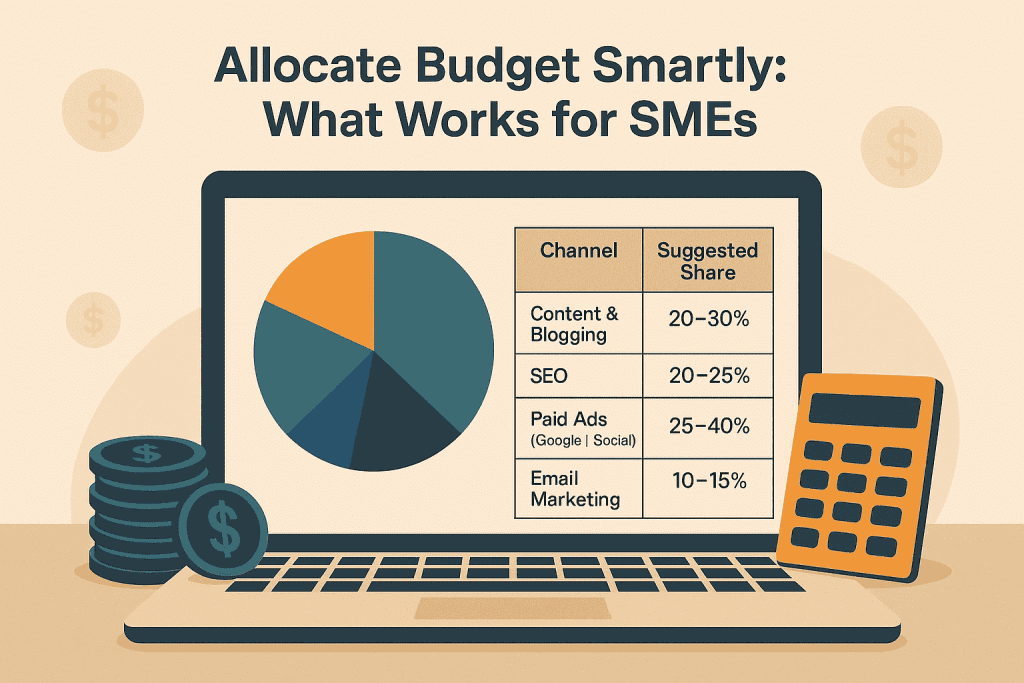
At Velacore, we believe there’s no one-size-fits-all formula for SME marketing budgets. While guidelines exist, the final split should always depend on your business goals, target market, audience behaviour, and even the seasonality of your industry.
For example, a local café might benefit from putting more into social media and content, while a B2B consultancy may need to prioritise SEO and email. The key is balance; spreading resources across channels while leaving enough room to double down on what actually works for your business.
In practice, many SMEs find success with a mix like this:
| Channel | Suggested Share | Why it matters |
| Content & Blogging | 20–30% | Builds long-term visibility |
| SEO | 20–25% | Sustained organic leads |
| Paid Ads (Google + Social) | 25–40% | Quick conversions |
| Email Marketing | 10–15% | Highest ROI channel |
But remember, this isn’t a rigid rule. Your ideal mix may look very different depending on your market and growth stage. The most important step is to track results closely, then tweak the budget regularly to reflect what’s working best.
At Velacore, we help SMEs design campaigns and tailor the right-fit budget for their unique goals. Whether you’re chasing quick wins, long-term growth, or both, we’ll make sure every dollar works harder for your business.
6. Measure, tweak, repeat; the ROI loop
Digital marketing is never “set and forget.” What works today might underperform tomorrow, which is why tracking ROI is non-negotiable. By keeping an eye on the right numbers, SMEs can quickly spot what’s driving growth and what’s draining budget.
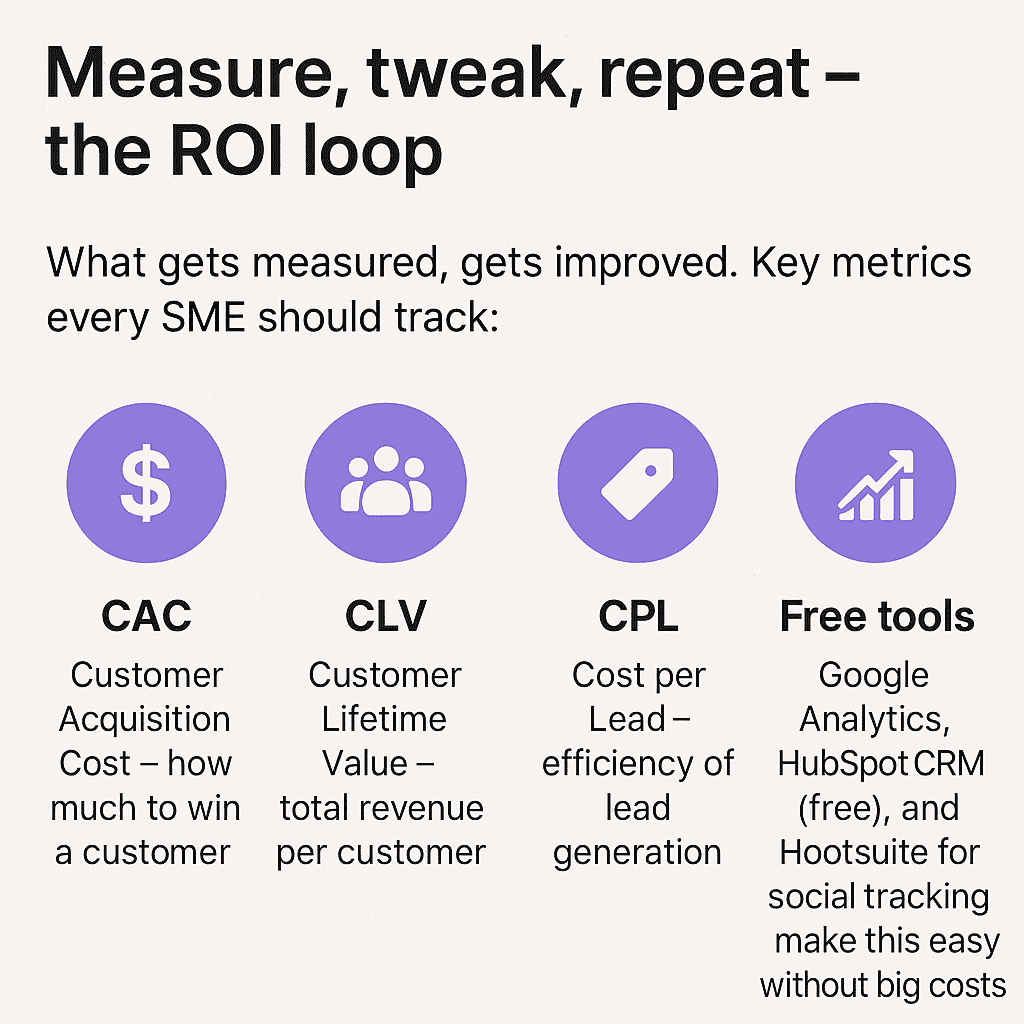
Key metrics every SME should track:
- CAC (Customer Acquisition Cost): The average spend to gain a new customer.
Formula: Total marketing spend ÷ number of new customers acquired.
Why it matters: If CAC is higher than what a customer is worth to your business, you’re running at a loss. - CLV (Customer Lifetime Value): The total revenue a customer is expected to generate over their entire relationship with your brand.
Often estimated as: Average purchase value × purchase frequency × customer lifespan.
Why it matters: CLV helps you see whether your CAC is sustainable and guides decisions on how much you can afford to spend on acquisition. - CPL (Cost per Lead): The cost of generating a qualified lead.
Formula: Total campaign spend ÷ number of leads generated.
Why it matters: A low CPL means your campaigns are efficient at filling the pipeline, but it should always be weighed against lead quality.
The magic happens when you measure, tweak, and repeat. The biggest benefit here lies in your ability to measure ROI in digital marketing, make adjustments, and reinvest where the results are strongest.
Free tools like Google Analytics, HubSpot CRM (free), and Hootsuite make this simple by helping SMEs measure performance without adding to overheads.
7. Emerging edge: AI & personalisation
AI isn’t just for big business anymore. Today, SMEs can use free or low-cost tools; chatbots, content generators, personalisation engines to compete smarter. Research shows AI-driven personalisation can lift conversions by 20–30% (Arxiv, 2025).
Start small: add a chatbot for FAQs or use AI-assisted content creation. The goal isn’t to replace human touch, but to scale efficiency and improve engagement without ballooning costs.
Conclusion: ROI is about focus, not spend
Here’s the truth: SMEs don’t fail in digital because of budget. They fail because of scattered focus; spreading limited resources too thin across too many channels, without the clarity of what actually works.
ROI isn’t about spending more; it’s about spending smarter. When SMEs invest strategically in high-return areas like email marketing, content, smart paid ads, social media, and continuous measurement, they experience significant growth. At Velacore, we help SMEs cut through the noise, design campaigns that matter, and build tailored budgets that deliver measurable ROI. Because your marketing dollar should be working just as hard as you do. Let’s talk already.
Is Your Website Working for You?
Most websites don't generate leads. We fix that with custom designs that look great and deliver measurable results for your business.
Get Started With Velacore