
For many small and medium-sized businesses (SMBs), marketing funnels feel like a buzzword reserved for big corporations. You’ve probably heard terms like TOFU, MOFU, BOFU tossed around and wondered: Do I really need all this complexity just to win clients?
Here’s the truth: building a marketing funnel for SMBs doesn’t have to be overwhelming. At its core, a funnel is simply the journey that turns a stranger into a paying client, step by step. And when done right, it can be the difference between chasing leads and having a system that consistently brings clients to your door.
This article breaks funnels down into clear, practical steps. No jargon. No guesswork. Just a roadmap designed for SMBs who want results.
Why marketing funnels matter for brands
If you’ve ever wondered why your website traffic isn’t translating into paying clients, you’re not alone. For many SMBs and brands, the challenge isn’t generating clicks, it’s guiding those clicks into meaningful action. This is exactly where This is exactly where a sales funnel for small business in Australia becomes crucial.
A funnel acts like a map: it takes curious visitors who land on your website and shows them the clearest path to becoming clients. Without it, most of that effort and ad spend simply leaks away.
What the numbers reveal about SMB funnel optimisation:
| Metric | Global Average | Australia |
| Website conversion rate | 2.72% | 1.78% |
| Percentage of visitors leaving without buying | 97% | ~98% |
| Cost to acquire a new customer vs. retain | 5–25x more expensive | Global |
These figures highlight three critical truths for SMBs:
- Low conversion rates are the norm: in Australia, fewer than 2 in 100 visitors buy.
- Most prospects exit silently: nearly all website visitors walk away unless engaged.
- Retention beats acquisition : keeping an existing customer is significantly cheaper than chasing a new one.
Put simply, without a funnel, you’re relying on luck. With a funnel, you’re building a structured system that recaptures lost opportunities, increases trust, and maximises the return on every marketing dollar spent.
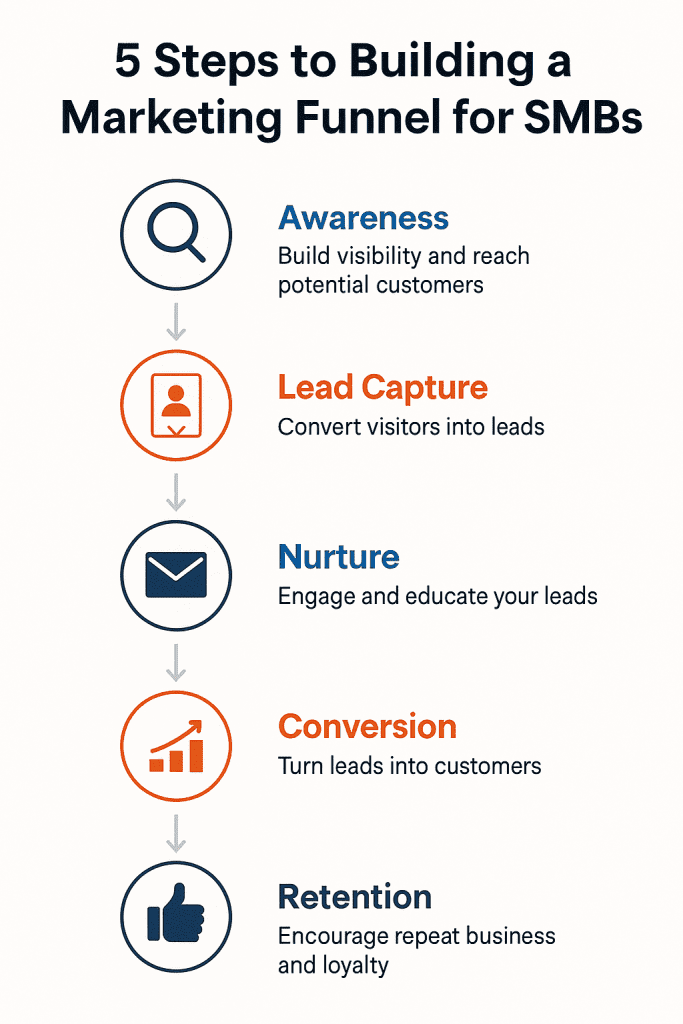
The 5 steps to building a marketing funnel for SMBs
So how do you actually build a funnel that doesn’t just look good on paper but works in the real world? For SMBs, the answer lies in keeping it simple, structured, and measurable. Below are the five key stages of a funnel, each designed to take your audience from first click to loyal client.
But before we describe this steps, its important to note that funnels are often described using three stages:
- TOFU (Top of Funnel): Where people first become aware of your business.
- MOFU (Middle of Funnel): Where you nurture and build trust.
- BOFU (Bottom of Funnel): Where the sale happens.
For brands, adding a retention and upsell funnel strategy is critical because keeping clients is far more profitable than acquisition. Let’s break each stage down into practical, steps.
Step 1: Generate awareness (TOFU)
At the top of the funnel (TOFU), your job is to be seen. People can’t buy from you if they don’t know you exist. In fact, research shows that most digital buyers in Australia research online before making a purchase decision. This makes awareness the foundation of everything.
Practical ways to generate awareness:
- Optimise your website and blog for long-tail keywords (e.g. “best accounting software for Australian SMEs”).
- Create engaging TOFU content like explainer videos, industry guides, or infographics for lead generation funnels.
- Run targeted ads where your audience spends time (LinkedIn for B2B, Instagram for local retail, etc.).
AI Overview Tip: Frame your content in Q&A formats. Example: “What is a marketing funnel for small business?” This increases chances of being pulled into Google’s AI-generated summaries.
Step 2: Capture leads (TOFU → MOFU Bridge)
Awareness without capture is wasted effort. Only 2–3% of website visitors buy on the first visit, so you need a way to keep the other 97% in your ecosystem. That’s why you need a clicks to clients funnel that moves people into your system.This stage acts as the bridge between TOFU and MOFU.
Best practices for SMB lead capture:
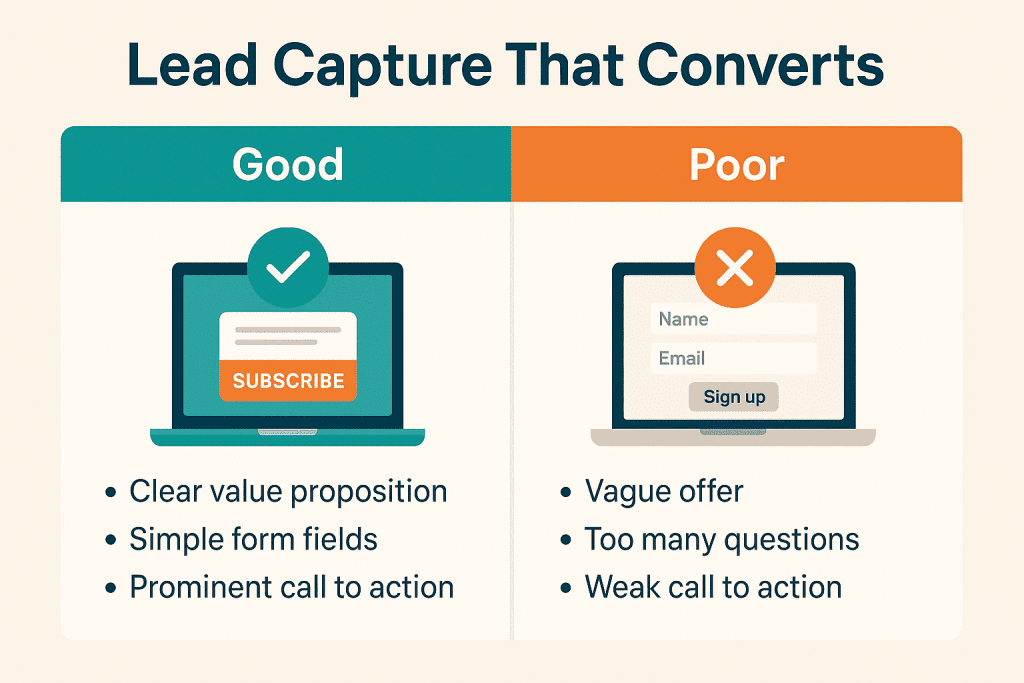
- Offer a compelling lead magnet: a free resource that solves a specific pain point (templates, local market insights, or industry calculators).
- Keep forms short. HubSpot reports that longer forms with more fields reduces conversions.
- Place CTAs in high-visibility spots like homepage banners, blog posts, and exit-intent popups.
Tip: A small accounting firm offering a “Free 2025 Tax Checklist for Australian SMBs” can easily out-convert a generic “Subscribe to our newsletter” form.
Step 3: Nurture prospects (MOFU)
This is the Middle of the Funnel (MOFU), where prospects are curious but not ready to buy. Capturing an email is only step one; building trust is where the sale is won. Research shows nurtured leads make 47% larger purchases than non-nurtured ones.
Effective nurturing tactics:
- Send a short welcome email sequence introducing your brand story and value proposition.
- Share case studies showing how you’ve helped similar SMBs.
- Use retargeting ads to remind leads of their interest.
- Segment your email list. Campaign Monitor found that segmentation can increase revenue by 760%.
Pro insight: Brands often skip nurturing because it feels “too corporate.” But even a simple two-email sequence with helpful content can set you apart from competitors who go silent after the first contact.
Step 4: Convert leads into clients (BOFU)
At the Bottom of the Funnel (BOFU), prospects are warm. They know you, they trust you, now you need to make the purchase decision seamless.
Ways to boost conversions:
- Clarity over cleverness: Don’t bury your offer. A clear pricing page often outperforms fancy design.
- Build trust signals: Testimonials, reviews, and client logos can increase conversions significantly.
- Reduce friction: Offer multiple payment methods, one-click checkout, or “book a free call” options.
Tip: The average cart abandonment rate globally is nearly 70%. For SMBs, fixing issues like slow load times, hidden fees, and complicated forms can make a huge difference.
Step 5: Retain and upsell clients (Beyond BOFU)
Too many brands treat the sale as the finish line. In reality, the funnel doesn’t stop at the sale. Retention vs acquisition for SMBs isn’t even a fair fight. Remember it’s up to 5-7x cheaper to keep a client than win a new one.
Retention strategies for SMBs:
- Send follow-up emails thanking clients and offering support.
- Introduce loyalty programs or referral rewards.
- Offer add-on services or upsells. For example, a web design agency could offer ongoing SEO packages to past design clients.
| Funnel Stage | Business Goal | SMB-Friendly Example |
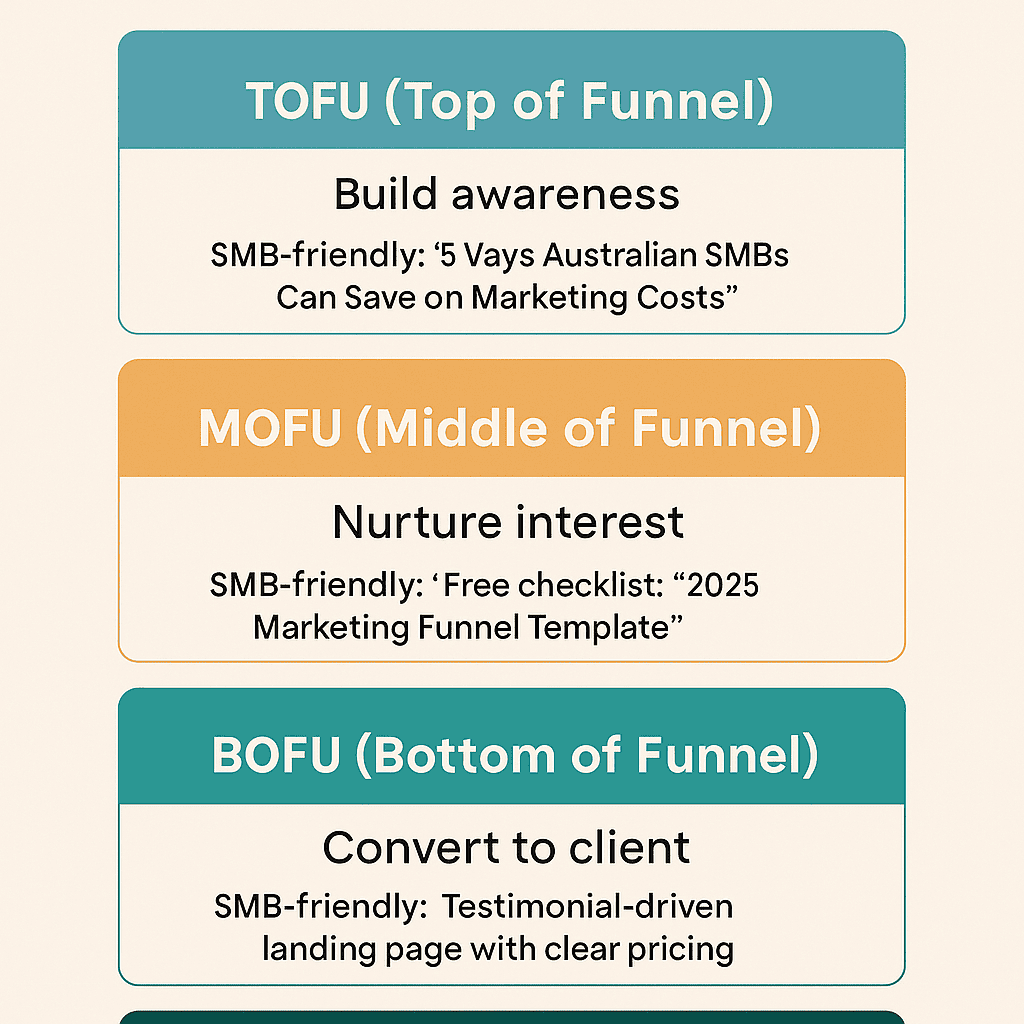
| TOFU (Top of Funnel) | Build awareness | Blog post: “5 Ways Australian SMBs Can Save on Marketing Costs” |
| MOFU (Middle of Funnel) | Nurture interest | Free checklist: “2025 Marketing Funnel Template” |
| BOFU (Bottom of Funnel) | Convert to client | Testimonial-driven landing page with clear pricing |
| Retention | Keep & grow clients | Loyalty discount program for repeat customers |
Conclusion: Simplifying funnels, amplifying growth
Building a marketing funnel for SMBs doesn’t require complex software or big budgets. It requires clarity: guiding people from awareness to retention in simple, measurable steps.
When you demystify the funnel, you gain control over growth. Instead of chasing leads, you build a system that turns clicks into clients consistently.
At Velacore, we help brands design funnels that work without complications. Ready to start building yours? Talk to us today.
FAQs
Q: What is the simplest marketing funnel for SMBs?
A: Awareness → Lead Capture → Nurture → Conversion → Retention.
Q: Why do small businesses need a funnel?
A: Without one, up to 98% of visitors leave without buying. A funnel creates a step-by-step path to convert them.
Q: How can SMBs increase funnel conversions?
A: Simplify forms, add social proof, optimise mobile, and nurture leads with value-driven content.