
Choosing between Squarespace, WordPress, and a custom-built website is one of the most debated decisions in the Australian small business world. Ask five different web designers and you will probably get five different answers, each one shaped by their own experience, favourite tools, and yes, sometimes their own commercial interests. This article takes a different approach. We lay out the honest facts about all three options, including real Australian pricing, the genuine strengths and weaknesses of each platform, and most importantly, a practical framework to help you figure out which one actually makes sense for where your business is right now.
There is no single correct answer when it comes to Squarespace vs WordPress vs custom website. The right choice depends on your budget, your technical comfort level, how fast your business is growing, and what you actually need your website to do. What we can do is give you the clearest picture possible so you can make that call with confidence.
What Exactly Are We Comparing?
Before we dive into the comparison, it helps to understand what each of these three options actually is, because they are fundamentally different things.
Squarespace is an all-in-one website builder. You pay a monthly or annual subscription, and everything including hosting, security, templates, and support is bundled together in one platform. You do not need to know how to code. You pick a template, customise it, and publish.
WordPress (specifically WordPress.org, the self-hosted version) is an open-source content management system. It is free to download, but you need to arrange your own hosting, your own domain, and manage your own updates and security. 43.4% of websites, making it by far the most widely used CMS in the world. That dominance comes partly from its flexibility, with 60,000+ plugins and 14,000 themes. That power, however, comes with a steeper learning curve.
A custom website is built from scratch by a developer or web design agency. There is no template involved. Every element including the design, the functionality, the code, and the underlying technology is created specifically for your business. It is the most expensive option by a significant margin but also the most powerful and the most differentiated.
How Each Platform Stacks Up
Ease of Use
Squarespace wins this category outright. The drag-and-drop interface is genuinely intuitive, the templates are beautiful out of the box, and you can have a professional-looking website live within a day or two without any technical background. If you have ever used a tool like Canva, you will feel at home in Squarespace almost immediately.
WordPress has a reputation for complexity, and it is at least partly earned. Setting up a WordPress site requires choosing a hosting provider, installing WordPress, selecting a theme, and then figuring out which plugins you need. Modern page builders like Elementor have made the design side much more manageable, but there is still a meaningful learning curve compared to Squarespace.
A custom website requires virtually zero input from you on the technical side, because a developer handles everything. The trade-off is that making changes after launch typically requires either developer support or a content management system built into the custom site.
Cost: What You Will Actually Pay in Australia
Cost is where things get interesting, and where a lot of business owners get surprised.
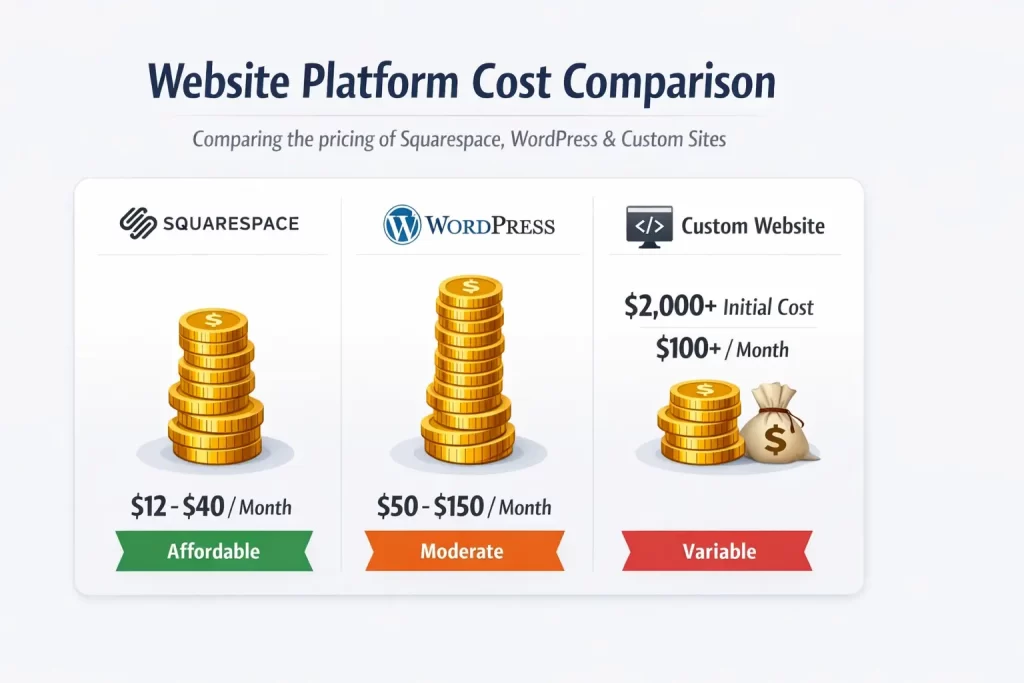
Squarespace pricing in Australia currently ranges from AU $17 to $69 per month billed annually. For most small businesses, the Core plan at around AU $28 per month is the most practical option. Over five years on the Core plan, you are looking at roughly AU $1,680 in subscription fees alone, before any designer costs to set the site up.
WordPress costs vary widely because you are assembling the pieces yourself. You will need hosting (typically AU $10 to $100 or more per month depending on quality), a domain name (AU $15 to $30 per year for a .com.au), and potentially premium themes and plugins (AU $50 to $200 each per year). If you hire a developer to build the WordPress site for you, expect to pay AU $3,000 to $8,500 for a professionally built site. The ongoing cost to host and maintain a WordPress site typically runs AU $500 monthly or more for managed support.
Custom websites represent the biggest upfront investment. Custom builds typically cost AU $5,000 to $25,000 for small to medium-sized businesses, with enterprise builds often exceeding AU $100,000. On top of the build cost, you will have ongoing hosting, maintenance, and support expenses.
Rough three-year cost comparison:
- Squarespace (DIY setup): AU $1,000 to $2,500 total
- WordPress (professional build and hosting): AU $6,000 to $15,000 total
- Custom website (agency build and maintenance): AU $15,000 to $40,000 or more
Search Engine Optimisation (SEO)
This is one of the most commonly debated aspects of any platform comparison, and it deserves an honest answer rather than a platform-biased one.
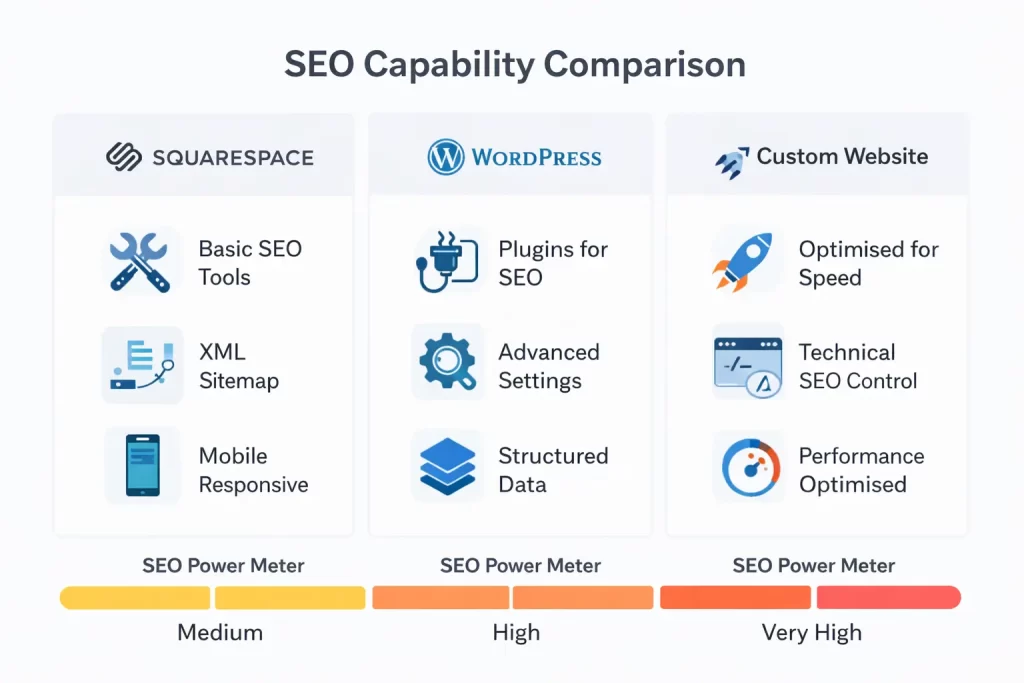
WordPress gives you more SEO control. Plugins like Yoast SEO and Rank Math allow you to fine-tune everything from metadata and canonical URLs to XML sitemaps and structured data. You have full access to the site code, which means developers can implement advanced technical SEO improvements.
Squarespace has solid built-in SEO tools covering the essentials: customisable page titles, meta descriptions, clean URL structures, automatic XML sitemaps, and mobile-responsive templates. It also integrates with Google Search Console. For businesses not competing in highly competitive markets, Squarespace’s SEO is For most small businesses not competing in highly competitive keyword markets, Squarespace’s built-in SEO capabilities are sufficient.
The key distinction is this: Squarespace handles the basics very well, while WordPress gives you the ceiling to go further if you need to. If organic search traffic is critical to your business model, WordPress has the advantage. For local businesses or creative professionals primarily building credibility, the gap is much smaller than many articles suggest.
Custom websites, when built properly, can be the strongest SEO performers of all three options, because every aspect of the code, page speed, and technical architecture can be optimised from the ground up.
Flexibility and Customisation
This is where Squarespace’s limitations show most clearly. The templates are stunning, but you are working within Squarespace’s framework. You cannot install third-party plugins the way you can on WordPress, and while custom code is possible on some plans, there is a ceiling on what you can build.
WordPress is almost infinitely flexible by comparison. The plugin ecosystem means there is a pre-built solution for almost any feature you could want, from booking systems and membership areas to complex e-commerce setups and multilingual sites. The trade-off is that managing a large plugin library comes with its own headaches including compatibility issues and performance overhead.
Custom websites have no ceiling. If you need a feature that does not exist anywhere else, a developer can build it. This is the option for businesses with genuinely complex requirements, unique functionality, or a brand experience that cannot be achieved through templates.
Security
Squarespace handles all security for you. SSL certificates, software updates, and server-level security are all managed by the platform. You do not need to think about it, which is a genuine advantage for non-technical business owners.
WordPress requires active security management. Because it is open-source and widely used, WordPress sites are frequently targeted by automated attacks. Research shows 92% of breaches stem from outdated plugins, making regular maintenance non-negotiable. If you are running a WordPress site without managed hosting and regular upkeep, security is a real risk worth taking seriously.
Scalability
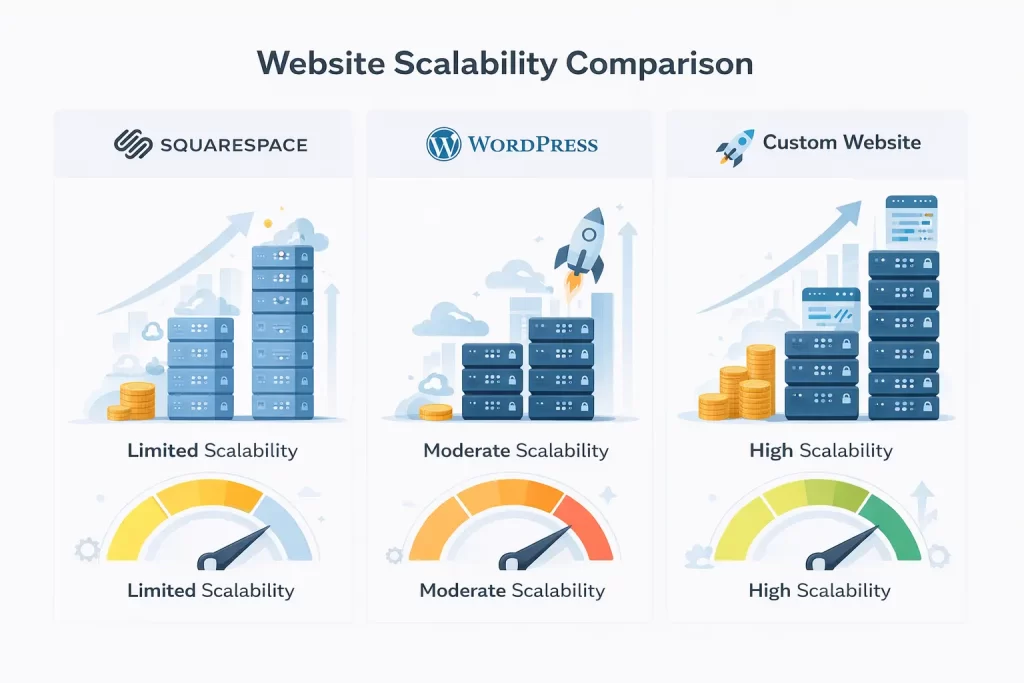
Squarespace handles growth reasonably well for small to medium-sized businesses. Where it starts to struggle is when you need highly customised functionality, very high traffic volumes, or complex integrations that go beyond its available extensions.
WordPress scales very well. Thousands of high-traffic websites run on WordPress, and with the right hosting infrastructure, it can handle significant growth. The open-source nature of the platform means you are never locked into one provider’s roadmap.
Custom websites can be built to scale from the beginning, which is particularly relevant for businesses with ambitious growth plans or complex technical requirements from day one.
The Business Stage Framework: Which Platform Is Right for You Right Now?
One thing that almost no comparison article covers is that the best platform changes depending on where your business is in its journey. Here is a practical framework to help you cut through the noise.
| If you are just starting out: Consider SquarespaceYou need a professional online presence quickly and cost-effectively.You do not have a dedicated web team or developer on hand.You are still testing what your customers respond to.Getting your business in front of people matters more right now than having a technically perfect website.Best for: New businesses, freelancers, photographers, consultants, service providers with straightforward offerings.Budget: AU $200 to $800 per year. |
| If you are growing and SEO or content matters: Consider WordPressYou are publishing content regularly and want real control over your SEO strategy.You need integrations that Squarespace cannot support.You are running campaigns that need more sophisticated tracking and landing page capability.The higher upfront cost pays for itself over time if organic traffic and inbound leads are core to your strategy.Best for: Growing small businesses, service companies running content marketing, e-commerce stores needing flexibility.Budget: AU $4,000 to $15,000 to set up professionally, then AU $500 or more per month ongoing. |
| If you are established and your website is a core business asset: Consider customYour brand needs to stand apart from competitors using the same templates.Your website needs to do something specific that templates cannot replicate.You are investing in long-term digital infrastructure, not just a digital brochure.Best for: Established businesses, companies where the website is the primary sales channel.Budget: AU $15,000 to $50,000 or more. |
If you are currently running an outdated site and weighing up whether to rebuild or redesign, our article on website redesign costs walks through exactly what to expect across each platform.
The Hidden Costs Nobody Tells You About
Every platform comparison article lists headline pricing, but the true cost picture is more complex. Here is what to watch for with each option.
Squarespace: Watch for
- Transaction fees on sales, which range from 0% to 2%
- Premium extensions for functionality not included by default
- Third-party email marketing tools if Squarespace’s built-in campaigns are not enough for your needs
- Professional setup costs if you hire a Squarespace designer
- The cost of eventual platform migration if you outgrow it
WordPress: Watch for
- Premium plugins at AU $50 to $200, and you may need several
- Managed hosting that keeps your site secure and fast, typically AU $100 to $300+
- Developer time for updates, customisations, and fixes
- Security incidents, which can result in significant recovery costs if a site is compromised
Custom website: Watch for
- Developer hourly rates average AU $100 to $180
- Hosting and infrastructure costs
- Long-term dependency on the original developer or agency if the project is poorly documented
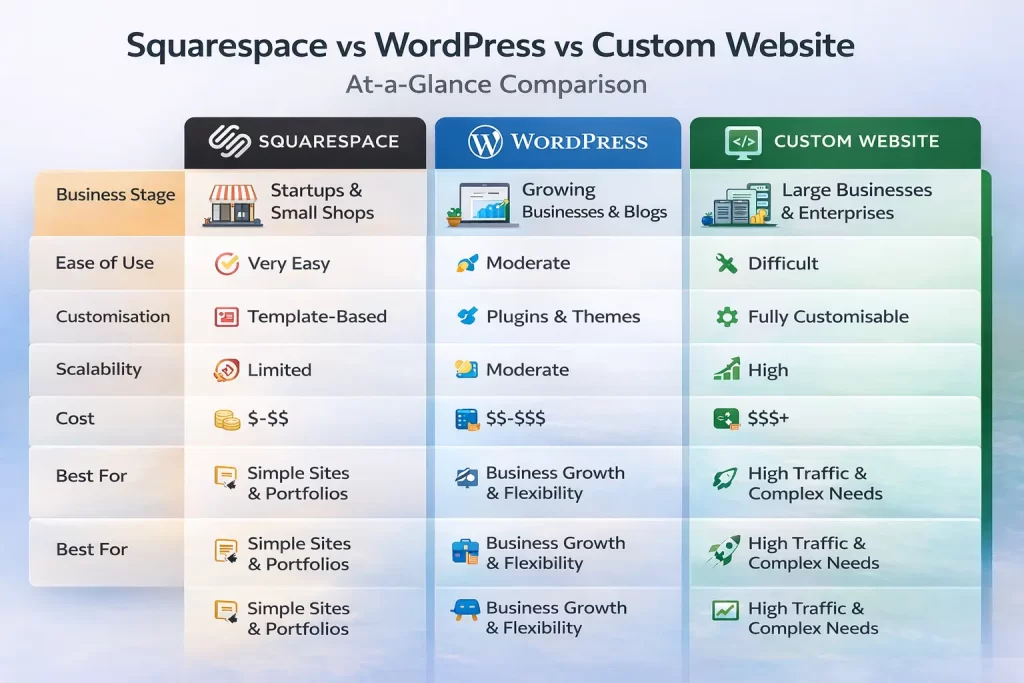
Squarespace vs WordPress vs Custom Website: At a Glance
| Feature | Squarespace | WordPress | Custom Website |
| Setup Ease | Very easy | Moderate | Handled for you |
| Monthly Cost (AU) | $17 to $69 | $10 to $100+ (hosting) | Varies |
| Build Cost (AU) | $0 to $3,000 | $3,000 to $8,500 | $5,000 to $50,000+ |
| SEO Control | Good basics | Advanced | Fully custom |
| Customisation | Limited | Very high | Unlimited |
| Security Mgmt | Platform handles it | Your responsibility | Depends on build |
| Scalability | Moderate | High | High |
| Best For | Startups / creatives | Growing businesses | Established businesses |
When You Have Outgrown Your Platform
One clear sign that you have outgrown Squarespace is that you keep finding yourself wanting features that are not available or require workarounds. Another is that your SEO progress has plateaued despite consistent content output. If your site has become genuinely central to your revenue and you are hitting its limits, migration is a worthwhile investment.
You might have outgrown a basic WordPress setup when managing plugins and updates is consuming more time than it should, when your site’s performance is struggling under traffic, or when your business needs custom functionality that requires regular developer involvement.
The decision to invest in a custom website is usually triggered by one of a few things: a significant rebrand, a business model evolution, a new product line or service offering, or a competitive landscape where standing out visually and technically has become a real commercial priority.
Not sure which category your current situation falls into? Our article on this article can help you work it out.
Frequently Asked Questions
Can you move from Squarespace to WordPress later?
Yes, but it takes some effort. You can export your content from Squarespace, but templates, design elements, and URL structures do not migrate directly. If you think you might need to switch eventually, it is worth factoring migration costs into your decision now. Our guide on redesign costs covers platform migration as part of its breakdown.
Is Squarespace good enough for an Australian small business?
For many businesses, yes. If you are a local service provider, creative professional, or early-stage startup, Squarespace can absolutely support a professional online presence. The limitations tend to show up when SEO or custom functionality becomes a real priority.
Does WordPress rank better on Google than Squarespace?
Not automatically. Both platforms can rank well when paired with strong content and SEO practices. WordPress does give you access to more advanced tools, which can translate to better results in competitive niches. For most small businesses, the quality of the content matters more than the platform it sits on.
How long does a custom website take to build?
Most custom website projects in Australia take 8 to 16 weeks is a typical timeframe from initial brief to launch, depending on complexity, content turnaround, and functionality scope.
Can I update a custom website myself?
Yes, most custom websites built today include a content management system that lets you update text, images, and blog posts without developer help. More complex structural changes will typically require developer involvement.
Ready to Get This Right for Your Business?
Choosing the right platform is only the first step. Getting the build, the strategy, and the SEO foundation right from day one is what actually determines whether your website generates enquiries or just sits there looking nice.
At Velacore, we work with Australian businesses across all stages, from first-time website projects to complex custom builds, and we help you make the decision that matches your goals and your budget.
Related reading you might find useful:
- Redesign Costs if you are thinking about rebuilding an existing site
Get in touch to talk through which option makes the most sense for your specific situation.