
Your website exists. Your products are great. But when potential customers search Google or ask ChatGPT for recommendations, your business is nowhere to be found. Meanwhile, your competitors are showing up everywhere, in traditional search results, AI-generated answers, and map listings. The problem is not your business. The problem is that search fundamentally changed in 2024-2026, and most small businesses are still using outdated tactics.
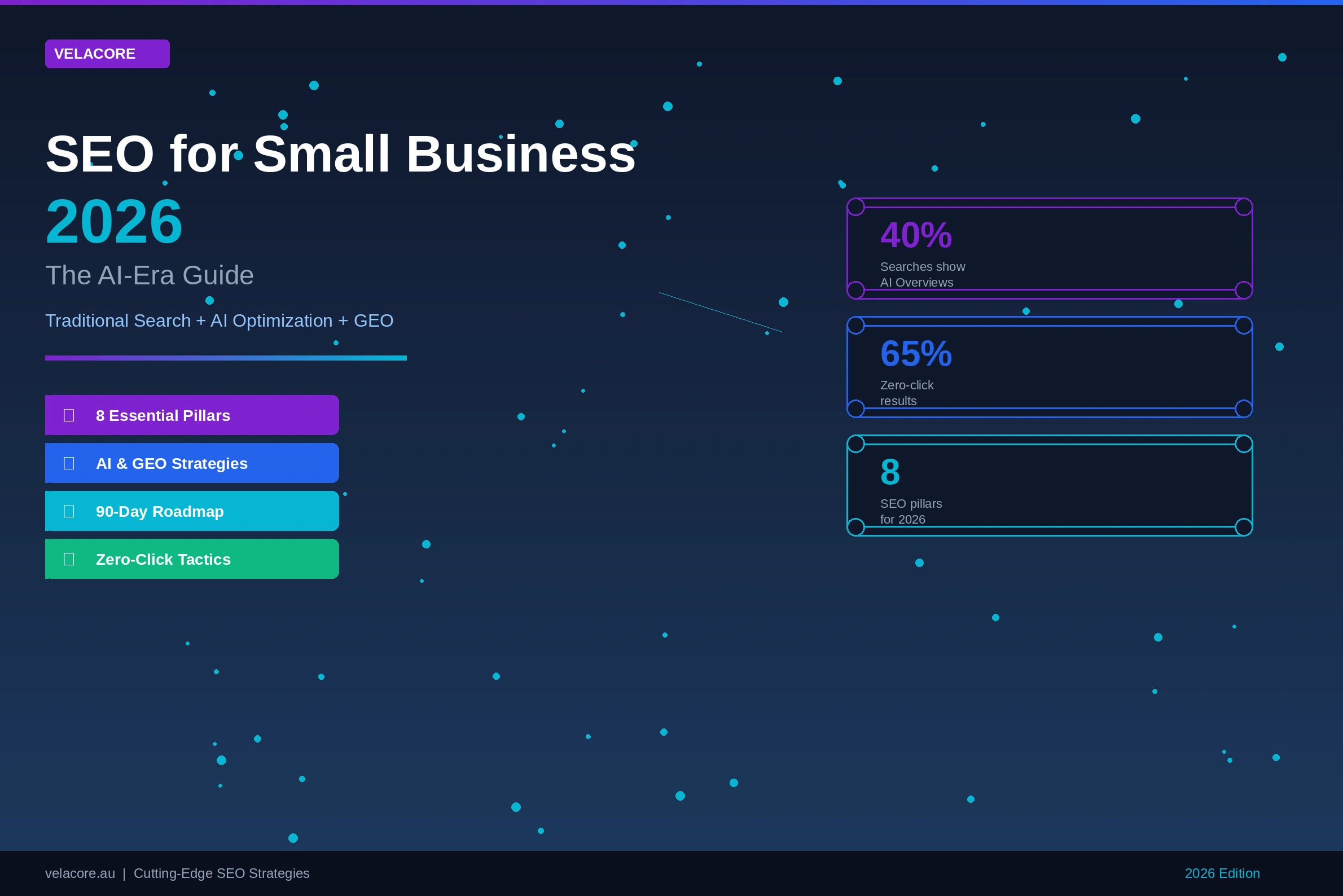
Google now generates AI answers for over 40% of searches, and 65% of searches end without any click. This means visibility in AI Overviews, featured snippets, and ChatGPT citations is no longer optional. Yet most of your competitors still do not understand how to optimize for this new landscape, which creates a massive opportunity for businesses that adapt quickly.
This complete guide to SEO for small business covers the 8 essential pillars of modern optimization, including the newest pillar most guides ignore: Generative Engine Optimization (GEO). You will learn how to rank in traditional Google search AND get cited by AI engines like ChatGPT and Perplexity. Whether you run a local business or serve customers globally, this roadmap works. Let’s get started.
What is SEO for Small Business in 2026?
Search Engine Optimization in 2026 is fundamentally different from even two years ago. It is no longer just about ranking on Google’s traditional blue links. Modern SEO encompasses optimization for traditional search engines, AI-powered answer engines like ChatGPT and Perplexity, voice assistants, and Google’s own AI Overviews that appear above traditional results.
For small businesses, this means showing up when potential customers search in any format: typing queries into Google, asking Siri for recommendations, prompting ChatGPT for advice, or using visual search on Pinterest or Google Lens. Each channel requires slightly different optimization approaches, but the core principles of relevance, authority, and technical excellence remain constant.
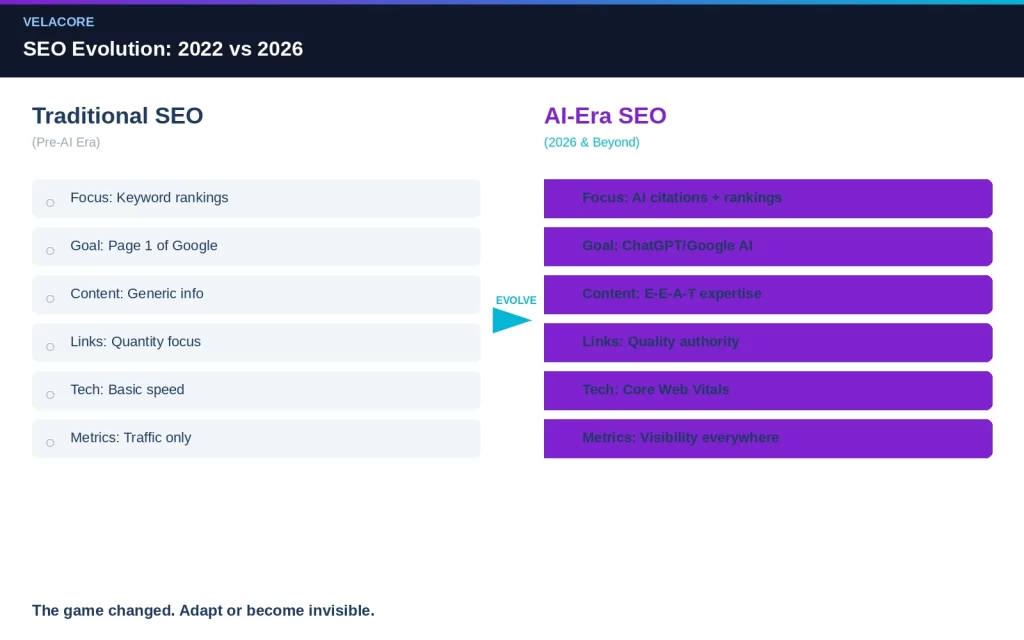
Traditional SEO focused on keywords and backlinks. Modern SEO in 2026 adds several new dimensions. Entity-based SEO means Google and AI engines understand your business as a distinct entity (not just keywords), connected to other entities like your industry, location, and expertise areas. E-E-A-T (Experience, Expertise, Authoritativeness, Trustworthiness) has become the primary quality framework Google uses to evaluate content. And Generative Engine Optimization (GEO) determines whether AI tools cite and recommend your business when users ask for help.
For small business SEO specifically, this evolution actually levels the playing field. Large corporations struggle to demonstrate genuine experience and build authentic trust signals. Small businesses with real expertise, happy customers, and quality content can outrank enterprises by focusing on E-E-A-T signals: verified reviews, expert-written content, transparent business practices, and genuine industry authority.
The ROI potential remains compelling. Studies show that SEO leads have a 14.6% close rate compared to just 1.7% for outbound leads like cold calls. More importantly, customers who find you through search (whether traditional Google or AI-powered answers) are actively seeking solutions right now, making them far more valuable than cold traffic from social media or display ads.
SEO in the AI Era: What Changed in 2024-2026
Between 2024 and 2026, search fundamentally transformed. If you are still optimizing like it is 2022, you are invisible to a huge portion of your potential customers. Here is what changed and why it matters for small businesses.
1. Google’s AI Overviews Dominate Search Results
Google now displays AI-generated answer boxes at the top of search results for over 40% of queries. These AI Overviews synthesize information from multiple sources and often prevent users from clicking through to any website. For small businesses, this means you must optimize to be cited as a source in these AI answers, not just rank in traditional results below them.
2. Generative Engine Optimization (GEO) Became Essential
ChatGPT, Perplexity, Claude, and other AI assistants are now primary research tools. When users ask “recommend a good plumber in Brisbane” or “what accounting software should small businesses use,” these AI engines pull from their training data and web searches to provide answers. Optimizing for AI citation (GEO) requires different tactics than traditional SEO: structured data, authoritative citations, clear factual content, and presence in high-quality sources that AI engines trust.
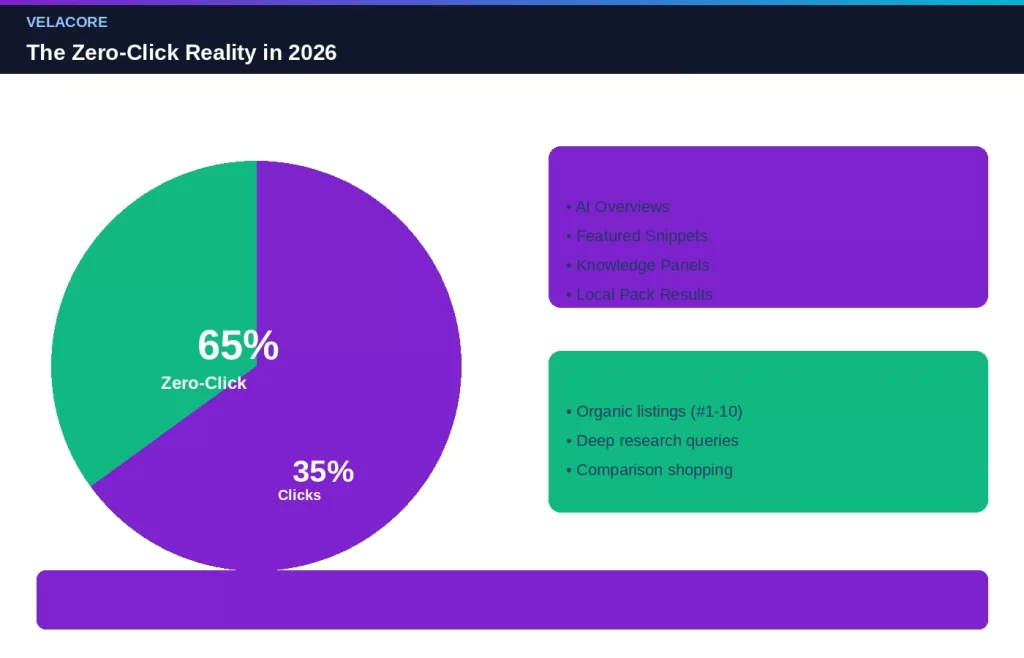
3. Zero-Click Searches Surpassed 65%
Over 65% of Google searches now end without any click to a website. Users get their answer from featured snippets, AI Overviews, local packs, or knowledge panels without visiting any site. This means visibility in these zero-click formats is often more valuable than ranking #1 in traditional results. Small businesses must optimize for featured snippets, Google Business Profile, and quick-answer formats.
4. E-E-A-T Became the Primary Quality Filter
Google added an extra E to E-A-T in 2023: Experience. The framework is now E-E-A-T (Experience, Expertise, Authoritativeness, Trustworthiness). Google heavily favors content demonstrating first-hand experience over generic information. For small businesses, this is an advantage. Your real customer stories, case studies, and hands-on expertise outweigh corporate content that lacks genuine experience signals.
5. Entity-Based Search Replaced Pure Keyword Matching
Search engines now understand entities (people, places, businesses, concepts) and their relationships, not just keywords. Google knows “plumber in Sydney” connects to entities like Sydney (location), plumbing (service), emergency services, licenses, and related entities. Small businesses benefit by establishing clear entity signals: consistent NAP (Name, Address, Phone), structured data markup, Wikipedia presence if possible, and relationships with other entities in your industry.
6. Voice and Visual Search Went Mainstream
Voice search queries are conversational and question-based. Visual search through Google Lens and Pinterest Lens lets users search with images. Both require optimization approaches different from traditional text search: natural language content, FAQ formats, high-quality images with descriptive alt text, and mobile-first design.
These six shifts are not future trends. They are current reality in 2026. The good news is that small businesses can adapt faster than enterprises. The rest of this guide shows you exactly how. For Australian businesses specifically, these changes are especially relevant given high mobile usage, strong adoption of voice assistants, and competitive local markets where local SEO optimization combined with AI-era tactics creates a significant competitive advantage.
The 8 Pillars of Small Business SEO in 2026
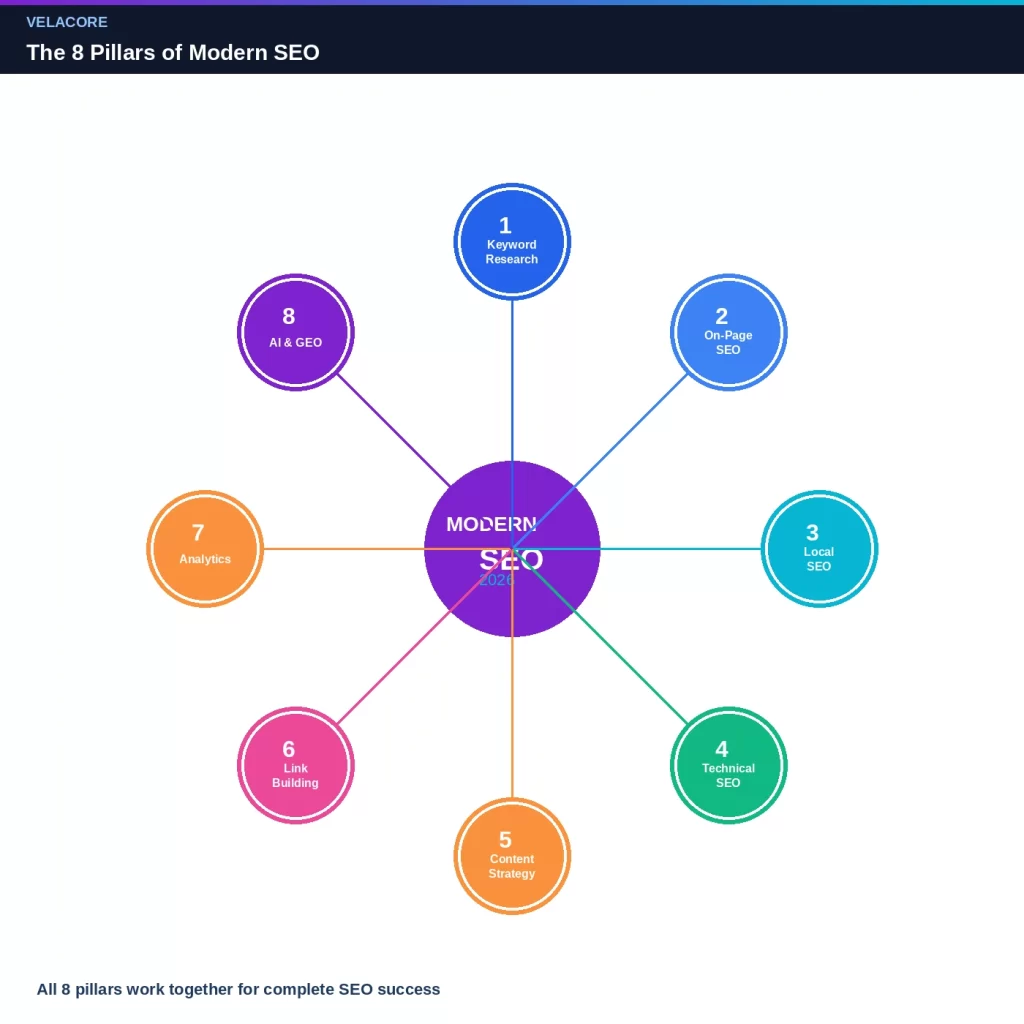
Effective SEO for small business in 2026 rests on eight foundational pillars. The first seven are evolved versions of traditional SEO elements, updated for modern algorithms. The eighth pillar is entirely new: optimization for AI and generative engines. Master all eight and you will dominate competitors still using outdated tactics.
These pillars are interdependent. Strong content attracts backlinks. Good keyword research guides on-page optimization. Technical health enables AI crawling. Local SEO feeds into entity recognition. You need a holistic approach where all eight pillars support each other.
| Pillar | What It Means | Why It Matters in 2026 |
| Keyword Research | Identifying search queries and conversational questions customers use | Now includes traditional keywords plus voice queries and AI prompts |
| On-Page SEO | Optimizing content, titles, headers, and structured data for clarity | Must satisfy both human readers and AI engines parsing your content |
| Local SEO | Optimizing for geographic searches, map listings, and local entity recognition | Critical as 46% of searches have local intent, now includes voice and AI local queries |
| Technical SEO | Site speed, Core Web Vitals, mobile-first, security, crawlability | Google’s ranking algorithm heavily weighs page experience and technical performance |
| Content Strategy | Creating expert, experience-driven content demonstrating E-E-A-T | Quality content is now the primary way to get cited by AI engines and earn featured snippets |
| Link Building | Earning backlinks from authoritative sources | Backlinks remain a top 3 ranking factor and signal trustworthiness to AI engines |
| Analytics & Tracking | Measuring traditional traffic plus zero-click visibility and AI citations | Must track both click-through traffic and non-click visibility in snippets and AI answers |
| AI & GEO | Optimization for ChatGPT, Perplexity, Google AI Overviews, and voice assistants | NEW IN 2026: Determines whether AI tools cite and recommend your business |
The eighth pillar, AI and Generative Engine Optimization, is what separates businesses thriving in 2026 from those still stuck in 2022 tactics. We will dive deep into this pillar because it is likely new to you and represents the biggest opportunity.
Keyword Research: Finding What Your Customers Actually Search
Keyword research in 2026 must account for how people search differently across platforms. Traditional Google searches are often short and keyword-focused (“plumber Sydney”). Voice searches are conversational questions (“who is the best emergency plumber near me that is open right now”). AI chatbot prompts are even more natural (“I need help finding a reliable plumber in Sydney who can fix a burst pipe today”).
Your keyword strategy must cover all three search types: traditional typed queries, voice search questions, and AI chatbot prompts. The good news is that optimizing for one often helps with the others because they all reflect genuine customer intent.
Step 1: Brainstorm Seed Keywords (Traditional + Conversational)
Start with 10 to 15 core terms, then expand each into conversational variations. If you run a plumbing business, traditional seeds might be: emergency plumber, blocked drain, hot water repair. Conversational variations: “how do I fix a blocked drain,” “why is my hot water not working,” “what should I do if I have a burst pipe.” These conversational phrases are what people ask voice assistants and AI chatbots.
Step 2: Use Modern Keyword Tools
Google Keyword Planner remains valuable but now also use AnswerThePublic (shows questions people ask), AlsoAsked.com (related questions from Google), and ChatGPT itself (ask it “what questions do homeowners ask about plumbing emergencies”). These tools reveal conversational queries that traditional keyword tools miss.
Step 3: Analyze Search Intent and Query Type
Categorize keywords by both intent (informational, commercial, transactional) and query type (traditional, voice, AI). Voice and AI queries trend more conversational and question-based. Informational questions (“how to”) are perfect for blog content that gets cited by AI. Transactional questions (“hire a plumber”) drive immediate business.
Step 4: Target Featured Snippet Opportunities
Use tools like SEMrush or Ahrefs to find keywords where competitors already have featured snippets (the answer boxes at the top of Google). These are prime opportunities because featured snippets generate both traditional visibility and AI citations. Structure your content to directly answer the question concisely at the start, then elaborate.
Step 5: Prioritize Based on Multi-Channel Value
Create a spreadsheet with columns for keyword, search volume, competition, intent, query type (traditional/voice/AI), and featured snippet opportunity. Prioritize keywords that work across multiple channels. A well-optimized answer to “how to choose a reliable plumber” can rank in Google, appear in AI Overviews, get cited by ChatGPT, and trigger when someone asks Siri for plumbing advice.
Pro tip: Local businesses should create content targeting both geographic keywords (“plumber Brisbane”) and non-geographic informational queries (“signs you need emergency plumbing”) because the second type builds authority that helps the first type rank higher. This dual approach works globally whether you are optimizing for markets in Australia, Canada, United States, or United Kingdom.
On-Page SEO: Optimizing for Humans and AI
On-page SEO in 2026 requires optimization for two audiences simultaneously: human readers and AI engines parsing your content. Both need clarity, structure, and authoritative signals, but in slightly different formats.
Title Tags and Meta Descriptions (Enhanced)
Titles must include your target keyword while also being conversational enough to work for voice search. Good: “Emergency Plumber Sydney: 24/7 Same-Day Service (Licensed & Insured).” This works for “emergency plumber Sydney” keyword searches and “find me an emergency plumber in Sydney” voice queries. Keep titles under 60 characters. Meta descriptions should answer the implied question and include a call to action.
Header Structure (H1, H2, H3) with Semantic Relationships
Use headers to create a clear content hierarchy that AI engines can parse. Your H1 should state the main topic. H2s should cover subtopics that relate to the main topic semantically. H3s provide details. This structure helps AI understand not just individual keywords but the relationships between concepts. For example: H1: “Complete Guide to Emergency Plumbing,” H2: “When to Call an Emergency Plumber,” H3: “Burst Pipes,” H3: “Blocked Drains,” H2: “What to Do Before the Plumber Arrives.”
Content Quality with E-E-A-T Signals
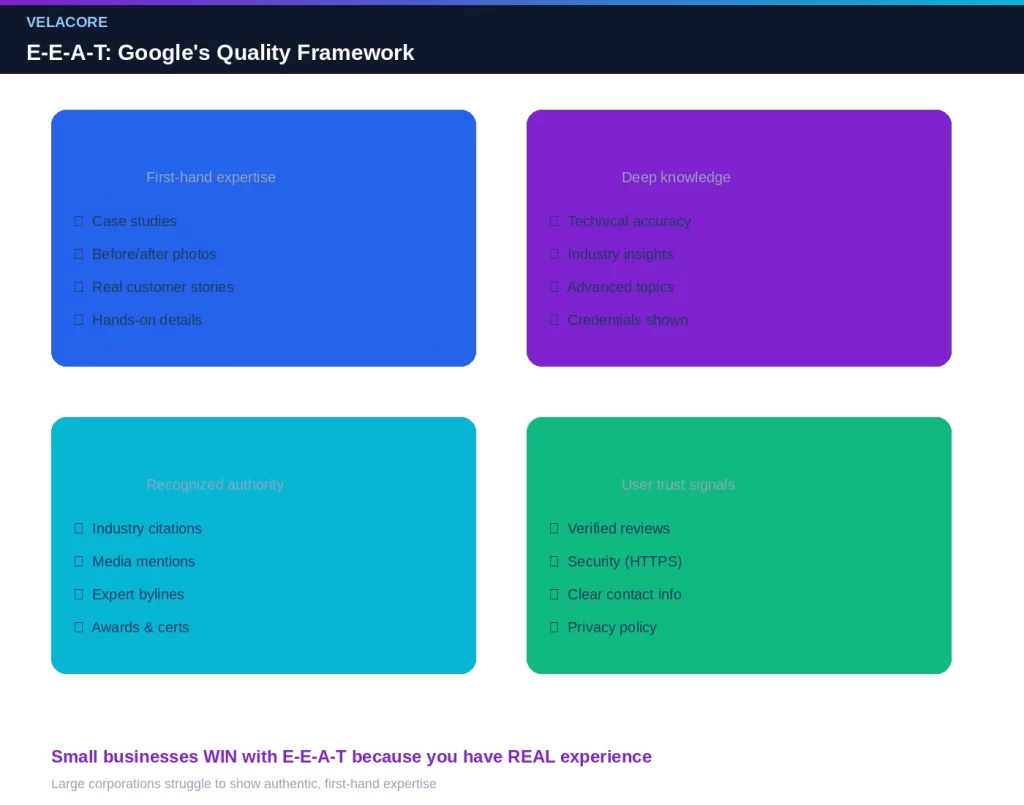
Your content must demonstrate Experience, Expertise, Authoritativeness, and Trustworthiness. Experience signals include first-person accounts, case studies, before/after photos, and specific details only someone with hands-on experience would know. Expertise signals include technical accuracy, industry terminology used correctly, and answers to advanced questions. Authoritativeness comes from author bylines with credentials, citations from reputable sources, and links from industry authorities. Trustworthiness includes transparent business information, verified reviews, security certificates, and clear privacy policies.
Structured Data (Schema Markup)
Schema markup is code that tells search engines and AI what your content means, not just what it says. Use LocalBusiness schema for your business information, FAQPage schema for FAQ sections, HowTo schema for instructional content, and Review schema for customer reviews. This structured data helps Google create rich results and helps AI engines understand and cite your content accurately.
Featured Snippet Optimization
Structure content to win featured snippets by answering questions concisely at the start of sections. Use formats Google favors: numbered lists for process questions, bulleted lists for component questions, tables for comparison questions, and paragraph answers (40-60 words) for definition questions. Featured snippets also feed AI Overviews, so winning a snippet often means getting cited by Google’s AI.
Internal Linking with Semantic Relationships
Link from one page to related pages using descriptive anchor text that shows semantic relationships. Instead of “click here,” use “learn about emergency plumbing costs” or “see our guide to preventing blocked drains.” This helps both users navigate and AI engines understand the relationship between your content pieces.
Local SEO: Dominating Geographic Search in the AI Era
Local SEO has evolved beyond just Google Maps. In 2026, local optimization must cover traditional map results, voice search local queries (“plumber near me”), AI chatbot location-based recommendations, and Apple Maps which powers Siri recommendations.
Google Business Profile (Still Critical, Now AI-Connected)
Your Google Business Profile feeds into multiple channels: Google Maps, local pack results, voice assistant responses, and Google’s AI Overviews. Claim and verify your profile. Complete every section: business name, exact address, phone, website, hours, categories, services, service areas, and attributes. Post weekly updates. Upload high-quality photos monthly. Respond to every review within 48 hours. This profile is now your primary local entity signal.
NAP Consistency Across the Web
Name, Address, Phone number must be absolutely identical everywhere: your website, Google Business Profile, Facebook, Apple Maps, Bing Places, and all directories. Inconsistencies confuse entity recognition algorithms and hurt local rankings. Use the exact same format for everything. If your address on your website is “123 Main Street, Suite 4,” it must be exactly that everywhere, not “123 Main St Ste 4” somewhere else.
Local Citations in Relevant Directories
Get listed in high-quality directories relevant to your location and industry. Globally, this includes Yelp, Apple Maps, Bing Places. In Australia specifically: True Local, Yellow Pages Australia, Aussie Web. In United States: Yellow Pages, Better Business Bureau, Chamber of Commerce. In United Kingdom: Yell, Thomson Local. Quality beats quantity. Ten accurate citations on authoritative directories outperform 100 on low-quality sites.
Reviews and Reputation (Now AI-Visible)
Online reviews influence both traditional rankings and AI recommendations. Actively request reviews from happy customers. Make it frictionless with a direct link to your Google review page. Respond to all reviews professionally. Businesses with 50+ recent reviews rank significantly higher. More importantly, AI chatbots often cite review scores and snippets when recommending businesses, so positive reviews directly influence AI citations.
Local Content for Voice and Conversational Search
Create content targeting conversational local queries. Traditional local SEO targets “plumber Brisbane.” Voice/AI optimization targets “who is the best emergency plumber in Brisbane,” “what plumbing services are available in Brisbane,” “how much does a plumber cost in Brisbane.” Write FAQ content answering these conversational questions. This content ranks for voice search and gets cited by AI when users ask location-specific questions.
Technical SEO: The Foundation That AI Engines Crawl
Technical SEO ensures both traditional search crawlers and AI engines can access, understand, and rank your website. Poor technical health prevents even the best content from ranking. In 2026, technical SEO includes Core Web Vitals, mobile-first indexing, and structured data that AI can parse.
Core Web Vitals (Critical Ranking Factor)
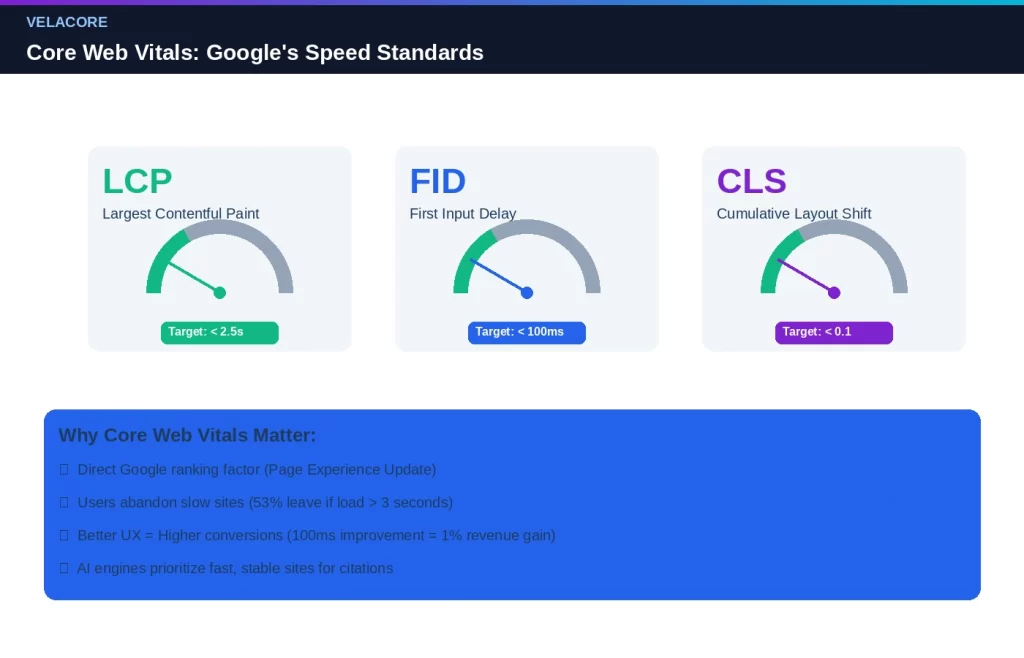
Google’s Core Web Vitals measure page experience across three metrics: Largest Contentful Paint (loading speed, target under 2.5 seconds), First Input Delay (interactivity, target under 100 milliseconds), and Cumulative Layout Shift (visual stability, target under 0.1). Test your site using Google PageSpeed Insights. Common fixes: optimize images, minimize JavaScript, use a content delivery network (CDN), and enable browser caching.
Mobile-First Indexing (Non-Negotiable)
Google exclusively uses the mobile version of your site for indexing and ranking. Over 60% of searches happen on mobile globally, with Australia seeing even higher mobile usage. Your mobile site must be fast, fully functional, and provide the same content as desktop. Use responsive design where the site automatically adapts to screen size. Test mobile-friendliness using Google’s Mobile-Friendly Test tool.
HTTPS Security (Trust Signal)
All sites must use HTTPS (not HTTP). Google gives a ranking boost to secure sites, and browsers flag HTTP sites as “not secure,” destroying user trust. Get a free SSL certificate from Let’s Encrypt or through your web host. Ensure your entire site (not just certain pages) runs on HTTPS.
Structured Data Implementation
Implement schema markup using JSON-LD format. Critical schemas for small businesses: LocalBusiness (business information), FAQPage (FAQ sections), HowTo (instructional content), Review (customer reviews), Product (if selling products), and Service (if offering services). Structured data helps Google create rich results and helps AI engines accurately understand and cite your content.
XML Sitemap and Robots.txt
Submit an XML sitemap to Google Search Console so Google knows all your pages. Most CMS platforms (WordPress, Shopify, Wix) generate sitemaps automatically. Use robots.txt to tell search engines which pages to crawl and which to ignore (like admin pages). Ensure your robots.txt is not accidentally blocking important pages.
Fix Broken Links, 404 Errors, and Redirect Chains
Use Screaming Frog SEO Spider (free for up to 500 URLs) to find broken links and 404 errors. Fix them by updating links or creating 301 redirects. Avoid redirect chains where one page redirects to another which redirects to another. This wastes crawl budget and confuses both users and bots.
Content Strategy: Creating Content for Humans and AI Citations
Content strategy in 2026 serves three purposes: rank in traditional search, get cited by AI engines, and convert visitors into customers. Quality content demonstrating genuine expertise and experience is how small businesses compete with large corporations.
Topic Clusters Instead of Individual Keywords
Organize content into topic clusters, not isolated keyword-targeted pages. Create a pillar page covering a broad topic comprehensively, then create cluster content covering subtopics in detail, with all cluster pages linking back to the pillar. Example: Pillar page “Complete Guide to Small Business SEO,” cluster pages “Keyword Research for Small Business,” “Local SEO Strategies,” “Technical SEO Basics.” This structure helps Google understand topical authority and helps AI engines see you as an expert on the entire topic.
Demonstrate E-E-A-T in Every Piece
Every piece of content must show Experience, Expertise, Authoritativeness, and Trustworthiness. Experience: Include first-hand stories, specific examples, case studies, and details only someone with real experience would know. Expertise: Use accurate technical information, explain nuances, and answer advanced questions. Authoritativeness: Add author bylines with credentials, cite reputable sources, and earn links from industry sites. Trustworthiness: Be transparent about your business, display reviews, and maintain consistent contact information.
Answer Questions AI Engines Ask
AI engines look for clear, factual answers to specific questions. Structure content with direct questions as headers (H2s) and concise answers immediately below. Example: “What is the average cost of SEO for small business?” followed by a clear 40-60 word answer, then elaboration. This format wins featured snippets and gets cited by AI chatbots.
Create Linkable Assets
Produce content types that attract backlinks naturally: original research, comprehensive guides, data visualizations, free tools or calculators, industry surveys, and case studies with hard numbers. Linkable assets earn backlinks, which boost domain authority, which improves rankings, which increases the likelihood of AI citation. It is a compounding cycle.
Optimize for Voice Search Naturally
Voice search queries are conversational and question-based. Create FAQ pages answering common questions in natural language. Use conversational phrasing in your content. Instead of “SEO services pricing,” write “How much does SEO cost for a small business?” This dual-optimizes for voice search and AI engines which also prefer conversational, question-answer formats.
Consistency Over Volume
Publishing one exceptional, thoroughly researched article per month beats ten thin, generic posts. Google and AI engines reward sites that regularly add valuable content. Set a sustainable publishing schedule: weekly, bi-weekly, or monthly. Consistency builds topical authority over time.
AI and Generative Engine Optimization: The New Frontier
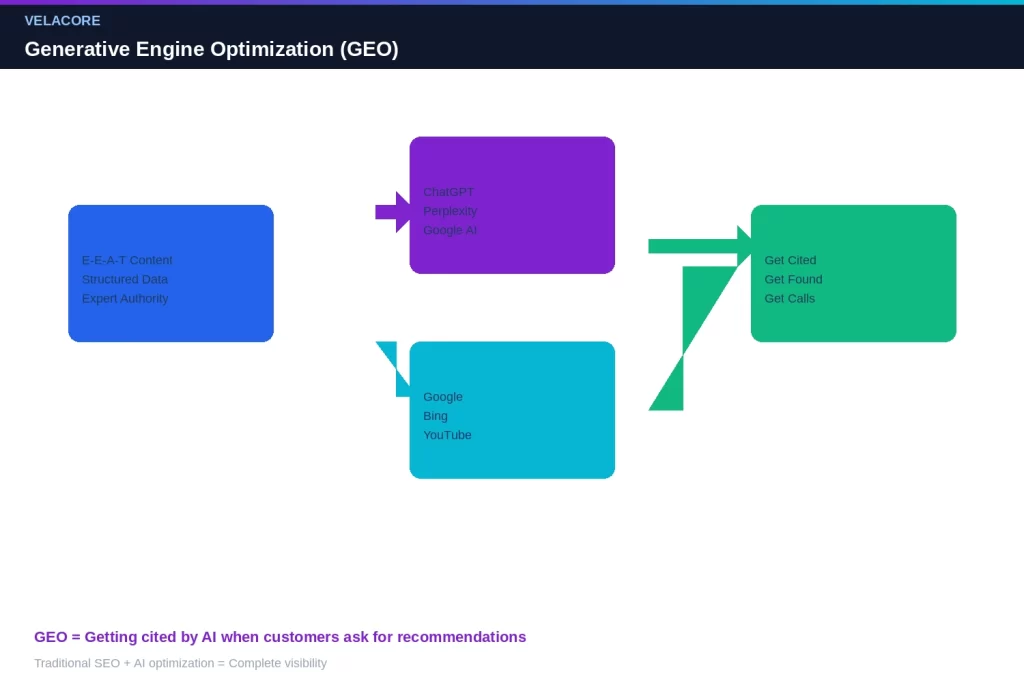
This is the pillar most small businesses are completely missing. Generative Engine Optimization (GEO) is how you get cited by ChatGPT, Perplexity, Claude, Google’s AI Overviews, and voice assistants when users ask for recommendations or information. In 2026, being invisible to AI engines means losing a massive and growing segment of potential customers.
What is GEO and Why It Matters
GEO is optimization for AI-powered answer engines. When someone asks ChatGPT “recommend a good accountant for small business,” or asks Google a question and gets an AI Overview, the AI must decide which sources to cite and recommend. GEO is about making your business the obvious choice for AI citation. Unlike traditional SEO where ranking #1 gets the most clicks, in AI search, being cited at all is what matters because most users only see the AI-generated answer without clicking through.
How AI Engines Decide What to Cite
AI engines prioritize sources that are authoritative, factually accurate, clearly written, well-structured, frequently cited by others, and aligned with user intent. They favor content from: established domains with high authority, sources that other reputable sites cite frequently, content with clear factual statements (not marketing fluff), structured data that machines can parse, and businesses with strong entity signals (consistent NAP, Wikipedia presence, news coverage).
Tactics to Earn AI Citations
Here are specific tactics that increase the likelihood of AI citation. First, create definitive, factually accurate content on your core topics. AI engines favor content that thoroughly answers questions without marketing spin. Second, get cited by high-authority sources because AI training data heavily weights authoritative publications. Earn mentions in industry publications, local news, and reputable blogs. Third, use structured data extensively so AI can extract facts cleanly. Fourth, maintain absolute consistency in your business information everywhere online, because entity recognition depends on consistency. Fifth, actively publish expert content showcasing first-hand experience, because AI engines are trained to identify and favor genuine expertise over generic content.
Optimizing for Google’s AI Overviews
Google’s AI Overviews appear above traditional search results for many queries. To get cited in AI Overviews: target question-based keywords, create concise, factual answers in the first paragraph, use structured data (especially FAQPage and HowTo schemas), earn featured snippets (AI Overviews often pull from snippet sources), and build topical authority by covering topics comprehensively across multiple related pages.
Voice Assistant Optimization
Voice assistants (Siri, Alexa, Google Assistant) increasingly use AI to generate answers. Optimize for voice by: using conversational language and natural phrasing, creating FAQ pages with question headers, targeting long-tail conversational keywords, implementing speakable schema markup, ensuring your Google Business Profile is complete (voice often reads from GBP), and creating locally-relevant content for “near me” voice queries.
Measuring AI Visibility
Measuring AI citations is harder than measuring traditional rankings. Tools are emerging but are not yet mature. Current approaches: regularly search for your brand and key topics in ChatGPT, Perplexity, and Google to see if you are cited; use tools like Google Search Console to track impressions from AI Overviews when available; monitor branded search volume as a proxy because AI citations increase brand awareness; and track featured snippet wins as these correlate with AI citations.
For small businesses, GEO represents a level playing field. Large corporations have not mastered this yet. By implementing GEO tactics now, you can outcompete much larger competitors in AI search. This is especially valuable in competitive markets like Australia, United States, and United Kingdom where traditional SEO is saturated. If you need expert help with modern SEO including GEO, Velacore’s SEO services cover both traditional and AI-era optimization strategies.
The 90-Day SEO Roadmap for Small Business in 2026
Most small businesses fail at SEO because they try to do everything at once. This 90-day roadmap breaks modern SEO (traditional plus AI optimization) into manageable monthly phases. Each month builds on the previous, with specific actionable tasks.
| Phase | Focus | Key Tasks | Expected Outcome |
| Month 1: Foundation | Technical setup, tracking, entity establishment | Set up Google Analytics 4 & Search Console, claim Google Business Profile, implement schema markup, ensure mobile-friendly and HTTPS, fix Core Web Vitals issues, create XML sitemap | Clean technical foundation, tracking live, strong entity signals |
| Month 2: Content & Traditional Optimization | Keyword research, on-page SEO, initial content | Conduct keyword research (traditional + conversational), optimize 5-10 key pages with E-E-A-T, publish 2-4 expert blog posts with author credentials, implement internal linking, optimize images with descriptive alt text | Key pages ranking, authority content published, traditional SEO foundation solid |
| Month 3: AI Optimization & Authority | GEO tactics, reviews, citations, links | Create FAQ content for AI/voice, optimize for featured snippets, get 10-15 quality local citations, request reviews aggressively, publish 2-4 more expert posts, reach out for guest posting, test AI citation (search your brand in ChatGPT) | AI-optimized content live, reviews growing, authority building, potential AI citations |
After 90 days, you will have a modern SEO foundation covering both traditional search and AI optimization. From month four onward: continue publishing expert content monthly, monitor and respond to reviews weekly, build links through partnerships and guest posting, track performance in Search Console and test AI visibility regularly, and optimize based on what is working. By month six, you should see measurable organic traffic and initial AI citations. By month twelve, SEO should be a major lead source.
Measuring Success in Traditional and AI Search
You must track both traditional metrics (traffic, rankings, conversions) and new metrics (AI visibility, zero-click results, featured snippets). Here is what to measure and how.
Traditional Search Metrics
Monitor organic traffic monthly in Google Analytics 4. Track keyword rankings for your top 10-15 target keywords using Google Search Console or tools like SEMrush. Measure conversions from organic traffic: form submissions, phone calls, purchases, quote requests. Watch bounce rate and time on page as quality signals. For local businesses, track Google Business Profile metrics: search views, map views, website clicks, direction requests, and phone calls.
AI and Zero-Click Metrics
Measure featured snippet wins because these often feed AI Overviews and get cited by AI engines. Track impressions versus clicks in Search Console to identify zero-click queries where you appear but users do not click (this is not necessarily bad as it indicates visibility in AI Overviews or featured snippets). Monitor branded search volume as a proxy for AI citation impact because AI mentions increase brand awareness. Manually test AI citation by searching for your brand and key topics in ChatGPT, Perplexity, and Google’s AI search monthly. Track voice search traffic if possible by looking at very long, conversational query patterns in Search Console.
Entity and Authority Signals
Monitor review count and average rating monthly across Google, Yelp, and industry-specific platforms. Track domain authority using tools like Moz or Ahrefs as a proxy for entity strength. Measure citation consistency by auditing NAP across major platforms quarterly. Watch backlink growth, especially from authoritative domains, as this signals trust to both traditional and AI search.
Realistic Expectations
Initial ranking movement typically appears in 60 to 90 days. Consistent lead generation from SEO usually takes 6 to 12 months. AI citations may appear faster for well-structured content but are harder to track. Do not panic if results are slow in months one through three. SEO builds momentum over time. Businesses that stick with it for a year or more see compounding returns where efforts from six months ago are still driving traffic and leads today.
Conclusion: Embrace the AI Era or Get Left Behind
SEO in 2026 is not about gaming algorithms or finding shortcuts. It is about making your business genuinely valuable, clearly understandable, and authoritatively positioned so both humans and AI recognize your expertise. When you focus on demonstrating real experience, building trust, and communicating clearly, SEO success becomes a natural byproduct of running a quality business.
The eight pillars covered in this guide give you a complete framework. The traditional pillars (keywords, on-page, local, technical, content, links, analytics) have evolved but remain essential. The eighth pillar, AI and Generative Engine Optimization, is the new frontier where early adopters gain massive advantages before the market catches up.
Start with the 90-day roadmap. Month one establishes your technical foundation and entity signals. Month two optimizes your core pages and publishes expert content. Month three tackles AI optimization and authority building. After 90 days, you will have positioning in both traditional search and AI engines, with momentum building toward sustained growth.
SEO compounds over time. The work you do today drives traffic twelve months from now. The AI citations you earn this quarter build brand authority for years. This is why SEO remains the highest ROI marketing channel for small businesses globally, whether you operate in Sydney, Singapore, Seattle, or anywhere else. If you want expert guidance implementing these strategies, get in touch with Velacore. Our team specializes in modern SEO that covers traditional optimization, local visibility, and cutting-edge AI and generative engine optimization.
The businesses that thrive in 2026 and beyond will be those that adapt to the AI era while maintaining the fundamentals that have always worked. You now have the complete roadmap. Start today.
Frequently Asked Questions About Small Business SEO in 2026
How long does SEO take to work for a small business in 2026?
Traditional SEO still takes 60 to 90 days for initial movement and 6 to 12 months for significant results. AI citations can happen faster if you optimize for featured snippets and use strong structured data, sometimes within weeks. However, building sustainable authority in both traditional and AI search requires a 12-month commitment minimum. SEO is a long-term investment that compounds over time.
What is Generative Engine Optimization and do small businesses really need it?
GEO is optimization for AI-powered answer engines like ChatGPT, Perplexity, and Google’s AI Overviews. Yes, small businesses absolutely need it. In 2026, over 40% of searches trigger AI-generated answers, and this percentage is growing rapidly. Being invisible to AI engines means losing a massive segment of potential customers. The good news is GEO favors quality, expert content, which small businesses can produce more authentically than large corporations.
How much should a small business budget for SEO in 2026?
DIY SEO requires 10 to 20 hours per month plus $50 to $200 monthly for tools. Hiring an agency or consultant typically costs $1,000 to $5,000 per month USD ($1,500 to $7,500 AUD in Australia) depending on market competitiveness and scope. Many businesses start DIY with the basics, then hire professional help for technical SEO, link building, and AI optimization. Expect to invest for at least 6 to 12 months before seeing strong ROI.
Can I still do SEO myself or is it too complex now with AI optimization?
You can handle basic SEO yourself, especially local optimization, on-page content, and Google Business Profile management. However, technical SEO, advanced GEO tactics, and link building benefit from professional expertise. A hybrid approach works well: DIY the fundamentals using guides like this, then hire help for complex areas like schema implementation, Core Web Vitals optimization, and strategic link building.
Is traditional SEO still important or should I focus only on AI optimization?
Both are critical. Traditional SEO still drives the majority of organic traffic and conversions. However, ignoring AI optimization means losing visibility in a rapidly growing search channel. The best strategy is integrated: optimize content to satisfy both traditional search algorithms and AI engines, use structured data that benefits both, and build authority signals (backlinks, reviews, expertise) that strengthen both traditional rankings and AI citations.
How do I know if my business is being cited by AI chatbots?
Measurement tools are still emerging, but here is what you can do now. Manually test monthly by asking ChatGPT, Perplexity, Claude, and Gemini questions related to your business and see if you are mentioned. Search your brand name plus your service in these AI tools. Monitor featured snippet wins in Google Search Console as these often correlate with AI citations. Track branded search volume as an indirect signal because AI mentions increase brand awareness. Tools specifically for measuring AI visibility are being developed and should mature in 2026-2027.