Search is no longer just a list of links; it’s a dialogue. When someone asks Google’s AI Overviews, ChatGPT, or Perplexity AI a question, they don’t browse; they expect an instant, intelligent answer. And behind those answers lies content that AI systems trust enough to cite.
That’s where GEO comes in.
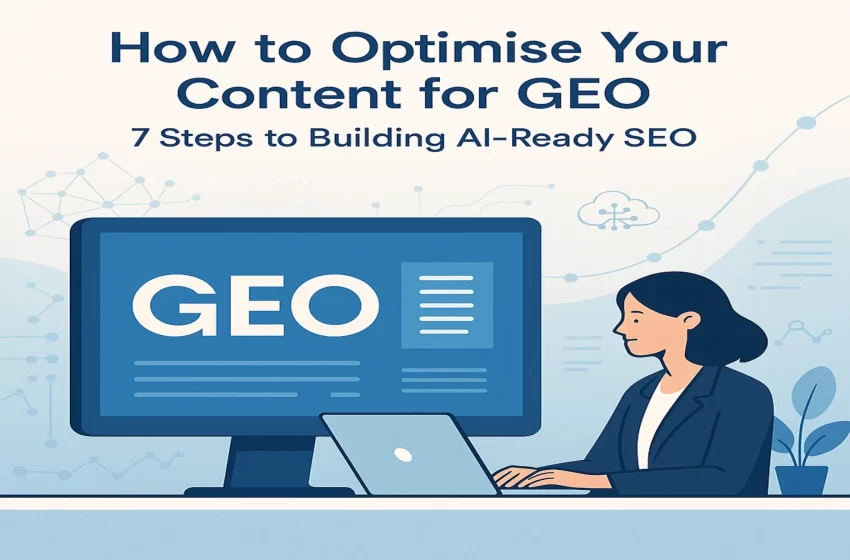
Understanding how to optimise your content for GEO isn’t about chasing another algorithm; it’s about learning how AI interprets information. It’s the evolution of SEO from searching to understanding.
At Velacore, we’ve seen this shift first-hand while helping Australian brands stay visible in an AI-driven world. Content that once ranked through backlinks and meta tags now competes on semantic clarity, author credibility, and data verifiability. These are now part of the core pillars of discoverability.
In our main GEO framework, we explained the theory: how generative engines crawl, connect, and cite.
In this article, we’re taking it further: a practical, step-by-step guide showing exactly how to optimise your content for GEO so that AI systems like Google’s SGE, ChatGPT, and Perplexity can find, understand, and quote it.
Because in the era of generative search, visibility isn’t just about being found, it’s about being trusted enough to be mentioned.
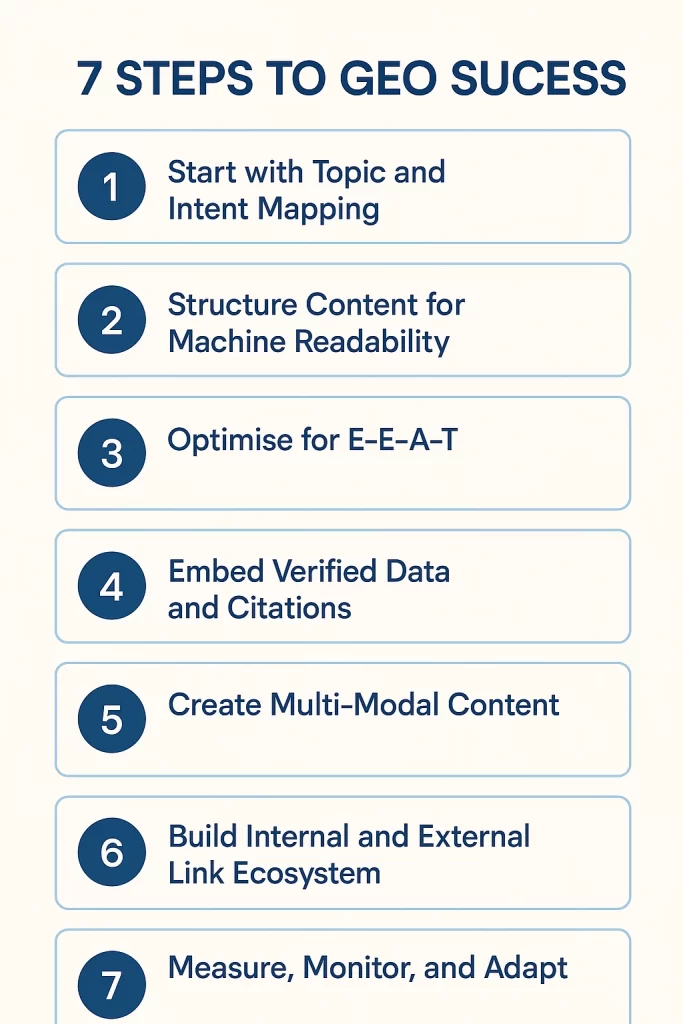
Step 1: Map topics to intent, not just keywords
Generative engines don’t scan for keyword density; they interpret intent and context.
Think of how ChatGPT answers a question; it doesn’t just pull matching phrases, it explains meaning.
Your goal: Write with the same logic.
Instead of asking “What keyword should I target?”, ask “What question is the AI trying to answer?”
Try this workflow
- Use Google’s “People Also Ask”, AnswerThePublic, or Semrush Topic Research to extract real questions.
- Categorise each one by user intent:
- Informational: “What is GEO and why does it matter?”
- Transactional: “Best GEO agency in Australia.”
- Comparative: “GEO vs traditional SEO.”
- Build clusters around these questions, with your main pillar linking outwards, and sub-articles like this guide connecting back.
That’s how you create an ecosystem where AI can trace relationships between ideas, not just URLs.
Step 2: Structure your content for machine readability
AI crawlers like Google’s Gemini and OpenAI’s GPT-4o use semantic parsing to understand information hierarchy. According to Google Developers, structured data helps search systems better understand the meaning of your pages and display them appropriately in rich results.
Implementation checklist
- Use clear heading hierarchy (H1 → H2 → H3) that mirrors user prompts (“What is…”, “How does…”, “Why is…”).
- Implement Article, FAQ, and Author schema via JSON-LD.
- Keep sentences concise; AI interprets short syntax more accurately.
- Optimise meta descriptions for meaning (≤ 160 characters).
- Include alt text and captions with descriptive, factual phrasing.
Velacore Tip: Each heading should read like a self-contained answer. AI models extract and reuse structured sections almost verbatim.
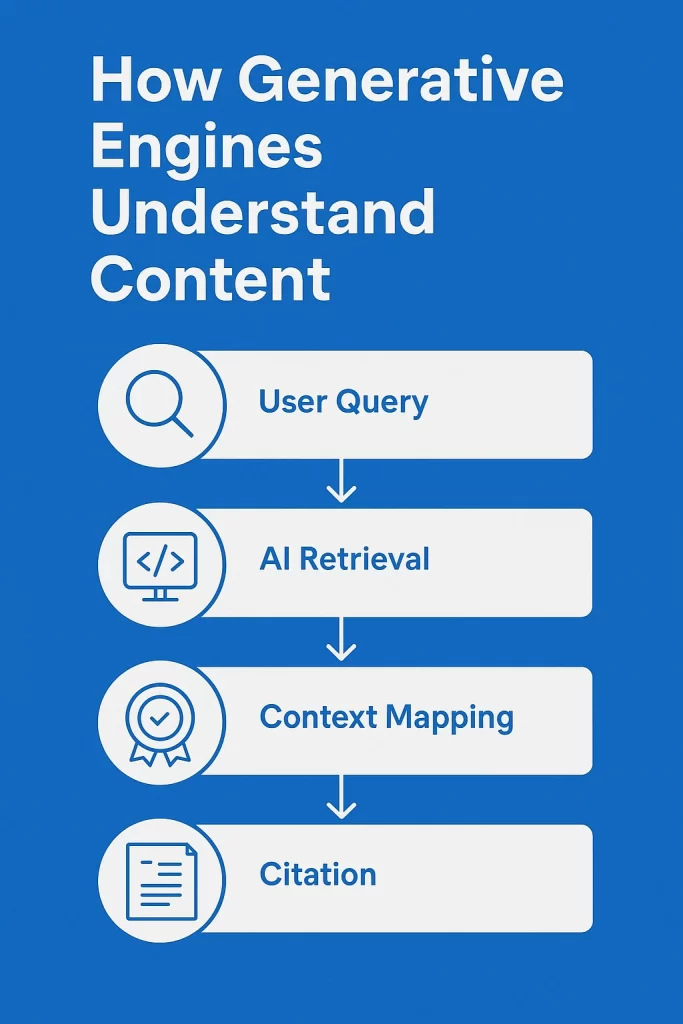
Step 3: Amplify E-E-A-T (Experience, Expertise, Authoritativeness, Trustworthiness)
If you’ve read our article on GEO Visibility in Google AI Overviews, you’ll know that Google’s AI doesn’t quote random blogs, it cites verified experts.
A Search Engine Land (2024) report confirmed that AI systems weigh author credibility and citation reliability heavily when generating summaries.
Practical actions:
- Write under a real author with credentials and an updated bio.
- Link to authoritative data sources e.g., the Australian Bureau of Statistics (ABS), CSIRO, ACCC, or NDIS when relevant.
- Add visible contact info, HTTPS security, and a clear privacy policy.
- Update content every few months and show timestamps.
GEO and E-E-A-T are inseparable; one fuels trust, the other visibility.
Step 4: Support every claim with verifiable data
AI crawlers reward content that proves what it says. If you write, “Google dominates search in Australia,” include a credible source like StatCounter’s 2025 data showing Google holds over 91% of Australia’s market.
It’s not about padding content with stats; it’s about teaching AI where truth originates.
Do this
- Link every major statement to a reliable source (Deloitte, ABS, HubSpot, etc.).
- Prefer .gov.au, .edu.au, and recognised research bodies.
- Use infographics or tables to make data easy to extract.
- Avoid broken links; AI models downgrade inconsistent data chains.
Each verified citation increases your content’s AI-citability score; its likelihood of being referenced in generative summaries.
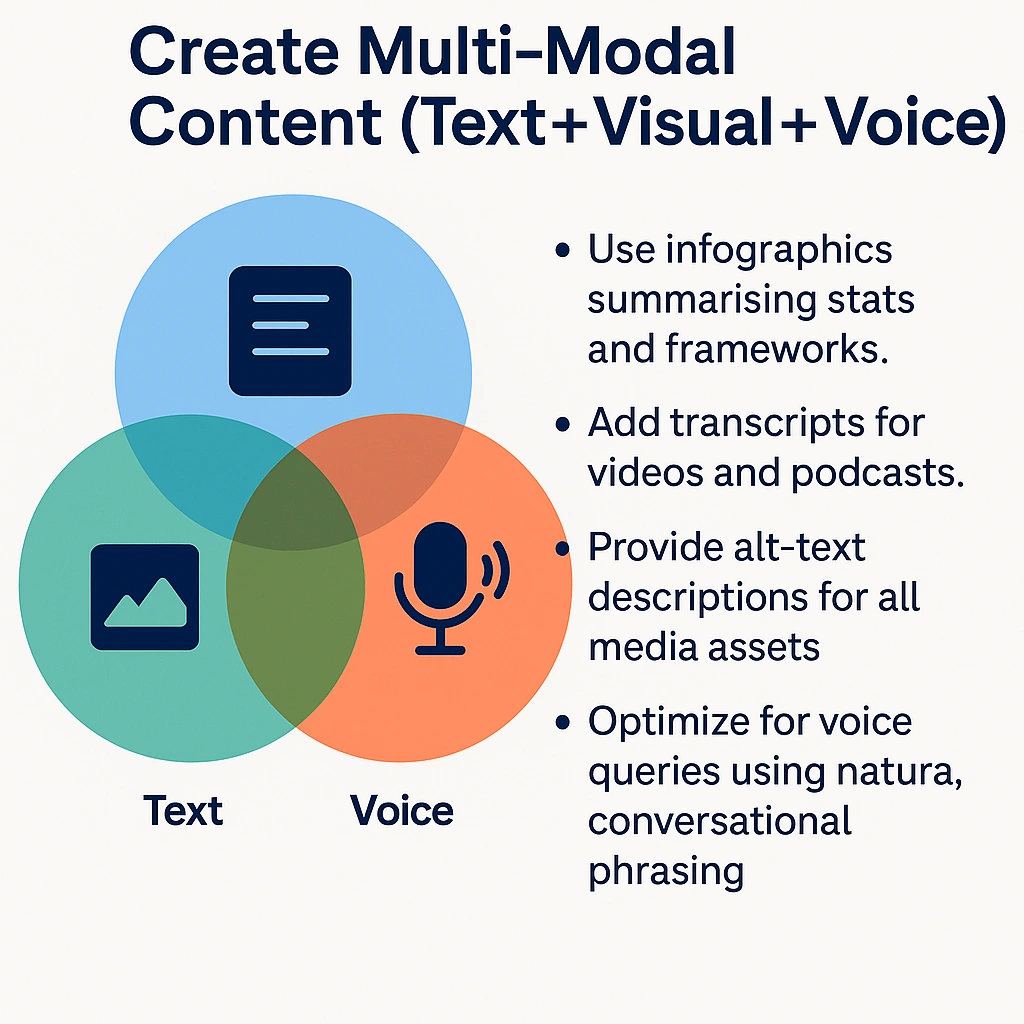
Step 5: Go multi-modal; text, visual, and voice (enhancing AI search visibility)
Modern search is multi-sensory. AI engines don’t just read text, they analyse visuals, captions, transcripts, and even tone.
A 2025 HubSpot report found that content with visuals achieves 94% higher engagement
Practical GEO actions
- Add infographics summarising data or frameworks.
- Include descriptive alt text for every image.
- Upload transcripts for videos or podcasts.
- Write in natural, conversational language to improve voice search results.
Every additional format strengthens your message and gives AI multiple “entry points” to understand your brand.
Step 6: Interlink like a human brain
Generative AI doesn’t evaluate a single page; it learns from your whole website network.
Internal linking tells it how your ideas connect.
An Ahrefs analysis showed that strong internal linking helps search engine crawlers find pages more easily and boosts their indexing and ranking potential.
How to optimise this:
- Build topic clusters:
- GEO Pillar → Generative Engine Optimisation (GEO)
- Supporting pages → “How to optimise your content for GEO,” “GEO Visibility in Google AI Overviews,” etc.
- Use descriptive anchors like “learn how to optimise your content for GEO” rather than “click here.”
- Link externally to authoritative Australian sites when referencing research or regulation.
The goal is to make your content graph feel cohesive and educational, like an intelligent library.
Step 7: Keep adapting, GEO never stops evolving
Generative search isn’t static. Google refines SGE, and OpenAI updates its models periodically.
Future updates may emphasise:
- AI citation weighting (how often brands are referenced),
- multimodal ranking (video + text fusion), and
- entity coherence (how connected your brand is within topics).
By combining structured clarity with human storytelling, you make your content future-fit and ready to appear not just on Google, but across every AI ecosystem.
Conclusion: Turning GEO into a competitive advantage
Learning how to optimise your content for GEO isn’t just another marketing tactic; it’s the evolution of visibility in an increasingly AI-first ecosystem.
Search has shifted from ranking pages to recommending trusted sources, and brands that adapt early will gain visibility faster.
When you blend semantic clarity, structured data, verifiable sources, and E-E-A-T integrity, your content becomes more than text, it becomes evidence. It’s the kind of content AI engines use to explain ideas, support answers, and shape user perception.
At Velacore, we help Australian businesses build intelligent content ecosystems. Our aim is to ensure every blog, landing page, and insight is optimised not just for algorithms, but for the AI models that define current search experience.
Because the future of digital visibility isn’t just about shouting louder online, it’s about earning trust through clarity, structure, and truth.
So start now. And if you don’t know where to begin, GET IN TOUCH!
Is Your Website Working for You?
Most websites don't generate leads. We fix that with custom designs that look great and deliver measurable results for your business.
Get Started With Velacore