If you’ve noticed fewer clicks but richer AI-generated summaries on Google lately, you’re not imagining it. Since expanding AI Overviews to more than 200 countries and 40 languages in 2025, search visibility has changed forever.
For Australian businesses, being found now means something different; it’s not just about ranking first, but also being quoted inside the answer itself. That’s where Generative Engine Optimisation (GEO) comes in.
Generative Engine Optimisation is the evolving practice of helping your website appear as a cited source within AI-generated results like Google’s AI Overviews. Think of it as the natural next step beyond SEO where instead of fighting for the top organic slot, you train Google’s AI to trust, lift, and attribute your facts, not your competitor’s.
If you’re new to the concept, start with our foundational guide, What is Generative Engine Optimisation (GEO)? — it explains the principles that this article builds on.
Up next, we’ll explore how Google AI Overviews choose their sources, what patterns we’re seeing locally, and the specific optimisation signals you can use to appear in them.
What Google’s AI overviews actually are (and how they appear in australia)
If you’ve searched for something like “best accounting software for small businesses in Sydney” recently, you’ve probably seen a colourful summary box at the top of Google’s results, that’s an AI Overview.
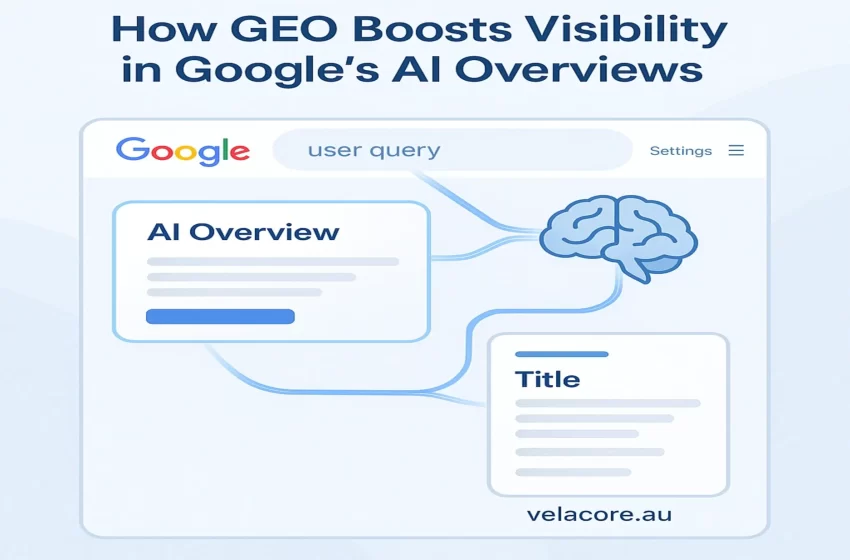
Google’s AI Overviews (previously “Search Generative Experience”) use generative AI to answer complex queries directly on the search results page. Instead of showing just links, the AI summarises information from multiple credible sources, cites them inline, and often invites users to “dig deeper” with follow-up prompts.
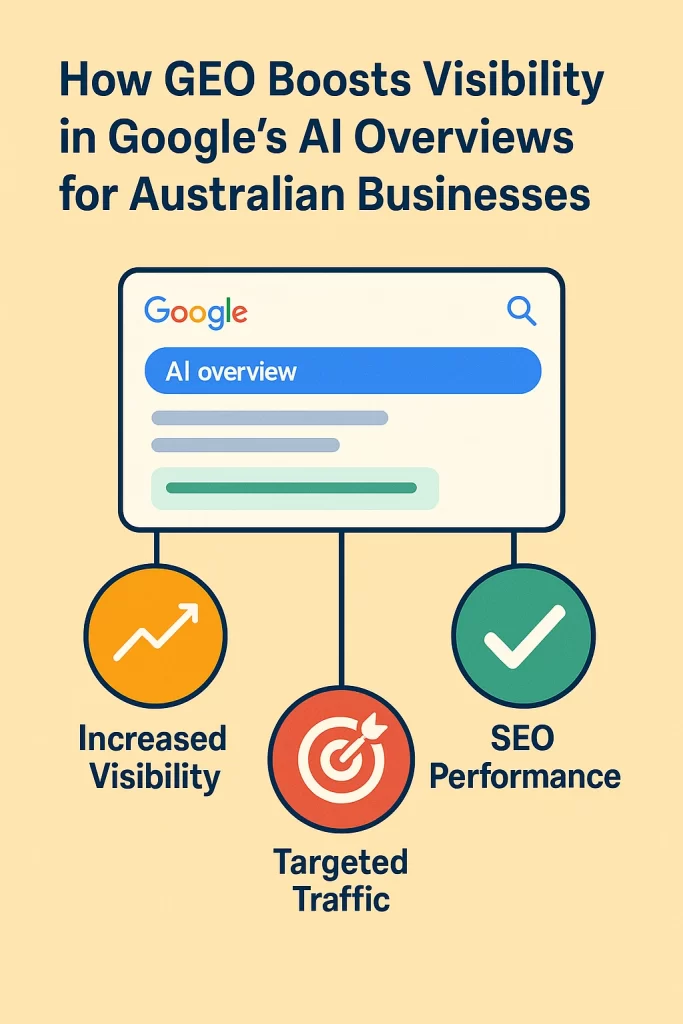
In plain terms, Google AI Overviews are AI summaries that cite and link to trusted web pages, and your goal with Generative Engine Optimisation (GEO) is to become one of those cited sources.
How Google decides what to include
Google AI Overview system looks for three things above all else:
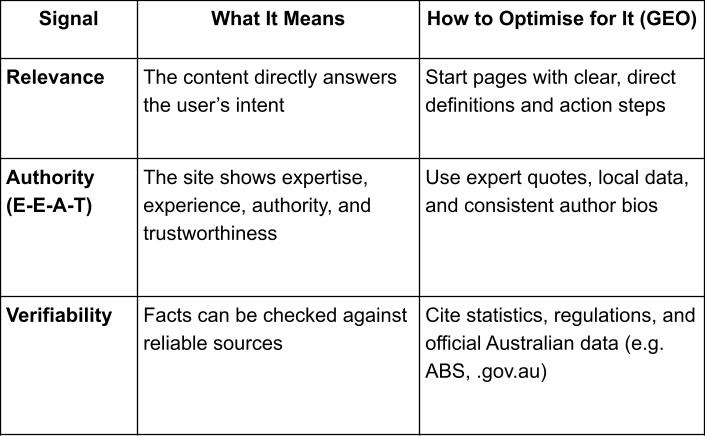
How often AI overviews appear in Australia
- By mid-2025, AI Overviews appeared in more than 50% of all monitored search queries globally.
- In Australia, tests by SEO professionals show similar patterns especially for “informational” and “how-to” queries.
- The highest AIO visibility has been observed in industries like healthcare, education, finance, and small business services, all sectors where accurate, regulated information is vital.
- Mobile search results are slightly more likely to show AI Overviews than desktop.
What this means is simple: if your Australian business publishes factual, structured, and trustworthy content, Google’s AI is far more likely to quote your page in an overview.
Tip: Run local queries related to your service (e.g., “NDIS website design Melbourne”) to see if AI Overviews trigger. If they do, those are your GEO targets.
What it looks like in practice
Below the AI-generated summary, you’ll often see three to five cited cards linking to source websites. These cards are the visibility real estate you’re competing for.
According to BrightEdge’s 2025 AI Overviews Impact Study, about 54% of citations in AI Overviews come from pages that already rank organically in the top 10. That means GEO doesn’t replace SEO, it amplifies it.
When your existing high-performing content is updated with clear definitions, schema markup, Australian examples, and verifiable facts, it’s more likely to be featured in AI Overviews and maintain organic strength.
Why this matters for Australian businesses
Australia’s digital space is becoming increasingly competitive, and AI search is levelling the playing field. GEO allows smaller brands; whether in NDIS services, finance, or local trades, to gain visibility by offering the clearest, most credible answers, not necessarily the biggest backlink profiles.
The GEO blueprint: What Google AI overviews reward, and how to earn it
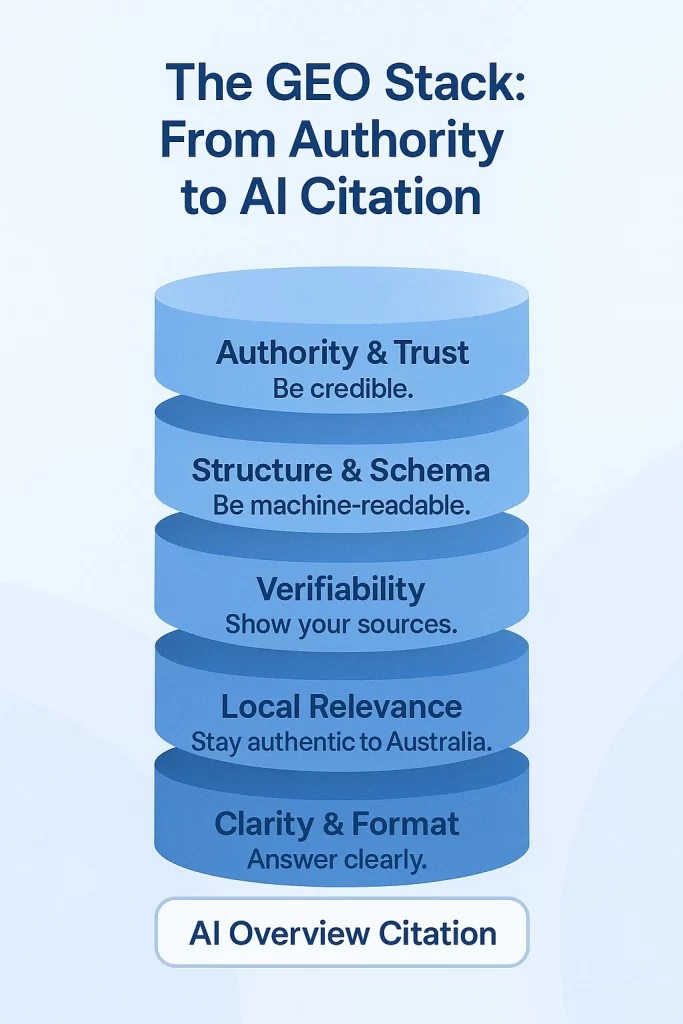
Generative search is no longer a tech preview, it’s the front page of Google. To appear inside AI Overviews, Australian businesses must understand how Google’s systems decide which voices to quote.Through Generative Engine Optimisation (GEO), you can deliberately shape those signals so your content earns citations, not just rankings.
The five pillars below summarise what Google’s AI rewards, and how to engineer them into every page.
Authority & trust: E-E-A-T in action
Google AI doesn’t invent authority; it detects it. AI Overviews favour content written by identifiable experts whose experience aligns with the search intent.
How to build it
- Attribute every article to a qualified human author or registered entity. Example: “Written by Jane Lau, Registered NDIS Provider (#ABC-123)”.
- Add short author bios and link to credential pages or LinkedIn profiles.
- Reference recognised Australian institutions such as NDIS.gov.au, ATO.gov.au, or ABS.gov.au.
- Keep your About and Contact pages detailed; they reinforce legitimacy for AI crawlers.
- Update and date-stamp content; AI models prioritise freshness.
Why it matters
BrightEdge found that pages displaying clear authorship and third-party references were significantly more likely to be cited in AI Overviews. In Australia’s regulated sectors (NDIS, healthcare, finance), this trust layer is essential for inclusion.
Structure & schema: Helping AI understand you
Even the most insightful paragraph is useless if AI can’t interpret it. Generative Engine Optimisation depends on structured data that clarifies relationships between entities and topics.
Implementation checklist
- Use a logical heading flow (H1 > H2 > H3); never skip levels.
- Apply relevant Schema.org types:
- Article — for blog content
- FAQPage — for quick Q&As
- HowTo — for processes or tutorials
- LocalBusiness — for service pages
- Keep code clean; no duplicate tags or nested H1s.
- Present stats in tables or key-fact boxes.
- Optimise image alt text with factual, descriptive phrasing.
Example
An article titled “How GEO Boosts Visibility for NDIS Providers in Sydney” could include a mini-table comparing “Traditional SEO vs GEO Outcomes.” This dual structure (semantic + visual) lets AI parse and summarise easily.
Verifiability & sources: Building citation confidence
AI Overviews rely on verifiable evidence, not speculation. If a claim can’t be traced, it’s often ignored.
Actions to take
- Attribute every statistic: “According to BrightEdge (2025), AI Overviews appear on 44 % of queries.”
- Link to .gov.au, .edu.au, or reputable industry reports.
- Use consistent citation style (Name + Year + URL).
- Include a “Sources & Last Reviewed” block at the end of the page.
- Avoid generic “research shows” phrasing; AI downgrades unverifiable claims.
Example
A Melbourne fintech might reference “Reserve Bank of Australia (2025)” when discussing inflation trends; that explicit attribution increases its chance of citation inside financial AI summaries.
Local relevance; Winning the Australian context
Google’s AI tailors results by region, so localisation is a ranking and citation factor. For Australian audiences, authenticity comes from language, currency, and context.
Best practices
- Use Australian English (“optimisation,” “organisation”).
- Reference AUD values, GST, and state regulations where appropriate.
- Add city and state names naturally in headings and meta tags.
- Ensure ABN and NAP consistency across your site, Google Business Profile, and directories.
- Include links to .gov.au pages relevant to each jurisdiction.
Example
A Brisbane-based NDIS provider might write “How GEO Helps Queensland Disability Services Stand Out in AI Search.” That state reference signals locality and boosts trust.
Local relevance appears in Google’s Quality Rater Guidelines as a key factor in judging regional accuracy.
Clarity & format: Writing for humans and machines
Generative engines summarise; they don’t infer nuance. The clearer your structure, the easier it is for AI to lift accurate sentences.
Write this way
- Begin each page with a two-to-three-sentence summary answer.
- Use short sentences and active voice.
- Include FAQ sections that mirror common search phrasing.
- Avoid keyword stuffing; rely on natural semantic variations.
- Support complex topics with graphics or flow diagrams described in alt text.
Example
An education platform might open with:
“Generative Engine Optimisation (GEO) helps Australian training providers get featured inside Google AI Overviews by structuring their content for clarity and trust.”
That’s instantly quotable for AI.
Measurement & iteration: Keeping visibility alive
Unlike classic SEO, GEO visibility will likely fluctuate with model updates. Sustained performance requires regular auditing.
Track and refine
- Monitor AI Overview appearances using BrightEdge Generative SERP Tracker or Semrush AI Visibility Index.
- Compare impressions vs clicks to gauge zero-click exposure.
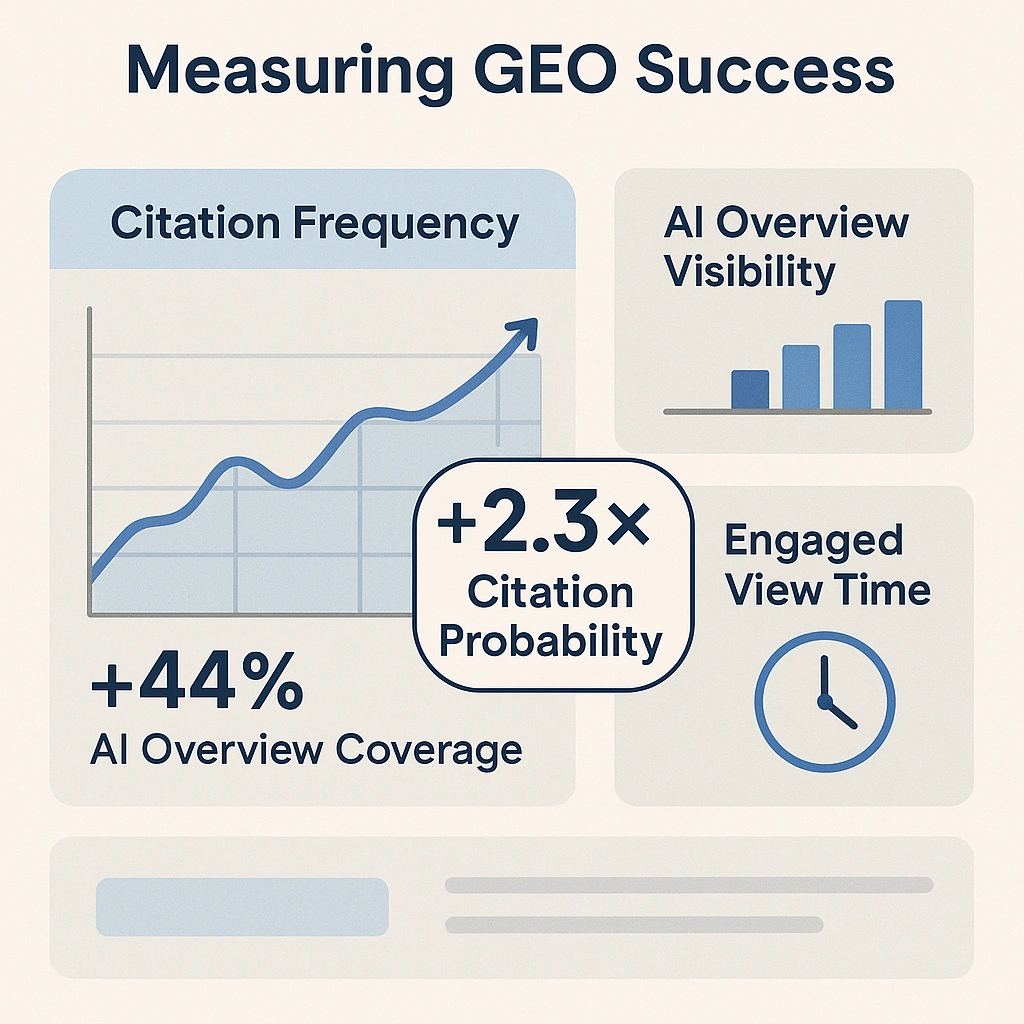
- Measure citation frequency; how often your brand appears in AI answers.
- Review engagement metrics (scroll depth, dwell time) quarterly.
- Refresh statistics, screenshots, and examples every 90 days.
Continuous iteration keeps your content current in model training cycles and preserves inclusion probability.
Quick reference GEO checklist
| GEO Signal | Core Action |
| Authority & Trust | Add author bios + expert credentials |
| Structure & Schema | Apply FAQ/HowTo/Article markup |
| Verifiability | Link to .gov.au or .edu.au sources |
| Local Relevance | Use Australian English + consistent ABN |
| Clarity & Format | Lead with direct answers + FAQs |
| Measurement | Track AI Overview citations quarterly |
Key Takeaway
Generative Engine Optimisation turns your expertise into machine-readable authority.
When content is accurate, structured, and locally relevant, Google’s AI doesn’t just index it, it endorses it.
Conclusion
Search is no longer a list of links, it’s a conversation powered by AI. As Google’s AI Overviews become the default search experience across Australia, the question isn’t just “Can people find you?” anymore. It’s also “Does AI trust you enough to quote you?”
For Australian businesses, this shift means authority and clarity may now outperform ad budgets and keyword stuffing.
If your pages are author-verified, schema-enriched, and factually grounded, you’re not just optimising for clicks, you’re building a digital footprint that AI systems endorse.
And when that happens, your brand becomes part of the answer itself.
At Velacore, we help Australian brands adapt to this new search reality. From advanced GEO strategy and AI search optimisation to structured-data implementation and content rewrites, our team ensures your business stays visible, cited, and trusted in Google’s evolving ecosystem.
Ready to enhance your visibility? Explore how Velacore’s GEO and SEO experts can help your business become AI-findable today. Get in touch
Frequently Asked Questions (FAQs)
- What is Generative Engine Optimisation (GEO)
Generative Engine Optimisation (GEO) is the process of optimising your website so AI systems like Google AI Overviews, Bing Copilot, or Perplexity.ai can confidently quote, cite, and summarise your content in their generated answers.
It builds on traditional SEO by adding structure, verifiable data, and E-E-A-T credibility, helping Australian businesses stay visible in AI-driven search.
- How is GEO different from traditional SEO?
Traditional SEO focuses on ranking in search results. GEO focuses on being cited in AI answers. While SEO improves visibility through keywords and backlinks, Generative Engine Optimisation enhances your chances of being featured inside AI Overviews by prioritising structured data, fact-checked content, and clear authorship. Both are essential; SEO builds authority; GEO helps AI trust and surface that authority.
- Why is GEO important for Australian businesses?
Google’s AI Overviews now appear in over half of all searches.
That means many users get answers without clicking. For Australian businesses, GEO ensures your brand still appears inside those summaries. It’s visibility, credibility, and brand awareness rolled into one.
- How can I make my website appear in Google’s AI Overviews?
Start by aligning your site with AI search optimisation best practices:
- Add FAQPage, HowTo, and Article schema.
- Use Australian English and local context (currency, laws, cities).
- Include verifiable citations (ABS, ATO, NDIS).
- Write answer-first content; short, factual intros that AI can quote.
- Keep content fresh; update statistics every quarter.
This mix of technical precision and trustworthy data increases your inclusion chances.
- Does Generative Engine Optimisation replace SEO?
No. GEO doesn’t replace SEO, it builds on it. You still need classic SEO signals: backlinks, site performance, and keyword relevance. But GEO adds another layer; ensuring your pages aren’t just found, but trusted and referenced by AI systems.
- Can smaller Australian businesses benefit from GEO?
Absolutely.
Generative Engine Optimisation levels the playing field by rewarding clarity and trust not just marketing budgets. Whether you’re a small local service or a national brand, publishing factual, structured, and locally relevant content can put you in the same AI summaries as industry leaders.
- Is GEO relevant beyond Google?
Yes.
GEO applies to all AI-powered search systems; including Microsoft Copilot, ChatGPT’s web search, Perplexity.ai, etc. However, since Google holds over 90 % of Australia’s search market, most GEO strategies focus there first.
Is Your Website Working for You?
Most websites don't generate leads. We fix that with custom designs that look great and deliver measurable results for your business.
Get Started With Velacore