What the estimate considers
Project category, number of pages, readiness of written content, and whether the build needs standard, lead-generation, advanced or integration-heavy functionality.
This page combines an instant website cost calculator with practical guidance on what shapes Australian website pricing, what different investment bands often cover, and why two websites that look similar can require very different levels of strategy, design, development and testing.
Select four early scope drivers: website type, page volume, content readiness and functionality. Then receive an indicative range in AUD. It is a planning estimate rather than a fixed quote. For wider market context, read our 2026 Australian website cost guide.

Complete all four selections. Your estimate updates automatically and is announced without moving your position on the page. Fields marked * are required.
Choose the closest match for your current requirements.
Ready to estimate
Your selections will generate a range based on the calculator’s published scope model.
Final pricing depends on discovery, technical requirements, delivery timing and confirmed inclusions.
Your selected scope will appear here.
Once your estimate is ready, share your details and Velacore can refine it around your project.
The result combines a base range for the selected website category with adjustments for page volume, content support and functional complexity. Each total is rounded to the nearest practical $500 boundary.
Project category, number of pages, readiness of written content, and whether the build needs standard, lead-generation, advanced or integration-heavy functionality.
Information architecture, design depth, accessibility requirements, integrations, migration, approvals, security, testing, delivery timing and operational constraints.
It is not a binding quote, invoice or guarantee of final scope. A formal proposal must confirm deliverables, exclusions, GST treatment, third-party costs, milestones and commercial terms.
Important: Hosting, domain renewal, premium software licences, transaction fees, maintenance, ongoing SEO, advertising and future content production may be recurring costs. Their inclusion depends on the final proposal rather than the indicative calculator result.
Price rarely comes down to visual style alone. The strongest early signals are project category, structural size, content readiness and functional complexity.
A brochure site, eCommerce store, custom platform and governed enterprise rollout require different levels of discovery, design and engineering.
More pages usually mean more architecture, content handling, template application, accessibility review and quality assurance.
Incomplete messaging expands the project into content strategy, copywriting, stakeholder review and search-intent alignment.
Bookings, portals, eCommerce, CRM connections, APIs and custom workflows create deeper engineering, security and testing requirements.
Deeper scope may require eCommerce development, custom software and integrations, or an aligned SEO and AI search strategy.
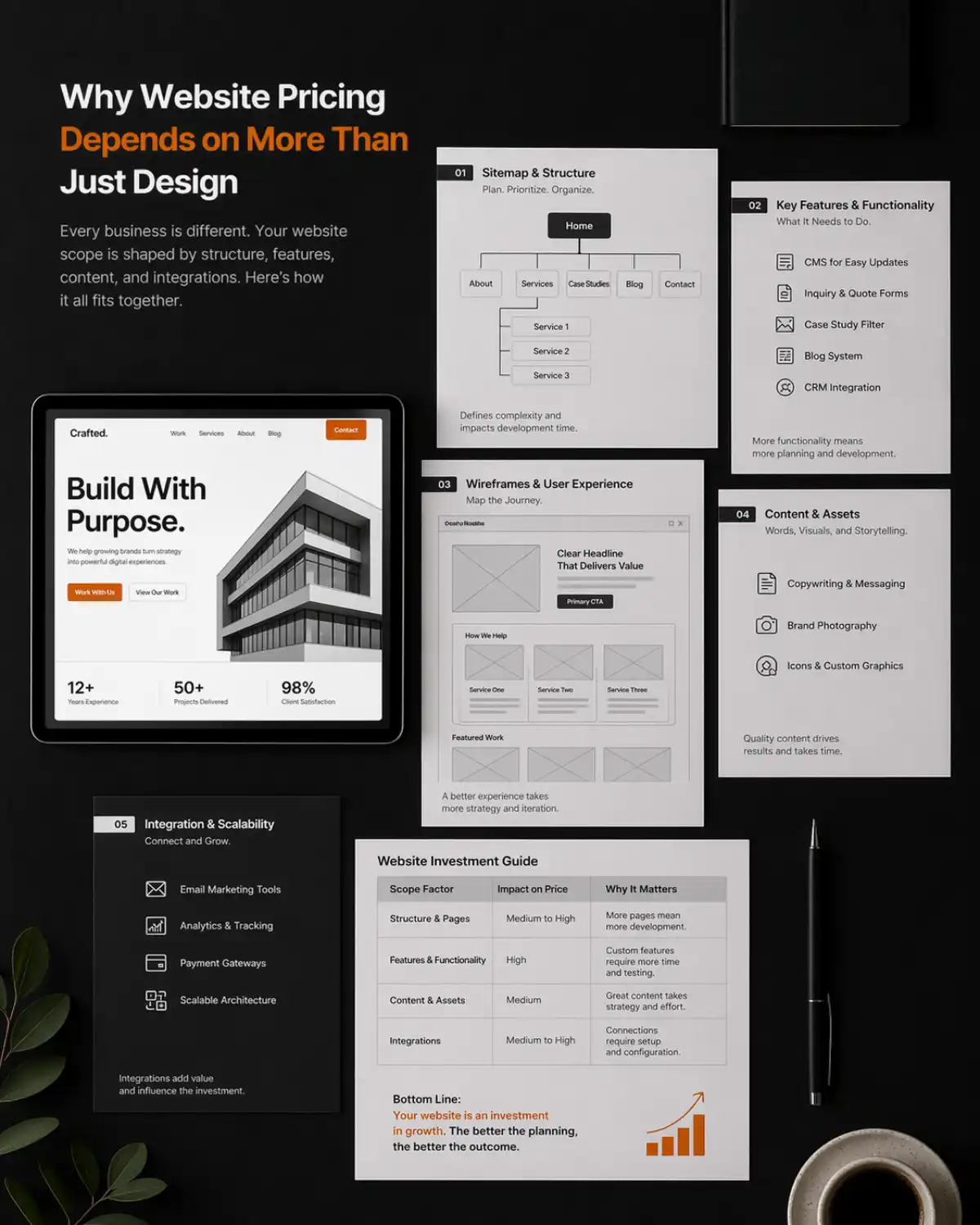
The purpose of the calculator is to make the first pricing conversation more grounded, not to compress a complex delivery process into false precision.
These are category-level starting ranges before page, content and functionality adjustments. They are planning guides, not fixed packages or guaranteed quotes.
Usually suits smaller websites focused on credibility, visual polish and clear presentation where deep functional complexity is not required.
Often fits businesses that need stronger messaging, service-page architecture, trust signals and clearer lead capture rather than a basic online presence.
Online stores add product architecture, category flow, checkout, payment, fulfilment and customer-trust requirements. Review our eCommerce development capability for broader delivery considerations.
Custom builds can involve bespoke UX, unique content models, user logic, integrations or workflows that move the project beyond standard website delivery.
These projects often expand through accessibility requirements, governance, stakeholder approvals, integrations, security and large-scale information architecture.

Some demanding projects look deceptively simple. Much of the effort sits underneath the interface: content models, user flows, approvals, CMS structure, accessibility, integrations and the commercial role the website must perform after launch.
Not necessarily. A redesign can be efficient when the current website has strong foundations. It can become more involved than a fresh build when migration, SEO preservation, accessibility, technical debt or weak information architecture must be corrected.
| Project path | Often a good fit when | Cost and scoping considerations |
|---|---|---|
| New website | You need clearer architecture, updated messaging, a stronger user experience or a cleaner technical foundation for growth. | Often easier to scope cleanly when the current platform or structure would constrain the desired outcome. |
| Redesign | Useful content, brand assets, platform components or SEO equity can be retained without compromising performance or flexibility. | Requires closer review of old templates, redirects, analytics, migration, accessibility issues and accumulated technical debt. |
For a deeper breakdown, read our website redesign cost guide.
The clearer the required business outcome, user journey and operational scope, the easier it becomes to compare proposals fairly. A lower quote may simply exclude strategy, content, accessibility, testing, migration or post-launch support.

These answers explain how to interpret the estimate and what to confirm before comparing proposals.
Velacore’s indicative base ranges run from $3,500–$6,500 AUD for a lean brochure or portfolio website, $6,500–$12,000 for a small-business website, $10,000–$22,000 for eCommerce, $18,000–$45,000 for custom website work, and $40,000–$120,000+ for enterprise or government projects. Page volume, content and functionality adjustments can increase the result.
We show a range because page volume, content, integrations, accessibility and security all shape the work. Your selections narrow the estimate; discovery turns it into a tailored quote.
Use it to plan your website budget. The closer your selections match the final page count, content and features, the closer the estimate. We confirm complex integrations and migration work during discovery.
Do not treat the calculator result as an all-inclusive tax invoice. GST treatment, third-party costs and all commercial inclusions must be stated explicitly in the formal proposal supplied for your project.
Not automatically. Hosting, domain renewals, premium licences, maintenance, security support and ongoing optimisation can be recurring services. Their inclusion and price depend on the final proposal.
Yes. Approved, well-structured content allows delivery to move more directly into design and development. Incomplete or inconsistent content adds research, messaging, information architecture, writing, review and implementation work.
Examples include bookings, portals, member access, eCommerce, workflow-driven forms, dynamic user logic, CRM processes, API connections and custom operational flows. These features require more engineering, security review and testing than standard informational pages.
Usually. Even a relatively lean store introduces product and category architecture, inventory considerations, checkout, payments, customer accounts, fulfilment logic, analytics, security and ongoing operational requirements.
No. Redesigns can be efficient when foundations are strong, but migration, redirect planning, SEO preservation, inaccessible templates, old integrations and technical debt can make them as involved as, or more involved than, a fresh build.
Timing depends on scope, content readiness, integrations and approval speed. A formal proposal should include project stages, client responsibilities, review windows and dependencies rather than relying on a generic timeframe.
Yes. The calculator displays AUD to keep its pricing context clear, but international organisations can still use it as an early baseline and request a proposal tailored to their location and requirements.
Your selected scope and estimate are submitted with your contact details. Velacore can then review your goals, content, functionality, delivery requirements and any hidden complexity before preparing the next-step response.
Use the calculator to establish a baseline, then share the result with Velacore so the assumptions, exclusions and delivery requirements can be reviewed before formal pricing.