
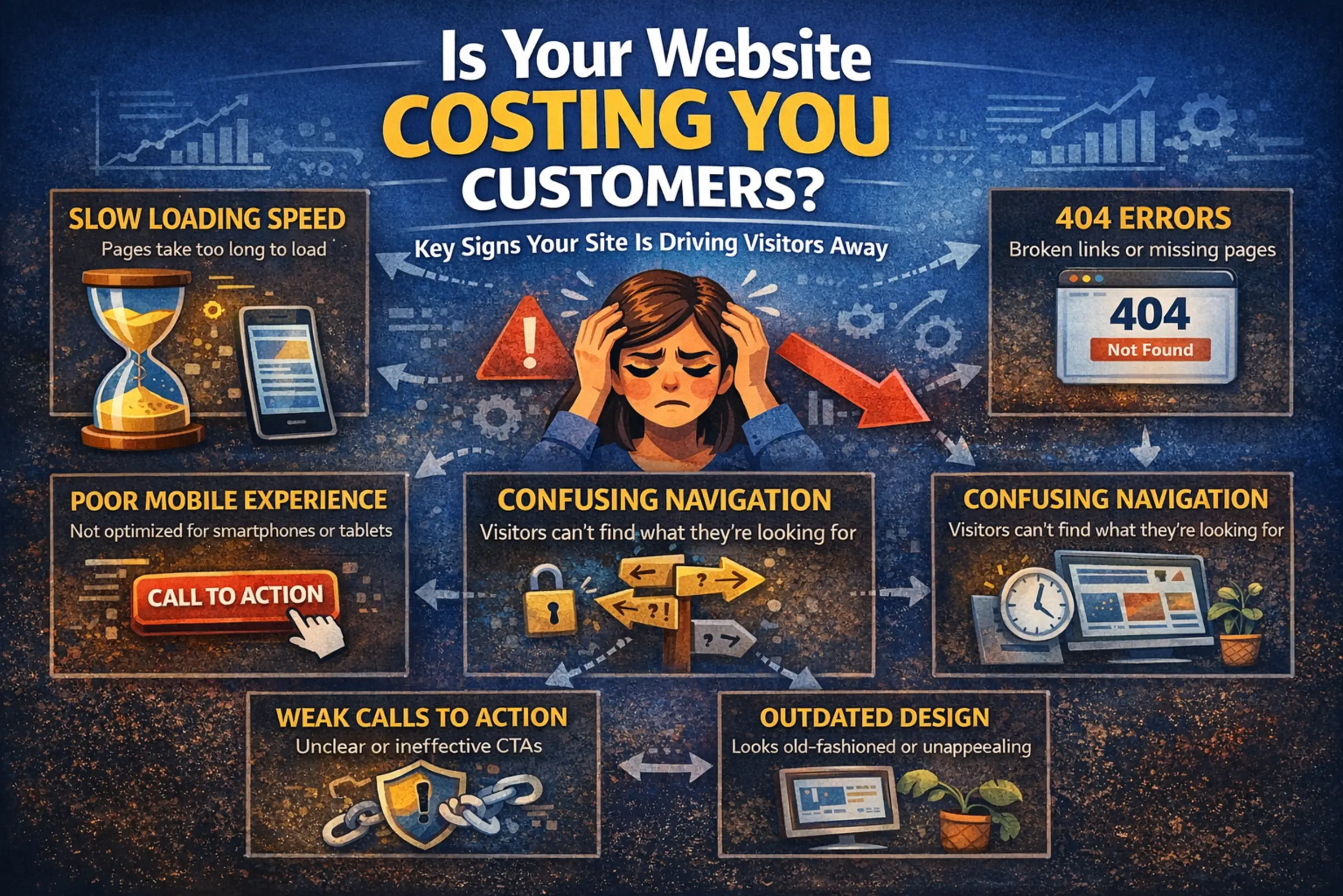
Most Australian business owners know their website could probably be better. But there is a difference between a website that is a little dated and a website that is actively working against you, turning away potential customers every single day without you realising it. The uncomfortable truth is that a poorly performing website does not just fail to generate leads. It actually drives people toward your competitors.
This article walks through the clearest signs your website is costing you customers, backed by real data. If you recognise two or more of these in your own site, it is worth treating this as a business problem, not just a design problem.
Your Website Loads Too Slowly
This is the single most common and most costly website problem for Australian businesses, and it is often completely invisible to the business owner.
When you visit your own website regularly, your browser caches the files and loads it almost instantly. Your customers are not getting that experience. They are loading it cold, often on a mobile connection, and they are not willing to wait.
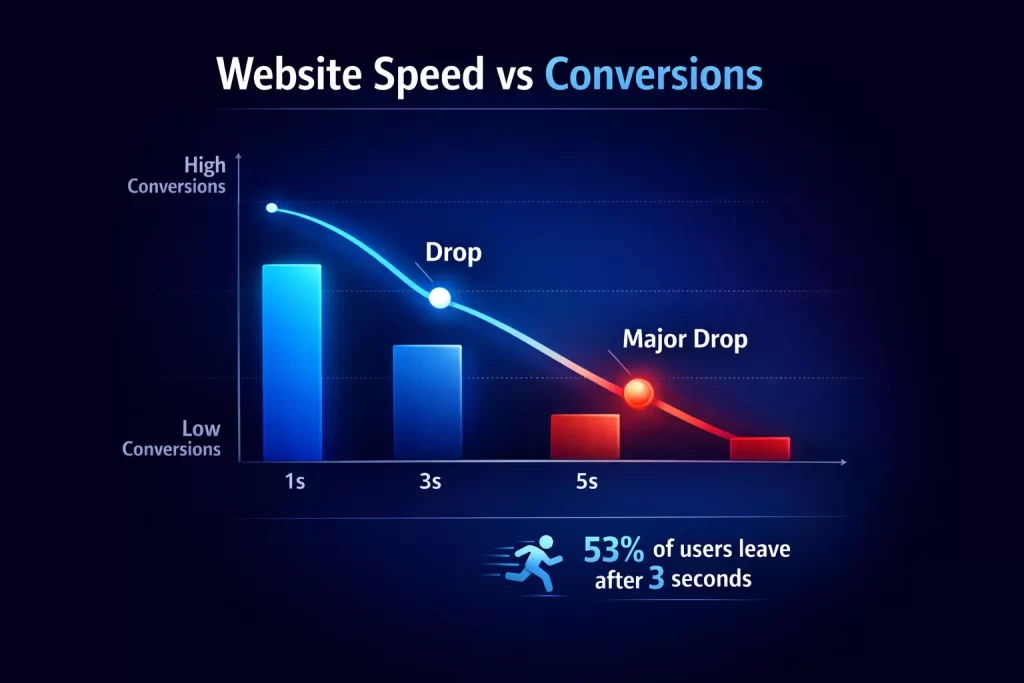
| 53% of mobile visitors abandon a page that takes more than 3 seconds to loadk |
According to Google, 53% of mobile website visitors will abandon a page that takes longer than 3 seconds to load. Three seconds. That is not a long time, but most business websites fail to meet it.
The financial impact is just as stark. Research found that for every additional second of load time between 0 and 5 seconds, conversion rates drop by an average of 4.42%. And a Portent study of over 100 million page views found that ecommerce sites loading in one second had conversion rates three times higher than sites loading in five seconds.
The fix is not always dramatic. Compressing images, upgrading to quality Australian hosting, and cleaning up unnecessary plugins or scripts can make a significant difference. But if you have never actually tested your website speed, do it today. Google’s PageSpeed Insights is free and will show you exactly where the problems are.
Your Website Is Not Designed for Mobile Users
If your website was built more than three or four years ago and has not been updated since, there is a reasonable chance it is delivering a poor experience to the majority of your visitors.
| 64% of all global web traffic now comes from mobile devices |
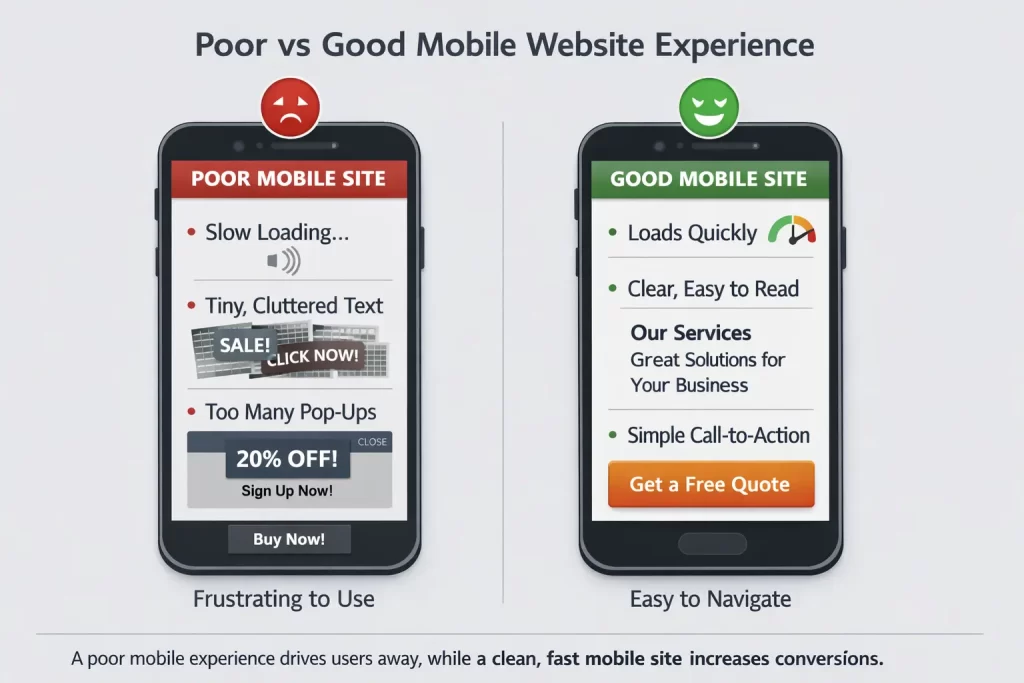
As of 2025, approximately 64% of all global web traffic comes from mobile devices. That means for most Australian business websites, more than half of all visitors are on a phone. If your site is not genuinely built for that experience, those people are leaving.
Mobile-specific problems go beyond just making content fit a smaller screen. Buttons that are too small to tap accurately, text that requires pinching and zooming to read, menus that collapse badly, and forms that are frustrating to fill out on a touchscreen all add friction that kills conversions. Mobile bounce rates globally sit between 58% and 60%, roughly ten percentage points higher than desktop bounce rates, and a poor mobile experience is a significant contributor.
Google also uses mobile-first indexing, which means it ranks your website based on how well the mobile version performs, not the desktop version. A site that looks fine on a laptop but breaks on a phone is not just losing customers. It is also losing search visibility at the same time.
Your Bounce Rate Is High
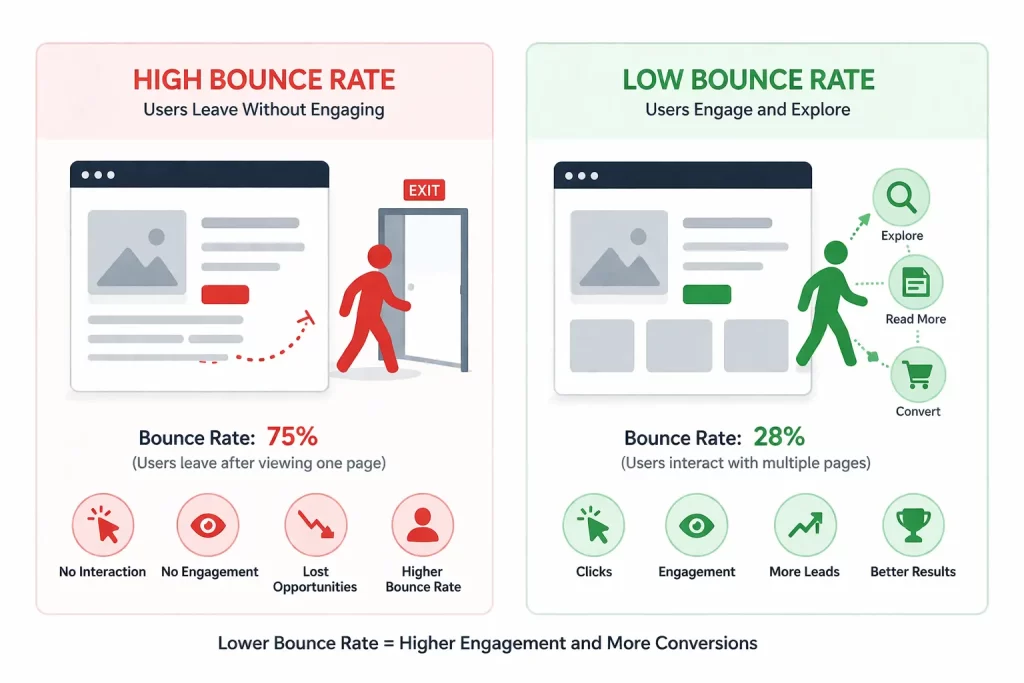
Bounce rate is the percentage of visitors who land on your website and leave without clicking anywhere else. A high bounce rate is one of the clearest signals that something on your site is not working.
According to current benchmarks, a bounce rate between 41% and 55% is considered average for most websites, while anything at 70% or above should be treated as a genuine alarm signal. If you are seeing those kinds of numbers in your analytics for service pages or your homepage, people are arriving and immediately deciding you are not what they were looking for or not worth staying around for.
The causes of high bounce rate are usually one of a few things: slow load speed, a design that looks untrustworthy or outdated, content that does not match what the visitor expected to find, or a page that makes it unclear what the visitor should do next. A 2-second delay in page load alone has been shown to increase bounce rates by 103%, which gives you a sense of how dramatically speed alone can affect this number.
The good news is that you can check your bounce rate for free in Google Analytics. If you do not have analytics set up on your website at all, that is itself a problem worth fixing immediately.
Your Website Looks Outdated or Untrustworthy
This one is harder to see objectively when you look at your own site every day. But first impressions on the web happen in milliseconds, and a website that looks like it was built years ago sends an immediate signal to visitors that your business may not be on top of things.
| 75% of users judge a business’s credibility based solely on its website designSource: wauu-creative.com |
Studies show that 75% of users judge a business’s credibility based solely on its website design. That credibility judgement happens before they have read a single word about what you do. And the consequences of losing that trust are severe: 89% of consumers say they would go to a competitor after a poor website experience.
Specific trust killers to watch for:
- Stock photography that looks generic and dated
- No reviews, testimonials, or client logos visible on the site
- A contact page with no phone number or physical address
- An SSL certificate that has expired (your browser will show a security warning)
- Copyright dates in the footer that are several years old
- Broken links or pages that return errors
Any of these individually can be enough to make a visitor question whether they are dealing with a legitimate, active business.
Your Website Is Hard to Navigate
When a visitor cannot figure out how to find what they are looking for within a few seconds, they leave. Good navigation should feel invisible. Users should be able to get from your homepage to the information they need in three clicks or fewer, without having to think about where to look.
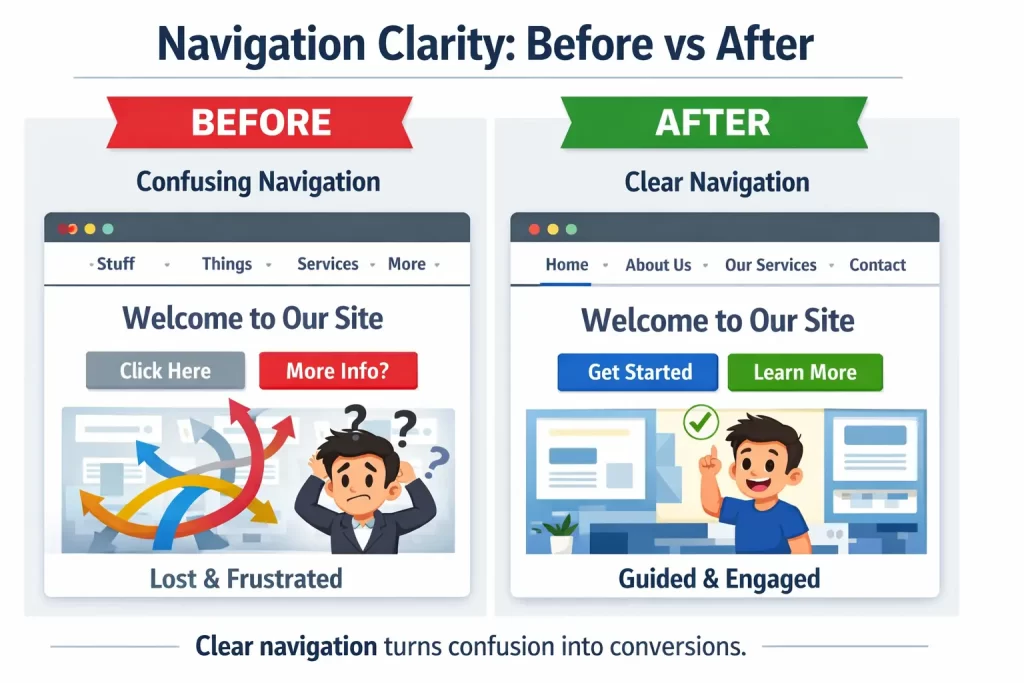
Research shows that 37% of people will leave a website specifically because of poor navigation. Common navigation problems that drive people away include menus overloaded with too many options, page titles using internal jargon rather than plain language, no clear path from your homepage to your most important services, and calls to action that are buried or missing entirely.
Think about what your ideal customer is trying to do when they arrive on your site. They want to understand quickly whether you can help them, see evidence that you are trustworthy, and find out how to get in touch or take the next step. If your navigation does not support that journey cleanly, you are losing enquiries you should be winning.
Your Website Is Not Showing Up on Google
If your website is not appearing on the first page of Google for searches related to your services in your area, you essentially do not exist to most potential customers who are looking for what you offer.
| Page one of Google captures approximately 71% of all search traffic clicksSource: sahutechnologies.com |
Page one of Google captures approximately 71% of all search traffic clicks, with the vast majority going to the top five results. If you are on page two or beyond, the traffic you are missing is enormous.
The reasons a website fails to rank are varied. Common causes include thin or outdated content that does not answer what people are actually searching for, a slow or technically broken website that search engines cannot crawl properly, no location-specific pages for the areas you serve, a complete lack of backlinks from other reputable websites, and no Google Business Profile or one that has not been maintained.
A simple test: open a private or incognito browser window, search for the main service you provide followed by your city or suburb, and see where you appear. If you are not on page one, your website is costing you enquiries every single day.
Your Website Has No Clear Call to Action
This is one of the most overlooked problems on small business websites in Australia. A visitor can arrive on your site, be genuinely interested in what you offer, and still leave without contacting you, simply because your website never clearly told them what to do next.
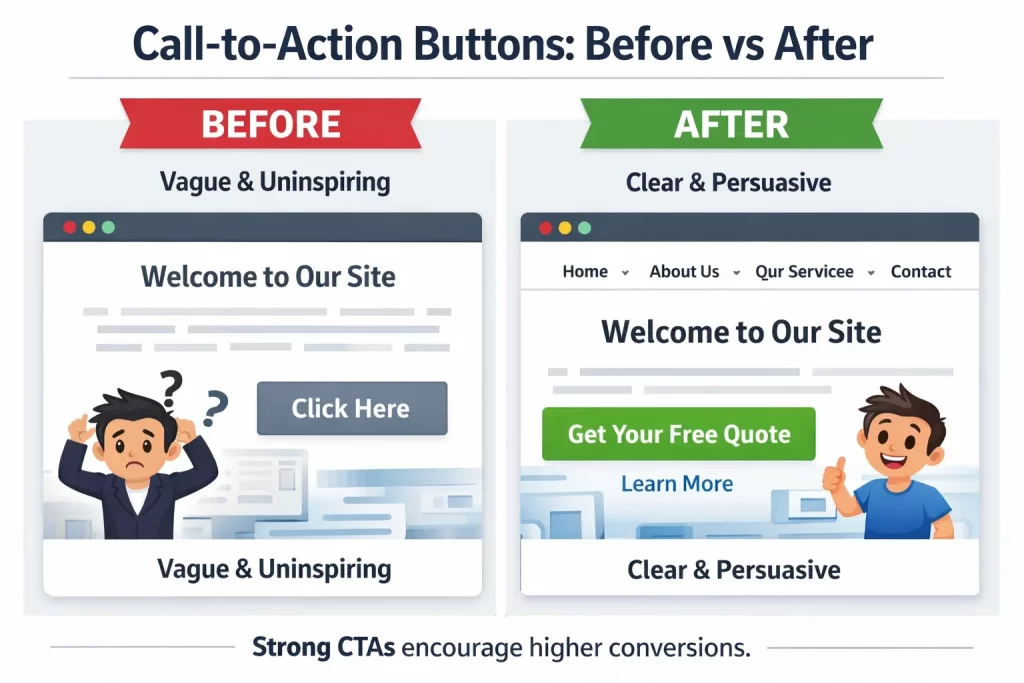
Every page on your website should have a purpose, and that purpose should be made obvious through a clear call to action. Whether that is booking a call, requesting a quote, downloading a guide, or calling your number, the next step should be impossible to miss.
Warning signs that your CTAs are not working:
- A contact form buried at the bottom of an obscure page
- No phone number visible without scrolling
- A homepage that describes your services but does not invite the visitor to do anything
- Generic button text like ‘Submit’ or ‘Click here’ instead of ‘Get a Free Quote’ or ‘Book a Discovery Call’
A great user experience, including clear and well-placed calls to action, can boost conversion rates by up to 400%. That is the difference between a website that actively generates business and one that simply exists.
Your Website Traffic Is Flat or Declining
If you have Google Analytics running, take a look at your organic traffic trend over the last twelve months. If it has been flat or declining while your business has otherwise been active and investing in marketing, your website is not doing its job.
Organic traffic growth is not automatic. It requires ongoing attention to content, technical health, and your overall SEO strategy. A website that was built a few years ago and has not been touched since is almost certainly losing ground to competitors who have kept investing.
Flat or declining traffic is also often a delayed reaction to a problem. If your website was penalised by a Google algorithm update, experienced technical issues, or lost quality backlinks, the traffic impact might not have been immediately obvious. Checking your analytics over a 12-month or even 24-month window gives a much clearer picture than looking at last month in isolation.
Your Website Does Not Reflect Your Actual Business
This one is surprisingly common, especially for businesses that have grown, evolved, or pivoted since their website was last updated. Your website might be describing services you no longer offer, missing services that have become core to your revenue, or representing a version of your brand that no longer matches how you actually operate.
A mismatch between your website and your real business creates friction in every sales conversation. Potential customers arrive on your site with certain expectations, then speak to you and find out the reality is different. Even when the reality is better, that inconsistency erodes trust.
Ask yourself honestly: if your best customer wrote a description of your business today, would it match what is on your homepage?
What to Do Next
If you have recognised several of these signs in your own website, the natural next step is to understand what fixing them would actually involve and cost. Start by running a free website speed test with Google PageSpeed Insights and checking your bounce rate and traffic trends in Google Analytics. Those two steps will confirm whether the problems are real and how serious they are.
If the picture that emerges is significant, it is worth having a professional audit done before investing in fixes. An experienced web agency can identify quickly whether your issues are fixable with targeted improvements or whether a full rebuild would give you a better return on investment.
Our article on how much a website redesign costs in Australia gives you an honest breakdown of what different levels of work typically involve and what you should expect to pay. And if you are in the process of evaluating agencies to help, our guide on how to choose a web design agency in Australia walks through exactly what to look for.
At Velacore, we work with Australian businesses to identify what their websites are actually costing them and build the case for what a properly performing site could deliver instead. If you would like a no-obligation conversation about your situation, get in touch with our team.
If you are still weighing up whether a rebuild is the right move or just a refresh, it is also worth reading our comparison of Squarespace vs WordPress vs custom website to understand which platform makes the most sense for where your business is now.
Frequently Asked Questions
How do I know if my website is actually losing me customers?
The clearest indicators are a high bounce rate in Google Analytics, flat or declining organic traffic, very few enquiries coming through your contact form or phone, and a website that loads slowly on mobile. If multiple of these are true at once, the evidence is fairly clear.
What is a good bounce rate for an Australian small business website?
A bounce rate between 26% and 40% is considered excellent, while 41% to 55% is about average for most websites. Service business websites and homepages should aim to be well below 60%. If yours is consistently above 70%, it warrants immediate attention.
How much does a slow website actually cost me?
The answer depends on how much traffic you receive, but the math can be sobering. Research found that for every second of additional load time, conversion rates fall by around 4.42%. If you receive 500 visitors per month and currently convert 2% of them into enquiries, shaving two seconds off your load time could meaningfully increase that conversion rate and the revenue that flows from it.
Can I fix these problems myself or do I need an agency?
Some issues, like compressing images or adding a clear call to action, can be addressed without a developer. Others, like core web vitals, technical SEO, and structural navigation issues, generally benefit from professional input. The right answer depends on what is wrong and how badly it is affecting your results.
My website looks fine to me. Could it still be a problem?
Yes, easily. You see your website through the eyes of someone who knows the business and visits frequently. Your customers see it with no prior knowledge, often on a phone, often for the first time. What feels obvious and well-organised to you can be confusing to a cold visitor. User testing or even asking a few people outside your business to try finding specific information on your site without help can be very revealing.