

More Australian organisations are exploring Sitecore alternatives as the digital experience ecosystem continues to evolve. Sitecore remains a leading enterprise DXP, but different businesses now have different priorities; from faster deployment cycles and cloud-native flexibility to lower total cost of ownership and stronger alignment with composable architecture.
The shift is driven by several trends shaping Australia’s digital environment:
- Composable DXPs are becoming the norm. Gartner’s outlook shows a steady rise in modular, API-first platforms that help enterprises adapt faster and reduce long-term technical debt.
- Cloud-native architectures are maturing. Many alternatives now offer powerful performance out of the box, edge rendering, and built-in scalability; all well-suited for geographically distributed Australian users.
- Privacy and compliance standards are tightening. The upcoming Privacy Act 2026 reforms make data residency, governance, and auditable processes even more important for digital platforms.
- Budgets and resourcing models are changing. Organisations want platforms that fit their operating rhythm, whether that means higher performance, lighter vendor overhead, or greater developer autonomy.
This guide breaks down the Top 10 Sitecore alternatives for 2026, comparing them across pricing, migration effort, compliance, MACH readiness, performance in the Australian market, and ideal use cases. The goal is simple: help you understand which platforms align best with your strategy, team capability, and growth plans for 2026 and beyond.
The top 10 Sitecore alternatives for 2026 (quick overview)
Below is the fast, high-level snapshot of the Top 10 Sitecore alternatives for Australian enterprises. Each platform is assessed based on performance, flexibility, MACH readiness, pricing, migration ease, and suitability for the Australian market.
- Storyblok: Best for visual editing, fast builds, and marketer autonomy.
- Contentful: Best for enterprise headless CMS and multi-brand ecosystems.
- Sanity:Best for structured content and real-time collaboration.
- Optimizely CMS: Best for experimentation-driven digital teams.
- Adobe AEM Cloud: Best for organisations needing a full enterprise suite.
- Kentico Xperience: Best for .NET teams wanting an all-in-one DXP.
- Contentstack: Best for automation-first, MACH-aligned architectures.
- Magnolia: Best hybrid CMS for Java-friendly and enterprise teams.
- Umbraco Heartcore: Best low-cost, frictionless option for .NET developers.
- Hygraph: Best for GraphQL-native, federated content architectures.
These platforms were ranked using 2025–2026 adoption patterns, APAC presence, developer ecosystem strength, and suitability for Australian data residency and enterprise requirements.
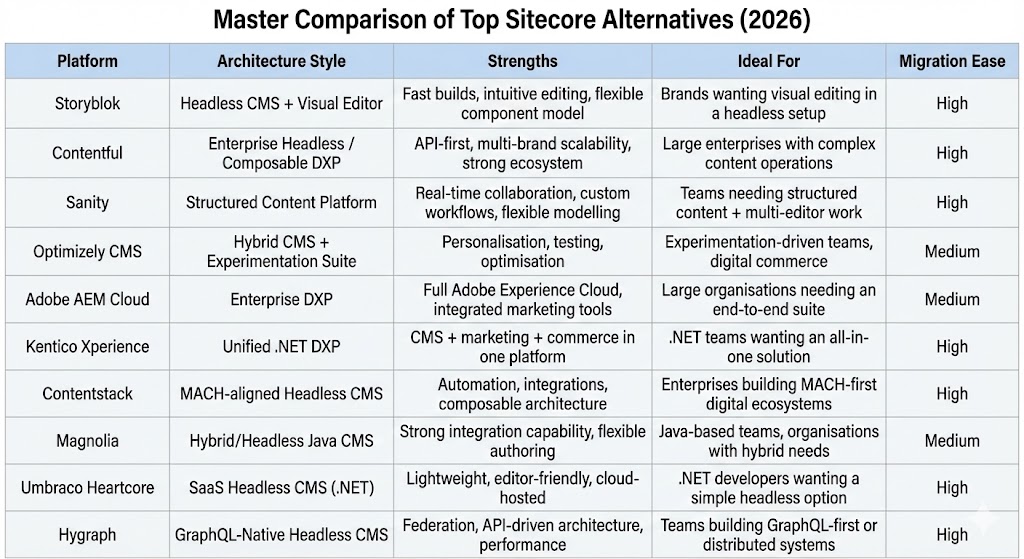
Master comparison table
This table gives a clear, high-level comparison of the leading Sitecore alternatives 2026, focusing on factors most relevant to Australian enterprises: architecture, scalability, ease of adoption, and suitability for modern digital teams.
Storyblok: flexible headless cms with visual editing
Storyblok has gained strong adoption across APAC because it solves one of the biggest frustrations in headless CMS: giving marketers a true visual editing experience without limiting developers. Its component-based architecture makes it easy to deliver consistent, scalable digital experiences across websites, apps, and multi-brand ecosystems. This is a major advantage for teams modernising their tech stack.
Why it’s a strong Sitecore alternative
- Visual editing in a headless setup: rare among headless CMS platforms and ideal for teams used to Experience Editor-style workflows.
- Reusable content components: It supports brand consistency and enable faster rollouts.
- Optimised for modern frameworks: It supports frameworks like Next.js, Nuxt and other Jamstack approaches.
- Cloud-native and globally distributed: Providing strong performance for audiences across Australia and APAC.
- Built for collaboration: Storyblok enables workflows, commenting, versioning and granular permissions.
Best for
Australian organisations wanting fast builds, an editor-friendly headless workflow, and scalable multi-channel delivery; especially retailers, lifestyle brands, universities, membership organisations and content-heavy teams.
Where Storyblok may feel limited
While Storyblok excels in flexibility and speed, teams requiring deep, built-in personalisation, extensive marketing automation, or complex enterprise-level orchestration may still need to integrate external tools, or consider more full-suite DXPs.
Contentful: enterprise-ready headless cms for scalable digital ecosystems
Contentful has become one of the most recognisable headless CMS platforms in the enterprise space, used by global brands that need to manage large, multi-market digital ecosystems. Its API-first architecture, strong reliability, and extensive integration options make it a natural fit for organisations modernising from traditional DXPs into more composable, modular environments.
Why it’s a strong sitecore alternative
- Enterprise-grade headless CMS with proven global adoption and uptime.
- API-first and cloud-native, making it easy to integrate with modern frameworks, apps, and third-party systems.
- Supports multi-brand, multi-region content operations, which is ideal for distributed Australian digital teams.
- Large ecosystem of marketplace apps, tools, and integrations to accelerate implementation.
- Strong governance features including roles, workflows, versioning, and space/environment isolation.
Best for
Australian enterprises running complex content operations across multiple brands, regions, or digital channels, particularly those transitioning to composable architecture while needing a stable, globally supported CMS.
Where contentful may feel limited
Contentful’s strength is its pure headless approach, which means teams often need to pair it with additional tools for personalisation, advanced marketing automation, or deep analytics. These are areas where full-suite DXPs typically offer more out of the box.
Sanity: structured content platform with real-time collaboration
Sanity stands out for its highly structured content model and a workspace designed for teams that need flexibility, speed, and the ability to customise their content operations. Its real-time collaborative editing makes it particularly attractive for organisations managing fast-moving content or working across distributed teams.
Why it’s a strong Sitecore alternative
- Built around structured content, making it easy to model complex, highly interlinked content types.
- Real-time collaboration allows multiple editors to work simultaneously. It is ideal for newsroom-style workflows or large marketing teams.
- Highly flexible content schemas and custom interfaces, giving developers control over the editing experience.
- Strong performance with modern frameworks like Next.js, Remix, Astro, and serverless architectures.
- Integrates smoothly with external services, APIs, and data sources, supporting composable DXP setups.
Best for
Australian organisations with content-heavy operations, frequent publishing cycles, or multi-editor environments; including digital media, universities, government agencies, and large marketing teams.
Where Sanity may feel limited
Because Sanity is built for customisation, teams may need to configure more from scratch, especially around marketing workflows or packaged features that full-suite DXPs typically include out of the box.
Optimizely CMS: built for testing and continuous improvement
Optimizely is a good choice for teams that care about performance, personalisation, and data driven decision making. It brings content, experimentation, and optimisation into one environment. This helps digital teams move from guesswork to clear, measurable improvements.
Why it is a strong sitecore alternative
- Powerful experimentation features that make testing simple
- Strong personalisation tools for tailored customer experiences
- Clean editing experience that suits both marketers and developers
- Works well with complex websites and commerce environments
- Recognised in global analyst reports for its strength in digital experience delivery
Best for
Australian organisations that want to test ideas, improve conversions, and refine user journeys. This includes retail brands, financial services, large ecommerce teams, and any organisation that relies on measurable digital growth.
Where Optimizely may feel limited
Optimizely is powerful, but its full potential shines when teams commit to a testing culture. Smaller teams that lack time or resources for ongoing optimisation might not use all its capabilities.
Adobe AEM cloud: full enterprise experience platform
Adobe AEM Cloud is one of the most complete digital experience platforms available today. It brings content management, personalisation, analytics, and campaign tools into one connected ecosystem. Many large organisations choose it because it supports complex teams, large content operations, and strict governance requirements.
Why it is a strong Sitecore alternative
- Deep integration with the Adobe Experience Cloud suite
- Strong personalisation features supported by Adobe Target
- High performance cloud hosting with automated scaling
- Advanced tools for analytics, forms, workflows, and digital asset management
- Reliable choice for enterprises with mature marketing operations
Best for
Australian organisations with large digital teams, strict compliance needs, and high content demand. Common users include banks, government departments, insurers, universities, and national brands that want an all in one marketing and experience platform.
Where Adobe AEM cloud may feel limited
AEM is powerful, but it comes with a learning curve. Smaller teams or organisations with limited internal resources may find the setup and ongoing management more demanding compared to lighter, headless first platforms.
Kentico Xperience: unified CMS and marketing for .NET teams
Kentico Xperience is a practical choice for organisations that want content management, marketing automation, and digital commerce in one system. It runs on a familiar .NET foundation, which makes it easier for many Australian development teams to adopt and maintain.
Why it is a strong Sitecore alternative
- Unified platform for content, marketing, and basic commerce
- Clear and simple editing experience for marketing teams
- Familiar .NET environment that reduces onboarding time
- Solid performance and reliable security features
- Good option for organisations that want fewer external integrations
Best for
Australian organisations with .NET development teams or those who prefer an all in one system without multiple vendors. It works well for mid sized enterprises, membership organisations, education providers, and teams that want a manageable DXP with less complexity.
Where Kentico Xperience may feel limited
Kentico offers core marketing tools, but it may not match the depth of larger enterprise suites. Organisations with very advanced marketing automation or personalisation needs may still require add ons or external tools.
Contentstack: composable, automation focused headless CMS
Contentstack is a strong option for teams moving toward a fully composable digital ecosystem. It is API first, cloud native, and built for automation. It also has a clean editing experience and strong developer tools, which makes it easy to run large content operations with speed and consistency.
Why it is a strong Sitecore alternative
- Designed for composable architecture and flexible integrations
- Automation tools that reduce manual work in publishing workflows
- Clean and simple interface for content editors
- Strong performance across global and multi site environments
- Founding member of the MACH Alliance, which reinforces its composable focus
Best for
Australian enterprises that want a modern headless stack with strong automation. It works well for organisations with microservices, multi-brand ecosystems, or teams that want to build custom digital experiences without a heavy DXP footprint.
Where Contentstack may feel limited
Contentstack is highly modular, which means teams may need to combine it with external tools for advanced marketing, analytics, or personalisation. Organisations looking for an all in one suite may prefer a more unified platform.
Magnolia: hybrid CMS for flexible and java friendly teams
Magnolia is a good choice for organisations that want a mix of traditional and headless capabilities. It is built on a Java foundation and offers a flexible authoring experience that works well for teams with mixed technical needs. Magnolia also supports strong integrations, which makes it suitable for complex enterprise environments.
Why it is a strong Sitecore alternative
- Hybrid CMS that supports both headless and page based delivery
- Familiar Java environment for teams with existing Java expertise
- Flexible authoring tools that suit marketing and development teams
- Strong integration options for enterprise systems and custom applications
- Good fit for organisations that need both structure and creative freedom
Best for
Australian organisations with Java based teams or mixed technology stacks. Magnolia works well for enterprises that want flexible editing, custom integrations, and control over how content is delivered across channels.
Where Magnolia may feel limited
Magnolia is powerful, but it can require more configuration upfront. Teams that want an out of the box solution with minimal setup may find lighter headless platforms easier to adopt.
Umbraco Heartcore: lightweight headless CMS for .NET teams
Umbraco Heartcore is the cloud hosted, headless version of the popular open source Umbraco CMS. It keeps the simplicity and clean editor experience Umbraco is known for while offering modern API delivery. Because it sits on a .NET foundation, many Australian teams find it easy to adopt and maintain.
Why it is a strong Sitecore alternative
- Simple and intuitive editing experience for non technical users
- Built on a familiar .NET ecosystem that many teams already understand
- Cloud hosted and fully managed, which reduces overhead and maintenance
- Flexible headless delivery for websites, apps, and digital channels
- Good option for teams that want modern delivery without a heavy platform
Best for
Australian organisations with .NET developers or teams moving from traditional CMS setups into headless. It works well for mid sized companies, education providers, and organisations that want a cost friendly and easy to manage CMS.
Where Umbraco heartcore may feel limited
Heartcore is lightweight, so teams that need advanced marketing automation, deep personalisation, or a full enterprise suite may require additional tools.
Migration insights for Australian teams
Many Australian organisations exploring alternatives are doing so as part of a broader shift toward cloud native and composable architecture. A platform change is not a small decision, so it helps to understand what a realistic migration looks like in 2026.
Typical migration timelines
Most migrations now fall within a three to twelve month window. This depends on the amount of content, the number of integrations, and whether the organisation is moving from a monolithic setup into a composable one.
What usually takes the most time
- Content modelling and mapping old structures to new ones
- Integration rebuilds, especially for legacy third party tools
- Front end redevelopment when shifting to headless
- Rewriting custom modules that cannot be reused
- Testing and UAT, especially when multiple channels or brands are involved
What makes migrations faster today
- Most modern CMS platforms have clean, well documented APIs
- Front end teams now use reactive frameworks that reduce build time
- Cloud hosting removes a lot of infrastructure setup
- Many platforms offer import tools for bulk content
- Global CDNs and edge platforms improve launch performance with minimal tuning
Key considerations for Australian teams
- Check for Australian data residency options, especially for government, health, and education
- Confirm support for Privacy Act 2026 requirements
- Ensure your new platform integrates with the local tools you depend on
- Plan for editor training, especially when moving from traditional CMS to headless
Final recommendations for Australian enterprises
Each of the leading Sitecore alternatives brings different strengths to the table, and the right fit depends entirely on how each organisation structures its digital operations, content workflows, and long term technology strategy.
Some platforms focus on speed and editorial simplicity, while others prioritise enterprise scale, experimentation, or API driven architecture. Many Australian organisations also consider factors such as existing development skills, preferred frameworks, compliance requirements, and the level of flexibility they expect from their digital experience stack in the coming years.
In 2026, the broader shift toward headless CMS, composable architecture, and cloud native DXPs has expanded the number of viable options. This gives digital teams more room to choose a system that aligns with their operating model, whether they value visual editing, multi brand governance, real time collaboration, GraphQL based delivery, or unified .NET development.
The platforms reviewed in this guide represent the most widely adopted and well regarded alternatives in the Australian market today. Each one is suitable in different scenarios, and each one can support modern digital experiences when matched with the right internal capabilities and strategic direction.
Frequently Asked Questions
1. Why are Australian organisations exploring Sitecore alternatives in 2026?
Many teams are modernising their digital stacks. They want faster builds, simpler workflows, and platforms that support cloud native and composable architecture. This has increased interest in headless CMS and flexible DXPs.
2. Is Sitecore still a strong choice for enterprises?
Yes. Sitecore remains a leading enterprise platform, especially for organisations that need deep personalisation, complex multisite setups, or full suite marketing capabilities. Alternatives simply offer different approaches, not replacements for every scenario.
3. Are headless CMS platforms easier to manage?
They can be. Headless systems separate content from presentation, which gives development teams more control. Editors may need time to adjust, but most modern headless platforms now offer clean, visual editing tools.
4. Do these alternatives support Australian data residency?
Many modern CMS platforms offer hosting in Australian regions or through global cloud providers with Australian availability zones. It is important to confirm this during evaluation, especially for government, health, and education.
5. How long does a migration usually take?
Most migrations fall between three and twelve months. The timeline depends on content volume, integrations, front end rebuilds, and internal resourcing.
6. Are these alternatives cheaper than Sitecore?
Some platforms are lighter to run. Others require more integration work. Cost depends on licensing, development, hosting, and ongoing operations. It varies by organisation.
7. Can these platforms support multi brand or multi site setups?
Yes. Most modern CMS and DXP platforms support multi brand environments. Some handle this through workspaces or environments. Others through component based design systems or structured content models.