

Translation can make a page readable. A content system decides whether that page is ready for a particular market.
Your global team has approved a campaign in English. AI produces versions for France, Japan and Brazil by lunchtime. The copy reads well, but the French offer expires on a different date, the Japanese product name needs local approval, and the Brazilian page still shows an English legal claim. Which version can actually go live?
That is the real question behind AI-powered content localisation. AI can accelerate translation and adaptation. A headless content management system (CMS) can hold the related language and market versions as structured content, connect them to the right website or app, and support a controlled release. It does not make an unreviewed market claim correct. The advantage is that your team can see and govern the difference between generated, approved and published content.
Translation creates a version. Localisation decides whether it belongs in that market.
Why a good translation can still be the wrong page
Localisation covers more than the words. The offer, price, currency, units, imagery, product availability, contact route and search URL may all change with the market. Consider a product page for a campaign shared across the UK, Germany and Japan. The core product description might be reusable. The finance claim, delivery promise and call to action might not be.
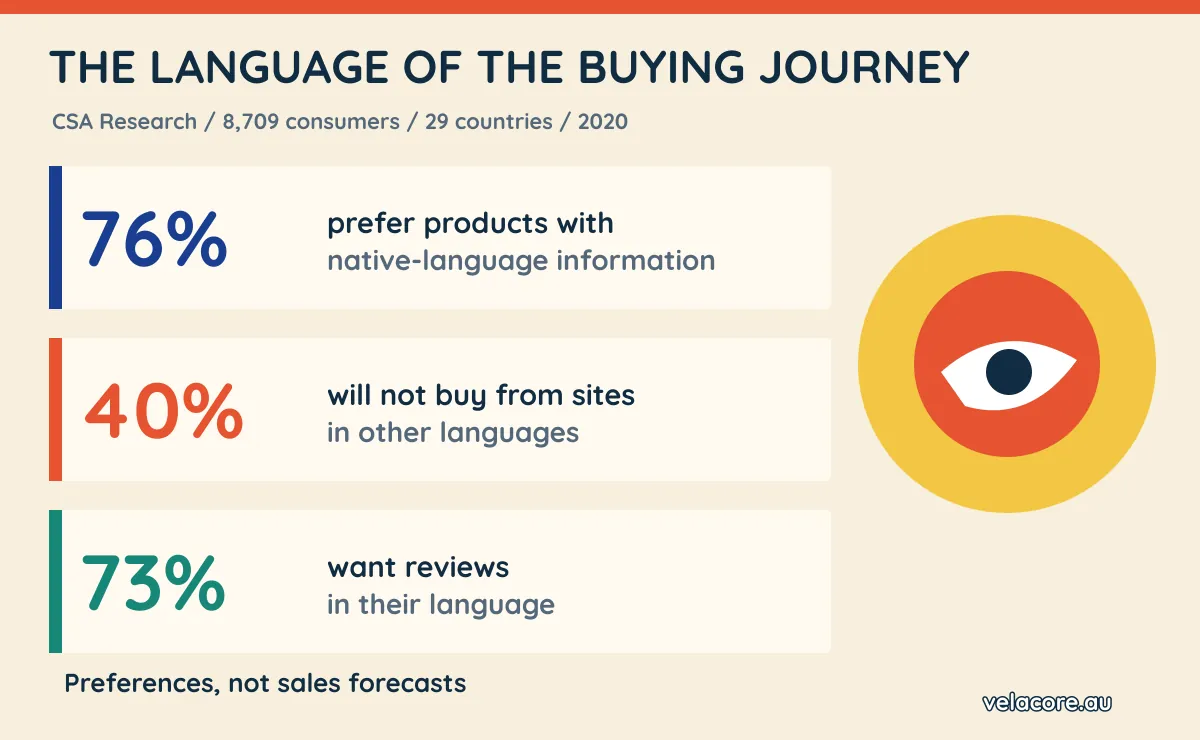
The commercial reason is substantial. In a 2020 CSA Research survey of 8,709 consumers across 29 countries, 76% preferred buying products with information in their native language, 40% said they would never buy from a website in another language, and 73% wanted product reviews in their language. These are reported preferences from that survey, not a promise that any one site will gain those percentages in sales. They do show why translating the headline while leaving reviews or buying details behind is a weak version of localisation.
The preference extends beyond shopping. A 2025 European Commission account of research in six European countries reported that 59% of web users preferred content in their preferred browsing language rather than English. For a global content team, the practical question is which parts of the experience can be reliably adapted, reviewed and kept current in each market.
AI is useful here. Give it a glossary, approved source copy and market brief, then ask for a proposed translation and a list of items needing local review. The list matters as much as the prose. A fluent page can conceal a wrong date more convincingly than an obviously broken translation.
How AI-powered content localisation works in a headless CMS
A headless CMS stores content separately from the design of a particular page. A website, app or other channel requests the content through an API, then presents it in its own interface. For a global brand, that means a product fact can have one managed home while different markets receive their appropriate version. The model and workflow still have to be designed well; buying the software does not do that work automatically.
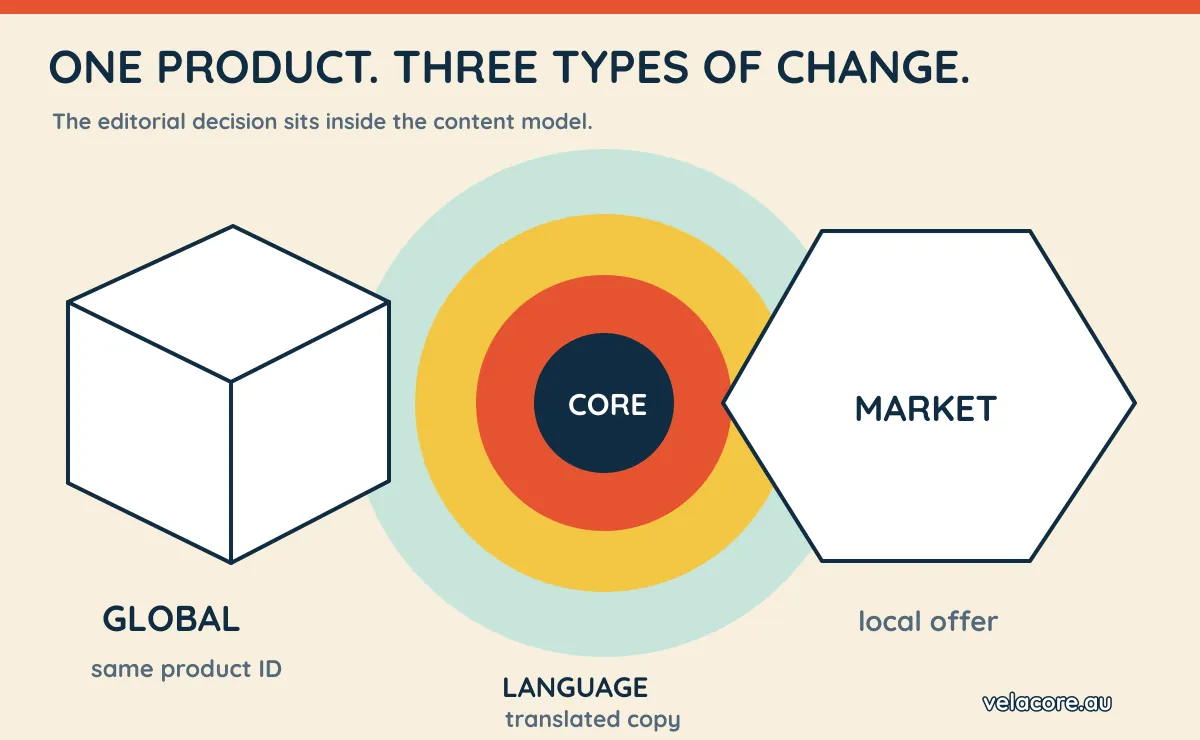
The important design choice is to identify which facts are global, which vary by language, and which vary by market. If those distinctions live only in documents passed between teams, every release depends on someone remembering the exception. In a content model, the exception can be visible at the field or document level.
Here is a simplified example. A fictional software company is launching the same product in three markets. The product ID and technical capability are shared. The headline can be translated. The trial length and regulated claims need separate market approval.
| Field | Ownership | Example | Release rule |
|---|---|---|---|
| Product ID | Global | One reference across markets | Reuse the approved value. |
| Headline | Language | English, French, Japanese | Review for meaning and tone. |
| Trial offer | Market | Different availability or dates | Show only after local approval. |
| Legal claim | Market | May be absent in a market | Never fill from another market by default. |
| Hero image | Market or shared | Approved regional creative | Check meaning, rights and crop. |
This table is a proposed operating model, not a claim that a vendor supplies these exact rules out of the box. It gives editors and developers a shared question for every field: what can be reused, and what must be approved again?
The overlooked risk: a fallback can publish the wrong promise
Here is the less obvious part. Many CMSs let one locale fall back to another when a translation is missing. Contentful’s delivery documentation explains that a missing field in de-CH can be filled from a configured de-DE fallback. That is useful for a generic description. It could be harmful for a Swiss price, availability statement or regulated claim.
The difference is not theoretical. Contentful’s locale guidance says an unset field can trigger fallback, while an explicitly empty value set through its API does not. A team that treats “blank” as one simple state may get different results depending on how the field was saved. Sitecore XM Cloud also documents page-language fallback when a language version is missing. The exact controls vary by platform, so test the delivery response rather than assuming the editor preview tells the whole story.
Our practical rule is to give each field a fallback policy before AI begins filling locales:
- Safe to inherit: a stable product identifier or technical specification that is valid everywhere the product is sold.
- Review before inheriting: general product descriptions, images and navigation text whose meaning or rights may vary.
- Never silently inherit: prices, promotions, legal claims, availability, eligibility and market-specific contact details.
If a restricted field is missing, a good release process blocks that market version or deliberately omits the field. It should not manufacture completeness by copying another market’s promise. This is an inference from documented fallback behaviour, translated into an editorial control that a team can test.
A complete-looking page is not the same as an approved page.

Where AI belongs between the brief and the release
AI belongs early in the workflow. It can propose a translation, adapt examples for a market, flag terminology conflicts and identify fields that need a human decision. The CMS should keep those proposals distinguishable from the approved content that an API delivers publicly.
One workable sequence is straightforward:
- Lock the source facts. Approve the product name, current offer, markets served and claims before asking AI to adapt them.
- Generate a market draft. Provide the target locale, glossary, tone, prohibited claims and fields that require local ownership.
- Review the differences. A local editor checks meaning, offer, imagery, accessibility and any claim that cannot simply be translated.
- Approve the release. A named owner confirms that the specific market variant is ready, then publishes it.
- Check the delivered page. Open the public URL, inspect the visible copy and metadata, and confirm that no restricted field fell back unexpectedly.
This is not a claim that every CMS enforces all five steps. Contentful documents locale-based publishing for certain plans, allowing selected locales to go live independently, while its documentation also describes limitations around first publication and scheduled releases. Sanity’s localisation guidance explains that document-level language variants can publish independently, whereas its described field-level model publishes languages together. These are materially different choices when one market is ready and another is still under review.

Should each market have fields or its own document?
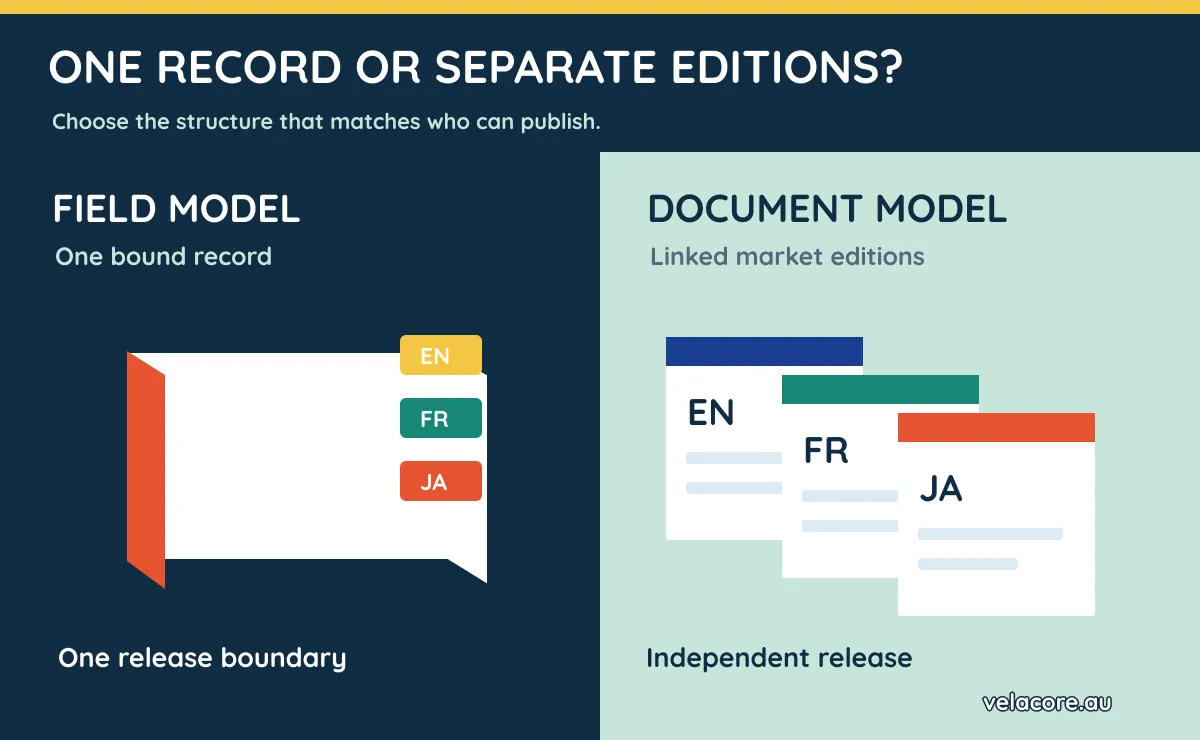
There is no universal winner. If most facts are shared and only a few labels differ, localised fields in one entry can keep the relationship simple. If markets need separate page structure, offers, owners or release dates, separate but linked locale documents can give each team a clearer publishing boundary. A hybrid model may be appropriate: shared product records feeding market-specific campaign pages.
Contentful describes field, entry, content-type and space-level localisation and asks teams to choose based on governance, asynchronous publishing, fallback and editing experience. Sanity documents field-level and document-level approaches, including the different publishing behaviour noted above. The lesson is not “choose the most flexible schema”. It is choose the smallest model that matches who owns each market decision.
Ask these questions before committing to a model:
- Can France publish while Japan remains in review?
- Can one market omit a claim without inheriting another market’s wording?
- Can editors see which variant an image and link belong to?
- Can the team update a shared technical fact once without overwriting a local offer?
If the answers require fragile workarounds, change the model before you add twenty more markets. For a closer look at two platforms, our Contentful versus Sanity comparison covers their broader editorial trade-offs.
How do you make every language version discoverable?
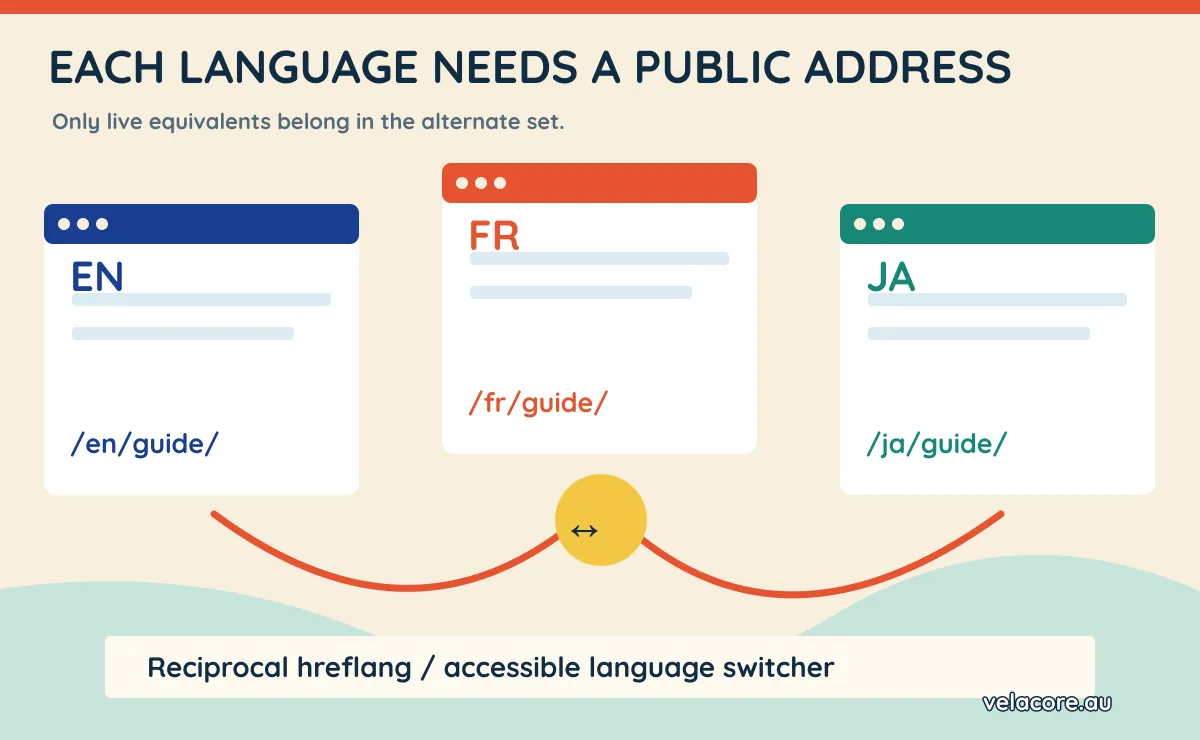
The CMS stores variants, but your website still has to expose them properly. Google recommends a distinct URL for each language version, rather than changing the page only by cookie or browser language. It also recommends links that let people switch language instead of forcing a guessed redirect.
For equivalent pages, hreflang helps Google understand the relationship between language or regional URLs. Google’s localised-version rules require each listed version to reference itself and the others, with fully qualified URLs. HTML links, HTTP headers and XML sitemaps are alternative ways to provide that information; maintaining all three brings no search benefit by itself. The URLs must also serve the appropriate visible content. A translated navigation bar around an untranslated article does not create a meaningful language version.
This is a measurable publishing task. The HTTP Archive’s 2025 Web Almanac found hreflang in the raw HTML of 20.3% of desktop pages and 19.7% of mobile pages in its dataset. Those percentages cover the sampled web, not just multilingual sites, so they are not a pass rate for international SEO. They show how easily alternate-language signals can be missed at scale if the front end does not generate them from the published variant relationships.
Search markup is only one part of the experience. The same archive’s 2025 accessibility analysis found that roughly 86% of sites had a valid page lang attribute. That attribute helps screen readers choose pronunciation rules. Google says it detects a page’s language from visible content rather than using lang as its language signal, so a global release check needs both meaningful translated copy and correctly declared language for readers using assistive technology.
For example, a global guide could use /en/guide/, /fr/guide/ and /ja/guide/. The content model should keep those pages linked as variants of the same guide; the front end should generate the alternate links from the published variant set, not from a guessed list of all configured locales. That last sentence is an implementation recommendation inferred from Google’s reciprocal-link rule: unpublished variants should not be advertised as live destinations.
A release test worth running before you scale
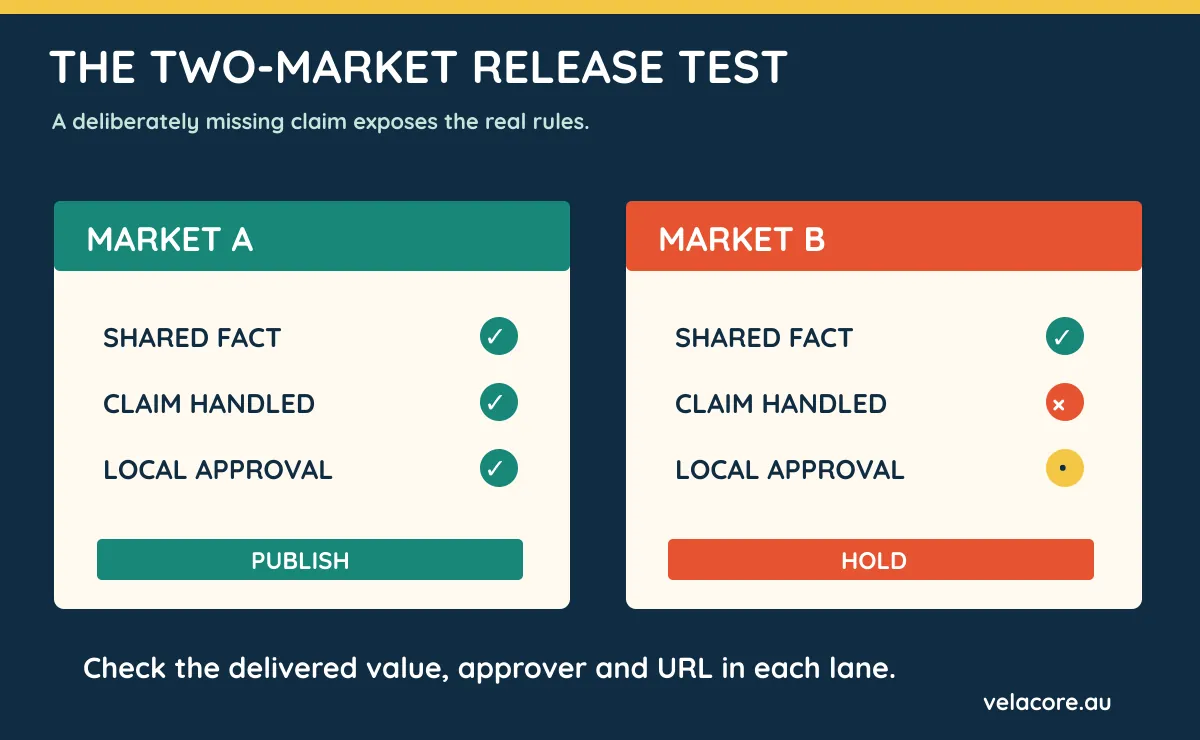
Before migrating a global site, choose one real content type and two markets. Use a low-risk test page, but make the scenario realistic: one shared fact, one translated headline, one market-specific offer and one deliberately missing claim. Then preview and request the delivered pages in both locales. The result should tell you whether the platform and front end honour the policy you thought you configured.
Record four outcomes for each market: which value was returned, which version was approved, which URL was published, and what a visitor could actually see. That gives you a usable acceptance test for AI-assisted localisation. If the missing claim quietly appears from another market, you have found a modelling or fallback problem before it becomes a global campaign problem.
The broader decision is whether your current publishing setup can keep shared content reusable while giving markets real control over their differences. A headless CMS is particularly useful when content must travel across websites, apps and regions, but the right platform depends on your editorial team, integration needs and governance. If you are weighing that architecture, talk to Velacore about your content platform with one example of a market release your current setup struggles to manage.
Questions global content teams often ask
Does AI translation remove the need for a local editor?
No. AI can prepare a draft and flag terms for review. A local owner still needs to decide whether offers, claims, imagery and tone fit the market. Give that owner an explicit approval step for fields with business consequences.
Do we need a separate CMS for every country?
Usually not. One well-designed content system can hold shared records and linked market variants. Separate spaces or systems may make sense when teams have genuinely different governance or integration needs, but they also increase coordination work.
Can we publish one market while another is unfinished?
Yes, if the chosen model and publishing configuration support it. Sanity documents independent publication for its document-level variants; Contentful documents locale-based publishing on eligible plans. Test the exact setup before relying on it for a launch.
Is a headless CMS enough for multilingual SEO?
No. Your front end still needs distinct crawlable URLs, relevant visible content, correct alternate links and usable language navigation. The CMS supplies the content relationships; the website turns them into discoverable pages.