
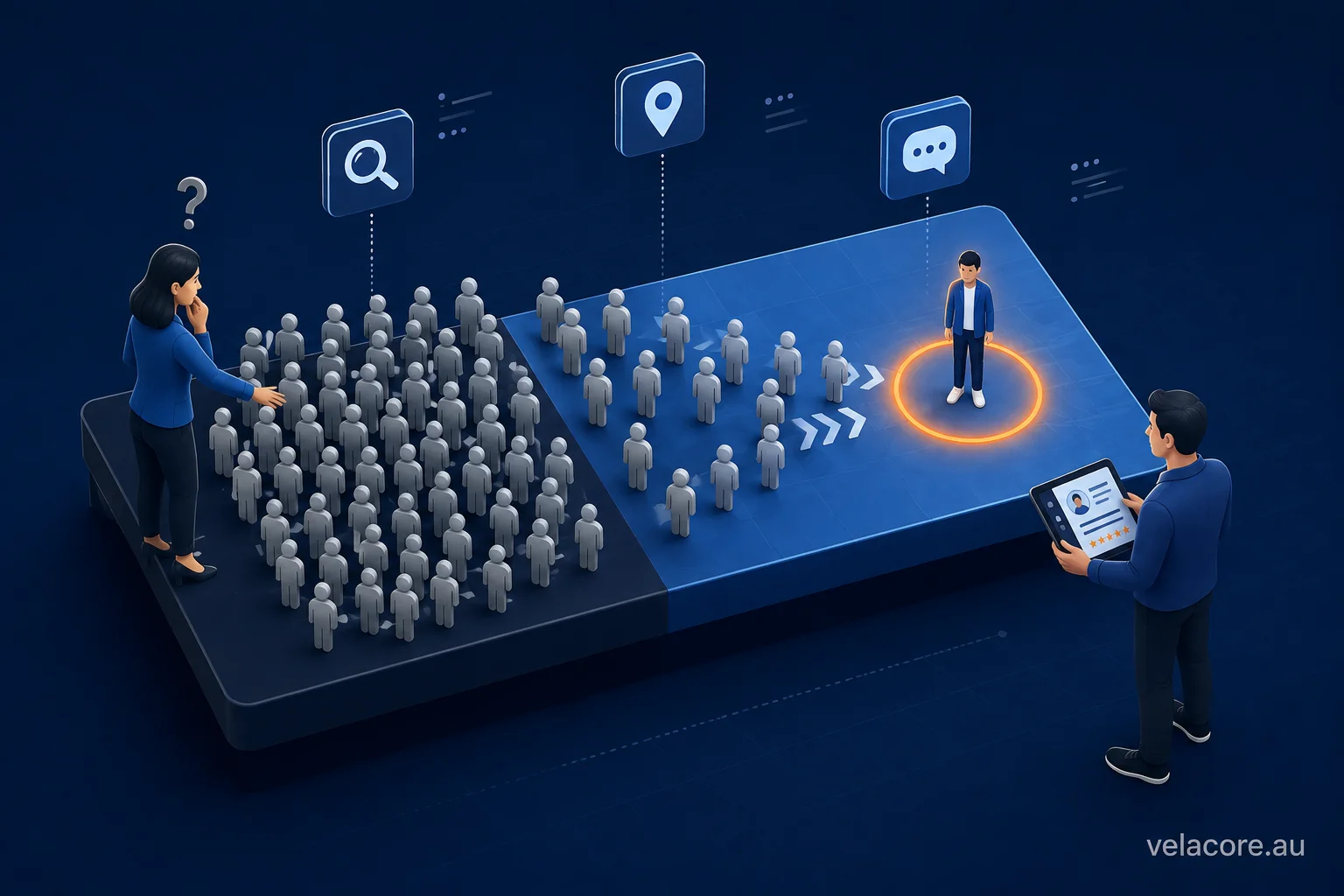
If your marketing feels like it’s talking to no one in particular, the problem usually isn’t your content, your budget or your channel. It’s that you haven’t actually worked out how to find your target audience, you’ve settled for a target market instead. The two sound similar, but they’re not the same thing, and mixing them up is one of the most common reasons marketing underperforms.
A target market is broad. It’s “small businesses” or “homeowners aged 25 to 45.” A target audience is specific. It’s the exact group of people, with a shared problem, motivation and buying trigger, that your marketing is actually trying to reach. Knowing the difference changes how you write, where you spend money and what you build your website around.
This guide walks through a practical process for finding your real target audience, backed by current research rather than guesswork, and covers the one thing almost nobody warns you about: how a correctly defined audience quietly stops being correct. Before any of that, though, it helps to settle the target audience vs target market confusion that trips most businesses up in the first place.
Your Target Audience Isn’t Your Target Market
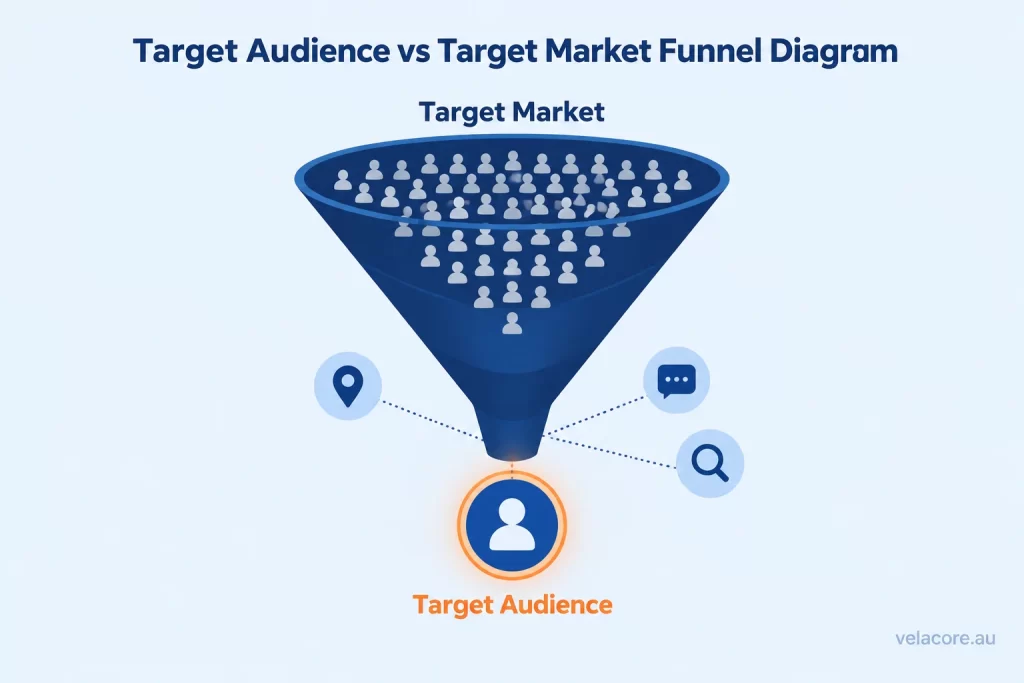
Most businesses start by defining a market, then treat that market as if it were an audience. It’s an easy mistake to make, because the two ideas blur together in everyday conversation.
Here’s the distinction that matters. Your target market is everyone who could conceivably buy from you. Your target audience is the specific slice of that market your current marketing effort is built to reach and convert. A physiotherapy clinic’s target market might be “people with musculoskeletal pain.” Its target audience for a particular campaign might be “amateur runners in their thirties dealing with recurring knee pain who’ve already tried rest and stretching without success.”
That second description is something you can actually write to. The first one isn’t.
Treating a market as an audience is why so much content and advertising feels generic. You end up writing for everyone, which in practice means writing for no one in particular. Nobody reads a headline and thinks “that’s speaking to a broad demographic.” They read it and think “that’s speaking to me,” or they scroll past.
Why “Everyone” Was Never an Audience
There’s a comfortable logic to keeping your audience broad. More people who could theoretically buy feels like more opportunity. In practice, it works against you, and the research on this is consistent rather than anecdotal.
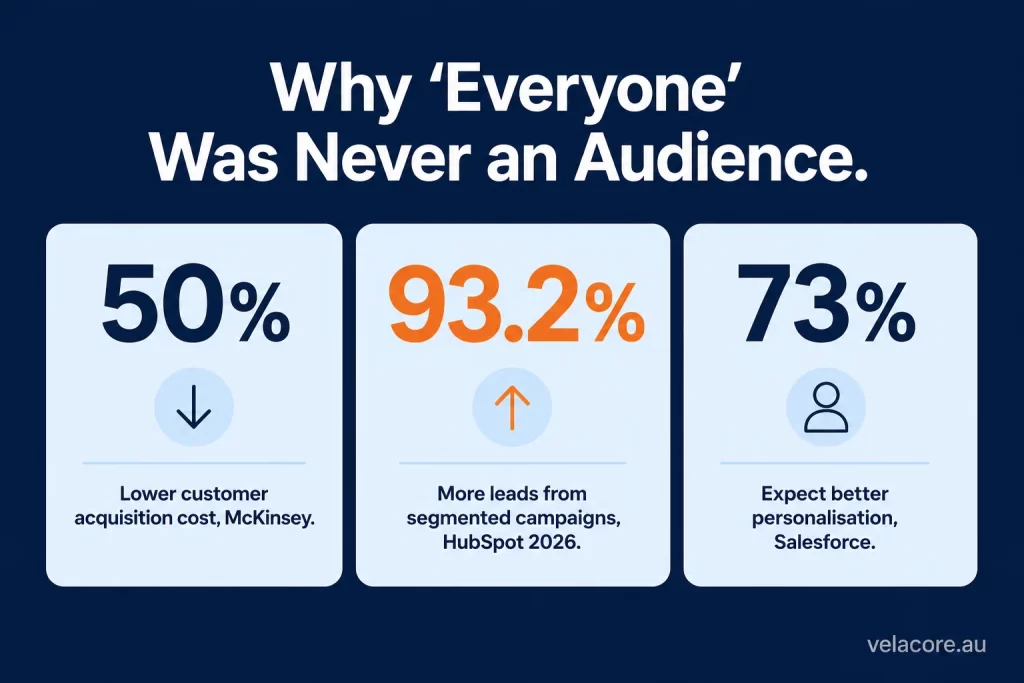
McKinsey’s research on personalisation and targeting found it can cut customer acquisition costs by as much as 50 percent and lift revenue by 5 to 15 percent, largely because narrower targeting stops businesses paying to reach people who were never going to convert. In HubSpot’s 2026 State of Marketing survey of over 1,500 marketers, 93.2 percent said personalised or segmented experiences led to more leads or purchases, yet only 65 percent said they actually had high-quality audience data to work with. That gap, most marketers know segmentation works but most don’t have the data to do it properly, is exactly where a lot of businesses get stuck. On the buyer side, Salesforce’s research puts a number on the expectation itself: 73 percent of customers now expect better personalisation than they got a few years ago.
The mechanism behind those numbers is straightforward. A vague audience forces vague messaging. Vague messaging doesn’t address a specific problem, doesn’t use the language a real buyer uses, and gives the reader no reason to feel understood. A sharp audience does the opposite. It lets you speak to a specific frustration in specific language, which is what actually earns attention and trust.
How to Find Your Target Audience: A Practical Process
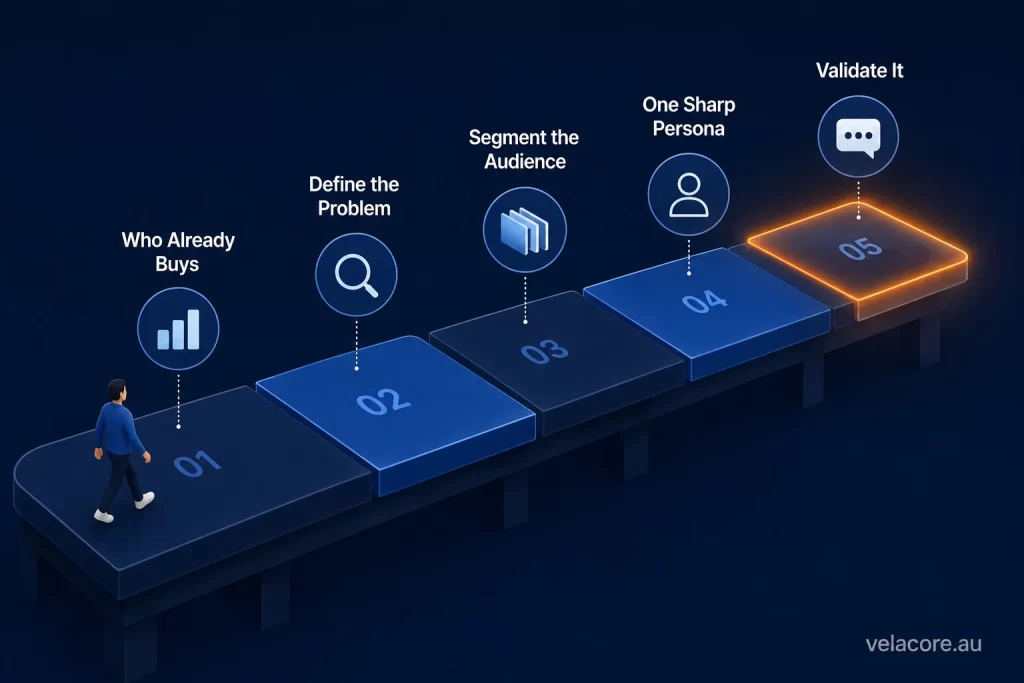
Finding your real audience isn’t a branding exercise. It’s a research exercise, and most of the raw material already exists inside your business, usually spread across a few tools you already have. Here’s how to identify your target audience in five practical steps.
Step 1: Start With Who Already Buys, Not Who Might
Before doing any external research, look at your existing customers. Who are your best ones, meaning the ones who convert quickly, pay full price and stick around? You don’t need enterprise software for this. A few places to actually pull the data from:
- Your CRM or invoicing system, filtered by customer lifetime value, to see who’s actually worth the most, not just who bought most recently
- Google Analytics or your website’s built-in analytics, looking at which landing pages and traffic sources correlate with enquiries rather than bounces
- Support tickets and reviews, which usually contain the exact language customers use to describe their problem
- A short exit or post-purchase survey, even five questions sent to your last twenty customers, to catch what your data can’t show you
Look for patterns that aren’t just demographic. What situation were they in right before they contacted you? What had they already tried that didn’t work? What almost stopped them from buying?
Step 2: Define the Problem, Not the Product
It’s tempting to describe your audience by what they buy. “People who need a new website.” That’s a product description, not an audience description, and it tells you almost nothing about how to reach them.
Instead, define your audience by the problem they’re trying to solve and the situation that put them there. “A business owner whose current website hasn’t been updated in years, who’s losing enquiries to a competitor with a more modern site, and who’s tired of being embarrassed to send people the link” is something you can build real messaging around.
Step 3: Use Audience Segmentation, Not Just Demographics
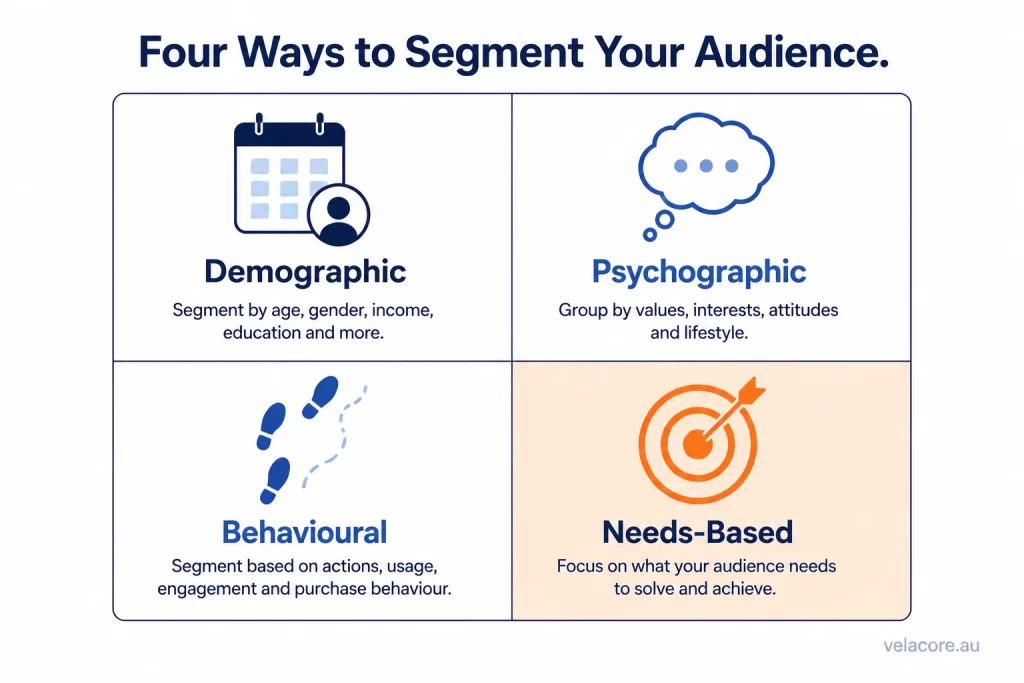
Age, location and income are easy to measure, which is exactly why so many businesses stop there. They’re also the weakest predictors of buying behaviour on their own. Proper audience segmentation goes further than any single data point.
| Segmentation type | What it captures | Best used for |
| Demographic | Age, location, income, job title | Basic filtering, media buying |
| Psychographic | Values, attitudes, priorities | Messaging tone and positioning |
| Behavioural | Past actions, buying patterns, engagement | Predicting what someone will do next |
| Needs-based | The specific problem or job the customer is trying to solve | Product positioning, content strategy |
Needs-based and behavioural segmentation tend to be the most useful for small and mid-sized businesses, because they map directly onto what you’d actually say in an ad, an email or a piece of content. Demographic data is still worth collecting, but it works best as a filter applied on top of a needs-based audience definition, not as the definition itself.
If you sell to other businesses rather than individual consumers, the process is largely the same, with one addition: you’re usually defining an audience made up of more than one person. A B2B buying decision typically involves a user, a budget holder and sometimes a technical evaluator, and each of them may need a slightly different message even though they work for the same target company.
Step 4: Write One Sharp Buyer Persona, Not Five Vague Ones
A common overcorrection is building an elaborate set of five or six buyer personas, each with a stock photo and a made-up name, none of which anyone on the team actually uses. If a persona document isn’t shaping actual decisions, like which pages you build or which pain point leads an ad, it isn’t doing its job.
Start with one. Write it as a paragraph, not a template: who they are, what triggered them to start looking, what they’ve already tried, what they’re afraid of getting wrong, and what would make them trust you enough to enquire. Everything else, the demographics, the channel preferences, can be added afterward.
Step 5: Validate It With Real Conversations
Whatever you’ve written down is still a hypothesis until you test it against real people. Talk to five to ten recent customers, ideally the good-fit ones from Step 1. Ask open questions: what were you dealing with before you found us, what almost stopped you from reaching out, what made you decide to go with us over an alternative.
You’ll usually find your written audience description was close but not quite right, often missing a specific worry or a competing option you hadn’t accounted for. That gap is exactly what you’re looking for.
Audience Creep: Why Your Target Audience Quietly Widens Over Time
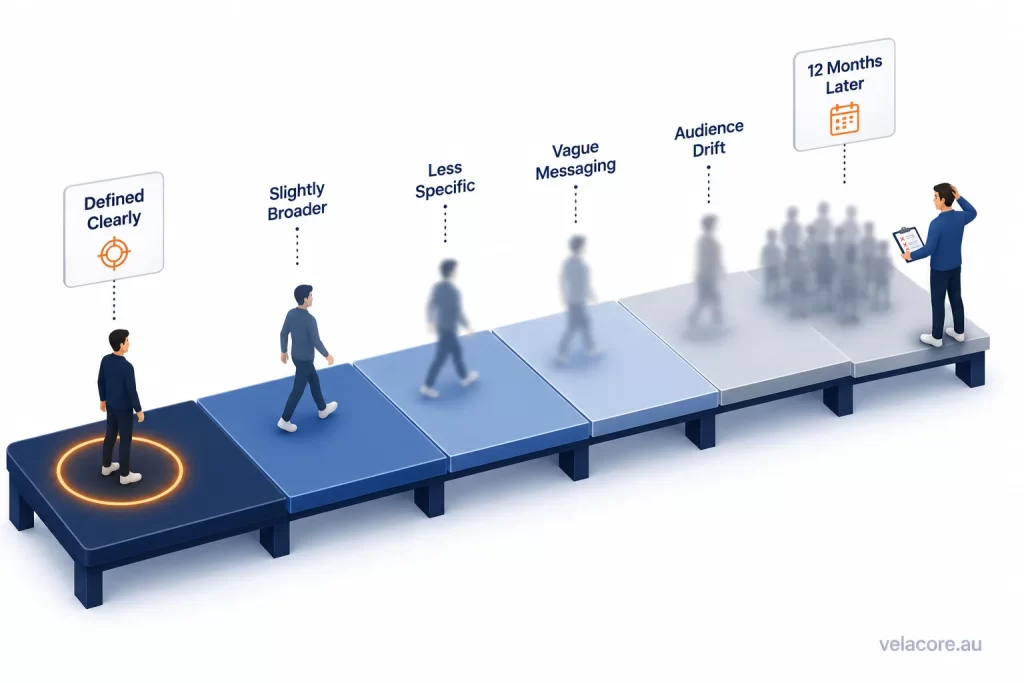
Here’s the part most guides on this topic skip entirely. Defining your audience properly once is necessary, but it isn’t permanent, and the way it breaks down is rarely dramatic.
It happens like this. A business defines a sharp, specific audience. Marketing built around that audience starts working. Then a sale comes in from someone who doesn’t quite fit the original description, close enough, different budget, slightly different industry, but the revenue is welcome, so nobody questions it. A few months later, another one arrives. Eventually the sales team starts quoting anyone who asks, because turning down revenue feels wrong in the moment. The original audience definition is never formally changed. It just stops being the thing the business is actually optimised for.
This is audience creep, and it’s harder to catch than most marketing problems because nothing looks broken. Leads are still coming in. Revenue might even be flat or growing. What’s actually happening is that the business’s messaging, website and content are still built for the original sharp audience, while the customers actually walking through the door have quietly become a different, blurrier group. The result is a slow decline in conversion quality and an increase in customers who churn early or need more support than expected, without an obvious single cause.
A few signs it’s happening in your business:
- Your best converting content or ads are increasingly older, and newer campaigns underperform them without a clear reason
- Sales is closing more deals but average deal quality, retention, or satisfaction is quietly dipping
- When you ask your team to describe your ideal customer, you get noticeably different answers depending on who you ask
The fix isn’t to never take a customer outside your original definition. It’s to review the definition itself on a schedule, roughly every six to twelve months, using the same process in Step 1: pull your best current customers, not your original assumptions, and check whether the audience you’re actually marketing to still matches the one on paper. If it doesn’t, that’s not a failure. It’s information. Either your original audience has genuinely evolved, or your team has been quietly discounting and accepting a worse fit to hit short-term numbers, and those require very different fixes.
Target Audience Examples
Seeing real target audience examples side by side makes the difference between vague and sharp easier to apply.
Too broad (a market, not an audience): “Small business owners who want more customers.”
Sharp B2C example: “A homeowner in their late thirties who’s just been quoted for a kitchen renovation, was surprised by the price, and is now comparing at least two other quotes before deciding, while worried about hidden costs appearing later.”
Sharp B2B example: “An operations manager at a 20 to 50 person logistics company who’s currently tracking deliveries in a shared spreadsheet, has had at least one costly scheduling error in the last quarter, and is quietly researching software without full buy-in from leadership yet.”
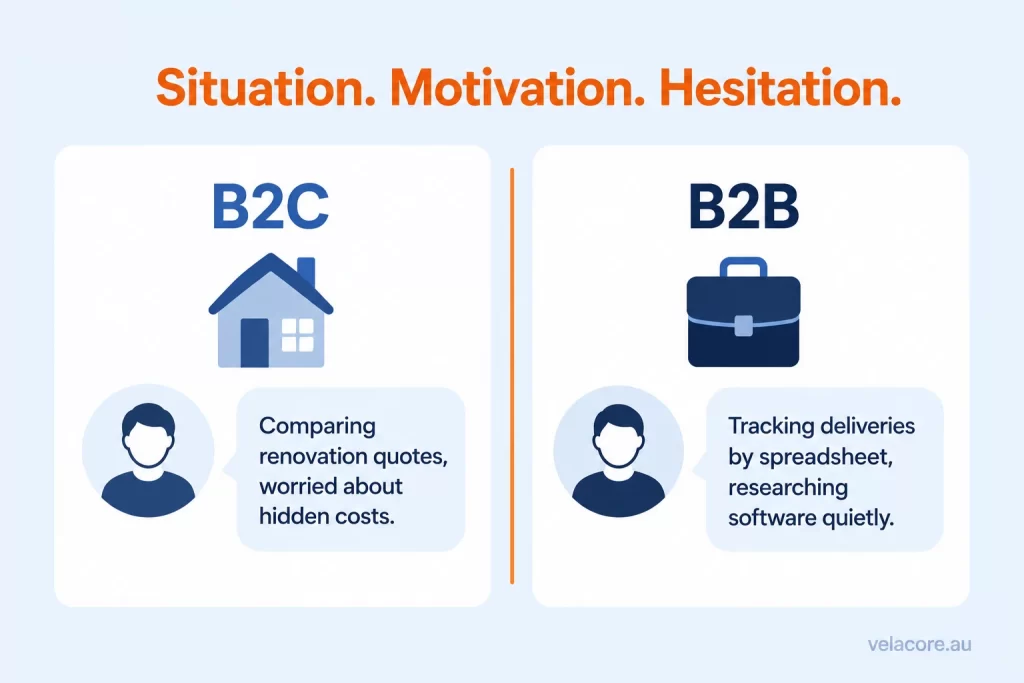
Notice both sharp examples include a situation, a motivation and a hesitation. That’s the actual test of whether an audience description is doing its job, not whether it includes enough demographic detail.
What Actually Changes Once You Know Your Audience
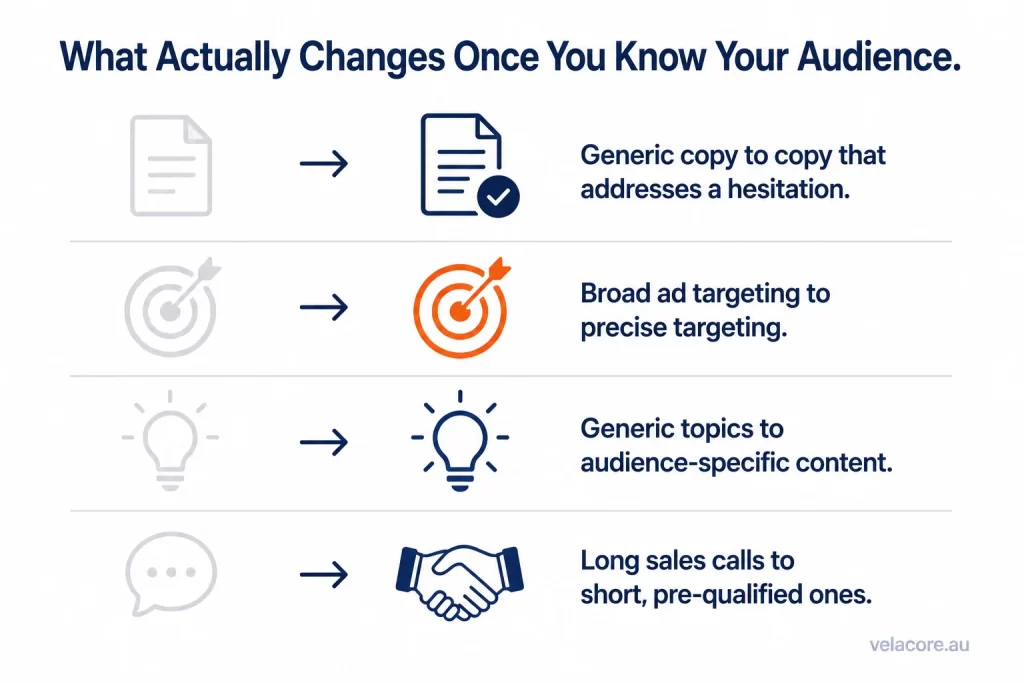
Getting specific about your audience isn’t an academic exercise. It changes concrete decisions:
- Website copy stops describing features and starts addressing the exact hesitation your audience walks in with
- Ad targeting narrows to the platforms and interests your specific audience actually uses, instead of broad demographic buckets
- Content topics shift from generic industry advice to the specific questions your audience is actually asking
- Sales conversations get shorter, because your marketing has already pre-qualified and pre-educated the person before they reach out
This is also where website metrics start telling you something useful. Once you know who you’re trying to reach, you can look at your website metrics and see whether the right people are actually converting, not just whether traffic is going up.
A Quick Way to Check You’ve Got It Right
A sharp target audience description should pass a simple test: could someone outside your business read it and immediately picture a real person, not a demographic category? If your description could apply to half the population, it’s still a market, not an audience.
FAQ
What’s the difference between target audience and target market?
A target market is the broad group of people who could theoretically buy from you. A target audience is the specific segment of that market your marketing is actually built to reach, usually defined by a shared problem, motivation or buying trigger rather than just demographics.
How many target audiences should a business have?
Most businesses are better served by one clearly defined primary audience than several loosely defined ones. It’s fine to have secondary audiences, but they should be added after the primary one is genuinely sharp, not instead of it.
Can a small business have a broad target audience?
Technically yes, but broad targeting almost always means weaker messaging and higher acquisition costs. Even businesses with wide appeal usually perform better by targeting audience segments one campaign or one piece of content at a time.
What are some examples of a well-defined target audience?
A well-defined target audience names a specific situation, motivation and hesitation rather than just a demographic. See the B2B and B2C examples above for a side-by-side comparison against a vague, market-level description.
How often should you revisit your target audience?
Review it whenever your offer changes, your best customers start to look different, or your conversion rate drops without an obvious cause. For most businesses, a proper review every six to twelve months is a reasonable baseline, since audiences tend to drift quietly rather than change overnight.
Getting This Right Is Part of a Bigger Picture
Knowing your audience is the foundation everything else gets built on, including your website, your content and your ad spend. If your site was built around a vague idea of who’d visit it, it’s worth revisiting both your messaging and the site itself. Our guide to choosing an agency covers what to look for if you’re weighing up whether to rebuild.
If you’d like a second opinion on whether your website and messaging are actually built around your real audience, get in touch. We’ll tell you straight whether the gap is in your targeting, your site, or both.