
When someone types a question into ChatGPT or Perplexity, the AI does not search for that exact phrase. It breaks the question apart into 12 to 15 sub-queries and runs each one independently. Google confirms that AI Mode and AI Overviews use this same query fan-out process. Your content is then evaluated passage by passage, not page by page, for each of those sub-queries.
This is the mechanism most GEO content guides miss. You can have the best article on a topic and still be invisible in AI-generated answers, because your content covers the main question but not the sub-questions the AI generated from it.
This guide covers eight implementation steps to optimise content for GEO, grounded in the latest research and ordered by the sequence in which they should be applied. If you are new to the concept itself, start with our guide on what GEO is before coming back here.
Step 1: Map query fan-out before you write
GEO content optimisation starts before a word is written. Traditional keyword research asks: what phrase does my audience search for? Query fan-out research asks: what sub-queries will the AI generate from that phrase, and does my content cover them?
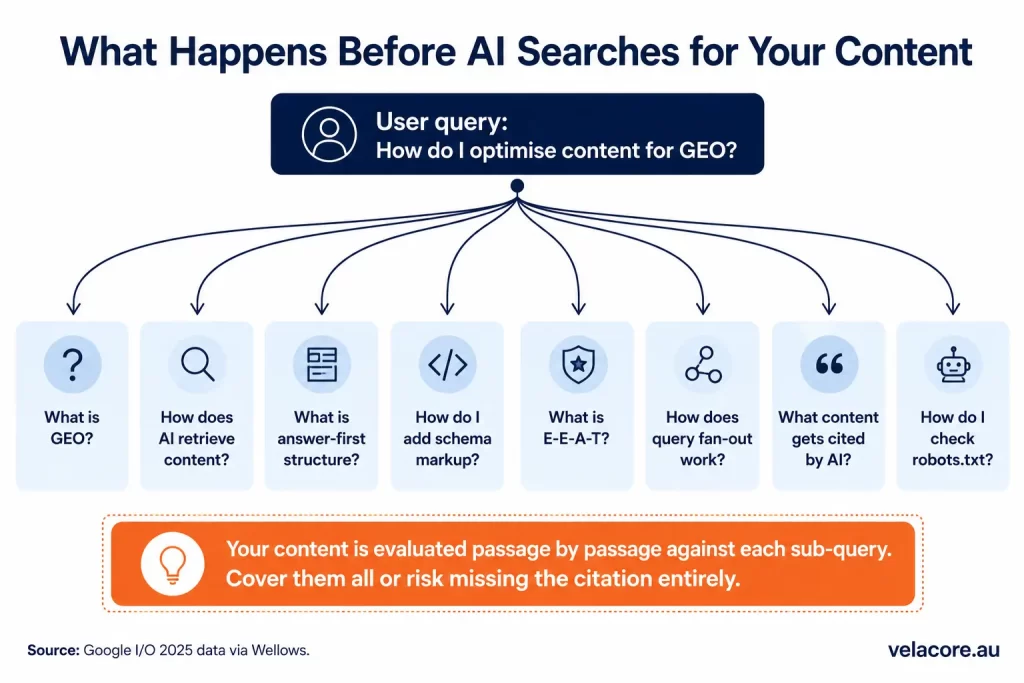
According to Google I/O 2025 data, the average user query now generates 12 to 15 sub-queries in AI Mode. Complex queries expand to over 50 variations. If your content covers the main topic but none of the sub-queries, it has no pathway into the AI’s answer.
A practical workflow for mapping fan-out before writing:
- Take your target topic and paste it into ChatGPT with the prompt: “What sub-questions would someone asking about [topic] also want answered?”
- Cross-reference with Google’s People Also Ask section and AnswerThePublic to find the sub-queries real users are generating
- Group sub-queries by intent (informational, comparative, transactional) and build your article sections around them
- Use each major sub-query as an H2 or H3 heading so the AI can match it directly during retrieval
Velacore tip: A single query about “how to appear in Google AI Overviews” generates sub-queries including: what are AI Overviews, what content gets cited, does ranking affect citation, and how do I implement schema. Each of those needs a dedicated section in your article.
Step 2: Write answer-first at the passage level, not just the page level
AI systems using Retrieval-Augmented Generation (RAG) extract individual passages from pages, not entire articles. Each section of your content is evaluated independently against the sub-queries the AI generated. This is called passage-level optimisation, and it changes how you structure every section.
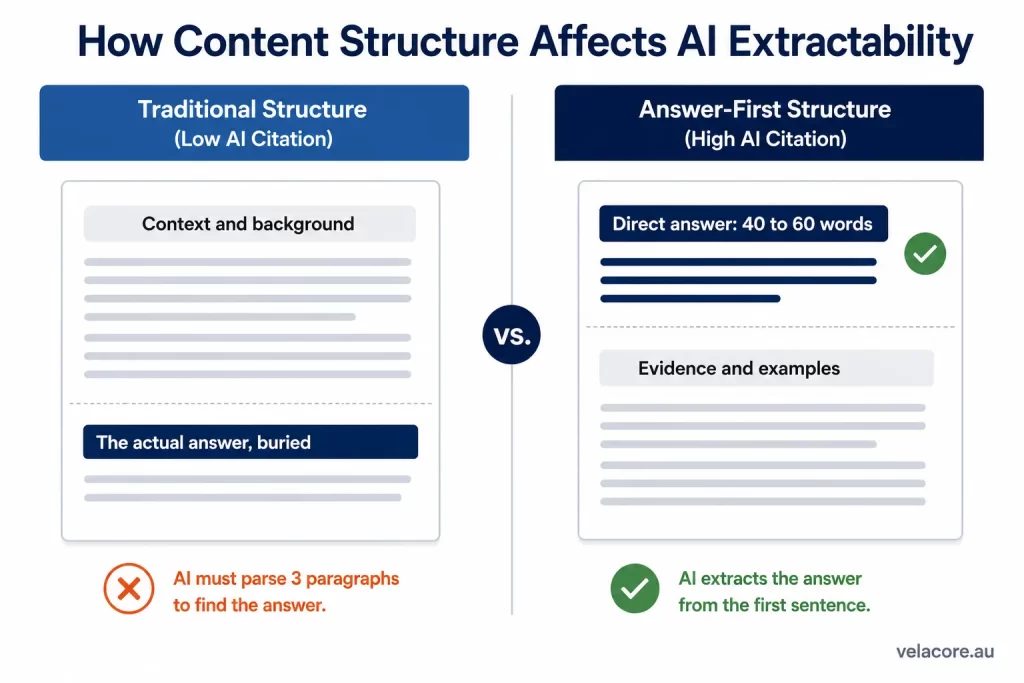
The research is specific: AI platforms favour content that directly answers queries within the first 40 to 60 words of each section. Traditional web content builds context before revealing the main point. That works for human readers. For AI retrieval, it means the answer gets buried past the extraction point.
Apply answer-first structure to every H2 section:
- Open with a clear, declarative 40 to 60-word answer to the question the heading implies
- Follow with supporting evidence, data, and examples
- Close the section with a practical application or next step
- Avoid pronouns in opening sentences: name entities explicitly. Say “Generative engine optimisation” not “it” or “this”
| Traditional structure (low AI citation) | Answer-first structure (high AI citation) |
| Opens with context and background | Opens with the direct answer in 40 to 60 words |
| Buries the key point mid-paragraph | States the key point in the first sentence |
| Uses pronouns to avoid repetition | Names entities explicitly in every section |
| AI must parse extensively to find the answer | AI extracts the answer from the opening immediately |
Step 3: Build E-E-A-T into the content structure, not just the author bio
96% of pages cited in Google AI Overviews have strong E-E-A-T signals. Most GEO guides interpret this as “add an author bio.” That is necessary but not sufficient. E-E-A-T for GEO content optimisation needs to be built into every layer of the article.
Author-level signals
- Every article needs a named author with demonstrable credentials relevant to the topic
- The author bio should include their role, relevant experience, and links to verifiable external profiles such as LinkedIn or institutional pages
- Where possible, include a quote or first-hand insight from the author that demonstrates real experience, not summarised knowledge
Article-level signals
- Reference the publication date and update date prominently so AI systems can assess freshness
- Cite primary sources, not secondary summaries. Link to the original research, government data, or institutional report, not a blog post that cites it
- Include Australian primary sources where relevant: ABS.gov.au, ATO.gov.au, NDIS.gov.au, ACCC, and state government portals all carry high trust weights for Australian queries
Site-level signals
- Your About page and Contact page need to be detailed and consistent with your content claims
- NAP (name, address, phone) must be consistent across your website, Google Business Profile, and online directories
- An AI visibility audit of your current E-E-A-T signals will show where the gaps are. Our AI visibility audit guide covers this in full
Step 4: Achieve verifiability density with sourced claims
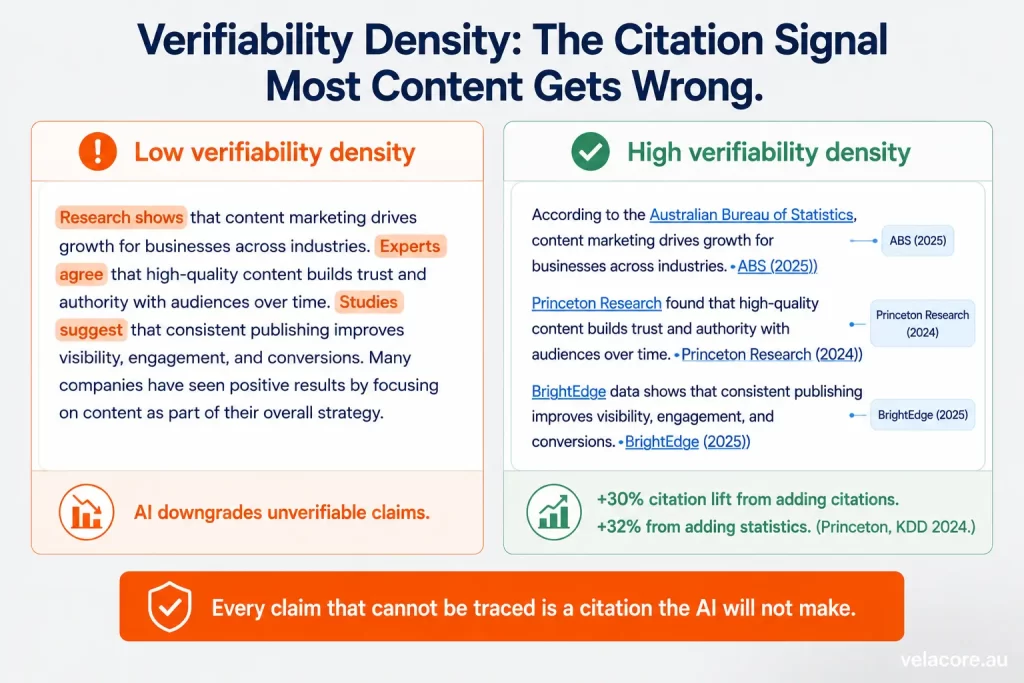
AI systems actively filter content based on what researchers have termed “verifiability density”: the ratio of cited, traceable data points to total word count. Content that states facts without sources is treated as unverifiable and deprioritised. Content with consistently sourced claims builds a data chain that AI systems can follow and trust.
Princeton research confirmed that adding statistics to content produces a +32% visibility lift in AI citation rates, and adding citations produces a +30% lift. These are not marginal improvements. Unverifiable claims produce the opposite effect: AI systems downgrade content where they cannot confirm the source of information.
Practical verifiability standards for each article:
- Every statistic must be hyperlinked to its primary source, not an aggregator
- Use the format: “According to [Source Name] ([year])” to make attribution explicit for AI parsing
- Prefer .gov.au, .edu.au, peer-reviewed research, and established industry publications over blog posts or social media
- Avoid vague attributions like “research shows” or “experts agree” without naming who and where
- Include a sources section or last-reviewed date at the bottom of each article to reinforce data chain integrity
Velacore tip: A Melbourne fintech article that cites “Reserve Bank of Australia (2025), Cash Flow Lending Guidelines” when discussing SME finance earns significantly more AI citations in financial queries than the same article citing a generic blog post on the same topic. The source specificity is the signal.
Step 5: Make every section machine-parseable with structured data
Even excellent content can be invisible to AI systems if those systems cannot parse and categorise it correctly. Structured data, implemented via JSON-LD schema, is the technical layer that tells AI crawlers what your content is, who wrote it, what entities it covers, and how it relates to other pages on your site.
The schema types with the highest measurable impact on GEO content optimisation are:
- Article or BlogPosting: includes author, datePublished, dateModified, publisher, and about attributes. This is the baseline for every blog post
- FAQPage: enables direct extraction of your Q&A sections into AI-generated responses. This is one of the highest-impact schema types for AI Overview visibility
- HowTo: structures step-by-step content so AI systems can extract and present individual steps, not just the overall article
- BreadcrumbList: signals your site’s topical cluster structure, helping AI systems understand how your content relates to your broader site architecture
Heading hierarchy matters as much as schema. Use H1 for the page title, H2 for major sections that each correspond to a sub-query, and H3 for subsections within those. Never skip heading levels. Google Developers documentation confirms that structured data helps search systems understand the meaning of pages and display them appropriately in rich results.
Meta descriptions should be under 155 characters and contain the primary keyword naturally. Alt text for every image should be factual and descriptive, not keyword-stuffed. AI systems read alt text as content during retrieval.
Step 6: Optimise for multi-modal content
AI engines do not just read text. They analyse visuals, read alt text, process captions, and infer context from content format. Research from 2026 citation analysis found that content combining text, images, and structured data earns 156% more AI citations than text-only content of equivalent quality.
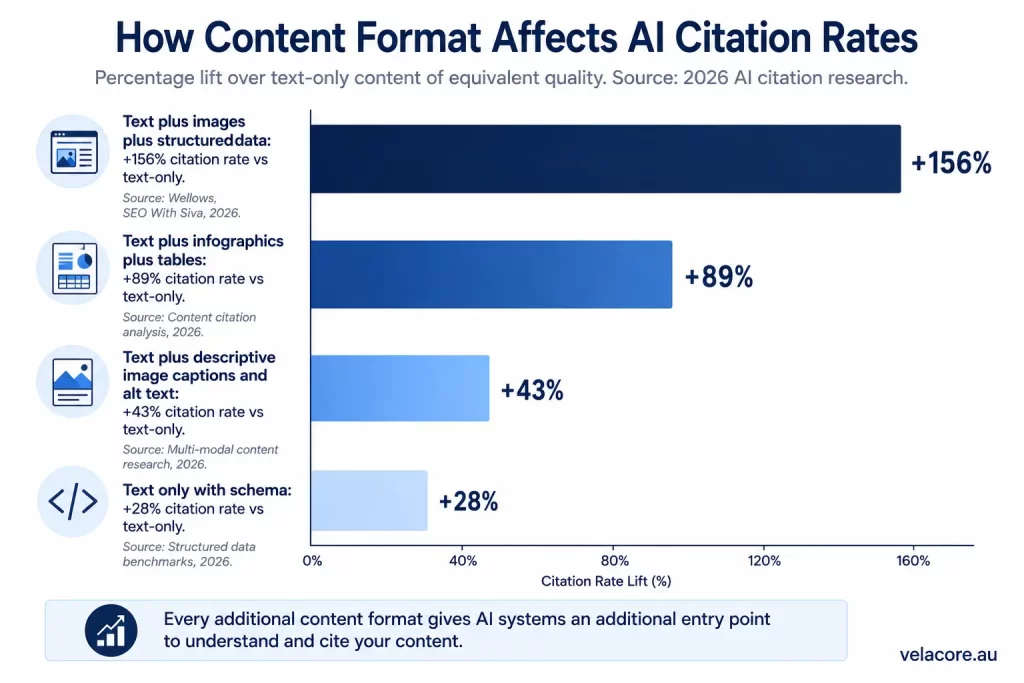
Multi-modal content optimisation for GEO:
- Infographics: summarise key data points visually. Write descriptive alt text that includes the key statistic or finding, not just a generic label like “chart showing GEO data”
- Tables: structure comparisons so AI systems can extract them as discrete data points. Every table should have clear headers and consistent formatting
- Video transcripts: if you produce video content, publish the transcript as indexable text. AI systems cannot extract value from video without a readable transcript
- Image captions: write captions as standalone factual statements. A caption that reads “GEO citation rates by content type, 2026” is more extractable than one that reads “The chart above shows…”
Velacore tip: YouTube presence is the strongest off-page correlating signal with AI Overview citation rates according to 2026 OtterlyAI research. If Velacore produces video content explaining GEO concepts, the YouTube descriptions, chapter titles, and video transcripts all contribute to entity authority signals that improve citation rates across the entire cluster.
Step 7: Maintain your content within the two-month freshness window
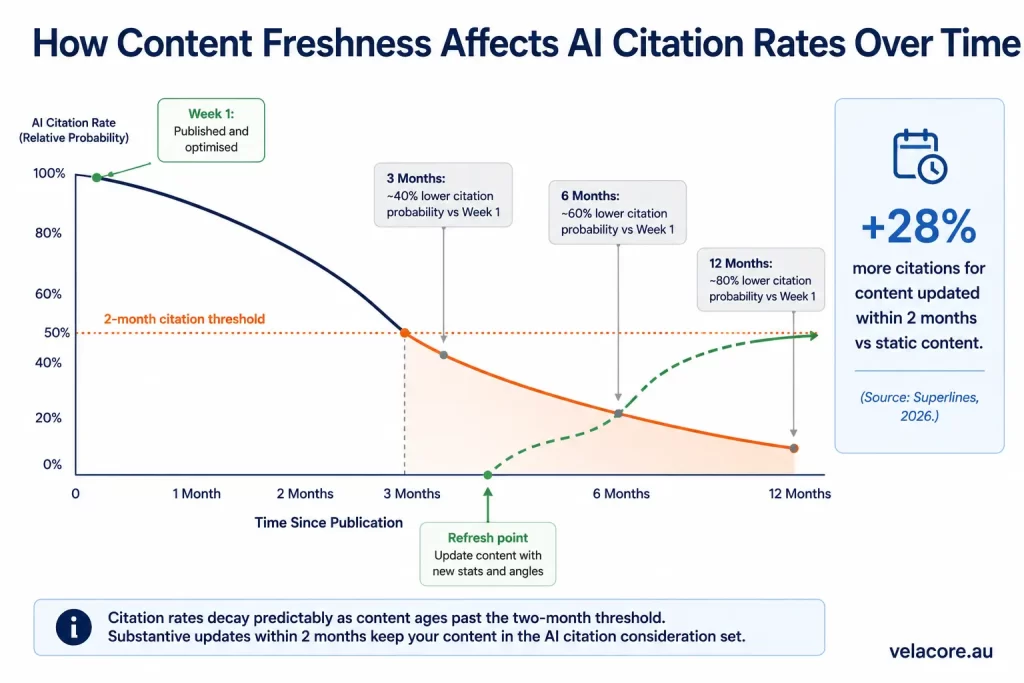
Content freshness is a measurable citation signal, not just a best practice. Pages updated within two months earn 28% more AI citations than older content on identical topics. AI retrieval systems using live web access, including Perplexity and Google AI Overviews, actively prefer recent, maintained content over static pages that have not been touched in months.
A quarterly refresh cycle is the minimum for maintaining citation eligibility within any GEO content strategy. Topical authority erodes when your statistics become stale and competitors publish fresher content on the same sub-queries. Each refresh should include:
- Update any statistics or data points that have been superseded by newer research
- Add a section covering recent developments in the topic if any have occurred
- Fix any broken external links, which AI systems treat as data chain inconsistencies
- Update the dateModified field in your Article schema to reflect the actual revision date
- Check whether competitor content has added angles you have not covered and consider whether those sub-queries should be added
This is different from just changing the publication date. AI systems can detect whether the content itself has changed. Updating a date without updating the content does not produce the freshness signal. The content must be substantively revised.
Step 8: Verify AI crawlers can access your site
This is the step most GEO implementation guides skip entirely. Every other element of your AI search content optimisation strategy depends on AI crawlers being able to reach and read your pages. You can follow every content optimisation step perfectly and still be invisible to AI engines if their crawlers cannot access your site. Most businesses do not realise their robots.txt configuration or JavaScript rendering setup is blocking AI retrieval agents entirely.
Check your robots.txt for AI retrieval crawlers
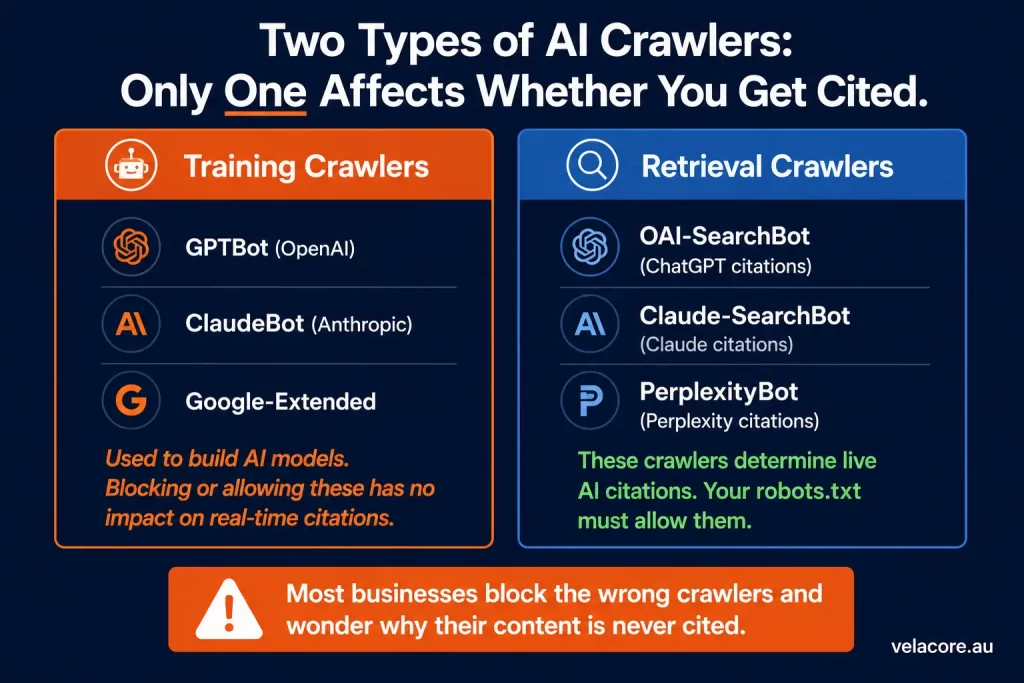
There are two types of AI crawlers. Training crawlers collect content for model training. Retrieval crawlers collect content for real-time AI answers. Most resources tell you to manage GPTBot (OpenAI’s training crawler) and ClaudeBot (Anthropic’s training crawler). But blocking or allowing those has no effect on whether AI engines cite you in live answers.
The crawlers that drive real-time citations are different. Your robots.txt must explicitly allow:
- OAI-SearchBot: OpenAI’s retrieval crawler for ChatGPT live search and citations
- Claude-SearchBot: Anthropic’s retrieval crawler for Claude citations and AI Overviews
- PerplexityBot: Perplexity’s search and citation crawler
- Google-Extended: Google’s AI training and Gemini retrieval crawler
If your robots.txt blocks all unrecognised user agents by default, you are likely blocking every AI retrieval crawler while your content remains fully visible to human visitors. Check this immediately.
Check your JavaScript rendering
According to Vercel and MERJ research, 69% of AI crawlers cannot execute JavaScript. If your website relies on client-side rendering, meaning content is generated in the browser rather than served as static HTML, AI crawlers may see a blank or partial page. Server-side rendering (SSR) or static HTML output ensures your content exists for AI crawlers in the same form it exists for human readers.
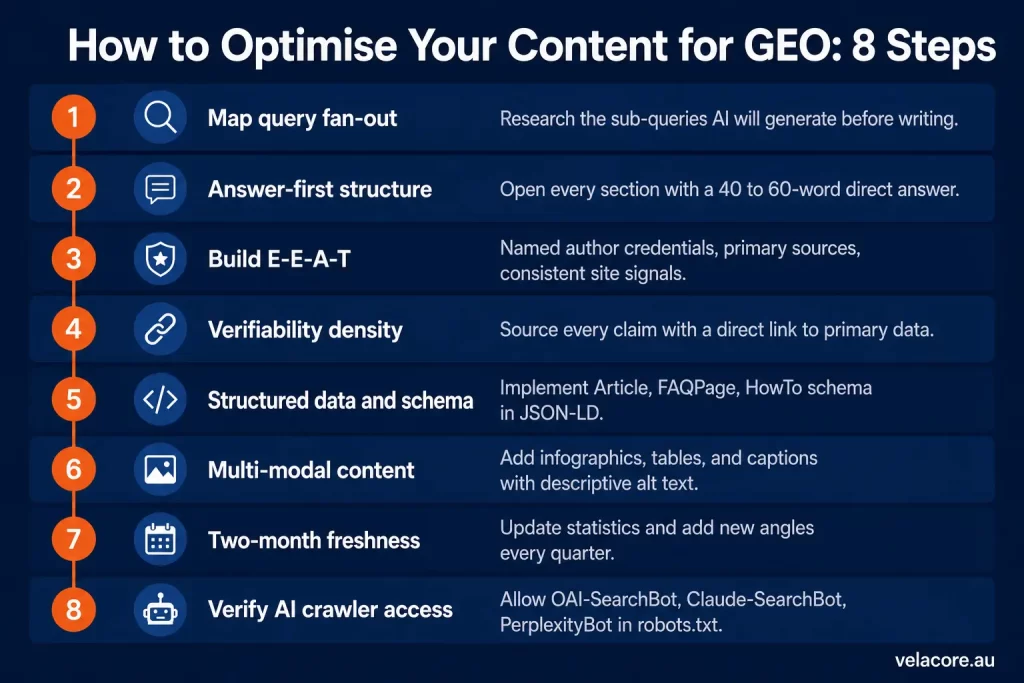
All 8 steps at a glance
| Step | Core Action |
| 1. Map query fan-out | Research the sub-queries AI will generate from your topic before writing |
| 2. Answer-first structure | Open every section with a 40 to 60-word direct answer |
| 3. Build E-E-A-T | Named author credentials, primary sources, consistent site signals |
| 4. Verifiability density | Source every claim with a direct link to primary data |
| 5. Structured data and schema | Implement Article, FAQPage, HowTo, and BreadcrumbList schema in JSON-LD |
| 6. Multi-modal content | Add infographics, tables, and captions with descriptive alt text |
| 7. Two-month freshness | Update statistics, add new angles, fix broken links every quarter |
| 8. AI crawler access | Verify robots.txt allows OAI-SearchBot, Claude-SearchBot, PerplexityBot |
Frequently asked questions about GEO content optimisation
What is the most important step when optimising content for GEO?
Based on the current research, query fan-out mapping is the most commonly missed and highest-impact step. Most content teams optimise for the main keyword and ignore the 12 to 15 sub-queries the AI generates from that keyword before searching. Content that covers sub-queries is significantly more likely to be cited than content that covers only the main topic, even when the main-topic coverage is excellent.
How is GEO content optimisation different from traditional SEO content writing?
Traditional SEO writing optimises at the page level for a target keyword. Knowing how to optimise for GEO means working at the passage level for a cluster of sub-queries. SEO writing aims to rank in a list of 10 links. GEO writing aims to be extractable as a cited source in a synthesised AI answer. The content principles overlap significantly, but the structural and technical requirements differ. Our guide to what GEO is explains the full distinction.
How many words should each article section be for GEO?
Forget a magic word count for GEO. Lead each section with a useful answer, then back it with evidence, examples and the questions readers are likely to ask next. Depth beats padding.
Does existing content need to be completely rewritten for GEO?
Rarely. Most existing content can be upgraded for GEO content optimisation through structural changes rather than complete rewrites. The most impactful quick changes are: adding a 40 to 60-word answer-first opener to each major section, adding an FAQ section with schema markup, sourcing any unsupported claims with primary links, and adding or correcting the Article schema to include author and dateModified attributes. A full AI visibility audit will identify which pages need structural work versus which just need schema and sourcing updates.
How do I measure whether my GEO content optimisation is working?
Track citation frequency manually by prompting ChatGPT, Perplexity, and Google with your target queries and recording whether your site is cited as a source. Monitor AI-referred traffic segments in Google Analytics. For more systematic tracking, tools such as Profound, Accio, and Brandwatch track citation frequency across AI platforms over time. Our guide on AI Overviews traffic loss covers the analytics setup in detail.
How long does GEO content optimisation take to show results?
For existing authoritative content with strong E-E-A-T signals, structural improvements can produce AI citation appearances within two to six weeks. For newer sites or lower-authority domains, it typically takes three to six months of consistent implementation before citation rates become measurable. The speed advantage of GEO over traditional SEO is that AI engines can surface content in synthesised answers immediately after indexing, without the months-long link-building cycle that traditional rankings require.
Does GEO content optimisation hurt traditional SEO performance?
No. GEO content optimisation and traditional SEO are largely complementary. Answer-first structure, sourced claims, named authorship, comprehensive subtopic coverage, and schema markup all improve both AI citation rates and traditional organic performance. The main GEO-specific additions (query fan-out mapping, retrieval crawler access, passage-level structure) do not conflict with any traditional SEO best practice.
Optimising your content for GEO is not a one-time task. It is an ongoing practice of matching your content structure to how AI systems actually retrieve and synthesise information. The businesses building that capability now are compounding a citation advantage that will be substantially harder for competitors to close in two years. If you want to assess where your current content stands and what changes would have the most impact, talk to the Velacore team and we will take a look.