
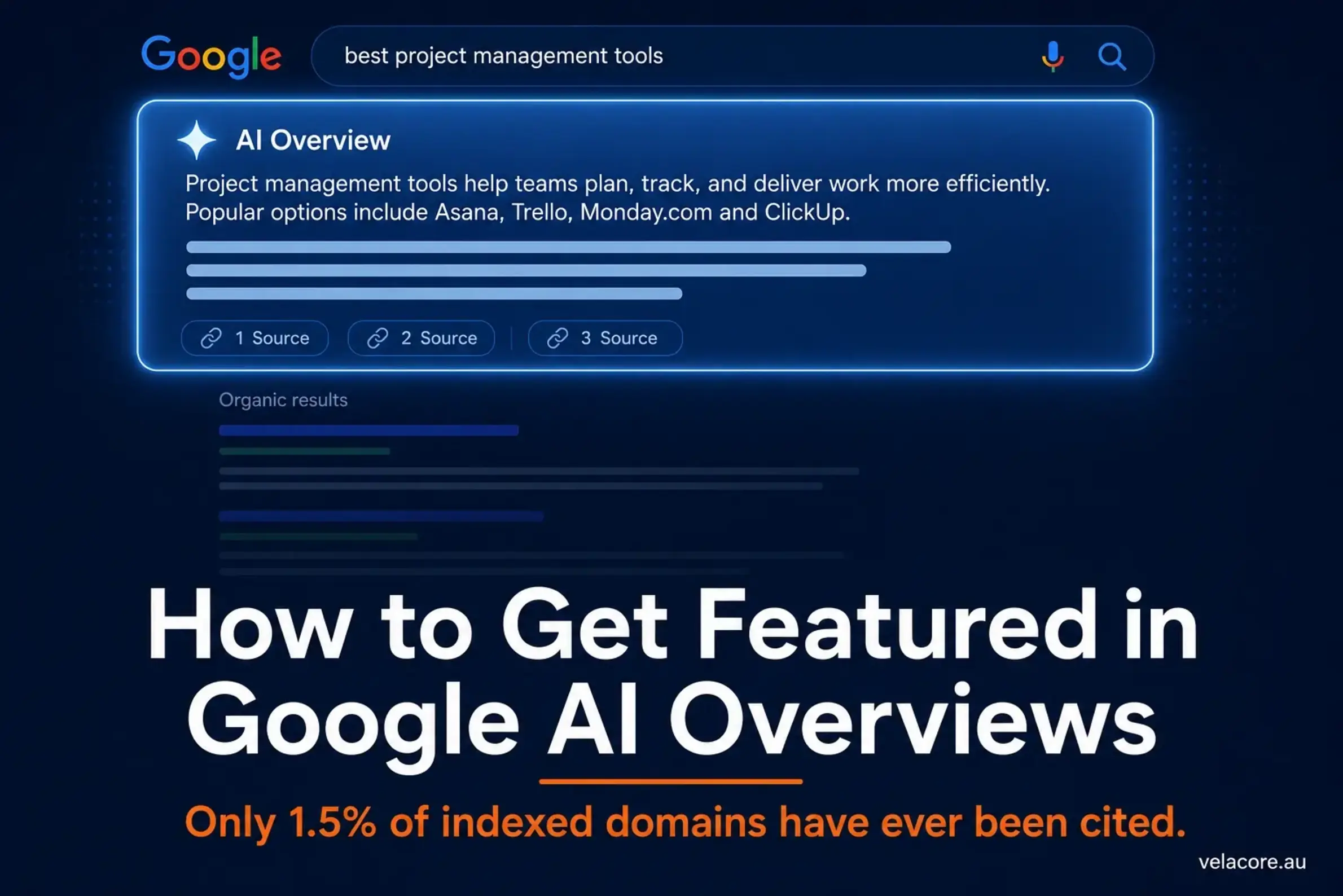
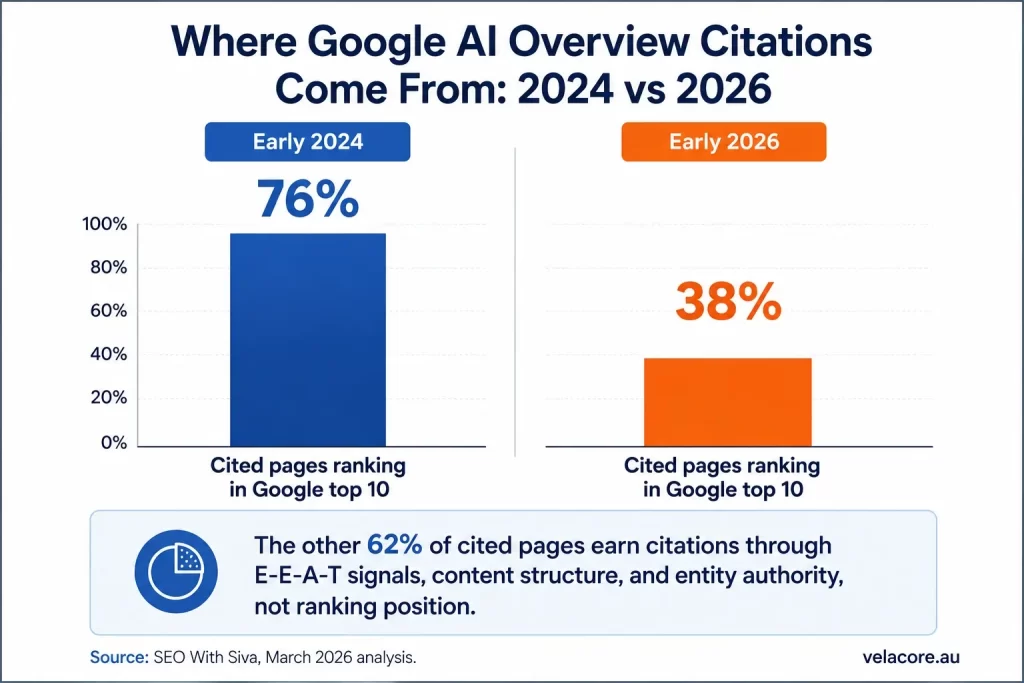
Out of 18.4 million domains indexed by Google, only 274,455 have ever appeared in a Google AI Overview. That is 1.5% of the entire indexed web. Google is not selecting citation sources at random, and it is not selecting them purely by ranking position either. Only 38% of cited pages rank in Google’s top 10 for the same query. The other 62% earned their citation through a different set of signals entirely.
Google AI Overviews now appear in up to 48% of searches globally and reach more than 2 billion monthly users. In Australia, separate testing across 100 sampled queries found AI Overviews present in 39 out of 100 results, with prevalence rising sharply on informational and how-to queries. For businesses that rely on organic search traffic, this is a structural shift. Understanding how to appear in AI Overviews has moved from a nice-to-have to a core part of any AI search visibility strategy. Around 60% of Australian searches now end without a zero-click search outcome. The visibility that matters is increasingly happening before anyone clicks anything, which is precisely why Australian AI search strategy needs to account for AI Overviews as a distinct channel.
This article covers what determines AI Overview citation, the signals Google’s system uses to select sources, and the implementation steps that have produced measurable results. For a broader overview of generative engine optimisation across all AI platforms, see our guide to what GEO is and how it works.
What Google AI Overviews actually are
Google AI Overviews are Gemini-powered summaries that appear at the top of Google Search results, above organic listings, for queries where Google determines a synthesised answer adds value. They pull from multiple credible sources, cite them inline, and surface three to five cited cards linking to those source pages.
They launched globally in 2024 and have expanded rapidly since. AI Overviews now appear in 200 countries and 40 languages. Growth accelerated sharply after the March 2025 core update, with AIO prevalence increasing 116% in the months that followed.
The citation cards below the AI-generated summary are the real commercial asset. Being cited there does not guarantee a click, but it delivers brand visibility at the exact moment a user is forming an opinion, often before they have looked at a single organic result. If you have been losing unexplained organic traffic, our guide to measuring AI Overviews traffic loss explains how to quantify the impact.
How AI Overviews differ from featured snippets
Featured snippets pull one passage from one page. AI Overviews synthesise across multiple sources, generate a new answer, and then cite the sources they drew from. You cannot optimise for an AI Overview citation the same way you optimise for a featured snippet. The signals are different, the selection logic is different, and the content requirements are more demanding.
What the 2026 citation data actually shows
Several large-scale studies have now produced consistent findings on what separates cited content from uncited content. The patterns are clear enough to inform a practical strategy.
Ranking position is a weaker signal than most businesses assume
The shift here is significant. In early 2024, around 76% of AI Overview citations came from pages ranking in Google’s top 10 for the same query. By early 2026, that figure had dropped to 38%. Pages ranking 6 to 10 with strong E-E-A-T signals are now cited 2.3 times more frequently than pages ranking first with weak authority signals. Ranking still matters, but it no longer determines citation the way it once did.
E-E-A-T has become an active filtering mechanism
This is the single most impactful finding in the 2026 citation research: 96% of AI Overview citations come from pages with strong E-E-A-T signals. Google is not just using E-E-A-T as a quality guideline. It is using it as a filter. Content that does not clear the E-E-A-T threshold is excluded from consideration before any other signals are evaluated.
Content format is a stronger citation signal than word count
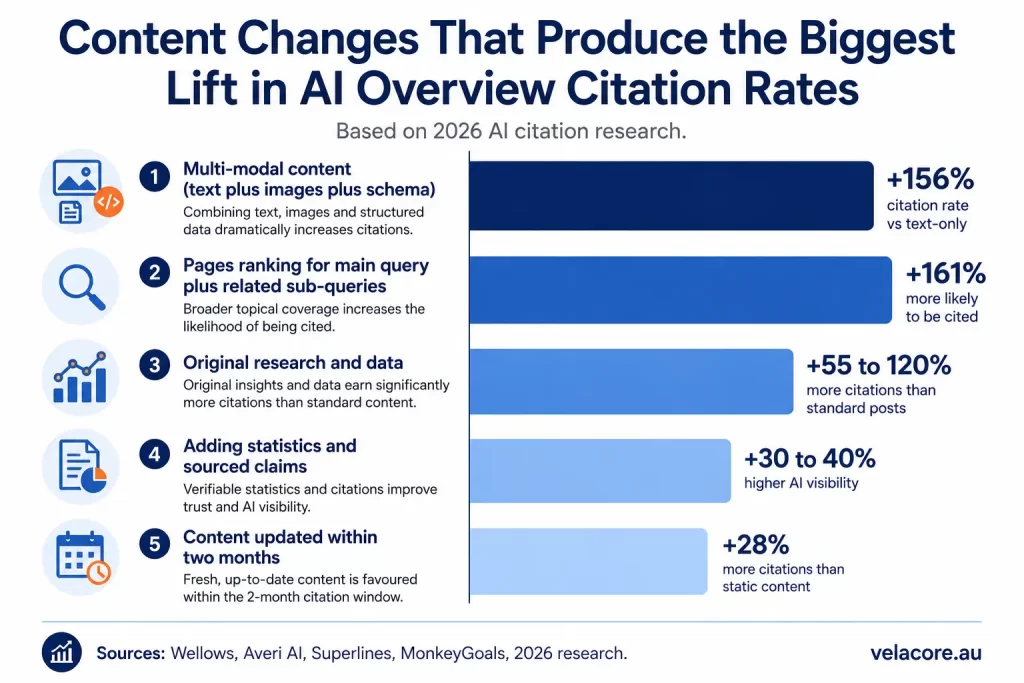
A key finding from analysis of 15,847 AI Overview results across 63 industries: content combining text, images, and structured data sees 156% higher citation rates than text-only content. Separately, length matters less than structure. 800-word articles with clear structure and specific information regularly get cited over 3,000-word guides with poor organisation. The AI is looking for extractable signal, not volume.
Topical clusters are 161% more likely to be cited
Research from 2026 found that pages ranking for both the main query and at least one related sub-query were 161% more likely to be cited in AI Overviews. Google evaluates entity authority across an entire site, not just individual pages. A single well-optimised article on a site with no related content is at a structural disadvantage compared to the same article sitting within a content cluster. Our guide on auditing your AI visibility covers how to assess your current entity authority position.
Original data earns dramatically more citations
Original research and data-rich content is cited at 3 to 10 times the rate of standard blog posts. Content that includes statistics, citations, and quotations achieves 30 to 40% higher visibility in AI responses. And pages updated within two months earn 28% more citations than older content with identical keyword focus. Freshness is a measurable citation signal.
What Google AI Overviews reward versus what traditional SEO rewards
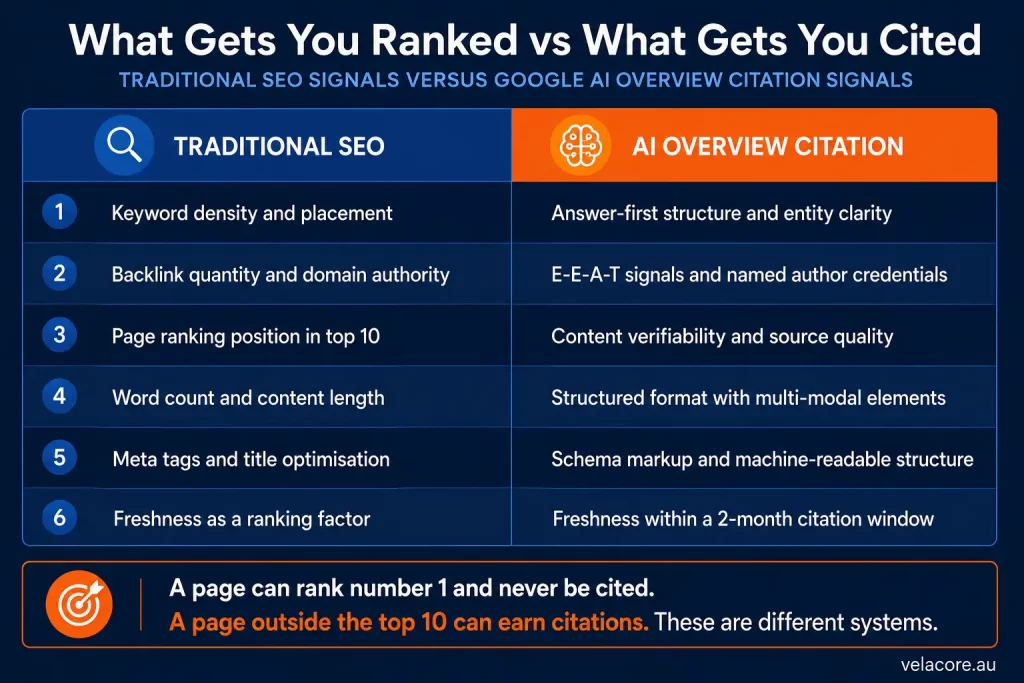
| Traditional SEO Signal | AI Overview Citation Signal |
| Keyword density and placement | Answer-first structure and entity clarity |
| Backlink quantity and domain authority | E-E-A-T signals and named author credentials |
| Page ranking position (top 10) | Content verifiability and source quality |
| Word count and content length | Structured format with multi-modal elements |
| Meta tags and title optimisation | Schema markup and machine-readable structure |
| Freshness as a ranking factor | Freshness as an active citation filter (2-month threshold) |
The seven signals that determine Google AI Overview citation
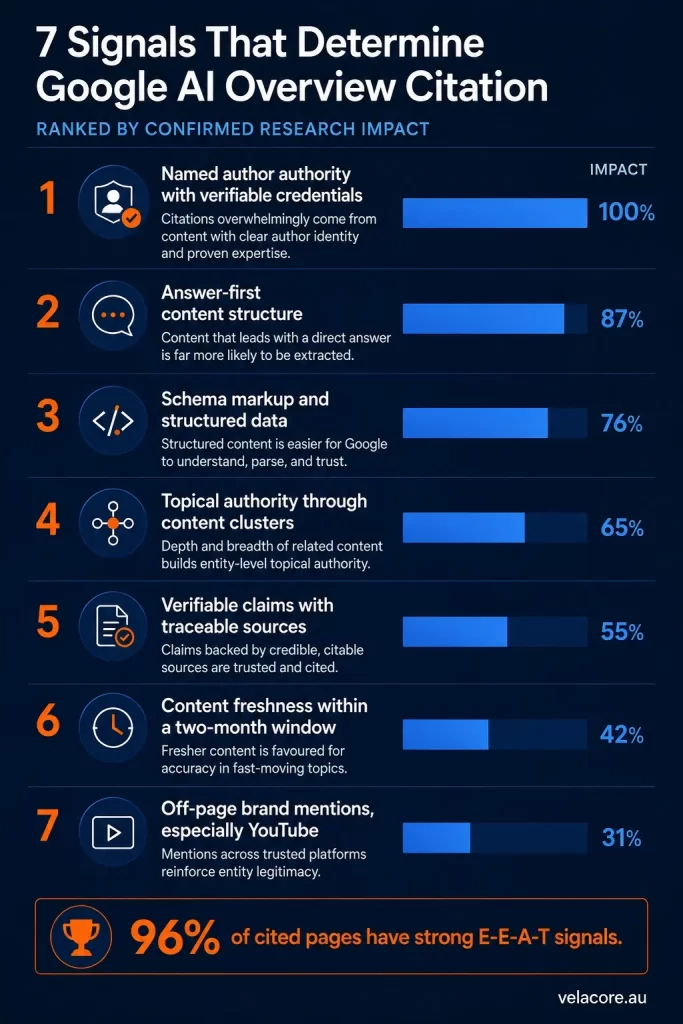
Based on the consolidated 2026 research, these are the signals with confirmed measurable impact on AI Overview citation rates. They are listed in order of impact, not implementation complexity.
1. Named author authority with verifiable credentials
96% of cited pages have strong E-E-A-T signals. For Google AI Overviews, the most important component of E-E-A-T in 2026 is named author authority. Content attributed to a real person with verifiable credentials, a detailed author bio, and preferably external mentions of that person in relevant contexts is treated as significantly more trustworthy than content with a generic author tag or no authorship at all.
Practical implementation: every article needs a named author, a bio that mentions relevant credentials or experience, and links to verifiable external profiles such as LinkedIn. This is not optional for AI Overview citation eligibility.
2. Answer-first content structure
Google’s AI retrieval system extracts passages from pages rather than reading them in full. Every major section of your content should open with a 40 to 60-word direct answer to the question that section addresses. This structure, sometimes called inverted-pyramid or answer-first format, is what makes content extractable for AI generation. Content that buries the key point after three paragraphs of context will be passed over for content that states the answer immediately.
3. Schema markup and structured data
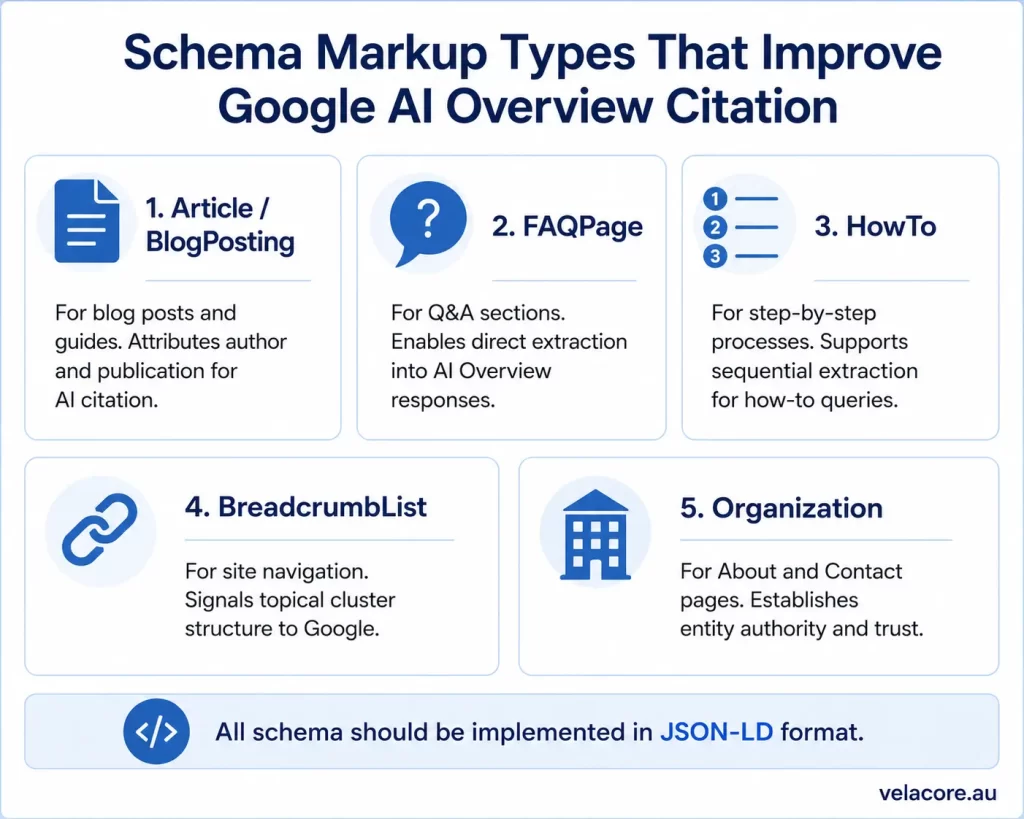
Schema markup is the technical layer that defines your content’s entity relationships for Google’s systems. For AI Overview citation specifically, the most impactful schema types are: Article or BlogPosting with author and organisation attributes, FAQPage for Q&A sections, HowTo for process-based content, and BreadcrumbList for site structure. Structured data is what makes content machine-readable and extractable by AI systems at the entity level, not just the keyword level.
| Schema Type | Use For | AI Overview Benefit |
| Article / BlogPosting | Blog posts and guides | Author and publication attribution |
| FAQPage | Q&A sections | Direct extraction for AI responses |
| HowTo | Step-by-step processes | Sequential extraction for how-to queries |
| BreadcrumbList | Site navigation | Topical cluster signal |
| Organization | About and contact pages | Entity authority and trust |
4. Topical authority through content clusters
Google evaluates entity authority at the site level, not just the page level. Pages ranking for both a primary query and related sub-queries are 161% more likely to earn AI Overview citations. Building a content cluster around a topic, where each article links to related articles and back to a central pillar, signals to Google that your site is a comprehensive and authoritative source rather than an isolated page on a topic. This is the link between GEO, Google AI Overviews, and the broader content strategy that determines whether your site is treated as a trusted entity or an isolated publisher.
5. Verifiable claims with traceable sources
AI Overviews rely on verifiable evidence. According to citation research, the highest-trust source types are peer-reviewed research, government publications, and established industry data platforms. For Australian businesses, this means citing ABS.gov.au, ATO.gov.au, NDIS.gov.au, and Australian industry bodies where relevant. Claims that cannot be traced to a primary source are deprioritised by AI systems. Vague phrasing like “research shows” without attribution is treated as unverifiable.
6. Content freshness within a two-month window
Pages updated within two months earn 28% more AI Overview citations than older content on identical topics. This is not just about updating the publication date. Google checks whether the actual content reflects recent data, whether statistics have been updated, and whether sections describe current rather than outdated behaviour. A quarterly refresh cycle that updates key statistics, adds recent developments, and corrects stale references is a practical way to maintain citation eligibility over time.
7. Off-page brand mentions, particularly on YouTube
This is the most overlooked citation signal in 2026. An OtterlyAI study drawn from over 100 million citation instances found that YouTube brand mentions, specifically in video titles, transcripts, and descriptions, represent the strongest correlating factor with AI Overview visibility among all the signals studied. Google infers entity authority partly from how other platforms and publications reference your brand. Earned media, editorial coverage, and relevant YouTube presence all contribute to the entity authority signals that determine whether Google trusts your site enough to cite it.
What this means specifically for Australian businesses
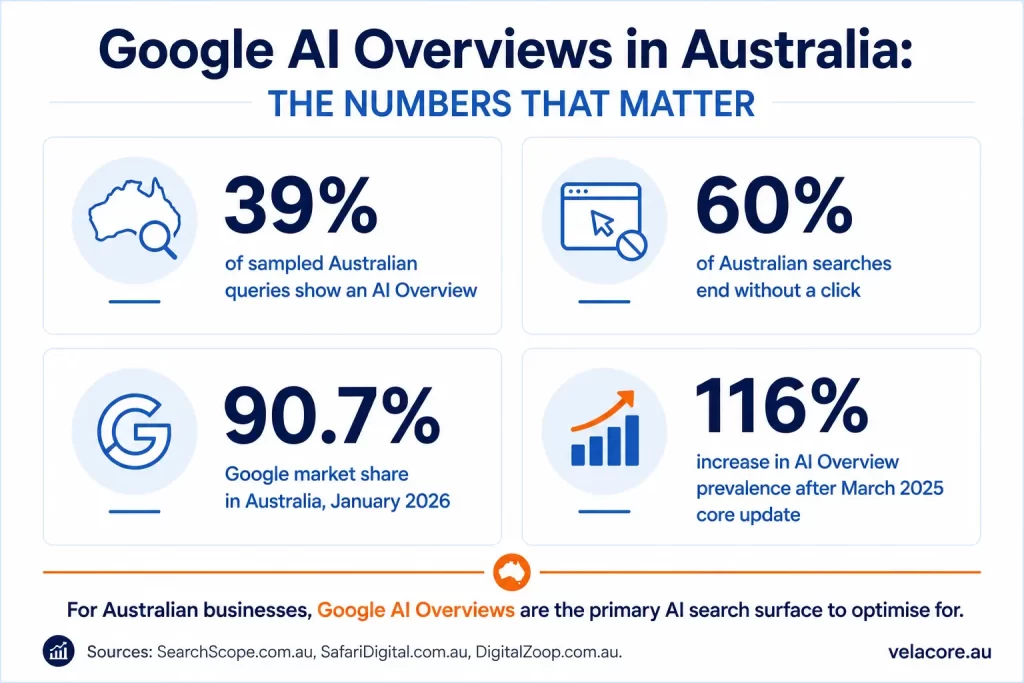
Australia’s search landscape has specific characteristics that affect AI Overview visibility. Google holds 90.7% of Australia’s search market, meaning Google AI Overviews are the dominant AI search surface for Australian audiences. Around 60% of Australian searches now end in a zero-click outcome, and AI Overviews are present in close to 39% of sampled queries across categories. For any business building an Australian AI search strategy, this zero-click reality makes AI Overview citation the priority visibility channel.
The local relevance signals that improve AI Overview citation rates for Australian content are specific. Google’s quality systems look for geographic signals that confirm your content is genuinely relevant to Australian audiences, not just keyword-targeted at them.
- Cite Australian primary sources: ABS.gov.au, ATO.gov.au, NDIS.gov.au, ACCC, RBA, and state government portals carry high trust weights for Australian queries
- Use consistent NAP: Business name, address, and phone number should be consistent across your Google Business Profile, website, and online directories
- Reference Australian currency and regulation: AUD values, GST, state-specific regulations, and Australian English spelling all reinforce geographic authenticity
- Name Australian cities and regions: Where genuinely relevant to your content, naming specific Australian locations strengthens local entity signals
- Australian industry body citations: Citing peak bodies relevant to your sector (ARCA, AICD, AMA, HIA, etc.) signals domain authority within Australian context
For regulated sectors such as NDIS services, healthcare, and financial advice, the verifiability threshold is higher and the payoff for meeting it is larger. These sectors see some of the highest AI Overview prevalence rates because users are seeking authoritative answers, and Google prioritises highly credentialed sources. Building topical authority within a regulated niche, backed by verifiable credentials and local primary sources, directly improves AI search visibility in the verticals where citation matters most commercially.
How to track whether your content is being cited
Most standard analytics setups do not capture AI Overview citation performance. Traditional ranking tools show where you sit in organic results but not whether you are appearing in the AI Overview above them. This is one of the most significant blind spots in most businesses’ AI search strategy. GEO and Google AI Overviews require their own measurement layer, separate from standard SEO reporting. There are three practical tracking approaches in 2026.
Manual prompt testing
The most accessible method is manual. Prompt Google, ChatGPT, and Perplexity with the queries you are targeting and record whether your site appears as a cited source. Do this monthly for your ten most important target queries and note the trend direction. It is time-consuming but free and gives you direct visibility into whether your content is being selected.
Analytics referral monitoring
Set up segments in Google Analytics to monitor referral traffic from AI platforms. OpenAI provides UTM referral tracking for ChatGPT search. Google does not currently pass AI Overview referral attribution in the same way, but monitoring direct traffic and referral patterns on days when you know an AI Overview is appearing for a target query can give a proxy signal. Our article on measuring AI Overview traffic loss covers this tracking setup in detail.
Specialist GEO tracking tools
Tools built specifically for AI search monitoring include Profound, Accio, Brandwatch, and Wellows. These platforms track citation frequency across AI platforms and can show trend direction over time. They are the most reliable option for consistent tracking but involve a platform cost. For most small and mid-sized Australian businesses, starting with manual prompt testing and analytics monitoring gives sufficient signal to guide content decisions.
Frequently asked questions about Google AI Overviews
Do I need to rank in Google’s top 10 to appear in AI Overviews?
No. Only 38% of pages cited in Google AI Overviews rank in the top 10 for the same query, down from 76% in early 2024. Citation is determined by E-E-A-T signals, content structure, verifiability, and entity authority rather than ranking position alone. This is why a strong GEO Google AI Overviews strategy operates independently from standard ranking optimisation, even though the two overlap significantly. Backlinks and domain authority still influence citation probability indirectly because they are used by Google’s systems to assess overall entity trust.
What is the single most important factor for AI Overview citation?
Based on the current research, E-E-A-T signals as a combined category have the highest impact. 96% of cited pages have strong E-E-A-T. Within E-E-A-T, named author authority with verifiable credentials is the component most often missing from content that otherwise meets content quality standards. If your content lacks a named author with demonstrable expertise, that is the highest-priority fix.
How is getting cited in AI Overviews different from ranking in standard search?
Standard SEO rankings are determined primarily by keywords, backlinks, and technical signals. AI Overview citations are determined by content extractability, entity authority, source verifiability, and structured data. A page can rank well organically and never appear in an AI Overview, and a page can appear in an AI Overview without ranking in the top 10. The GEO Google AI Overviews relationship is best understood as a two-layer system: GEO is the discipline, Google AI Overviews is the primary surface you are optimising for. Our guide to generative engine optimisation explains the full distinction.
How quickly can AI Overview citations appear after optimising content?
For existing authoritative content where the main work is structural, adding direct answers, FAQ sections, and schema can produce AI Overview appearances within two to six weeks. Understanding how to appear in AI Overviews quickly is less about shortcuts and more about having the right existing foundation. For newer sites with lower domain authority, it typically takes three to six months of consistent content development before you can reliably get featured in AI Overviews. The key variable is your existing entity authority position, not just the individual page.
Does Google use the same signals for AI Overviews as for featured snippets?
They overlap but are not identical. Both favour clear, direct answers. But AI Overviews pull from multiple sources and generate a synthesised response, while featured snippets pull a single passage from a single page. Featured snippets quote a single passage; AI Overviews bring several sources into one answer. Both call for sharp explanations, credible evidence and a page worth exploring.
Are Australian businesses at a disadvantage in AI Overviews?
No, and in regulated sectors they may have an advantage. Google’s AI systems localise results by region. Australian content citing Australian primary sources (ABS, ATO, NDIS, state government portals) is given preference for Australian queries over internationally-focused content covering the same topic. For sectors like healthcare, financial services, and NDIS support, Australian businesses that demonstrate regulatory knowledge and cite authoritative local sources are well-positioned to earn citations that international content cannot easily compete for.
Knowing how to get featured in AI Overviews and then implementing it consistently is what separates the 1.5% of domains that earn citations from the other 18 million. It is about building the kind of content and site authority that Google’s AI trusts enough to cite in front of its users. The businesses doing that work now are compounding a visibility advantage that will be significantly harder to close in two years. If you want to know where your site currently stands and what it would take to start earning AI Overview citations, talk to the Velacore team and we will take a look.