
When someone asks ChatGPT, Perplexity or Google a question, a cited page can introduce them to your business before they visit a conventional search result. GEO is about making that first encounter count: clear answers, credible evidence and a compelling next step.
Generative Engine Optimisation is the practice of structuring your content and digital presence so that AI-powered answer engines choose to cite you. It works differently from traditional SEO, rewards different content behaviours, and operates through a technical layer that most businesses have not set up correctly. This guide covers what GEO is, what peer-reviewed research says actually drives AI citations, and how to implement it in a way that produces measurable results.
What generative engine optimisation actually is
Generative Engine Optimisation (GEO) is the practice of structuring your content and digital presence so that AI-powered answer engines, including Google AI Overviews, ChatGPT, Perplexity, and Gemini, retrieve, cite, and recommend your brand when generating responses to user queries.
The term was formalised in 2023 by researchers at Princeton, Georgia Tech, and IIT Delhi who published the first peer-reviewed study defining GEO as a distinct discipline from traditional SEO. By 2026, what began as an academic concept has become, in the words of Digital Agency Network, “a boardroom imperative.”
The simplest way to frame it: SEO gets you ranked in the list of links. GEO gets you cited in the answer itself.
That distinction matters more than it might sound. Research by BrightEdge found that only 6.82% of ChatGPT results come from Google’s top-10 organic results, and 83% of AI Overview citations come from outside the organic top 10. Ranking well on Google no longer guarantees visibility in AI-generated answers. ChatGPT visibility and Perplexity citations are earned through a different set of signals entirely. If you have noticed a drop in organic traffic that you cannot explain through rankings alone, AI Overviews may be absorbing clicks that previously went to your site.
GEO vs SEO: not a replacement, an additional layer
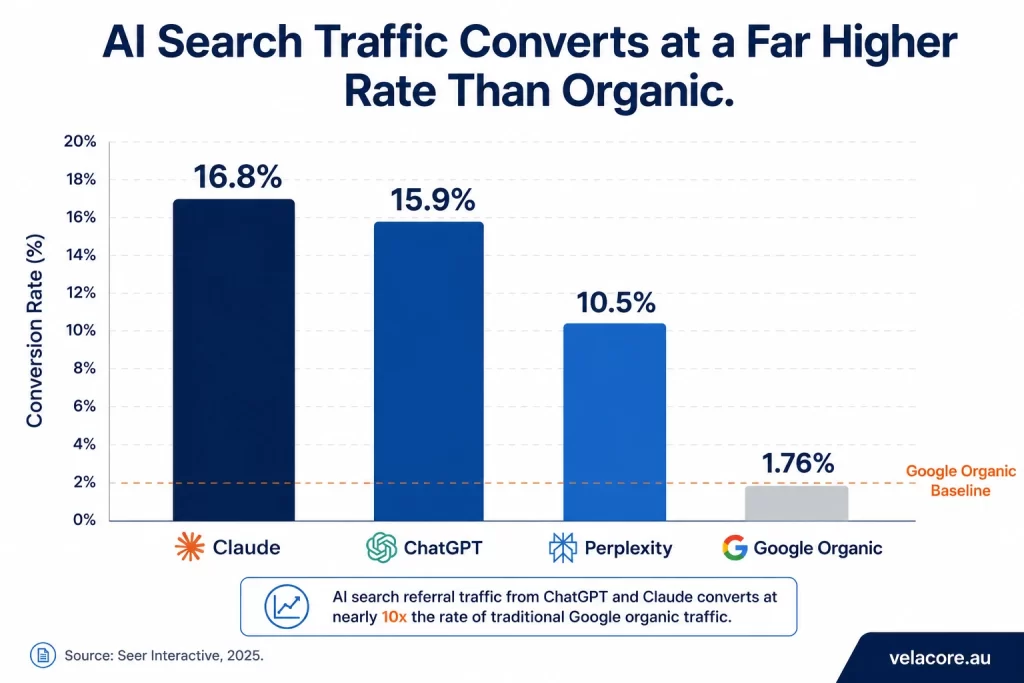
Understanding GEO vs SEO starts with a simple distinction: one gets you ranked, the other gets you cited. The two are not in competition. GEO traffic is currently about 1/34th the volume of traditional organic search traffic. The two channels serve different purposes and reward different behaviours, but the strongest strategy in 2026 combines both.
| Traditional SEO | GEO |
| Optimises for ranked positions in search results pages | Optimises for citations within AI-generated answers |
| Measured by rankings, impressions, and organic clicks | Measured by citation frequency across AI platforms |
| Prioritises keywords, backlinks, and domain authority | Prioritises content depth, structured data, and verifiability |
| Competes to be clicked in a list of 10 links | Competes to be one of 2 to 7 sources an AI cites per response |
| Traffic converts at roughly 1.76% (Seer Interactive, 2025) | Traffic converts at 4.4x to 23x higher rates than organic search |
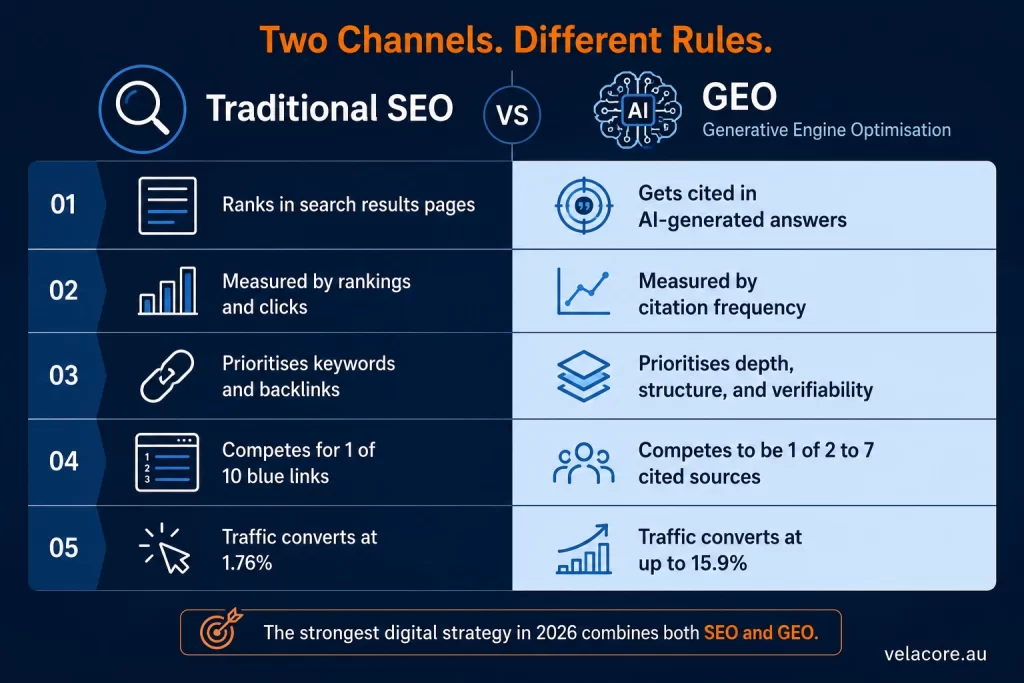
That conversion rate gap is where the business case for GEO becomes difficult to ignore. According to Seer Interactive data published in 2025, ChatGPT referral traffic converts at 15.9%, Perplexity at 10.5%, and Claude at up to 16.8%, compared to Google organic search at 1.76%. Ahrefs found that AI search visitors generated 12.1% of signups despite accounting for only 0.5% of total visitors, a 24:1 conversion ratio relative to organic traffic.
The mechanism behind this is intent. A user who reads an AI-generated answer and then clicks through to your site is not browsing. They have already been pre-qualified by the AI system and arrived at your page deep in the decision process.
What the research actually says about getting cited
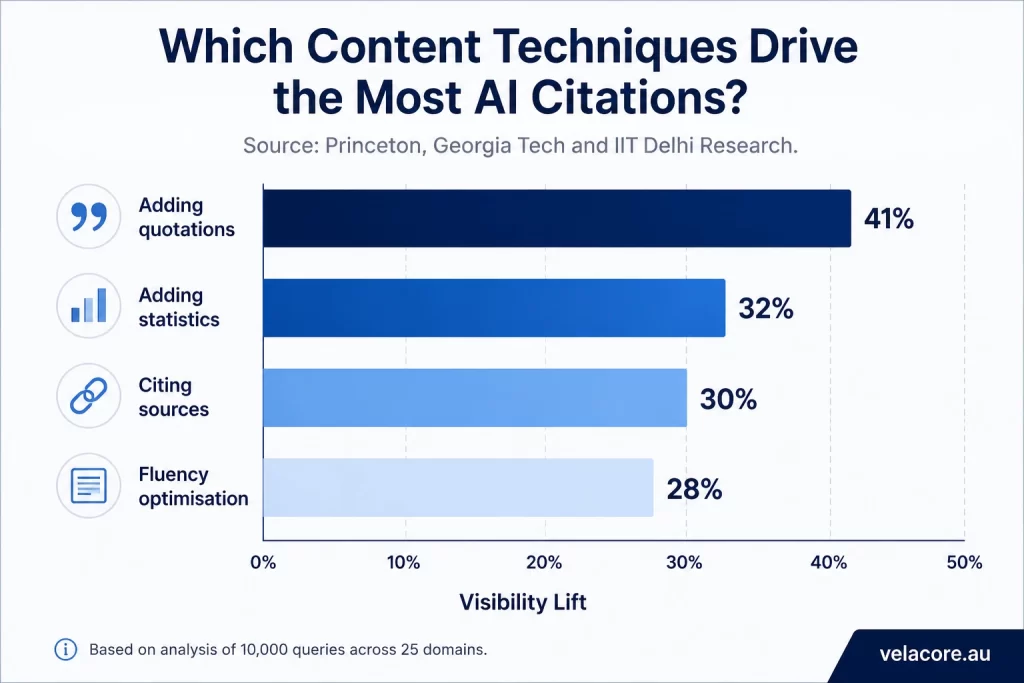
The Princeton, Georgia Tech, and IIT Delhi study tested GEO techniques across 10,000 queries in 25 domains and measured the impact on AI visibility using a metric called Position-Adjusted Word Count. The validated findings showed that specific content techniques produced measurable, repeatable lifts in AI citation rates.
Here is what actually moved the needle, ranked by impact:
- Adding quotations: +41% visibility lift
- Adding statistics: +32% visibility lift
- Citing sources: +30% visibility lift
- Fluency optimisation: +28% visibility lift (clear, direct, declarative sentences)
A 2026 benchmark study by ConvertMate added further data: pages above 20,000 characters receive 4.3x more AI citations than shorter pages, and articles covering 8 or more major subtopics receive 4.7x more citations than those covering only 3 to 4, even when the shorter content is objectively higher quality per section.
The takeaway is not that longer is always better. It is that comprehensive coverage of a topic, backed by data and sourced claims, is what AI systems are looking for when deciding what to cite.
The technical layer most businesses completely miss
Here is where most GEO guides stop being useful. You can write exceptional content, implement perfect schema markup, and cite every source correctly, and still be invisible to AI engines. Why? Because AI crawlers cannot access your site.
AI crawlers are not the same as Googlebot
Every major AI platform runs its own crawler to retrieve and index content for use in generated answers. These crawlers use different user-agent strings from Googlebot, and your existing robots.txt configuration may be blocking them without you realising it.
The key AI crawlers active in 2026, according to Mersel AI, are:
- OAI-SearchBot and ChatGPT-User (OpenAI’s real-time search and citation agents)
- Claude-SearchBot and Claude-User (Anthropic’s live retrieval agents for AI Overviews and citations)
- PerplexityBot (Perplexity’s search crawler)
- Google-Extended (Google’s AI training and Gemini retrieval crawler)
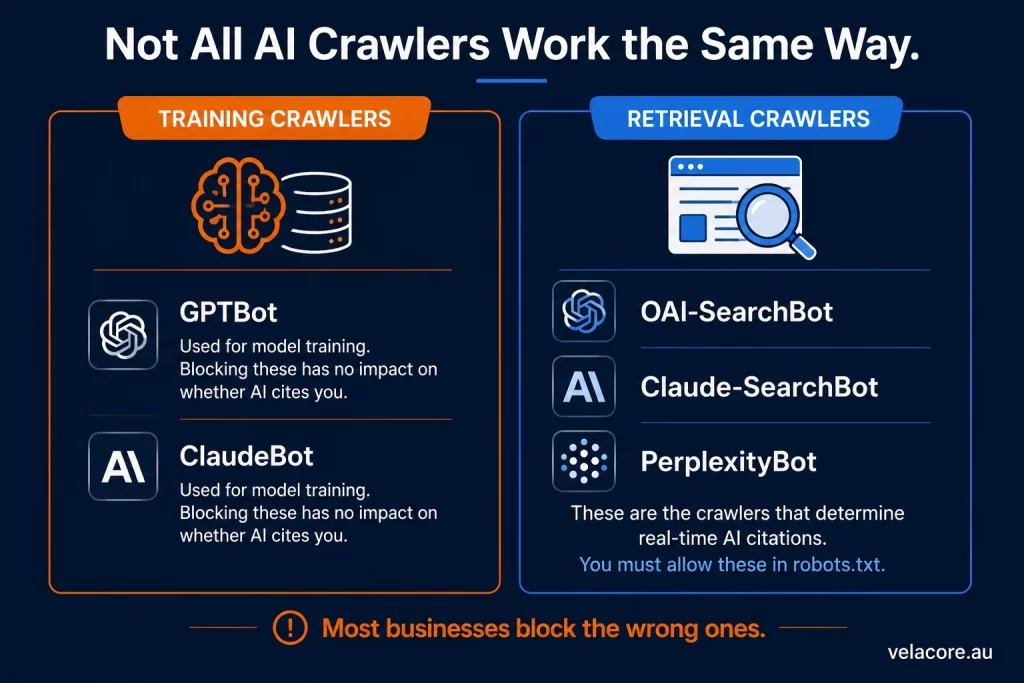
There is an important distinction here that almost every guide glosses over. GPTBot and ClaudeBot are training crawlers, used to scrape content for model training rather than live search. Blocking GPTBot has no measurable impact on whether ChatGPT cites you in answers. The crawler you need to allow for ChatGPT citations is OAI-SearchBot. The crawler you need for Claude citations is Claude-SearchBot, not ClaudeBot.
If your robots.txt file blocks all unrecognised user agents by default, you may be blocking every AI retrieval agent while still allowing GPTBot, which does nothing for your AI search visibility.
JavaScript rendering is a silent visibility killer
According to research by Vercel and MERJ, 69% of AI crawlers cannot execute JavaScript. If your website relies on client-side rendering, large parts of your content may simply not exist from an AI crawler’s perspective. The page loads visually for human users, but the crawler sees a blank page or partial content. Server-side rendering (SSR) or static HTML is significantly more AI-crawler-friendly.
The llms.txt reality check
You may have read that adding a llms.txt file to your website improves AI search visibility. The data does not support this, at least not yet. Google’s Gary Illyes confirmed in July 2025 that Google does not support llms.txt and has no plans to. An analysis of 515 million LLM bot traffic events found that the share of requests from citation-driving crawlers that actually visit llms.txt files is statistically negligible.
The robots.txt configuration matters significantly more than llms.txt for AI citation visibility right now.
The six principles of effective GEO: 2026 edition
With the foundational research and technical layer covered, here is how these principles translate into content and site decisions. Every GEO 2026 implementation worth its salt comes back to these six fundamentals.
1. Answer-first structure
AI systems do not read articles from start to finish. They extract. Every section of your content should open with a clear, direct 40 to 60-word answer to the question that section addresses. This is sometimes called the answer-first or inverted-pyramid structure, and it is the most reliable way to make your content extractable by AI retrieval systems.
2. Entity clarity over keyword density
AI systems think in entities: people, organisations, concepts, and the relationships between them. Your content needs to establish clear, unambiguous entity relationships. Structured data is what makes those relationships machine-readable. Schema markup is the technical layer that defines these relationships for AI systems, but the content itself also needs to name entities clearly and consistently rather than varying terminology to avoid repetition.
3. Verifiable claims with traceable sources
AI engines actively favour content where claims can be traced to primary sources. According to Seenos.ai analysis, 68% of failed GEO optimisations come from framework incompleteness, followed by poor heading hierarchy (14%) and insufficient external citations (11%). Vague claims such as “experts say” or “studies suggest” without attribution are treated as unverifiable and reduce citation confidence.
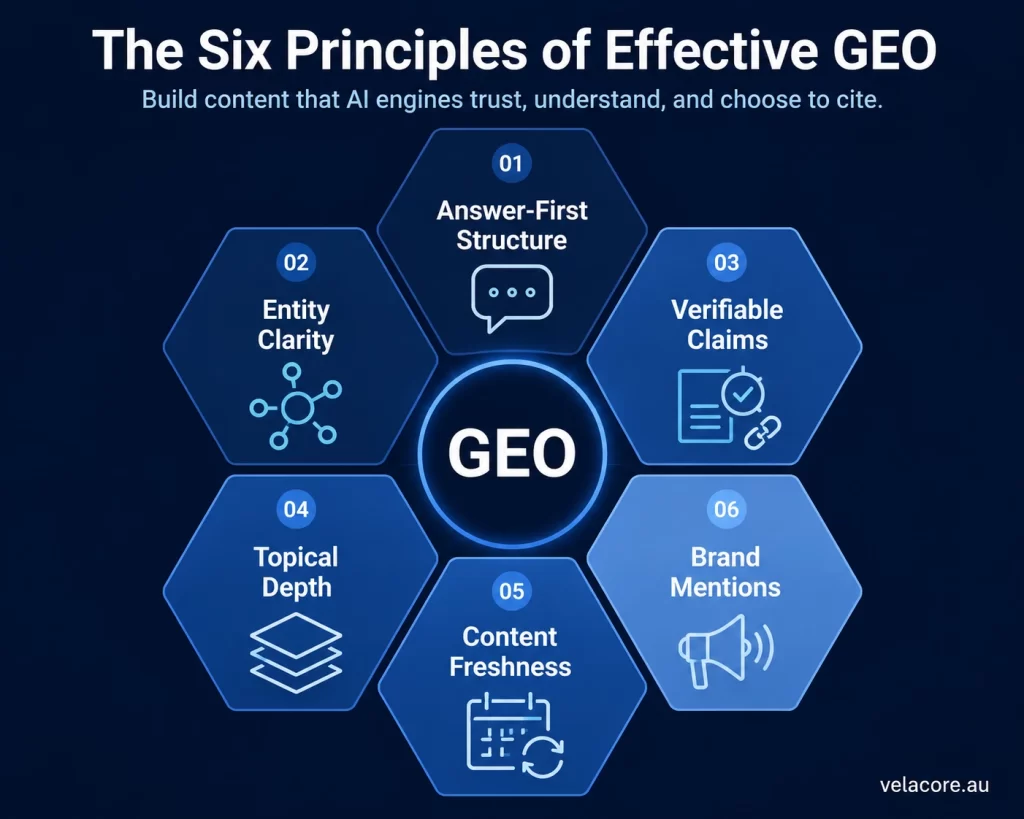
4. Topical depth, not surface coverage
A single well-optimised article covering a topic in depth will outperform a cluster of shallow articles on related topics. Topical authority, the signal that your site is the definitive resource on a subject, is built through comprehensive coverage, not scattered posts. The Content Marketing Institute found that articles covering 8 or more major subtopics received 4.7x more citations than those covering 3 to 4, even when the narrow-focus content was higher quality per section. Comprehensive coverage signals authority to AI systems in a way that fragmented content cannot.
5. Consistent publishing and content freshness
AI models are trained on data with cutoff dates, but live retrieval systems such as ChatGPT Search and Perplexity actively prefer recent, maintained content. ClayHog’s analysis found that publishing content once and never updating it causes citation rates to erode as competitors refresh theirs monthly. Outdated statistics, retired product names, and stale examples are all signals that reduce citation confidence.
6. Third-party brand mentions
AI systems infer trust partly from how other sources talk about you. Research findings show that YouTube mentions and branded web mentions carry strong correlation with AI citation rates. PR, editorial coverage, and community mentions in relevant forums all contribute to the entity authority signals that AI systems use to decide whether your brand is a credible source on a given topic.
Why most businesses are invisible to AI engines right now
The market context here is worth spelling out plainly. Incremys data from 2026 shows that only 34% of companies have trained their teams in GEO, despite 63% of marketers listing AI search visibility as a priority. GEO in 2026 is where social media marketing was in 2010: most businesses know they need it, very few have built a real capability around it. The gap between intention and execution is significant.
At the enterprise level, most teams have begun a GEO initiative. At the SMB level, Digital Agency Network research found that most have not started yet. For smaller businesses and agencies willing to move now, this represents a genuine first-mover advantage in a channel that is growing faster than traditional search.
The GEO market is projected to grow from $886 million in 2024 to $7.3 billion by 2031, a 34% compound annual growth rate. The businesses investing now are building citation authority that will compound over time, the same way domain authority compounded in traditional SEO.
How GEO and traditional SEO work together
The practical implication of the conversion data is not that you should abandon SEO for GEO. It is that the two channels reward different content behaviours and you need both. Jeremy Moser’s framework, cited widely in 2026 GEO literature, puts it simply: “80% of GEO is good, fundamental SEO.” Building an AI search strategy that covers both channels does not require starting from scratch if your SEO foundations are already solid.
The overlap is real. Well-structured content with clear headings, sourced claims, and topical authority performs well in both traditional search and AI citation. A joined-up AI search strategy that covers both channels is the strongest position a business can hold right now. Thinking about AI search optimisation as a layer on top of existing SEO, rather than a separate discipline, makes it far easier to implement. Where GEO requires additional work is in technical access (robots.txt configuration, JavaScript rendering), entity clarity (schema markup and consistent terminology), and answer-first structure (making content extractable, not just readable).
If your website already has a solid SEO foundation, adding GEO optimisation completes your AI search optimisation coverage with an incremental layer of work that has disproportionate impact on a high-converting traffic channel.
Frequently asked questions about generative engine optimisation
What is the difference between GEO and SEO?
SEO optimises content to rank in traditional search engine results pages so users click through to your site. GEO optimises content to be cited by AI answer engines like ChatGPT, Google AI Overviews, and Perplexity when they generate responses. Put simply, what is GEO in practice? It is the discipline of making your content extractable, verifiable, and authoritative enough for AI systems to choose it as a source. SEO measures rankings and clicks. GEO measures citation frequency. Both channels matter, and the strongest digital visibility strategy combines them.
Does GEO replace SEO?
No. GEO traffic currently represents a fraction of traditional organic search volume. The two channels complement each other, and strong SEO foundations support GEO performance. GEO adds specific requirements around content structure, technical access for AI crawlers, and entity clarity that SEO alone does not address.
How do I know if AI engines can access my site?
Check your robots.txt file for directives that might block AI retrieval crawlers including OAI-SearchBot, Claude-SearchBot, PerplexityBot, and Google-Extended. Also check whether your site uses client-side JavaScript rendering, since 69% of AI crawlers cannot execute JavaScript and may see a blank page instead of your content.
What content changes have the biggest impact on GEO?
Princeton research found that adding quotations (+41%), statistics (+32%), and source citations (+30%) produced the largest measurable lifts in AI citation rates. Structuring content with clear answer-first paragraphs, comprehensive subtopic coverage, and consistent entity terminology also significantly improves extractability for AI retrieval systems.
How is GEO performance measured?
GEO is measured by citation frequency, not ranking position. You track how often your content appears as a cited source when you manually prompt AI platforms with relevant queries, and you monitor AI-referred traffic in your analytics (OpenAI provides UTM referral tracking). Traditional ranking tools do not capture GEO performance, which is why most businesses currently have no visibility into whether their content is being cited.
Is GEO worth the investment for smaller businesses?
AI-referred traffic converts at 4.4x to 23x the rate of traditional organic traffic. For context on what is GEO delivering right now: ChatGPT visibility alone drives referral traffic that converts at 15.9%, and Perplexity citations convert at 10.5%, compared to Google organic at 1.76%. Even modest citation visibility in AI search generates disproportionate business value because the users who click through from AI answers are already deep in the decision process. For smaller businesses building their GEO 2026 strategy, the current low adoption among SMBs represents a genuine first-mover opportunity in a high-converting channel.
Generative Engine Optimisation is no longer a future consideration. The businesses earning AI citations right now are building visibility advantages that compound over time, in a channel that converts at 4.4x to 23x the rate of traditional organic traffic. If you want to know what it would take to start earning AI cittions, we can help. Talk to us and we’ll take a look.