Your website might rank on Google’s first page and still be completely invisible to the tools millions of people are using to make buying decisions right now. That is not a hypothetical. It is happening to thousands of businesses every single day, and most of them have no idea.
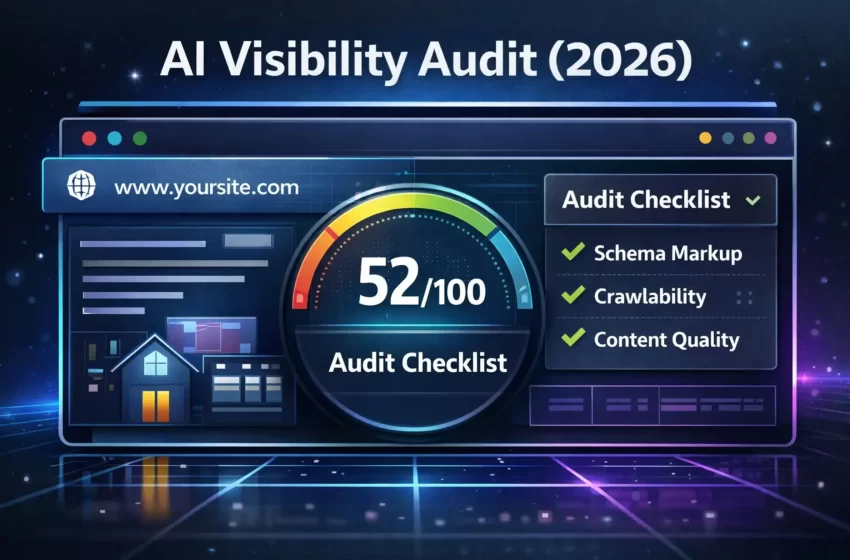
An AI visibility audit tells you exactly where you stand in AI-generated search results, what is holding you back from being cited, and what to fix first. This guide walks you through every step, in plain language, so you can run the audit yourself or know exactly what to ask for when working with an agency.
By the end, you will have a clear picture of how your site shows up across ChatGPT, Google AI Overviews, Perplexity, and other AI search tools, and a practical list of fixes ranked by impact.
Why AI Visibility Is Now a Business Priority, Not a Nice-to-Have
Before we get into the audit steps, it helps to understand what is actually happening in search right now, because the numbers are striking.
Google AI Overviews now appear in over 25% of all Google searches, more than doubling from 13% in early 2025. ChatGPT processes roughly 12% of Google’s daily search volume with over 900 million weekly active users. And here is the part most businesses miss:
AI search traffic converts at 14.2% vs Google’s 2.8%.
The people coming from AI answers are serious buyers. They are ready to act. But there is a flip side. Around 93% of AI search sessions end without a website visit. If your brand is not being cited in those answers, you are invisible to one of the highest-converting channels online.
Only 12% of businesses have completed a formal GEO audit.
Running a proper AI visibility audit now puts you ahead of the vast majority of your competitors. Let’s get into it.
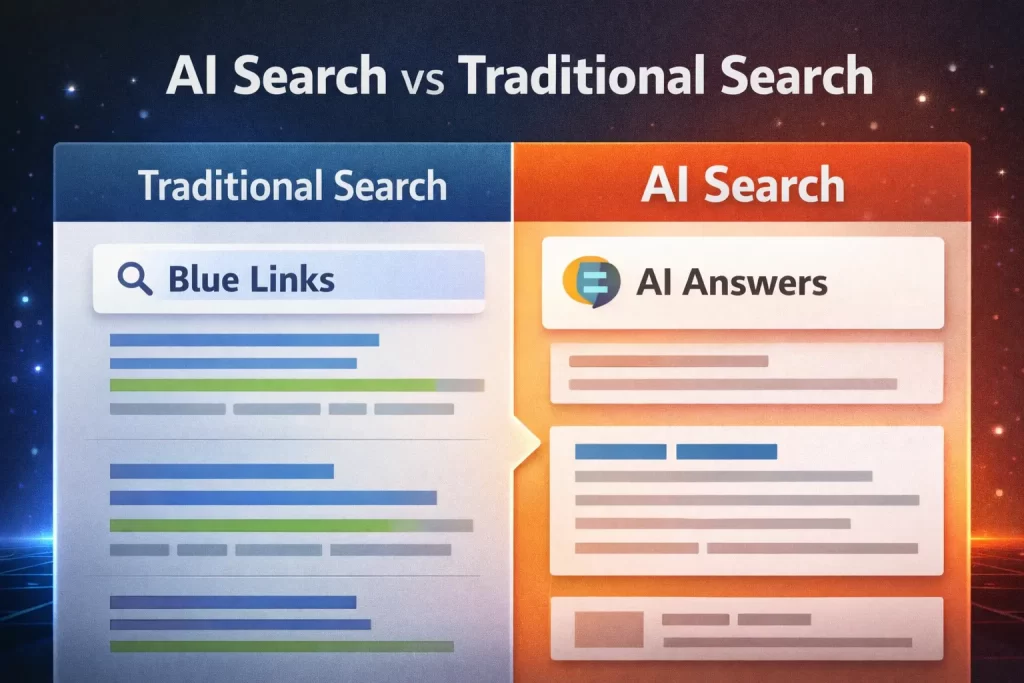
Step 1: Run a Manual AI Presence Check Before You Touch Any Tool
Most guides jump straight to paid tools. But the smartest place to start your AI visibility audit is completely free, and it gives you context no tool can replicate. You are going to test AI platforms manually.
Open ChatGPT, Google Search (for AI Overviews), and Perplexity in three separate browser tabs. Then run a series of searches your ideal customers would realistically ask.
Do not just search your brand name. Search the problems you solve. “Best web design agency in Sydney.” “Who should I hire for ERP implementation in Australia.” “What does a website redesign cost in 2026.” “How do I get more leads from my website.” These are the queries where your business should be appearing in AI-generated answers.
Note three things for each query. First, does your brand appear at all? Second, if it does, is it mentioned positively, neutrally, or not recommended? Third, which competitors are being cited and why? That third question is gold. AI systems do not pick sources randomly. They pick sources that are structured, authoritative, and easy to extract information from.
Run at least 20 queries before moving to the technical steps. Document every result. This baseline is your before picture, and you will want it when you compare results after your fixes.
Step 2: Check Whether AI Crawlers Can Actually Access Your Site
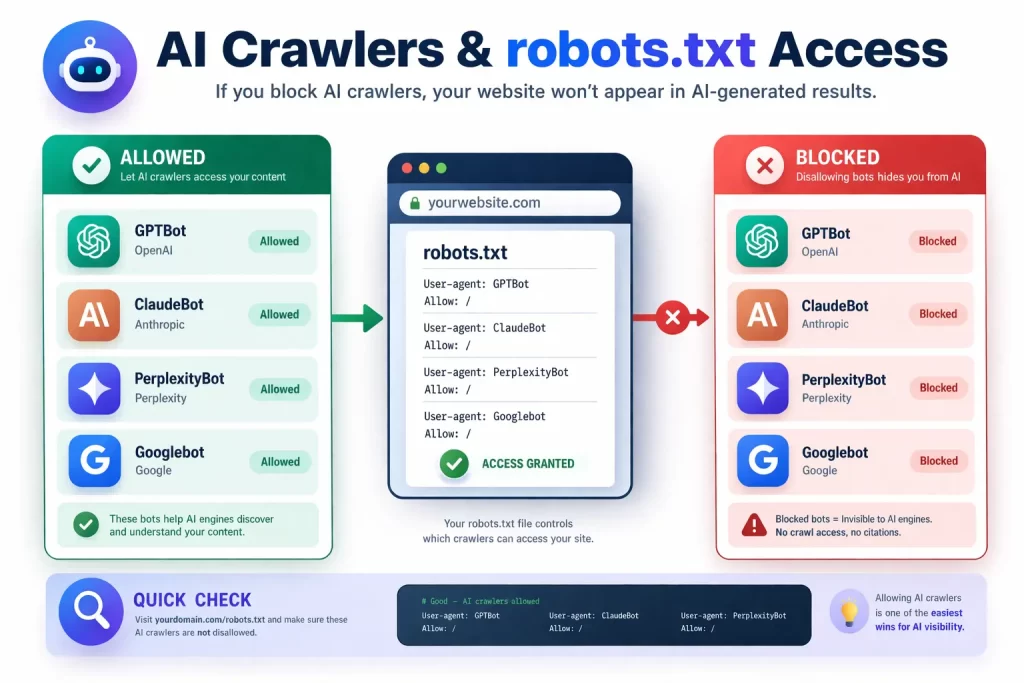
Here is a step almost nobody talks about, and it is one of the biggest reasons websites that look fine technically are still invisible to AI systems.
AI engines use their own crawlers to index the web. GPTBot (OpenAI), ClaudeBot (Anthropic), PerplexityBot, and Google’s own crawlers all need permission to access and read your pages. If your robots.txt file is blocking them, none of your other optimisation efforts matter. The AI engines literally cannot see your content.
Go to yourdomain.com/robots.txt and look at what is listed under Disallow. If you see GPTBot, ClaudeBot, or PerplexityBot blocked, that is your most urgent fix. Update your robots.txt to allow these crawlers explicitly.
The llms.txt File: An Early-Mover Advantage
There is a newer signal worth knowing about called llms.txt. A growing number of websites are publishing a file at yourdomain.com/llms.txt that provides a clean, structured summary of who they are, what they do, and what content is most important. It is the AI equivalent of giving a journalist a one-page brief before an interview.
Adoption is still extremely low across the web, which means adding one now is a practical early-mover advantage for businesses serious about AI visibility.
While you are checking access, also verify that your key pages are not hidden behind login walls, JavaScript rendering that bots cannot process, or excessive redirects. AI crawlers are effective but they are not patient.
Step 3: Audit Your Schema Markup for AI Readability
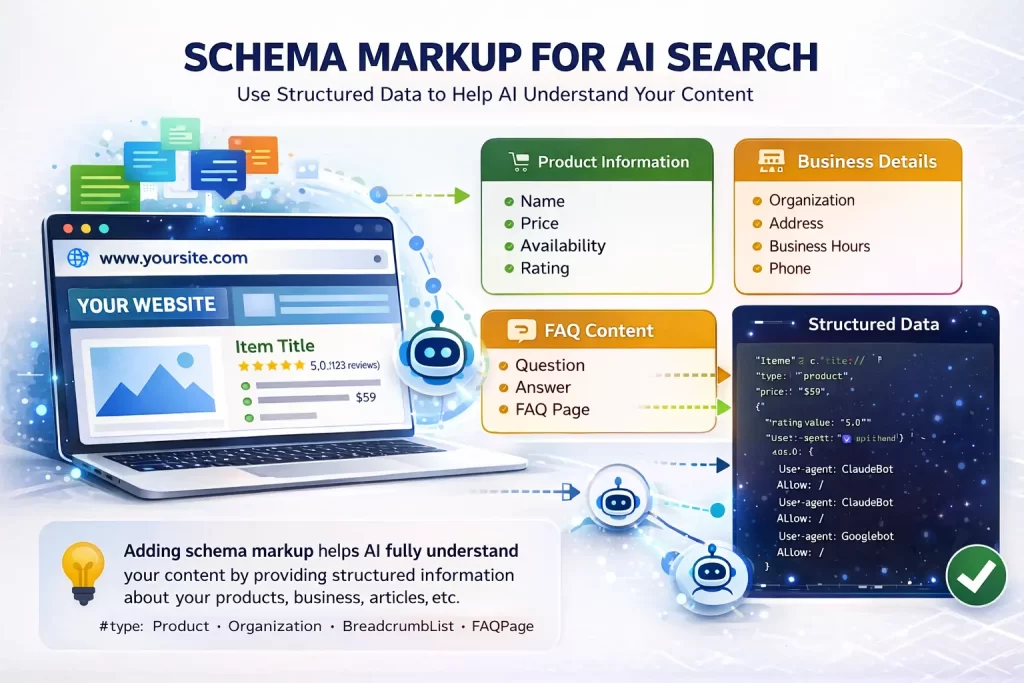
Schema markup is the translation layer between your website content and AI systems. Without it, AI engines have to guess what your pages are about. With it, you are telling them directly.
Pages with structured schema markup earn 44% more AI citations.
And fewer than 33% of websites implement schema markup beyond the very basics. That gap is your opportunity.
The Schema Types That Matter Most for AI Citations
Organization schema on your homepage establishes your business as a recognised entity. It needs your official name, logo, website URL, contact details, and sameAs links pointing to your Google Business Profile, LinkedIn page, and authoritative directory listings. This is how AI systems verify that all references to your business across the web are actually you.
Article or BlogPosting schema on every piece of content. This tells AI systems who wrote the content, when it was published, and what organisation is responsible for it. Content updated within two months earns 28% more citations than older content, so keeping the dateModified field current matters more than most people realise.
FAQPage schema is the highest-impact type for earning AI citations. It maps your content directly to the question-and-answer format AI engines use to generate responses.
Service or Product schema on your key service pages gives AI systems the specific signals they need to recommend your business when someone asks for a service in a specific location.
To check what schema you currently have, paste your URL into Google’s Rich Results Test. Run this on your homepage, your top three service pages, and your five most visited blog posts.
A Critical Shift from Google’s March 2026 Update
Google’s March 2026 core update changed what schema markup is fundamentally for. AI Mode now uses schema as a trust and entity verification signal during answer synthesis, not just as a display trigger for rich results. Schema that accurately describes your content increases citation probability even when no rich result appears. It used to be about getting star ratings in search results. Now it is about proving to AI systems that your content is trustworthy.
Step 4: Evaluate Your Content for AI Extractability
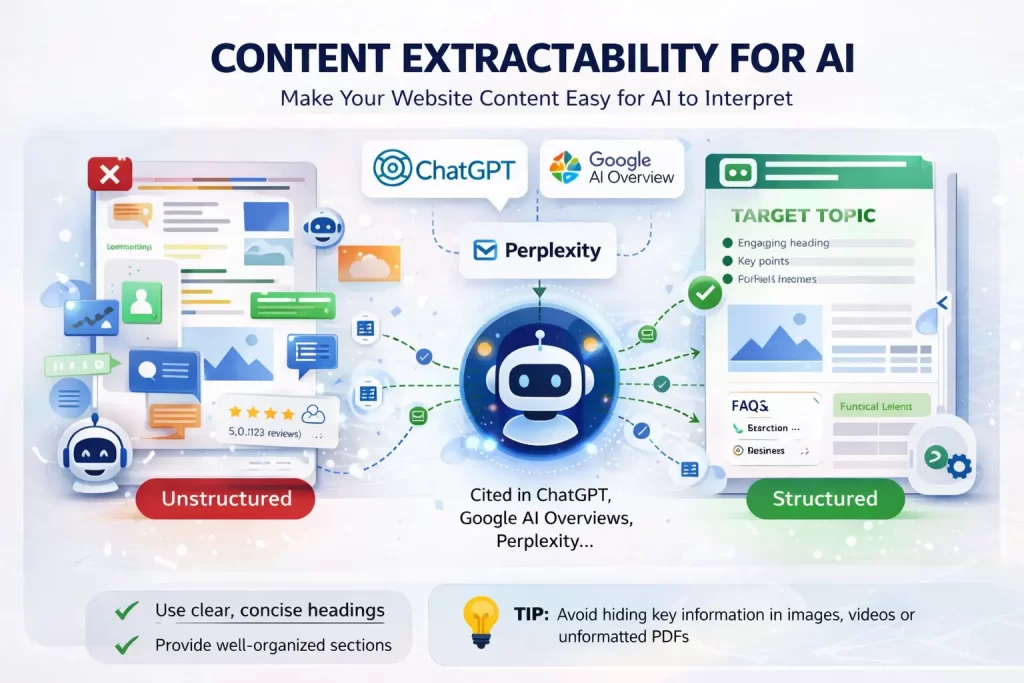
Being indexed by AI crawlers is not the same as being cited by AI systems. The next layer of your AI visibility audit is looking at whether your content is written in a way that AI systems can confidently extract, summarise, and attribute.
AI engines prioritise what researchers call semantic completeness. Each section of your content should be able to stand alone as a clear answer to a specific question. If your content is structured like a traditional essay where ideas build on earlier paragraphs, AI systems will struggle to extract individual passages without losing context.
Ask yourself: if someone read only this paragraph, would they understand the point completely without needing the rest of the article? That is the extractability test.
Content Signals That Increase AI Citation Rates
Verified statistics with source links. Content with statistics, citations, and quotations achieves 30-40% higher visibility in AI responses. Not because AI engines like numbers, but because verifiable claims are more trustworthy claims.
Direct answers at the start of sections. AI systems are trained on the question-and-answer format. Content that leads with the answer before the explanation performs better than content that builds to a conclusion.
Consistent use of your core entities. If you want to be cited for “web design in Australia,” your content needs to use that phrase and connected concepts consistently across multiple pages.
Freshness. Pages updated within two months earn significantly more AI citations than older content. Review your highest-value pages quarterly and update statistics, examples, and internal links.
Our content marketing services at Velacore include a content extractability review designed to identify where existing content is underperforming in AI search. Learn about content marketing.
Step 5: Assess Your Brand Entity Signals
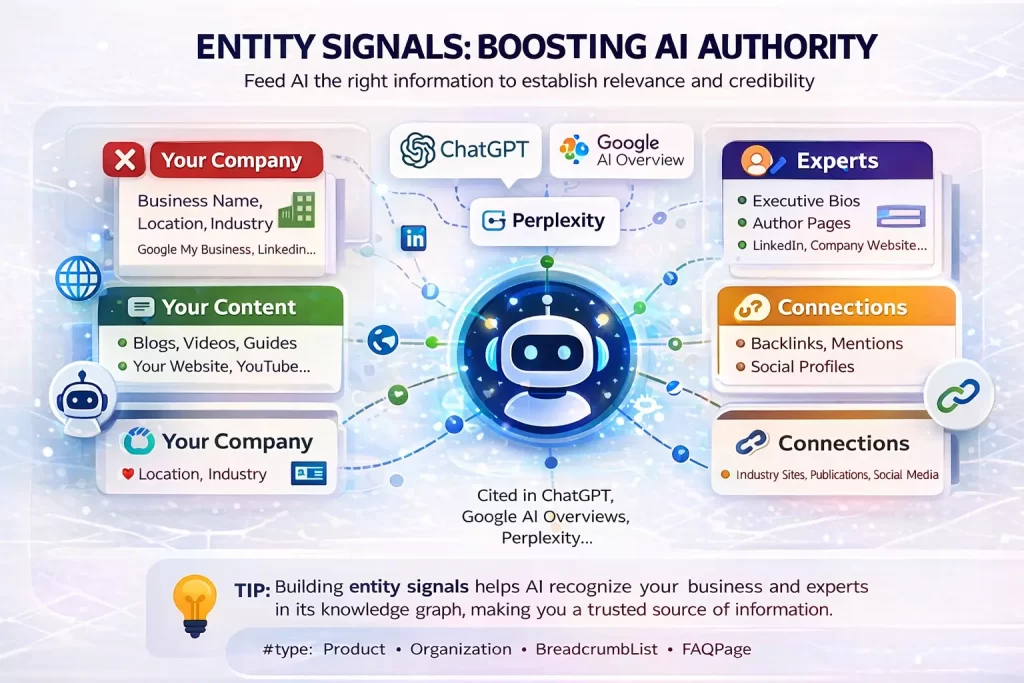
AI systems do not just read your website. They synthesise information about your brand from dozens of sources across the web. Reviews, mentions, directory listings, social profiles, and news coverage all feed into how AI engines understand and represent your business.
Start with NAP Consistency
Your business name, address, and phone number (NAP) must be absolutely consistent across your Google Business Profile, your website, all directory listings, and social profiles. AI systems use these signals to confirm that references to your business in different places are all referring to the same entity. Inconsistencies create ambiguity, and AI systems do not recommend brands they cannot clearly identify.
Reviews and Third-Party Mentions
Reviews on Google and industry platforms contribute directly to AI citation decisions. E-E-A-T signals including reviews appear in 96% of AI Overview citations. You do not need hundreds of five-star reviews. You need consistent, genuine reviews that establish a clear pattern of credibility.
Check also whether your brand is mentioned in any publications, industry blogs, or news sites. AI systems weight external citations heavily. A single mention in a reputable Australian business publication can do more for your AI visibility than a dozen new blog posts on your own site.
Step 6: Test Your E-E-A-T Signals
Google’s E-E-A-T framework (Experience, Expertise, Authoritativeness, and Trustworthiness) is not just a traditional SEO consideration anymore. It is now a core input in how AI systems evaluate whether a source is worth citing.
E-E-A-T signals appear in 96% of AI Overview citations.
Experience and expertise are demonstrated through author credentials. Every article on your website should have a named author with a bio that clearly states their professional background. If your content is published without author attribution, AI systems cannot verify the information comes from someone qualified to give it.
Authoritativeness comes from third-party signals. Who links to you? Who mentions you? Are those sources reputable in your industry?
Trustworthiness is demonstrated through transparency. Does your website have a clear About page? Are your contact details easy to find? Do you have a privacy policy and terms of service? AI systems use these signals to assess whether a website is a legitimate, accountable business.
Step 7: Review Your Technical AI Health
There are a handful of technical factors that specifically affect AI indexing performance, separate from traditional SEO technical audits.
Page speed. Core Web Vitals remain a factor in how Google’s AI systems evaluate page quality. A site that loads in under 2 seconds is simply more likely to be crawled, indexed, and cited.
Mobile optimisation. Over 75% of zero-click searches happen on mobile, and AI Overviews are served to mobile users constantly. A poor mobile experience is a signal working against you.
Internal linking. AI systems use internal link structure to understand your site’s topical architecture. Your key service pages should be supported by links from your blog content and homepage.
HTTPS. Unsecured sites are immediately deprioritised by AI systems as untrustworthy sources. Every page should serve over HTTPS with no mixed content warnings.
Our web design team at Velacore can run a full technical audit and implement fixes that improve both traditional SEO and AI visibility. Talk to the web design team.
Step 8: Set Up Your AI Visibility Tracking Baseline
The last step in your AI visibility audit is setting up measurement so you can track progress. Running the audit without a tracking system means you have no way of knowing whether your fixes are working.
Create a spreadsheet listing 20-30 queries your target customers are likely to ask AI tools. Check those queries in ChatGPT, Perplexity, and Google’s AI search once a week. Note whether your brand appears, whether it is cited as a source, and how it compares to competitors.
Only 22% of marketers are currently tracking AI visibility. Exposure Ninja, 2026
Within Google Search Console, monitor branded search volume over time. AI citations frequently drive people to search your brand name directly even if they do not click the cited link. Growing branded search volume is one of the clearest indirect signals that your AI visibility is improving.
Aim to rerun your full AI visibility audit every quarter. AI search is evolving fast enough that a quarterly review is the minimum cadence for staying competitive.
What to Do After Your Audit: Fix Priority Order
Running the audit gives you a prioritised list of issues. The fix order that will give you the fastest improvement in AI visibility generally looks like this:
- Fix crawlability first. If AI bots cannot access your site, nothing else matters. Update robots.txt, check page speed, and verify HTTPS.
- Address schema markup. Organisation schema on your homepage and FAQPage schema on your content-heavy pages are the highest-leverage implementations. These can be done in a few hours.
- Work on content extractability and E-E-A-T. Add author attribution, update statistics in existing content, and restructure sections to lead with direct answers.
- Build entity signals over time. Review generation, directory consistency, and earned media are longer-term plays, but they compound. Start now.
Ready to find out where your website stands in AI search? Get a free AI visibility assessment from the Velacore team. Contact Velacore.
Frequently Asked Questions
What is an AI visibility audit?
An AI visibility audit is a structured review of how your website performs in AI-generated search results, including Google AI Overviews, ChatGPT, and Perplexity. It checks whether AI crawlers can access your site, how well your content is structured for AI extraction, what schema markup you have in place, and how your brand entity signals read to AI systems.
How is an AI visibility audit different from a traditional SEO audit?
A traditional SEO audit focuses on keyword rankings, backlink profiles, and on-page optimisation for Google’s blue-link results. An AI visibility audit focuses specifically on how AI systems crawl, understand, and cite your content. Some factors overlap, particularly E-E-A-T and page speed, but AI visibility requires specific checks around schema markup, content extractability, entity signals, and crawler access that a standard SEO audit does not typically cover.
How long does an AI visibility audit take?
A manual AI visibility audit covering the steps in this guide takes between 4 and 8 hours for a typical business website. Working with an agency that has structured tools and processes can compress this significantly, with a prioritised fix list ready to implement.
How quickly will fixes improve my AI visibility?
Technical fixes like robots.txt updates and schema markup can be picked up by AI crawlers within days. Content improvements typically take 4 to 8 weeks to show measurable improvement in AI citation rates. Entity signal building through reviews and third-party mentions is a longer play, usually 3 to 6 months before it meaningfully moves your AI visibility score.
Does AI visibility help with traditional Google rankings too?
Yes. Most of the factors that improve AI visibility, including schema markup, E-E-A-T signals, content quality, and page speed, also improve traditional Google rankings. The strategies overlap significantly, which is why investing in AI visibility optimisation has a compounding effect on your overall search performance.
Is Your Website Working for You?
Most websites don't generate leads. We fix that with custom designs that look great and deliver measurable results for your business.
Get Started With Velacore