
ERP implementation cost in Australia is one of those questions that gets a very different answer depending on who you ask. Ask a vendor and the number sounds manageable. Ask a business that has been through a poorly managed implementation and you will hear something quite different. The honest answer is that ERP costs vary enormously depending on your business size, the platform you choose, how much customisation you need, and critically, a set of hidden costs that most businesses do not budget for until they are already mid-project.
This guide gives you a clear, practical breakdown of ERP implementation cost in Australia for 2026, from small businesses with under 50 staff to mid-market companies with hundreds of employees. We cover software licensing, implementation services, ongoing support, the hidden costs that blow budgets, and what the data says about return on investment.
What Is ERP and Why Does It Matter for Australian Businesses?
Enterprise Resource Planning (ERP) is software that integrates your core business functions, including finance, inventory, HR, sales, purchasing, and operations, into a single connected system. Instead of managing spreadsheets, disconnected tools, and manual processes across departments, an ERP gives everyone in the business access to the same real-time data.
For Australian businesses specifically, ERP handles compliance obligations that are genuinely time-consuming to manage manually. These include GST calculations and BAS generation, Single Touch Payroll (STP) reporting to the ATO, superannuation management, and payroll compliance under Australian employment law.
ERP is no longer reserved for large corporations. ERP adoption data. What once required massive upfront investments and months of complex setup can now be deployed in weeks through modern cloud platforms. ERP systems have moved from being luxury items for large companies to practical tools for businesses with as few as 10 to 20 employees.
ERP Implementation Cost in Australia: The Breakdown by Business Size
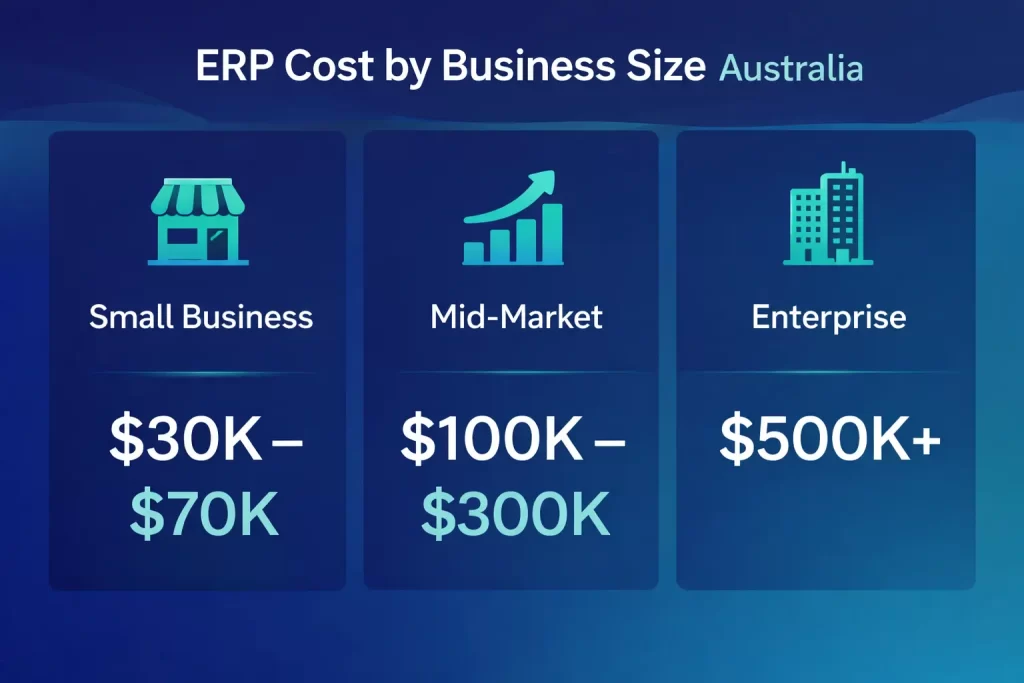
So how much does ERP cost in Australia, really? There is no single price. The most useful way to think about costs is by the size and complexity of your business.
| Business Size | Turnover | Implementation Cost | First-Year Total |
| Small (under 50 staff) | Up to AU $30M | AU $30,000 to $70,000 | AU $50,000 to $120,000 |
| Mid-Market (50 to 200 staff) | AU $30M to $100M | AU $100,000 to $300,000 | AU $150,000 to $500,000 |
| Enterprise (200+ staff) | AU $100M+ | AU $500,000+ | AU $1M+ |
Small Businesses (Under 50 Employees, Turnover Up to AU $30 Million)
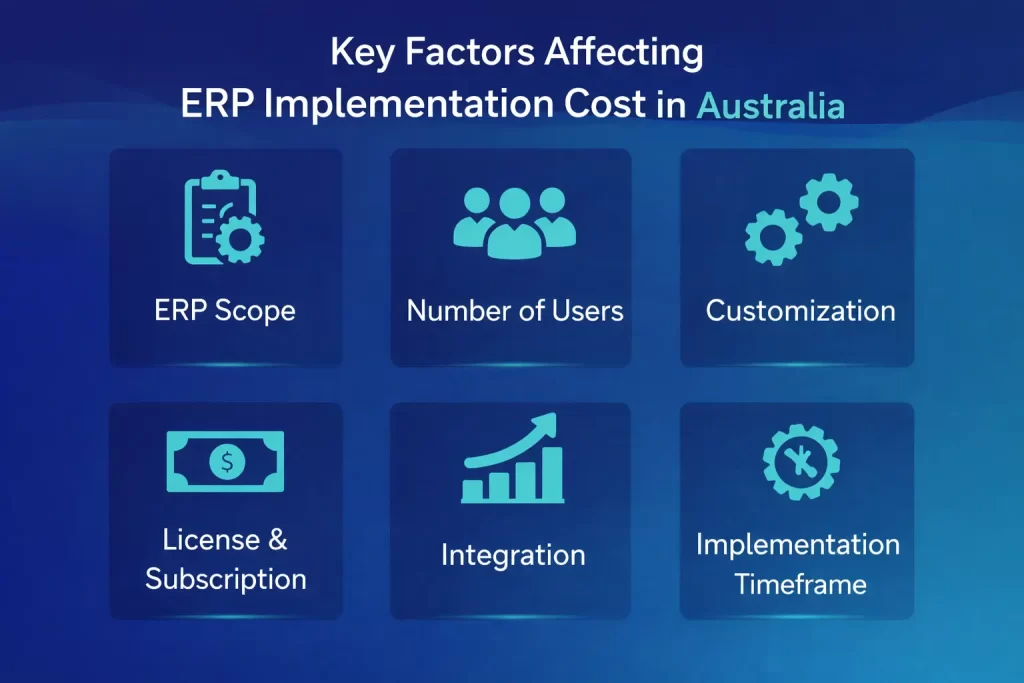
SMB cost range. That covers implementation services. On top of that, you will have ongoing software licensing costs.
For cloud-based platforms, subscription pricing. For off-the-shelf ERP solutions, licensing costs.
Total first-year investment for a small Australian business: AU $50,000 to $120,000
Mid-Market Businesses (50 to 200 Employees, Turnover AU $30 Million to $100 Million)
mid-market costs. That reflects more complex requirements, more users, more integrations with existing systems, and a longer implementation timeline. Implementation at this level typically takes between 6 and 12 months from kickoff to go-live.
Total first-year investment for a mid-market Australian business: AU $150,000 to $500,000
Large Enterprises (200-Plus Employees)
enterprise pricing for a full ERP deployment. Implementation timelines at this level can run from 12 to 18 months or longer. This guide focuses primarily on the SMB range, which is where the majority of Australian businesses sit.
The Main Cost Components: What You Are Actually Paying For
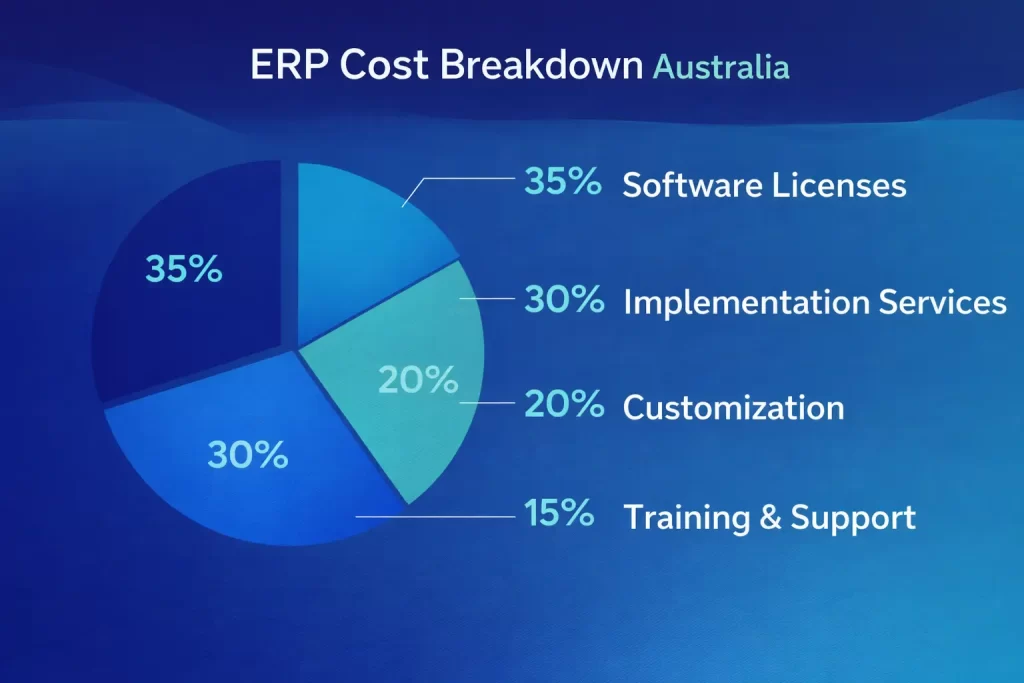
Understanding ERP software pricing in Australia is just as important as knowing the headline number. Most businesses that experience budget overruns do so because they budgeted for the software and forgot about everything else.
Software Licensing
cost rule. So if your annual software cost is AU $36,000, budget AU $36,000 to $72,000 on top of that for implementation services.
Implementation and Consulting Services
This is usually the largest single cost component, covering system configuration, data migration, integrations, testing, and go-live support. consulting fees. consultant success rate, compared to significantly lower success rates for businesses that manage the process without specialist support.
Data Migration
migration costs, but can increase significantly if your existing data is messy, spread across multiple systems, or requires significant cleansing before import. This is almost always more complex and time-consuming than businesses expect.
Customisation and Development
customisation costs. A practical caution: customisation data. The more you can align your processes to the platform, the lower your cost.
Integrations
integration costs. Budget AU $10,000 to $30,000 for a small number of standard integrations and more if you have complex or bespoke systems.
Training
training costs. For a business of 20 to 50 users, budget AU $5,000 to $20,000 for formal training. This is one of the most consistently underestimated costs in ERP budgets.
Ongoing Support and Maintenance
maintenance costs. For cloud systems, additional managed support from your implementation partner is worth budgeting for, particularly in the first 12 months after go-live.
The Hidden Costs Nobody Warns You About
| Watch for these costs that rarely appear in vendor quotes:Internal staff time. Key staff commonly spend 20 to 30% of their working time on ERP activities during a 6-month implementation.Temporary or backfill staff for data migration and user acceptance testing peaks.Hardware and devices for warehouse or field staff needing mobile access.Post-go-live fixes. Budget a 20 to 25% contingency for adjustments after the system goes live.Productivity dip. Expect your team to operate at reduced capacity during the transition period. |
budget overruns. Building a realistic contingency into your budget before the project starts is not pessimism. It is good planning.
productivity impact. Factor this into your revenue and operational planning for the implementation period.
What Does ERP Actually Cost Over 5 Years?
five-year costs. For a business with 30 users, that translates to roughly AU $216,000 over five years, or around AU $43,000 per year including all costs.
A practical rule of thumb: revenue benchmark. A business turning over AU $5 million should budget AU $50,000 to $100,000. A business at AU $20 million should expect AU $200,000 to $400,000.
| The average ROI for ERP projects is 52%. Most businesses recover their investment within 16 months. |
ERP Pricing by Platform: What Australian Businesses Are Using
| Platform | Best For | Pricing (approx) | Key Strength |
| MYOB Advanced | AU $5M to $50M turnover | Custom quote | Local compliance (GST, STP, Super) |
| Microsoft Dynamics 365 | Microsoft ecosystem users | From ~AU $100/user/month | Office 365 and Teams integration |
| Odoo | Budget-conscious SMBs | From AU $25/user/month | Modular, cost-effective, flexible |
| NetSuite | Fast-growing mid-market | Custom quote | Complex financials, multi-entity |
| SAP Business One | Manufacturers and distributors | Higher SMB range | Operational control and compliance |
Odoo growth. For NetSuite, implementation timeline, making it better suited to businesses that can invest in proper change management.
The right platform depends on your industry, your current tech stack, your compliance requirements, and your growth plans. Choosing the wrong one is one of the most costly mistakes a business can make.
The ERP Failure Rate: Why the Right Partner Matters So Much
| 55% to 75% of ERP projects fail to meet their objectives, according to Gartner |
Gartner research. budget overruns. timeline delays.
The most common causes of ERP failure are choosing the wrong platform for the business’s actual needs, underestimating the complexity of data migration, insufficient internal project leadership, poor change management and user adoption, and selecting an implementation partner without relevant industry experience.
The failure rate drops dramatically with the right support. consultant success rate. And ROI analysis data. The lesson: do not rush the partner selection, do not skip planning, and do not treat ERP as a software purchase. It is a business transformation project.
What Return on Investment Can Australian Businesses Expect?
The reason businesses invest in ERP despite the costs and complexity is that a well-implemented system delivers measurable financial returns.
Most commonly reported post-implementation benefits:
For Australian businesses, the compliance automation benefits add a further layer of value. Automating GST, BAS, STP, and superannuation removes enormous manual workload and reduces the risk of ATO penalties, which ATO penalties.
Is Your Business Ready for ERP?
ERP is not the right investment for every business at every stage. Here are the signals that suggest your business is genuinely ready.
You are likely ready for ERP if you are:
- Spending hours every week manually reconciling data between disconnected systems
- Unable to get a real-time view of your inventory, cash position, or profitability without building complex spreadsheets
- Struggling to generate accurate financial reports or BAS returns without significant manual effort
- Growing fast enough that your current systems are becoming a bottleneck to taking on new work or customers
- Managing more than 20 to 30 staff and finding that information is not flowing efficiently between teams
How to Budget for ERP Without Getting Burned
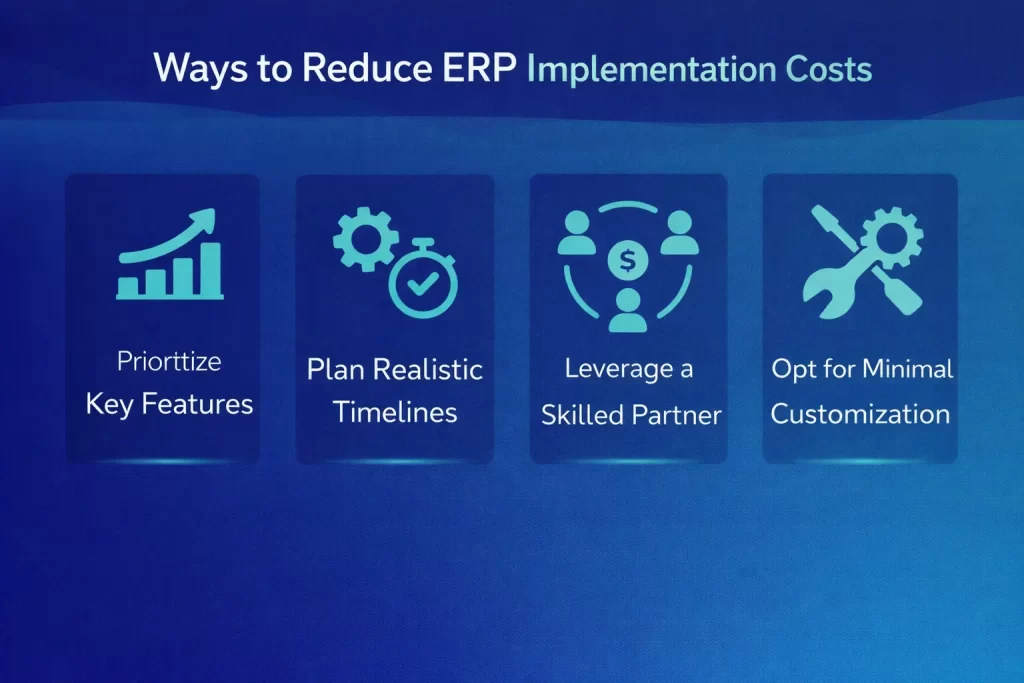
- Start with your business requirements, not a vendor shortlist. Document what your business actually needs the ERP to do before you speak to a single vendor.
- Always budget for TCO, not just the software fee. Use the full five-year cost of ownership as your comparison basis.
- Add a 20 to 25% contingency. Every ERP project encounters unexpected requirements. Build this in before the project starts.
- Demand a detailed scope document before signing. Any reputable implementation partner should provide defined deliverables, a timeline, and a price before you commit.
- Check the partner’s track record. Ask specifically for references from Australian businesses of similar size and in similar industries.
Frequently Asked Questions
How long does ERP implementation take for an Australian small business?
implementation timelines. Simpler cloud-based implementations can be completed in 6 to 8 weeks for businesses with straightforward requirements, while more complex projects can take 12 months or more.
Is cloud ERP or on-premise ERP better for Australian SMBs?
When weighing up cloud ERP cost in Australia, most small and medium businesses will find cloud the better choice in 2026. cloud adoption rate. Cloud systems offer lower upfront cost, built-in updates, better security management, and remote access.
What is the cheapest ERP option for a small Australian business?
For ERP implementation, Australian SMBs will find Odoo consistently the most cost-effective entry point, with subscriptions starting from AU $25 per user per month. MYOB Advanced is another strong option with strong local compliance support. The software cost is only part of the picture though. A cheap platform with a poor implementation is more expensive than a mid-tier platform implemented well.
Do I need a consultant to implement ERP?
You do not have to use a consultant, but the data strongly suggests you should. consultant data. For most Australian SMBs, the cost of a consultant is well justified by the reduction in risk and quality of outcome.
How do I know if ERP will actually pay off for my business?
ROI research. Map your current manual processes, estimate the hours saved by automation, and calculate what that is worth at your average labour cost. That exercise usually makes the business case very clear.
Ready to Explore ERP for Your Australian Business?
ERP implementation is a significant investment, but for businesses that are ready for it and approach it properly, it delivers real and measurable returns. The key is going in with accurate cost expectations, the right platform for your specific needs, and an experienced partner who understands the Australian market.
At Velacore, we provide ERP consulting services for Australian businesses, helping you identify the right platform, scope the project accurately, and manage the implementation to a successful outcome.
contact us to discuss your ERP requirements and get a realistic picture of what implementation would involve for your business