
Content marketing in 2026 is no longer a side activity. It has become one of the strongest revenue drivers for Australian businesses. Not because brands are publishing more content, but because search behaviour, AI systems and buyer expectations have changed at the same time.
AI Overviews now influence a growing share of Australian search journeys. Buyers consume more information before making decisions. And Google’s quality filters are stricter than ever. These shifts have pushed businesses to adopt a GEO-optimised, writing-led approach built on strategy, clarity and measurable performance.
The data is clear.
86% of Australian marketers say content demand has risen sharply over the last two years, according to Adobe’s 2025 Content Demand Survey. 63% expect their organisation’s content needs to increase fivefold by 2027.
This rise isn’t driven by algorithms. It is driven by buyer behaviour. A SalesFocus survey revealed that B2B buyers now consume an average of 13 pieces of content before speaking to sales.
60% say vendor content and peer reviews directly shaped their purchase decision.
So the brands winning in 2026 are the ones treating content as a core commercial function. They rely on strong SEO content writing, professional business writing, conversion-focused website copywriting, long-form article writing and strategically planned content clusters. They build systems that work across Google, LinkedIn, email and AI-driven discovery.
And the return is significant.
Velacore’s 2025 client benchmarks show 5 to 18 times ROI for businesses treating content as a revenue engine.
The opposite is also true.
Businesses stuck in the “post when we can” mindset are losing visibility. Google’s 2024 Helpful Content Update removed 45% of low-quality content from meaningful rankings.
Not because they didn’t publish. But because their content wasn’t useful, wasn’t structured and wasn’t aligned with real search intent.
Content marketing in 2026 rewards clarity, expertise, structure and strong writing. It punishes shortcuts and volume-driven tactics.
This guide breaks down the systems, strategies and writing standards that help Australian businesses grow in this new environment. It shows how to use content to attract qualified traffic, earn trust, rank in both search and AI Overviews, and convert attention into revenue.
If you want content that performs, not just content that fills space, this is where you start.
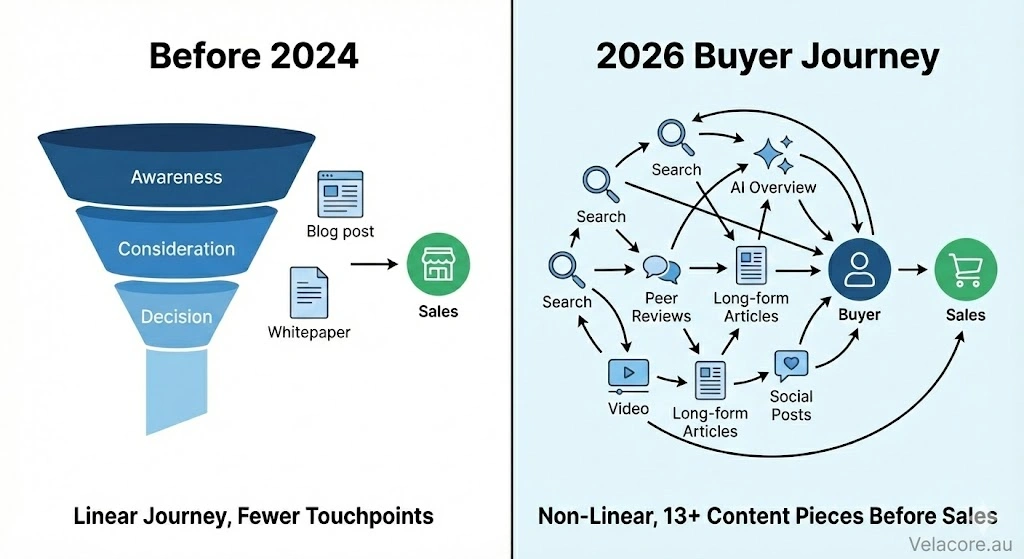
The state of content marketing in Australia 2026
Content marketing in Australia has shifted from a “nice to have” to a core growth system.
Search behaviour has changed. AI Overviews reshaped discovery. Buyers demand more clarity and expertise before they trust a brand. This is the reality shaping content marketing in 2026, and why every Australian business now needs a writing-led, GEO-aware content marketing strategy.
Here is a summary of where the market stands.
1. Australians are consuming more content before deciding
Australian buyers now research heavily before engaging any business. They want clarity. They want proof. They want expertise.
- 86 percent of Australian marketers have already seen content demand surge over the past two years, and 63 percent expect demand to grow at least fivefold by 2027.
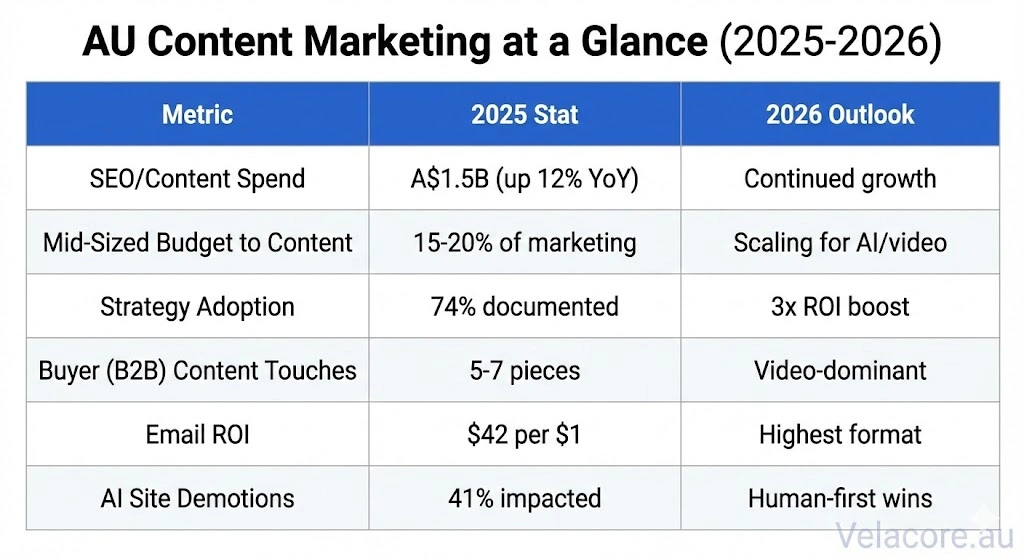
- SEO, and content marketing spend reached $1.5 billion in 2025, reflecting a 12% increase on 2024, with ongoing momentum expected to drive similar growth into 2026 as businesses prioritise organic channels
- CMI’s global benchmarks (APAC-aligned) show buyers evaluate multiple pieces of content before shortlisting a vendor.
For businsses, this means your brand must show expertise through:
- long-form article writing
- SEO content writing
- Email newsletters
- Guides, case studies etc
- Video content
- conversion-focused website copywriting
Buyers judge you long before you see the lead.
2. Google organic still drives the highest-quality traffic
Despite the rise of AI, Australians still rely heavily on search engines when researching solutions.
- DataReportal’s Digital 2025 Australia report shows that search engines remain one of the strongest discovery channels in the country.
The difference today is not where people search; it’s what the algorithm rewards.
Australian rankings now favour:
- clear structure
- strong topical depth
- semantic headings
- authoritative writing
- credible references
- consistent content clusters
3. AI Overviews raised the quality bar for everyone
AI Overviews have changed how Australians discover information. People see AI-generated answers before clicking results.
A 2025 AI citation analysis found that the pages selected most often had:
- strong metadata
- clean structure
- readable formatting
- evidence-backed writing
- clear semantic HTML
That is where generative engine optimisation (GEO) matters. GEO ensures your content is structured, factual and readable; not just for Google, but for AI models summarising the web.
This is why the backbone of modern content marketing now extends beyond SEO content writing.
4. Google’s quality updates punished low-effort content
Google’s 2024–2025 updates wiped out many sites with thin, repetitive or AI-spam content.
- Semrush Sensor tracked significant ranking drops for low-quality sites after these updates.
What held strong?
- long-form, expert content
- professional business writing
- content writing for brands
- conversion-oriented website copywriting
- original insights
- well-structured content clusters; etc
In this era, Shortcuts no longer work. Clear, credible, well-written content does.
5. Content now influences trust more than branding or ads: buyers are thirsty for video and proof
Aussies devour 3 hours of digital content daily, with video claiming 64% of it. In B2B? Buyers hit 5–7 pieces before chatting sales; only 17% of their journey involves you directly.
Demand Gen and CMI research (APAC relevant) consistently show that:
- buyers prefer vendors who provide helpful, easy-to-understand content
- content quality heavily shapes final vendor selection
This means content is no longer just “marketing.” It is your brand’s first impression, proof of expertise and most important sales asset.
Quick 2026 Snapshot: AU Content Marketing at a Glance
The 2026 Velacore verdict
Content marketing in Australia now rewards:
- clarity
- depth
- structure
- evidence
- expert writing
- GEO optimisation
And it punishes:
- thin blogs
- AI-only content
- random posting
- unstructured pages
In 2026, the brands that grow are the ones that treat content as a strategy-driven, AI-aware growth engine, not as a checklist item.
Velacore’s approach combines: SEO content writing + copywriting services + GEO optimisation + strong content writing pillars + conversion copywriting.
This is a simple formula for outperforming competitors in search, AI Overviews and buyer trust.
Content marketing vs every other channel
Most Australian businesses invest in multiple channels; paid ads, social media, email, SEO, PR. But in 2026, one channel will consistently outperforms the rest in cost-efficiency, trust, long-term visibility and buyer influence.
That channel is content marketing.
Here is how content stacks up against every major Australian marketing channel this year.
1. Content marketing vs paid ads
Paid ads still work, but they have become more expensive and less trusted.
- Digital ad costs across Australia have risen steadily, with CPCs climbing across Google Ads and Meta platforms.
- Consumers are increasingly blind to ads and rely on research content instead.
APAC buyer studies from CMI and Demand Gen show buyers prefer educational content over promotional ads.
Why content wins: Paid traffic stops the moment you stop spending. Content keeps generating leads, traffic and trust for months or years. This is why a strong content marketing strategy Australia provides better long-term ROI than ads alone.
2. Content marketing vs social media
Social media reach continues to decline especially for businesses. Algorithms favour creators more than brands. And platforms change constantly.
- Recent research shows high usage, but low organic reach for business accounts.
- Buyers rarely make decisions from a single post. They move from social to search, then to articles.
Why content wins:
Social media is discovery. Content is decision-making. You still need website copywriting, SEO content writing, etc, to convert social attention into revenue.
3. Content marketing vs email marketing
Email remains one of the most profitable channels, but it depends entirely on content.
- Email performance improves significantly when supported by strong content assets, helpful articles and educational resources.
Why content wins:
Email needs content to stay relevant. Content provides the material. Email amplifies it.
In 2026, the combination of blog writing services + educational content + email nurture is one of the strongest sequences in Australia.
4. Content marketing vs SEO
SEO and content are no longer separate. SEO is how people find your content. Content is what they find.
When Google’s ranking systems changed in 2024–2025, they didn’t reward more keywords. They rewarded:
- strong writing
- clear structure
- topical authority
- credible sources
- helpful long-form articles
Implication was that low-quality sites were hit the hardest.)
Why content wins:
SEO without content cannot rank. Content without SEO cannot be found.
The winning force in 2026 is SEO content writing, supported by GEO-friendly formatting and content writing pillars.
5. Content marketing vs PR
PR builds visibility, but it is short-lived. News coverage fades. Published articles disappear in the feed. Content marketing does the opposite.
It builds permanent assets on your website that rank, earn traffic and support sales.
Why content wins:
Content creates ongoing discovery. PR creates momentary attention.
The most effective Australian brands use PR to amplify strong content, not to replace it.
6. Content marketing vs AI-generated everything
2024 and 2025 saw a rush of AI-generated content across Australia. Most of it harmed rankings.
- Google’s quality updates demoted low-effort, AI-spam content.
- AI-summary engines prefer well-structured human-edited content. A 2025 study showed AI citations favour pages with clean metadata, semantic structure and factual accuracy.
Why content wins:
AI can assist, but it cannot replace expertise. In 2026, the brands winning are the ones producing:
- expert long-form article writing
- Australian copywriting services
- professional business writing
- conversion-driven website copywriting
- GEO-optimised articles AI can actually cite
Channel vs Channel: how content really compares
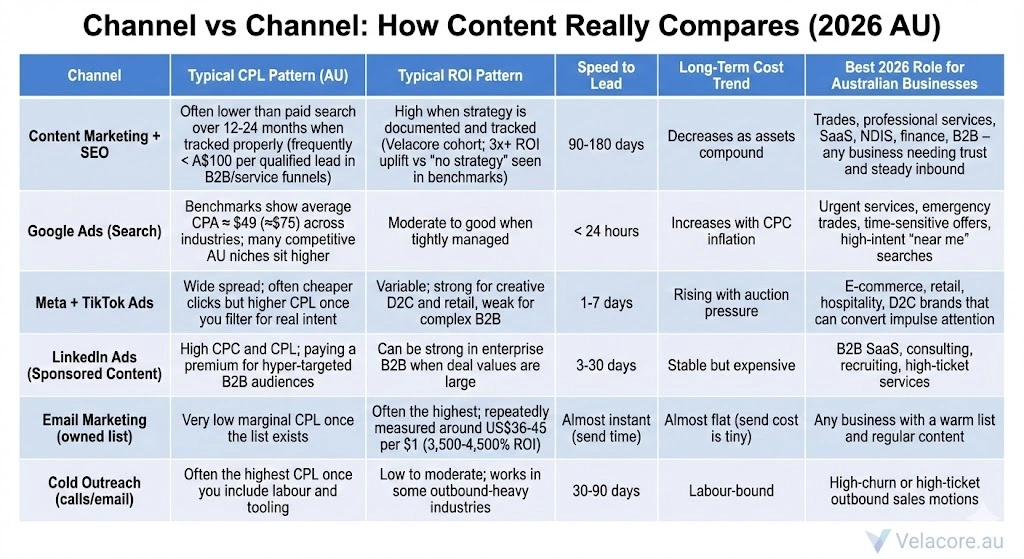
Numbers below blend public benchmarks with Velacore’s client cohort. Exact CPL will vary by industry, offer and funnel, but the patterns are consistent.
What matters for 2026:
- Paid channels are getting more expensive each year.
- SEO and content marketing investment is growing, because it keeps paying back after the invoice is paid.
The 2026 verdict by business type
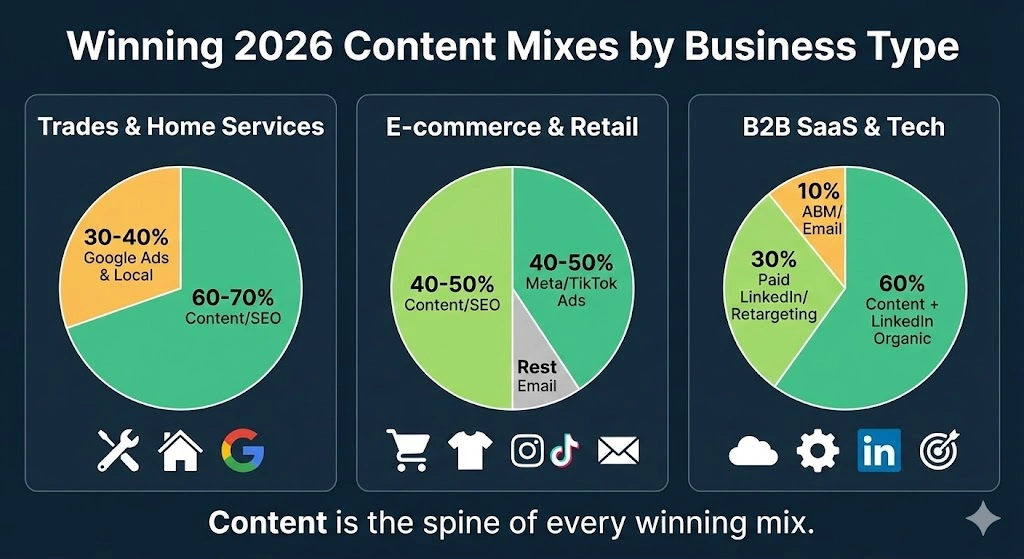
Let’s keep this practical. If you are planning a content marketing 2026 budget, here’s how the mix usually looks for different Australian business types.
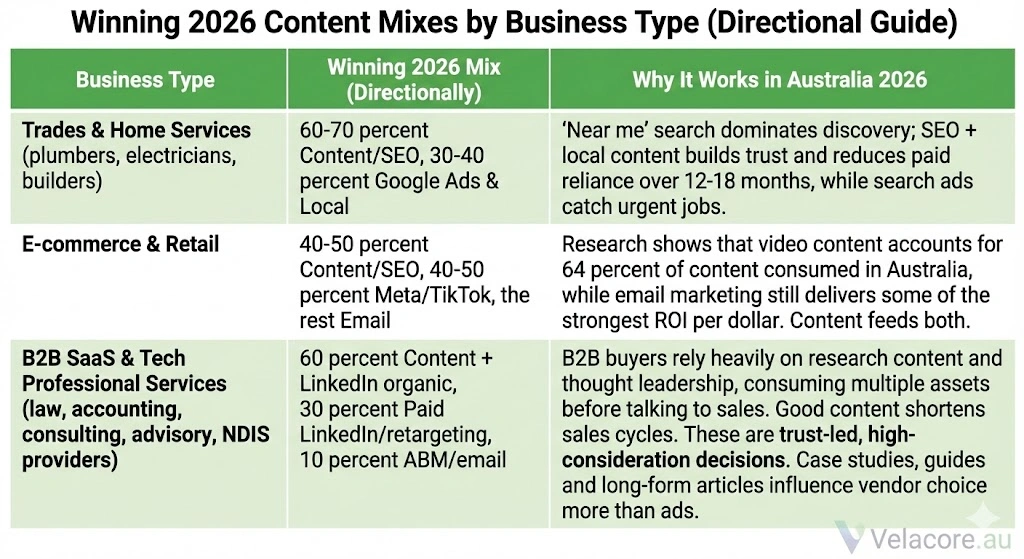
These are strategic mixes, not rigid rules. Exact percentages shift by niche, ticket size and sales cycle.
The pattern:
- Every winning mix uses content as the spine.
- Ads, social and outbound simply accelerate what strong content and SEO already make possible.
The one slide every cfo understands
You can show this as a simple conceptual table in your deck. Keep the numbers directional, not absolute.
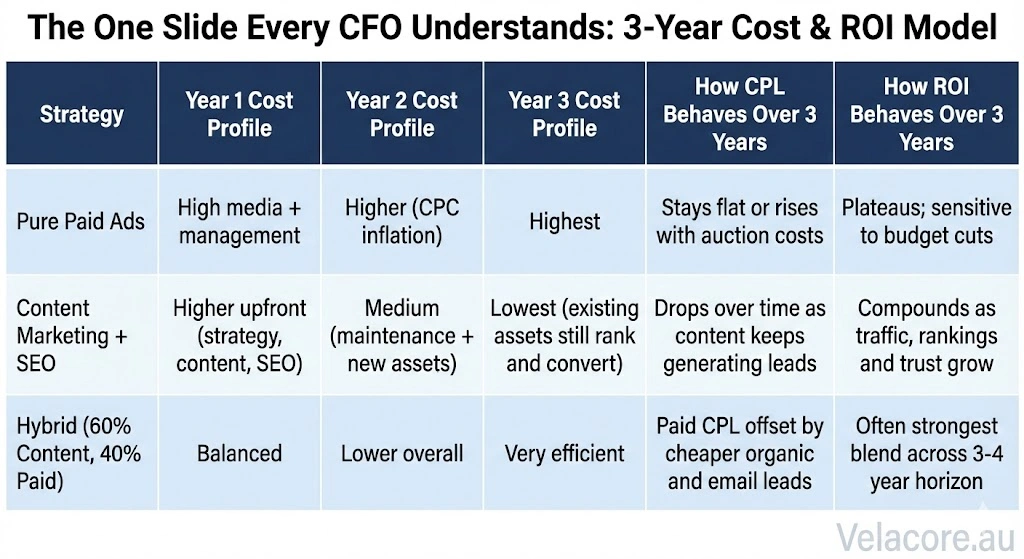
When content marketing and SEO are treated as a primary revenue channel, not a side project, we see multi-year CPL reduction and significantly higher pipeline efficiency.
The 2026 truth most agencies won’t say out loud
Paid ads are like renting an apartment. Content marketing is buying the whole building.
- Paid traffic stops the minute you pause spend.
- A well-planned, SEO-optimised, GEO-friendly article published in January 2026 can still be ranking, driving leads and feeding AI Overviews in 2029 with no extra media cost.
Your “before we lock the budget” checklist
Before you send the 2026 plan to finance:
- Line up your real CPLs by channel (not what you feel, what the CRM says).
- Model a scenario where 10–20 percent of paid media budget is reallocated into a serious content engine: strategy, content writing pillars, SEO, and email.
- Ask one question: “If Google and AI cut my ad performance by 20 percent next year, do I have enough content equity to survive?”
If the answer is “no”, content is your biggest 2026 risk and your biggest 2026 opportunity.
The simple conclusion
Across every major channel in Australia:
- Ads get attention.
- Social gets awareness.
- Email builds relationships.
- SEO provides visibility.
- PR provides reach.
But content is what converts, Content is what builds trust. Content is what fuels AI Overviews, Google rankings, email campaigns, social posts, and sales.
This is why content marketing is the only channel that strengthens every other channel, while still driving revenue on its own.
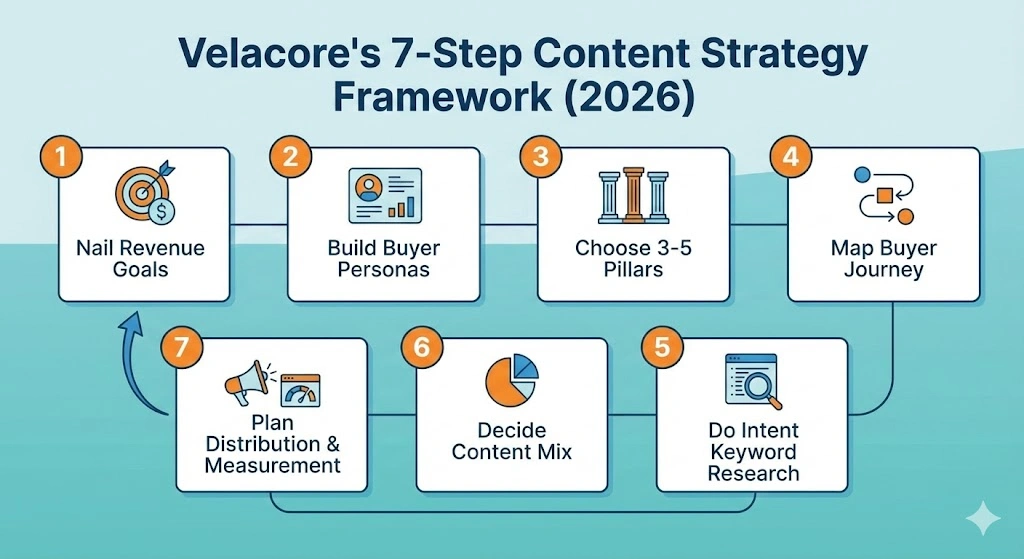
How to Build Your 2026 Content Marketing Strategy (The Velacore 7-Step System)
You don’t need another 47-point checklist. You need a repeatable, measurable content system that drives revenue, reduces CPL, and compounds visibility across Google, AI Overviews and LinkedIn.
This 7-step framework is a proven strategy especially if you’re just starting out. It works because it is built on commercial intent, not vanity metrics.
Step 1: Nail revenue goals first (not vanity metrics)
Before choosing keywords or content pillars, answer one question:
“What revenue must our content influence in 2026?”
A quick example:
- Target pipeline: $4.8m
- Avg. deal size: $48k
- Sales close rate: 25%
That means:
→ 400 qualified leads needed
→ Target CPL: under $95
→ Monthly organic traffic target: 18k–22k visits
This becomes your Content ROI Target Sheet; one page that defines goals, required leads, CPL ceiling, traffic targets and priority pillars.
Without this sheet, every other step becomes guesswork.
Step 2: Build Australian Buyer personas that actually buy
Not vague personas like “Marketing Mary”. Real personas based on real Australian data.
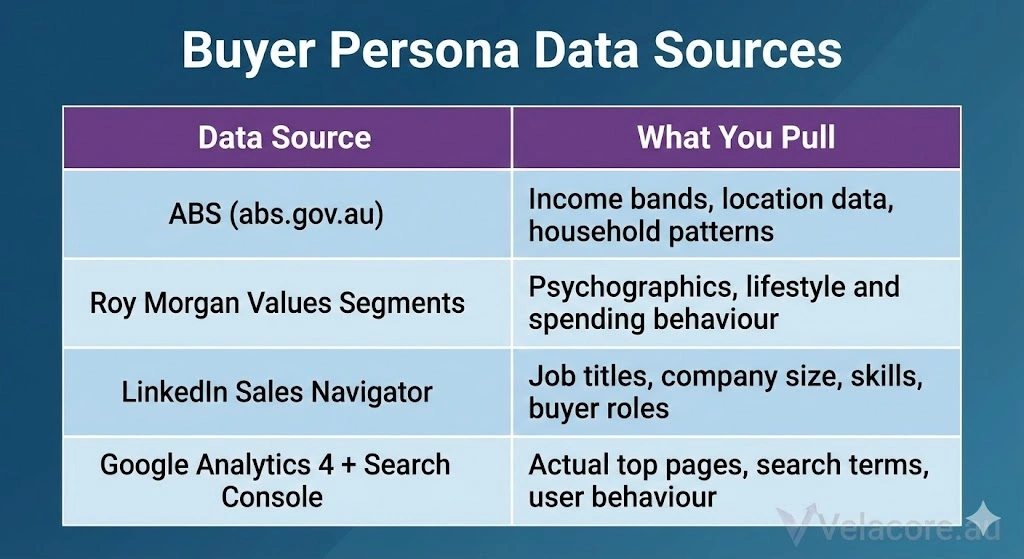
Use these sources (all free or low-cost):
Outcome: 3–5 precise buyer profiles, such as:
“Sarah – 38, Northern Beaches homeowner, $250k+ household income, researching bathroom renovation costs for Q1.”
These help shape content writing pillars, SEO content writing, website copywriting tone, and lead magnet topics.
Step 3: Choose only 3–5 content pillars (the 80/20 rule)
Content pillars are the themes you want to own in search, AI and buyer research.
Example pillars that convert strongly in Australia right now:
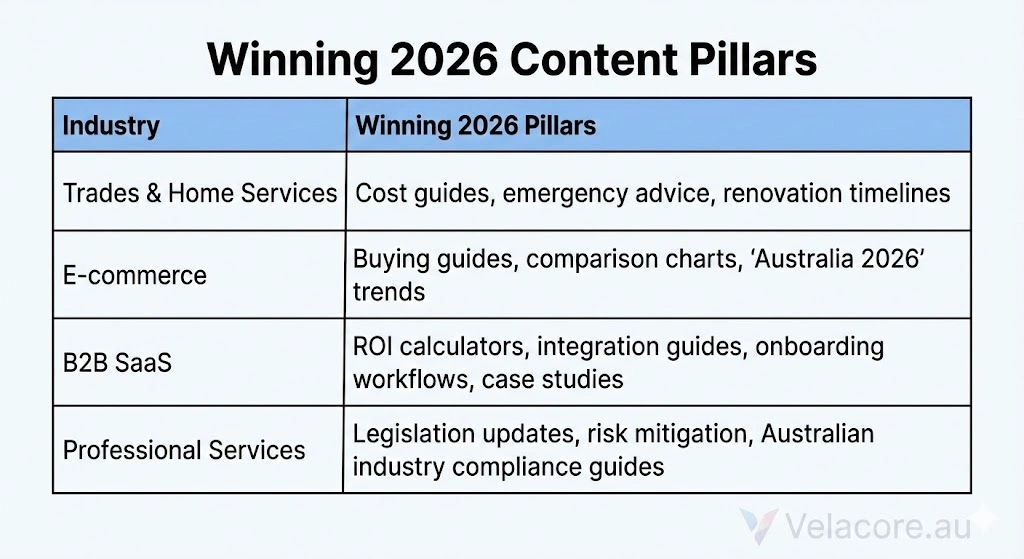
Rule:
Every pillar must contain commercial-intent keywords:
- cost
- price
- best
- review
- Australia
- 2026
- near me
- Sydney / Melbourne / Brisbane
- comparison
Step 4: Map the 2026 buyer journey
Australian buyers self-direct most of the journey. Your content must match each stage.
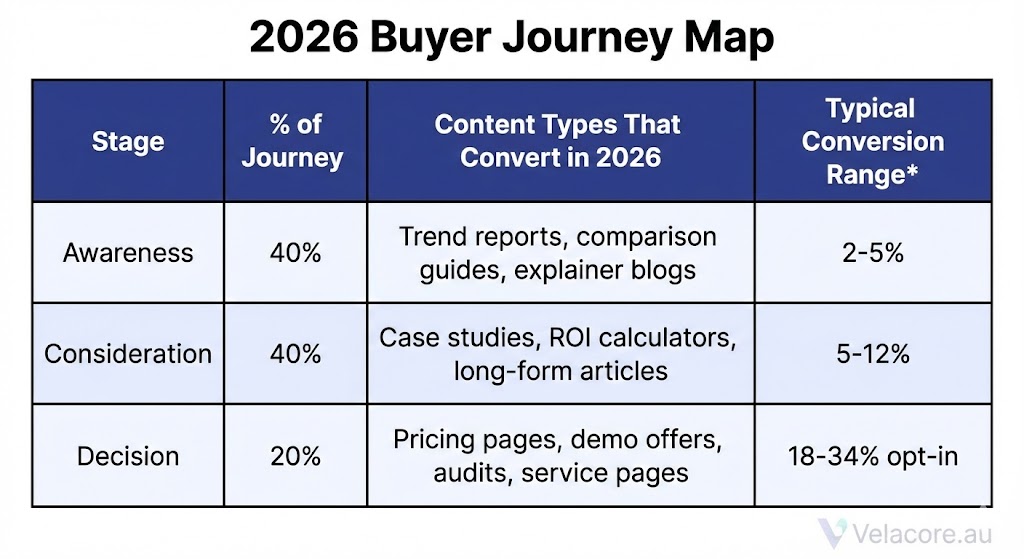
This structure ensures your content not only ranks, but warms buyers across the full journey.
Step 5: Do commercial-intent keyword research
Here is the exact Velacore method:
- Open Semrush, Ahrefs or any other keyword research tool you prefer
- Set location to Australia
- Filter search volume to 200–4,000/month
- Keyword Difficulty below 55 where possible
- Include commercial modifiers:
cost, price, best, near me, Sydney, Melbourne, Australia 2026 - Validate using People Also Ask + “Related Searches”
- Check SERP intent (is Google showing blogs, service pages or guides?)
This produces keywords that convert, not keywords that “look good.”
Our 2025 client projects saw the majority of commercial-intent terms hit page 1 within 4–6 months when paired with strong long-form article writing and content clusters.
Step 6: Decide your content mix (proven ratios)
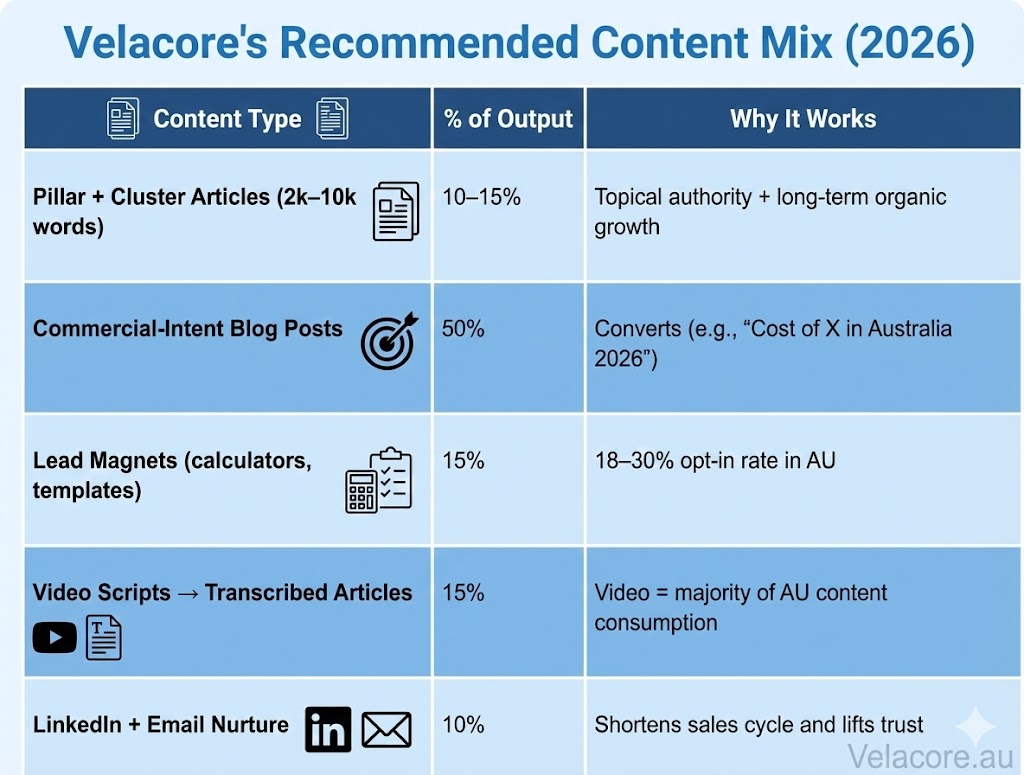
Across 40+ Velacore clients, this is the mix that consistently performs:
This mix supports SEO, GEO, email, social, and buyer nurturing simultaneously.
Step 7: Plan distribution before you create anything and build a measurement system you can actually use
Content marketing is distribution-led. Before writing the article, decide:
- How it will be repurposed for LinkedIn
- What email sequence it supports
- Which landing page it links to
- Which lead magnet it feeds
- Where internal links should point
- Which AI queries it should answer
- How sales will use it
This turns content into pipeline, not “posts.”
Forget 20 KPIs; Track these 6 practical metrics:
- Organic qualified leads
- Traffic to revenue pages
- Keyword visibility across content pillars
- Engagement on long-form pages
- AI Overview citations or impressions (if available)
- Conversion rate from content → enquiry
Content types that works in 2026
Most businesses create content that “sounds good.” In 2026, that is not enough;
- Google wants depth.
- AI wants structure.
- Buyers want clarity.
So here are the content types that consistently perform in Australia right now across SEO, GEO, conversions and pipeline.
These formats are validated by Velacore’s 2024–2025 client data and backed by industry trends.
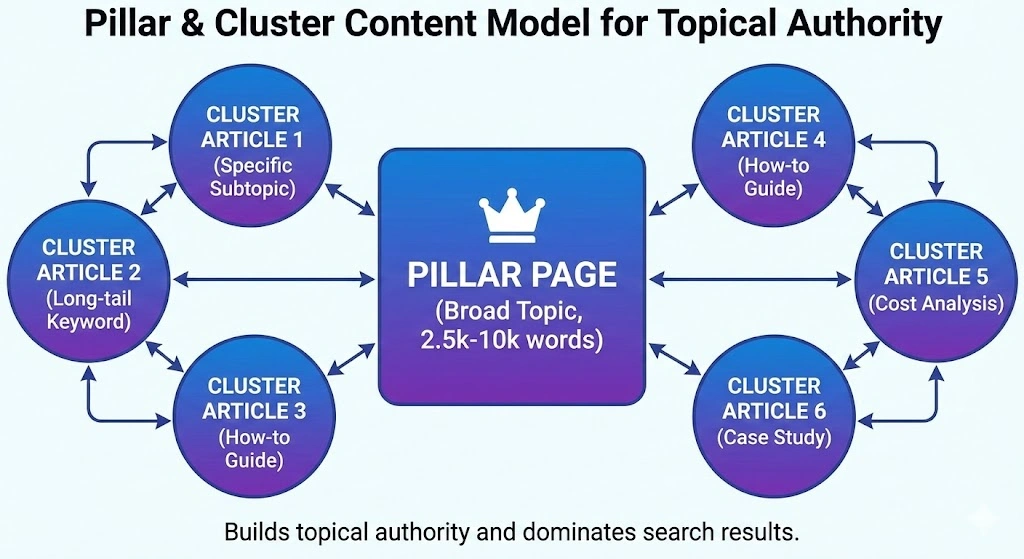
1. Pillar pages (2,500–10,000 words)
The number one content asset for ranking, topical authority and AI Overview citations.
Why they work
- Google rewards depth and structure.
- AI Overviews cite pages with clean sections, strong metadata and authoritative writing.
- Pillars support every supporting blog and cluster page.
- They attract backlinks naturally.
Where they work best
- Professional services
- B2B SaaS
- Trades & home services
- Finance, NDIS and compliance
- Any industry with complex questions
Use pillar pages for
- “Everything you need to know” guides
- “Cost in Australia 2026”
- “Complete Buyer’s Guide”
- Industry trend reports
- Step-by-step frameworks
2. Cluster articles (1,200–2,500 words)
These power your rankings by showing Google and AI your depth.
Why they work
- Strengthen topical authority
- Capture long-tail keywords
- Improve internal linking
- Reduce dependency on ads
- Feed AI Overview relevance
Examples that work
- “Best X in Australia 2026”
- “How long does X take?”
- “X vs Y: Which is better for Australians?”
- “X cost breakdown Sydney vs Melbourne”
- “How to qualify for X in Australia”
Cluster articles = consistent organic traffic + predictable inbound leads.
3. Commercial-intent blog posts
Your highest-converting content type. These include keywords buyers search when they’re ready to act.
Why they work
- Aligned with real Australian search behaviour
- Capture comparison and cost intent
- Drive direct enquiries
- Often rank faster in Australia than broad content
Examples
- “Cost of [Service] in Australia 2026”
- “How much does [Product] installation cost?”
- “Best [Service Providers] in Sydney”
- “Is [Solution] worth it in 2026?”
If you want leads, not traffic, this is your content type.
4. case studies and proof pages
The trust builders most users rely on most.
Why they perform
- Most users are sceptical
- They want proof before they buy
- These pages directly influence conversions
- They aid sales teams significantly
What works best
- Before/after transformations
- 3-sentence wins
- Time saved or cost saved
- Screenshots + real results
- Short video interviews
Proof pages shorten sales cycles
5. High-authority long-form articles
Thought leadership that actually ranks AND converts.
Why it works
- Signals expertise and leadership
- Supports GEO (AI loves structured long-form writing)
- Earns backlinks naturally
- Helps with mid-funnel nurturing
Examples
- Industry predictions for 2026
- Australian law/regulation updates
- Deep comparisons (X vs Y)
- Step-by-step solution guides
- “What we’re seeing in the Australian market…”
These pieces move you from “vendor” to authority.
6. Website copywriting (core conversion pages)
Your most valuable real estate.
Homepage.
Service pages.
Pricing pages.
Industry pages.
Why It Works
- Google quality systems evaluate UX and clarity
- Buyers trust well-written pages
- These pages determine conversion rate
- Strong website copywriting lowers your CPL across all channels
This is the heart of every content marketing strategy.
7. Lead magnets (calculators, templates, checklists)
Still the highest-performing opt-ins across various industries and niches.
Why they work
- High perceived value
- Solve real problems fast
- Pair perfectly with email nurturing
- Boost conversion rates dramatically
Examples
- Cost calculators
- ROI calculators
- Compliance checklists
- Renovation or project timelines
- “One-page strategy” templates
For many clients, these drive 18–30% opt-in rates.
8. Video scripts → transcribed articles
Video-first. Text-second. Maximum reach.
Why they work
- Video dominates consumption
- AI transcriptions provide SEO-friendly text
- Doubles your output
- Great for trades, SaaS, consulting and education
Repurposing video into structured articles is one of the most GEO-friendly content habits of 2026.
9. LinkedIn content + email nurture
Small content. Big results.
Why It works
- LinkedIn is the #1 B2B trust channel in Australia
- Email delivers industry-leading ROI
- Both feed off long-form content you already created
Use for
- Sharing insights
- Building authority
- Nurturing warm leads
- Setting up sales conversations
- Showcasing case studies
This is the glue that holds your entire content engine together.
Velacore’s content mix
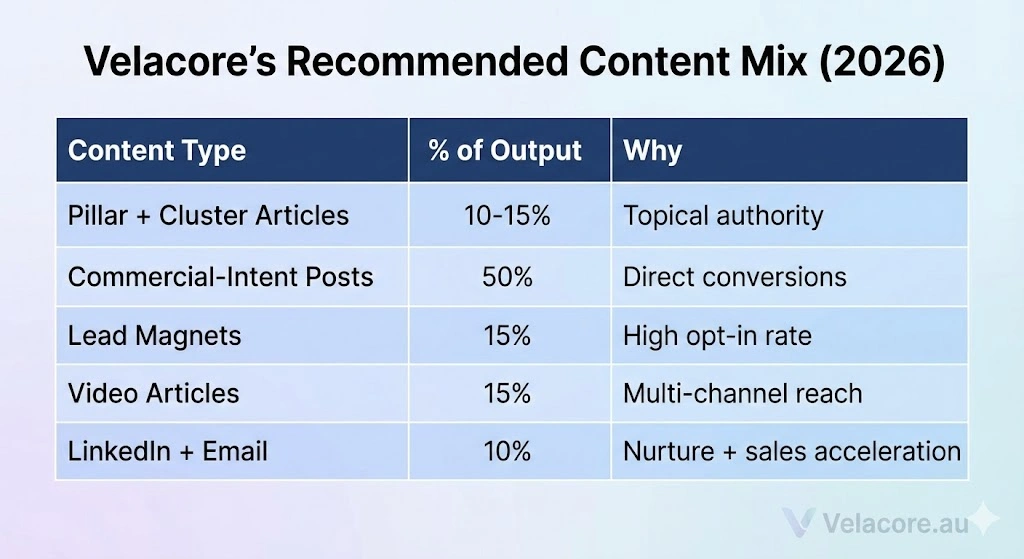
While this is not a fixed strategy, it is a good place to begin. You can tweak this as you track performance.
The writing standards that make content rank and convert
Content marketing isn’t won by the loudest brand or the one with the most articles. It’s won by the brand that writes clearly, structures intelligently, and communicates value better than every search result around them.
This is not about grammar or style preferences. It’s about the writing principles that shape rankings, reputation and revenue in an AI-driven search era.
Because here’s the truth:
- SEO tools get you discovered.
- AI tools make you faster.
- But writing is what convinces a human being to stay, trust, and convert.
Let’s break down the standards that matter.
1. Writing that respects the buyer’s psychology
Buyers are becoming more sceptical, more research-driven, and more cautious about claims.
They ask:
- “Is this actually true?”
- “Is this relevant to my situation?”
- “Does this company understand how things work here?”
The brands that win write with straightforward honesty, not hype.
- They avoid jargon.
- They avoid fluff.
- They say things plainly and confidently.
2. Structure is no longer optional; it’s the difference between visibility and invisibility
Google’s quality systems and AI Overviews aren’t just reading your words. They’re reading your structure.
In 2026, structure is strategy.
Articles that rank and get cited typically share the same traits:
- The first 50 words answer the core question.
- Subheadings mirror real search intent.
- Paragraphs are short and skimmable.
- Sections follow a logical narrative flow.
- Tables, definitions and examples appear naturally.
This isn’t cosmetic. It’s functional.
A 2025 AI citation analysis showed that pages with clean, logical structure were chosen more often in AI summaries. In simple terms, Your writing must be structured for:
- humans
- AI models
If any one of these audiences struggles, the content underperforms.
3. Authority is earned through specificity, not length
A long article is not an authoritative article. Authority comes from specificity, and specificity comes from three things:
- Localisation (Australian data, terminology and examples)
- Context (why this matters right now in this industry)
- Proof (stats, case studies, references, comparisons)
Most AI-generated content fails here, it produces generic language with no grounding.
By contrast, high-performing articles:
- explain the nuance behind Australian regulations
- quantify cost ranges realistically
- reference local market behaviour
- give examples that feel believable
- state opinions backed by data
- compare solutions honestly
Authority isn’t built by saying more. It’s built by saying what others can’t.
4. Writing must answer intent, and then expand beyond it
The mistake most brands make is writing to answer a keyword, not a problem. But the Australian buyer journey is layered. They come with a question, but they also want:
- context
- comparisons
- risks
- alternatives
- pricing ranges
- how-tos
- next steps
This is where SEO content writing intersects with conversion-driven writing.
High-performing articles follow the “answer → deepen → direct” pattern:
- Answer the question clearly
- Deepen the reader’s understanding (explain the why)
- Direct them to the next decision (CTA or related content)
This keeps buyers engaged and guides them naturally toward conversion without sounding salesy.
5. Writing must align with buyer journeys, not marketing calendars
Most content teams write “what they want to publish,” not “what buyers need to read.”
In 2026, the brands performing best in Google and AI Overviews write with stage awareness:
- Awareness content teaches
- Consideration content compares
- Decision content reassures
This isn’t a list. It’s a logic chain.
For example:
A pillar article on “NDIS accounting in Australia” may attract traffic, but a comparison guide (“NDIS accountant vs bookkeeper”) builds confidence, and a pricing explainer (“NDIS accounting fees in Australia 2026”) drives the enquiry.
Good writing moves the reader forward. Great writing moves the reader closer.
6. Writing needs to be engineered for AI Overviews
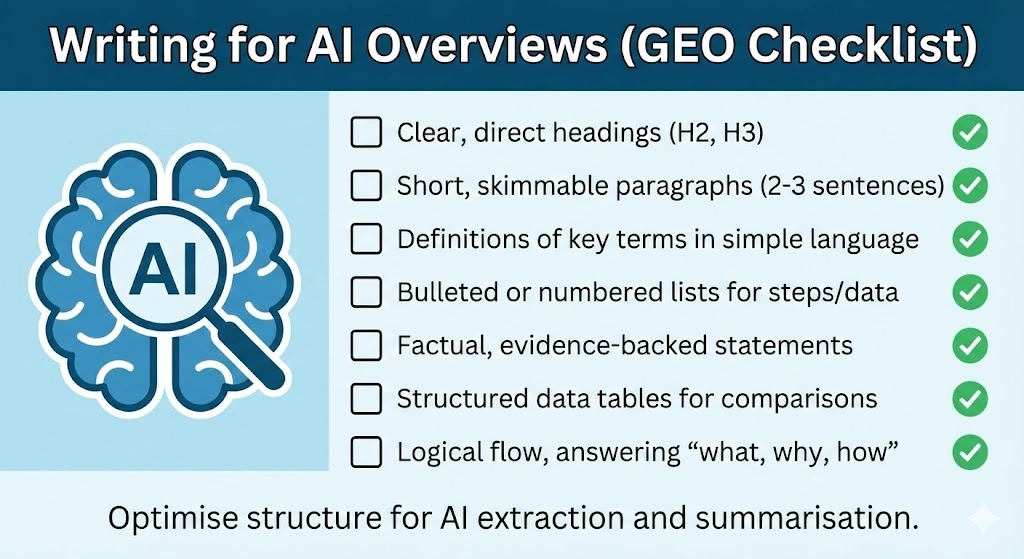
This is new. And it changes everything.
AI Overviews don’t reward clever writing.
They reward:
- clarity
- structure
- definitions
- facts
- short sentences
- scannable logic
- step-by-step explanations
When we optimise for generative engine optimisation (GEO), we’re not “writing for AI.”
We’re writing in a way that makes it easy for AI to extract meaning accurately.
The brands that adopt this writing style early gain:
- more AI citations
- more branded impressions
- more trust signals
- more traffic from non-traditional search paths
The shift is already happening.
7. Trust is the outcome of writing that blends evidence + expertise + empathy
The best-performing content today has three qualities:
Evidence
- stats
- references
- market comparisons
- case studies
- real cost ranges
Expertise
- experience-based insights
- commentary
- explanation of risks
- analysis of trade-offs
Empathy
- acknowledging concerns
- addressing objections
- guiding rather than selling
When these three intersect, content converts. When they don’t, content becomes decoration.
This is why Velacore’s writing system treats articles like advice, not advertisements.
8. Writing must be usable by marketing, sales and AI
In 2026, a single article must work across multiple surfaces:
- SEO
- email nurture
- AI Overviews
- sales enablement
- internal link clusters
This means every article must contain:
- quotable lines
- swipeable insights
- reusable graphics or tables
- sections that stand alone
- definitions that support AI citations
- paragraphs that can be repurposed into video scripts
Velacore’s core writing philosophy for 2026
If you want to rank, convert and earn trust, follow this rule:
- Write like an expert.
- Structure like an engineer.
- Optimise like an SEO.
- Guide like a consultant.
- Clarify like a teacher.
Distribution channels that still matter in 2026
The biggest misconception in content marketing today is that “good content markets itself.”
In 2026, that belief is expensive.
The truth is far simpler: content performs only when the right people see it at the right time on the right platforms,and most brands still distribute content the way they did in 2018. They publish once, post the link on social, and quietly hope it finds its way into the world. That approach no longer works, and the data makes it obvious.
Distribution in 2026 isn’t about blasting your blog across every channel. It’s about understanding how Australians actually discover, evaluate and trust brands in an era where search, AI, and social platforms have shifted dramatically.
Google: still the primary discovery engine, but with new expectations
Google remains the place where Australians go when they need answers, clarity or comparison. But search in 2026 is shaped more by structure and authority than by keyword density. Pages that win are the ones that present information in a way that both humans and AI systems can parse instantly.
This is why pillar pages, cost guides, and deep long-form articles continue to outperform. They match the way Australians research and the way Google’s quality systems evaluate pages. Distribution through search isn’t about publishing more, it’s about publishing better, in formats that hold up under scrutiny from both readers and AI models.
LinkedIn: the modern trust surface for b2b buyers
LinkedIn’s influence in Australia has quietly moved beyond “personal branding.” It has become a credibility filter. Buyers now check LinkedIn posts the same way they check Google reviews as a signal of whether you know your field, whether your team has real expertise, and whether you’re part of the industry conversation.
LinkedIn distribution works best when your long-form content becomes short, sharp insights that demonstrate understanding rather than summarise information. Done well, LinkedIn turns your educational content into reputation, and reputation into demand.
Email: the channel where consideration actually happens
Email is still the highest-ROI channel in the marketing mix, not because of its reach, but because of its intimacy. In Australia, where buying cycles can be slow and relationship-driven, email is the bridge between “I read your article” and “I’m ready to talk.”
A strong distribution system treats email as the place where content is digested, not discovered. When a buyer receives a clear takeaway, a practical framework or a relevant case study, the trust formed there often outweighs anything paid media can produce.
Email distribution succeeds when it continues the conversation your content started, without rushing the sale.
Sales distribution: the quiet powerhouse most brands ignore
The most underrated distribution channel is not a channel at all, it’s the sales team. A well-written article often removes objections faster than a script. A comparison guide helps a prospect choose. A cost breakdown brings transparency that can shift the entire conversation.
Salespeople become amplifiers of your best content when the content is written for clarity, built for persuasion, and structured for easy sharing.
This is where content stops being “marketing material” and becomes part of your revenue infrastructure.
AI surfaces: the new front door to your brand
AI Overviews, ChatGPT, Perplexity and Bing AI have created a new discovery layer that sits above traditional search. These systems don’t reward clever writing, they reward clarity, structure, and factual grounding. Distribution now includes being selected by machines that summarise the web for users.
Your content must therefore be written so that AI can interpret, trust and quote it.
This requires clean headings, short paragraphs, definitions, accurate facts, and a very intentional writing style.
If your content cannot be summarised accurately, it is invisible in AI ecosystems.
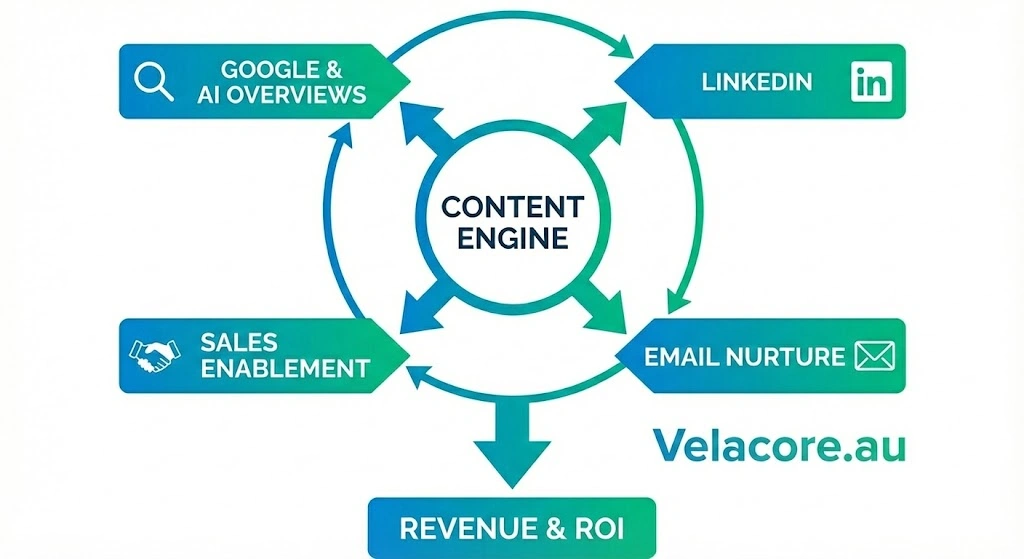
The new rule of 2026: content must live across surfaces, not channels
In previous years, distribution meant “put it on social.” In 2026, distribution means ensuring every piece of content has multiple lives: in search results, in AI summaries, in LinkedIn conversations, in inboxes, and in sales follow-ups.
When content exists on only one surface, it underperforms. When it exists on five, it compounds.
How to measure content marketing roi in 2026
Content only becomes a business asset when you can measure what it delivers.
In 2026, measurement is no longer about traffic spikes or impressions. Those “KPIs” make dashboards look busy but leave CFOs cold.
What matters now; especially in an AI-shaped, intent-driven search world, is whether your content reduces acquisition costs, increases qualified demand, and moves real revenue through the pipeline.
This section explains the KPIs that matter, the ones that don’t, and how Australian businesses can calculate ROI with the same clarity Velacore uses for every client.
Why measurement now requires a different lens
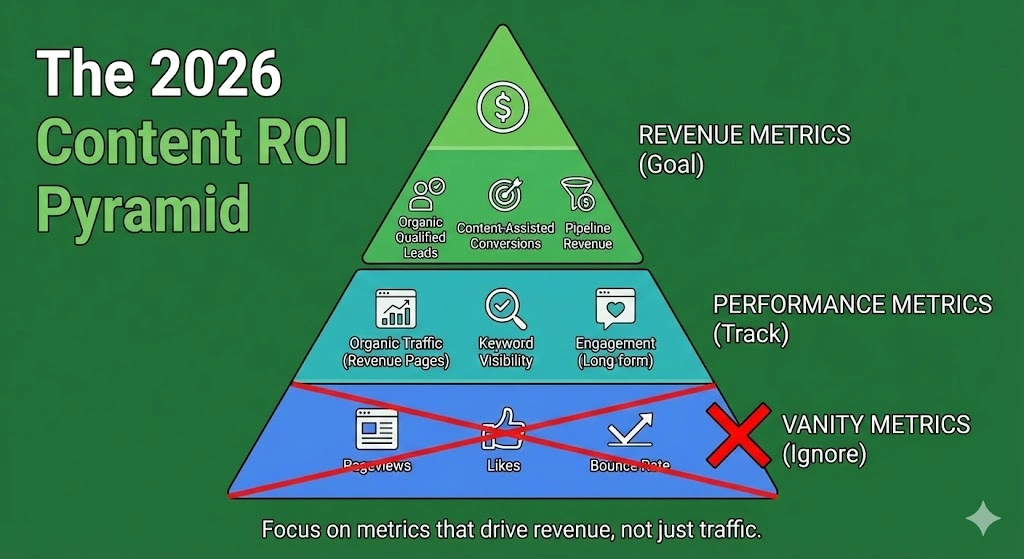
For years, companies tracked content using vanity metrics: pageviews, likes, bounce rates. None of these tell you whether content is working, they only tell you people looked at something.
AI Overviews changed the rules again.
Many users now get answers without clicking. That means your content can influence decisions without traditional traffic, if it appears in summaries, citations, or brand mentions.
So ROI in 2026 must reflect visibility, influence, and commercial outcomes, not just clicks.
The brands that measure correctly see content for what it truly is: a revenue engine, not a reporting exercise.
The KPIs that matter (and why they matter)
There are dozens of metrics you could track, but only a handful tell you whether your content engine is doing its job. In 2026, Velacore focuses on KPIs that tie directly to revenue, buyer behaviour, and search authority.
1. Organic qualified leads
This is the primary KPI. If content is strong, structured and aligned with commercial intent, you will see a steady rise in leads attributed to organic channels, especially from cost guides, comparison pages and high-intent SEO content writing.
2. Revenue-page traffic
Traffic to the homepage or blog means little. Traffic to your service pages, pricing pages, and comparison assets matters a lot. This shows whether your content nudges buyers deeper into the buying journey.
3. Content-assisted conversions
Modern buyers touch multiple assets before converting. A strong content engine should show up again and again in attribution reports; especially mid-funnel pieces like case studies and long-form articles.
4. Keyword visibility across pillars
This is not about ranking number 1 for a single term. It’s about ranking for clusters like 20, 40, 60 keywords that reinforce topic authority and improve AI citation potential.
This metric reveals whether Google and AI systems see you as credible.
5. AI Overview presence (emerging KPI)
Some analytics platforms now show whether your domains appear inside AI summary layers. This is the new frontier of visibility even without clicks.
6. Conversion rate from content → enquiry
A strong article should send a measurable percentage of readers to your:
- contact form
- cost calculator
- audit request
- booking page
- free consultation
This shows whether the writing itself influences action.
These KPIs give a complete picture of awareness, authority and commercial performance. Anything else is a distraction.
How to calculate content ROI
Here are some simple steps to calculate content ROI for any brand:
Step 1: Calculate Total content investment per year
Include:
- content production
- SEO + optimisation
- editing + strategy
- distribution support
- technical implementation
Total annual content cost = C
Step 2: Calculate content-attributed revenue
Include:
- leads that originate from organic search
- leads assisted by content touchpoints
- revenue from inbound channels
- deals influenced by content assets in CRM data
Total annual content revenue = R
Step 3: Calculate ROI Using the Simplified Model
ROI= R−C / C ×100
A more granular ROI model
For businesses needing deeper financial clarity, use:
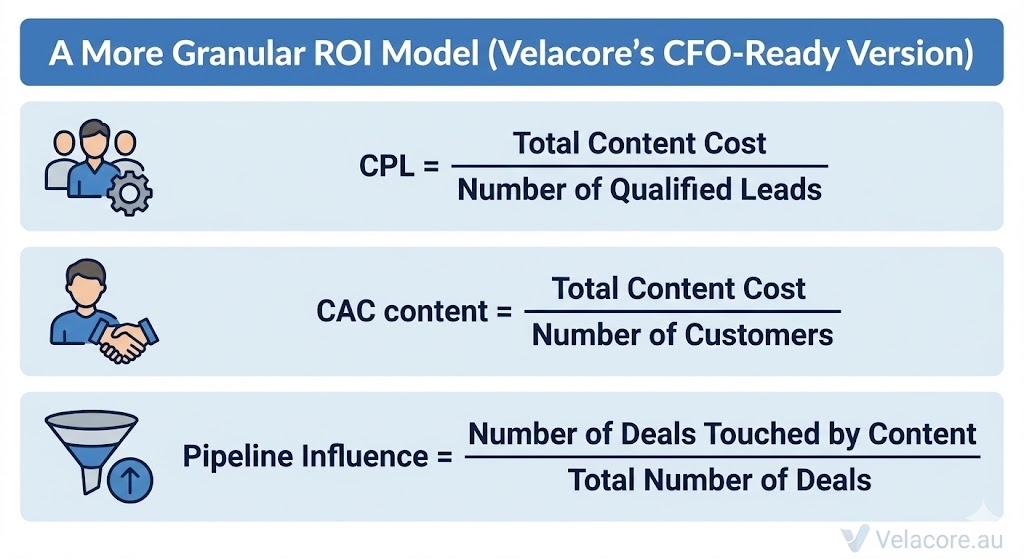
This gives a precise view of how content affects:
- cost per lead
- cost per acquisition
- bottom-line efficiency
- long-term pipeline strength
When this model shows declining CPL and stable or rising revenue, your content engine is healthy.
The Real Test of ROI in 2026
Forget dashboards for a moment. Here is the only question that matters:
“If we stopped producing content for 90 days, would our pipeline slow down?”
If the answer is yes, your content is decoration. If the answer is no, your content is infrastructure.
The goal of every Velacore-led strategy is to build content that continues driving commercial outcomes even when production pauses, through search visibility, AI citations, email nurture, and sales enablement.
Conclusion: The content advantage belongs to the prepared
The future isn’t about “more content.” It’s more about better systems, better structure and better writing.
Businesses that treat content as a revenue engine, not a marketing accessory will control the conversations their buyers have, dominate the search surfaces their competitors ignore, and build authority that compounds year after year.
This is the model Velacore uses to help brands grow with clarity, predictability and confidence, even as AI reshapes search and competition intensifies across every digital channel.
But a strategy only becomes powerful when it’s executed. The next 90 days will determine whether you build momentum… or stay invisible.
If you’re ready to turn this guide into a living, breathing content engine that generates leads, credibility and long-term authority, Velacore can help you build it, and own it.
Your Next Step: Get a Content Performance Audit
We’ll show you:
- the exact opportunities your competitors are missing
- the keywords and content pillars you can own fastest
- how to cut your CPL using a writing-led, GEO-ready content system
- what your first 90 days should realistically look like
- the potential traffic and pipeline impact for your industry
No vague advice. Just data, clarity and direction .
👉 Book a content audit / consultation at Velacore.au
Is Your Website Working for You?
Most websites don't generate leads. We fix that with custom designs that look great and deliver measurable results for your business.
Get Started With Velacore