Introduction: Why Sitecore Still Matters Today (and Beyond 2026)
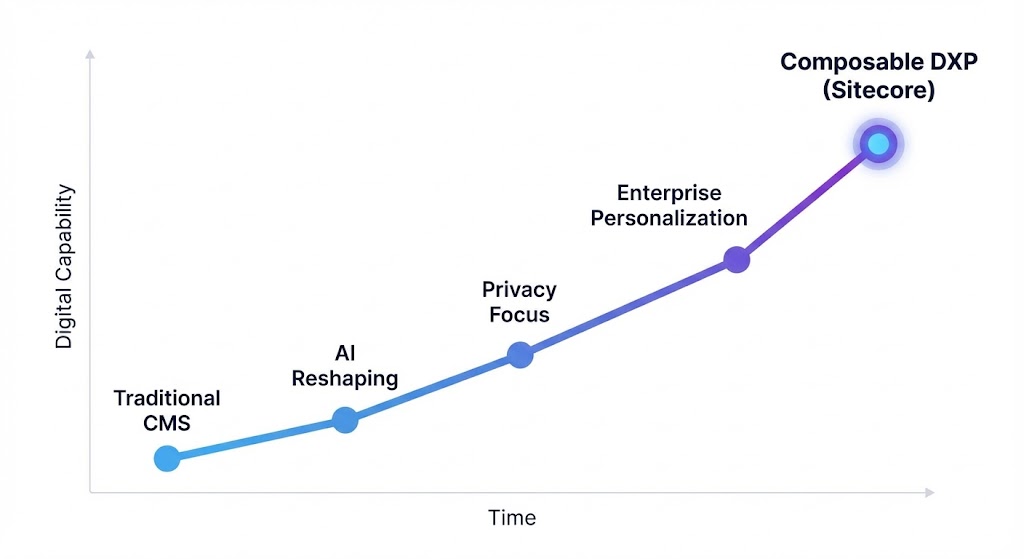
If you’re looking for a clear, honest and up-to-date Sitecore Guide, you’re exactly where you need to be. The digital experience ecosystem has drastically evolved: AI is reshaping content delivery, privacy laws are tightening, and enterprises expect personalisation at a scale traditional CMS platforms simply can’t handle. Yet, across this evolution, Sitecore remains a leading digital experience platform (DXP), especially for enterprise organisations with multi-brand, multi-region digital ecosystems.
This isn’t speculation. Independent research consistently shows the direction of the market:
- The global Digital Experience Platform market is growing sharply, with a projected value of over USD $27 billion this decade, driven by the demand for composable, cloud-ready systems (Fortune Business Insights).
- Gartner continues to urge enterprises toward composable architecture, highlighting its importance for speed, adaptability and long-term digital resilience.
- McKinsey’s data reveals that real-time personalisation; a core strength of Sitecore CDP + Personalize can lift revenue by 5–15%, a significant competitive advantage for any modern business.
In simple terms:
Sitecore isn’t just a CMS. It’s a modern composable DXP designed to help enterprises deliver personalised, scalable, future-proof digital experiences.
And that distinction matters more now than ever.
From CMS to composable DXP; Sitecore’s evolution
When Sitecore first emerged, it was primarily a CMS. Today, Sitecore has evolved into a composable digital experience platform built around cloud-native services like XM Cloud, CDP, Personalize, Content Hub One and OrderCloud. This shift aligns directly with industry recommendations from organisations like Gartner, who advocate for decoupling systems into modular, API-driven components.
This evolution allows enterprises to modernise at their own pace: adopt XM Cloud without rebuilding everything, introduce CDP to unify customer data, or deploy Personalize for real-time optimisation.
Why enterprises still choose Sitecore in a headless-first world
Despite the surge of lightweight headless CMS platforms, Sitecore continues to hold its position because it solves complex problems smaller tools cannot. Enterprises choose Sitecore because it excels in:
- Multi-brand, multi-site management
- Enterprise governance and compliance
- Deep personalisation and experimentation
- Global content delivery at scale
- Flexible integration with modern front-end frameworks
- A clear cloud-first direction through XM Cloud
Industries with strict operational requirements like, finance, government, healthcare, education, retail depend on this level of robustness.
The 2026 digital reality and how it shapes sitecore adoption
Three major forces are shaping digital experience investments today:
AI-driven experience delivery
Generative AI and predictive modelling are accelerating personalisation, content automation, testing and optimisation. Sitecore’s investment in CDP + Personalize positions it strongly in this shift.
Privacy and data stewardship
With new regulations emerging globally, including updates to Australia’s Privacy Act, enterprises need platforms aligned with strong security and compliance practices. Sitecore remains a trusted choice in regulated environments.
Omnichannel customer expectations
Customers expect consistent experiences across websites, apps, email, social, and even offline touchpoints. Sitecore’s composable architecture is designed to manage these complex journeys in a unified way.
Who this guide is for
Whether you’re assessing Sitecore pricing, planning a migration to XM Cloud, evaluating Sitecore alternatives, or simply trying to understand whether Sitecore is worth it, this guide gives you the clarity and authority you need to make the right decision.
2. What Is Sitecore? a clear, practical explanation for beginners
Before we dive deeper into the ecosystem and architecture, let’s break down exactly what Sitecore is;
Here’s the easiest way to put it:
Sitecore is a content, personalisation,and automation ecosystem designed for organisations that need more than just a website; they need full control over every digital touchpoint.
Let’s break it down further;
What Sitecore actually does
At its core, Sitecore is a digital experience platform (DXP) that helps organisations:
- Manage content across multiple websites and channels
- Personalise experiences for different audiences
- Automate marketing journeys
- Unify customer data
- And deliver consistent brand experiences at scale
In other words, Sitecore isn’t just where you “edit pages.” It’s the engine that runs your entire digital presence, from content to customer intelligence.
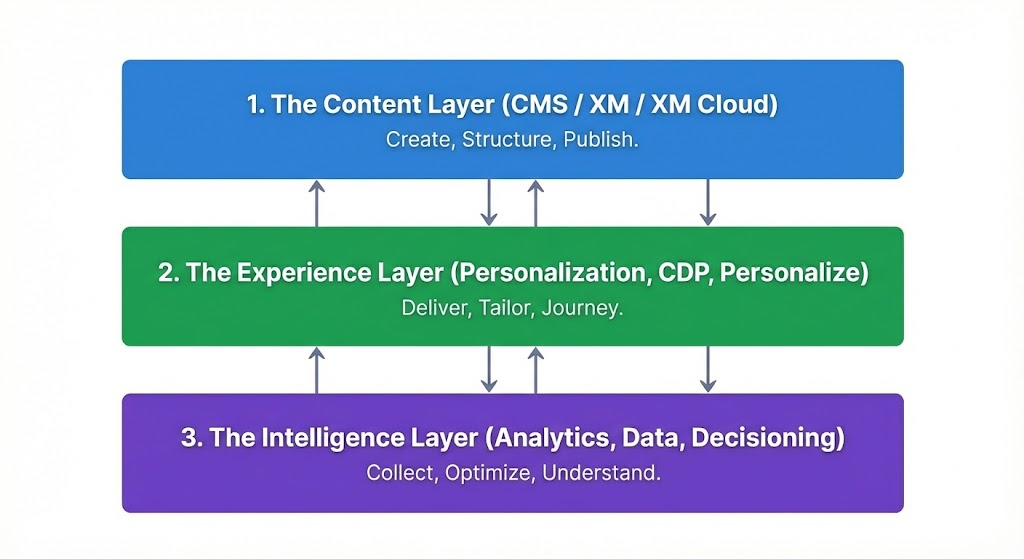
You can think of Sitecore as three powerful layers working together:
1. The content layer (CMS / XM / XM Cloud)
This is where marketing teams create, structure, approve and publish content across multiple brands and regions. It solves the problems of fragmented websites, inconsistent content, and manual publishing.
2. The experience layer (Personalization, CDP, Personalize)
This layer delivers tailored content and customer journeys based on behaviour, intent, or history; a capability many popular competitors simply can’t match at this time.
3. The intelligence layer (Analytics, Data, Decisioning)
This layer collects behavioural and transactional data to help optimise journeys, improve conversions, and understand user needs across channels.
This architecture is why Sitecore is widely recognised in enterprise categories by organisations like Gartner and Forrester. In simple terms, sitecore’s functionality extends far beyond a traditional CMS.
Sitecore CMS vs Sitecore DXP; Understanding the Difference
One of the most common points of confusion is the difference between Sitecore CMS and Sitecore DXP.
Sitecore CMS (XM / XM Cloud)
This is strictly for content management.
It lets you:
- Publish content
- Control governance
- Manage component-based layouts
- Deliver content headlessly
- Localise content regionally
If you need a high-performance, enterprise-ready CMS without the full DXP stack, this is the core product.
Sitecore DXP (XP + CDP + Personalize + OrderCloud + Send)
This goes beyond content.
It manages the entire digital experience, including:
- Personalisation
- Customer data aggregation
- Marketing automation
- Journey optimisation
- Commerce workflows
This is the version used when organisations need a unified platform for engagement, intelligence, and content; not just publishing.
The easiest way to visualise it:
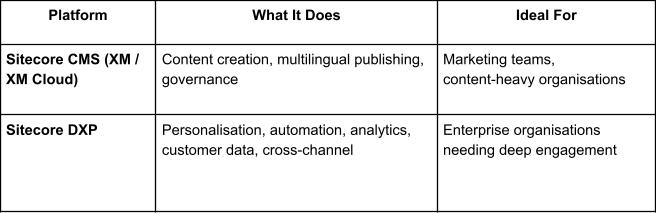
Most modern implementations combine XM Cloud + CDP + Personalize, which aligns with Sitecore’s composable DXP strategy, as outlined in their official product roadmap.
The key problems sitecore solves for enterprise teams
Enterprises adopt Sitecore not because it’s trendy, but because it solves real operational and digital complexity:
1. Multi-brand, multi-region content chaos
Sitecore centralises everything; websites, microsites, brand portals, campaign pages, into a single, controllable system.
2. Inconsistent customer journeys
CDP + Personalize delivers the right content, to the right user, at the right time, based on the user’s behaviour.
3. Fragmented technology stacks
Sitecore replaces a patchwork of CMS, DAM, CRM add-ons, landing page builders, email tools, and analytics tools with an integrated ecosystem.
4. Slow development and publishing cycles
XM Cloud’s cloud-native architecture removes upgrade backlogs, server maintenance, and deployment bottlenecks.
5. Rising privacy, compliance & security requirements
Sitecore’s architecture aligns with enterprise governance, helping organisations maintain compliance with strict frameworks, including Australia’s evolving Privacy Act reforms.
When enterprise organisations evaluate major digital platforms, these challenges often appear at the top of their brief, and they align perfectly with where Sitecore is strongest.
What industries can use Sitecore today
Sitecore is trusted across industries where accuracy, scale and personalisation matter:
- Healthcare: managing patient-facing content across dozens of clinics
- Financial Services: delivering secure, personalised self-service journeys
- Government: ensuring accessibility, governance and public-sector compliance
- Retail & Ecommerce: powering dynamic, personalised experiences across channels
- Education: supporting multi-faculty and multi-campus content structures
- Energy & Utilities: centralising service information for millions of users
3. Sitecore product ecosystem (clear, practical & enterprise-focused)
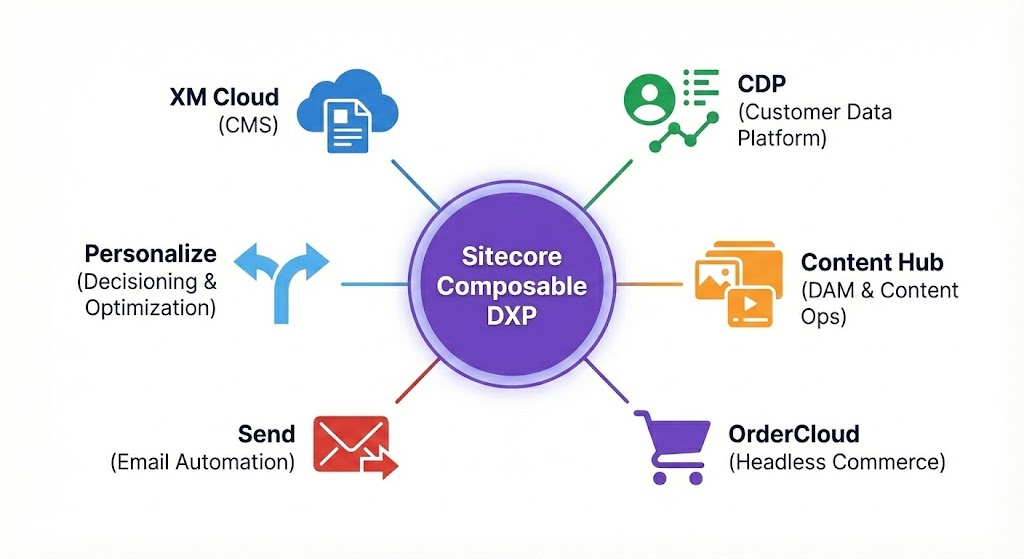
Sitecore’s ecosystem is broad, but every component plays a very specific role in helping organisations deliver connected, personalised, and scalable digital experiences. Understanding what each product actually does is essential. Whether you’re modernising an existing implementation, comparing Sitecore XM Cloud to alternatives, or assessing long-term migration paths.
What follows is a clear, practical breakdown of Sitecore’s key products, written for marketers, developers, architects, and enterprise leaders.
Sitecore XM (Experience Manager)
Sitecore XM is the core content management engine behind the entire platform. It provides a stable foundation for managing multiple websites, brands, regions, and languages from one place; something most mid-to-large enterprises struggle to achieve with lighter CMS platforms.
What it does:
- Centralises content authoring
- Supports multilingual publishing
- Enforces governance and workflows
- Delivers content headlessly to websites and apps
- Provides component-based building with SXA
Why it matters:
It allows teams to maintain consistency across large digital ecosystems. A national healthcare organisation, for example, can manage dozens of clinic sites with shared templates, central governance, and unified content standards.
Sitecore XM Cloud (SaaS CMS)
XM Cloud is Sitecore’s cloud-native evolution of XM, a modern SaaS CMS designed to remove hosting, maintenance, and costly upgrade cycles.
What it does:
- Removes all infrastructure management
- Offers automatic upgrades and patches
- Integrates natively with React, Next.js, and Vercel
- Enables faster deployments through built-in DevOps tooling
- Supports global content delivery through CDN acceleration
Why it matters:
XM Cloud reduces long-term operational cost and complexity, while giving development teams a modern, flexible environment. A 2025 Forrester TEI study showed customers achieving 371% ROI, less than 6-month payback, and millions in benefits from reduced infrastructure and faster time-to-market
Many organisations evaluating Sitecore XM Cloud pricing, XM Cloud features, or XM Cloud migration readiness choose it for its scalability and maintenance-free architecture.
A common scenario: a university migrating from on-premise Sitecore to XM Cloud gains faster performance, better author experience, and eliminates server overhead.
Note: While XM Cloud represents Sitecore’s strategic future, but it is not a mandatory upgrade path. It simply provides a modern option for organisations wanting cloud-first digital operations.
Sitecore XP (Experience Platform)
XP used to dominate the market because it offered CMS + personalisation + analytics in a single monolithic system. But in recent times, monoliths are expensive to maintain, slow to deploy, and harder to scale.
This is why Sitecore is encouraging most new customers to adopt XM Cloud + CDP + Personalize, which offer:
- Better performance
- More flexibility
- Faster deployment
- Lower infrastructure costs
XP is still used widely, particularly in organisations that rely on its integrated data and personalisation structure.
While newer innovations appear primarily in XM Cloud and the composable stack, XP continues to receive updates and remains a stable choice for existing implementations.
What it does:
- Tracks behaviour through xDB
- Automates campaigns
- Personalises content based on rules
- Provides built-in analytics
- Supports multi-step customer journeys
Why it matters:
XP still powers deeply personalised experiences for brands that haven’t moved to composable architecture.
Sitecore CDP (Customer Data Platform)
Sitecore CDP is built for enterprises that need a unified, accurate view of their customers across channels. Instead of storing data in silos, CDP consolidates customer interactions into a single, actionable profile.
What it does:
- Collects behavioural and transactional data
- Unifies profiles across systems
- Provides real-time segmentation
- Enables decisioning and activation
- Powers advanced personalisation
Why it matters:
Teams use CDP to deliver relevant, timely experiences; something that improves customer engagement, retention, and revenue. Research shows companies using real-time personalisation capture 5–15% more revenue and achieve up to 30% better marketing efficiency.
A retail brand, for example, can synchronise website behaviour, loyalty data, and in-store transactions to create a consistent customer journey.
Sitecore personalize
Personalize brings the CDP data to life by delivering tailored content, messages, and experiences in real time.
What it does:
- Runs A/B/n experiments
- Delivers dynamic content blocks
- Supports real-time decision models
- Personalises journeys across web, email, and apps
- Optimises conversion paths continuously
Why it matters:
Enterprises increasingly rely on Sitecore Personalize to test, adjust, and refine digital experiences without waiting for full development cycles. For many teams, this capability is a deciding factor when evaluating Sitecore XM Cloud vs Adobe or assessing whether Sitecore remains worth the investment.
Content Hub & Content Hub One
Content Hub
A full-suite content operations platform that manages the entire content lifecycle, from creation and approvals to asset storage and distribution.
What it does:
- Provides enterprise DAM (images, videos, brand assets)
Handles rights, tagging, metadata, and workflow - Coordinates teams through a unified content pipeline
- Maintains brand consistency
Why it matters:
Global organisations use Content Hub to eliminate version chaos and streamline brand governance.
Content Hub One
A simplified, headless-only CMS for teams that need fast, flexible, API-based content delivery.
What it does:
- Stores structured content
- Publishes to web, mobile, apps, and connected devices
- Integrates easily with modern front-end frameworks
Why it matters:
Ideal for microsites, product catalogues, and omnichannel content needs, and often appears in evaluations of best Sitecore alternatives for lighter use cases.
Sitecore Send (email automation)
Send replaces the older EXM system with a modern, streamlined email automation solution.
What it does:
- Creates emails with a drag-and-drop builder
- Automates sequences and journeys
- Segments audiences
- Supports personalised email content
- Tracks performance metrics
Why it matters:
It gives marketers autonomy and integrates closely with CDP and Personalize to power more coordinated engagement campaigns.
Sitecore OrderCloud (headless commerce)
OrderCloud is Sitecore’s headless commerce platform built for complexity, especially B2B and marketplace models.
What it does:
- Supports multi-seller marketplaces
- Manages catalogue variations
- Handles complex ordering workflows
- Integrates through APIs
- Supports unlimited customisation
Why it matters:
It enables commerce structures that traditional platforms cannot support — such as multi-brand distributors or two-sided marketplaces.
Supported & Actively Used
- Sitecore XP
- Sitecore XM
- Sitecore XM Cloud
- CDP
- Personalize
- Send
- OrderCloud
- Content Hub
Strategic Investment Focus
- XM Cloud
- CDP
- Personalize
- Composable services
Still supported, but less innovation
- XP (still maintained, but not where new features often appear)
- xDB (functional within XP, but no recent major innovation)
Understanding this evolution helps digital teams plan proactively, especially those assessing Sitecore migration paths, evaluating alternatives for 2026 and beyond, or forecasting long-term platform risk.
To wrap-up this section,
The Sitecore product ecosystem is intentionally modular. Each component solves a specific business challenge, whether it’s managing content at scale, delivering real-time personalisation, unifying customer data, or enabling complex commerce.
With this clarity, teams can now better understand how Sitecore fits into their digital roadmap, what alternatives exist, and whether Sitecore XM Cloud, Sitecore DXP, or a composable strategy is the right investment going forward.
4. Sitecore CMS: capabilities, strengths & modern enhancements
Sitecore’s CMS remains one of the most advanced enterprise content management systems, built for organisations that operate at scale and require strong governance, multi-site coordination and future-ready delivery models. Below is an overview of what the CMS offers today; both in its traditional XM form and its modern XM Cloud version.
Headless Content Delivery (API-First Architecture)
Sitecore CMS supports fully headless publishing using REST and GraphQL APIs, enabling content to be delivered consistently across websites, mobile apps, portals, digital signage and emerging AI-driven channels.
This aligns with the broader industry shift towards API-first and composable architecture, an approach supported strongly by industry leaders.
Headless delivery decouples content from presentation, giving engineering teams the flexibility to use frameworks like Next.js, React, Vue, and Vercel deployments.
Multi-language & multi-region management
Sitecore offers one of the most advanced global content management systems available. Features include:
- Language fallback logic
- Regional variants and localisation workflows
- Multi-brand publishing targets
- Shared vs market-specific content structures
- Enterprise governance controls
This makes Sitecore particularly suitable for organisations operating across multiple regions, varying languages, brands and regulatory environments.
Authoring Experience (SXA, Pages & Workflow Controls)
Recent improvements have significantly enhanced the authoring workflow:
- Pages Editor for intuitive component editing
- SXA for rapid, component-driven page assembly
- Workflow engine for approvals, role-based permissions and version control
These tools help large teams maintain consistency, accelerate delivery and enforce clear governance throughout content operations.
Integrated DAM via content hub
When paired with Sitecore Content Hub, the CMS integrates enterprise-grade digital asset management:
- Centralised media storage
- Taxonomy + metadata
- Automatic renditions
- Rights and expiry management
- Cross-brand asset reuse
For content-heavy organisations, this reduces redundancy and improves accuracy across channels.
Accessibility, governance and compliance
Sitecore’s CMS continues to follow evolving global standards, including:
- WCAG accessibility
- Security best practices
- GDPR, CCPA and Australia’s Privacy Act reforms
- Enterprise role-based access and auditability
This is why the platform remains widely used in regulated sectors.
Performance and scalability with XM cloud
Sitecore XM Cloud modernises the CMS with a SaaS delivery model:
- Automatic upgrades
- Zero infrastructure maintenance
- Global CDN distribution
- Built-in CI/CD pipelines
- Decoupled authoring and delivery
- Modernised editing experience
The result is a more scalable, more maintainable CMS with significantly reduced operational overhead.
Enterprise use cases
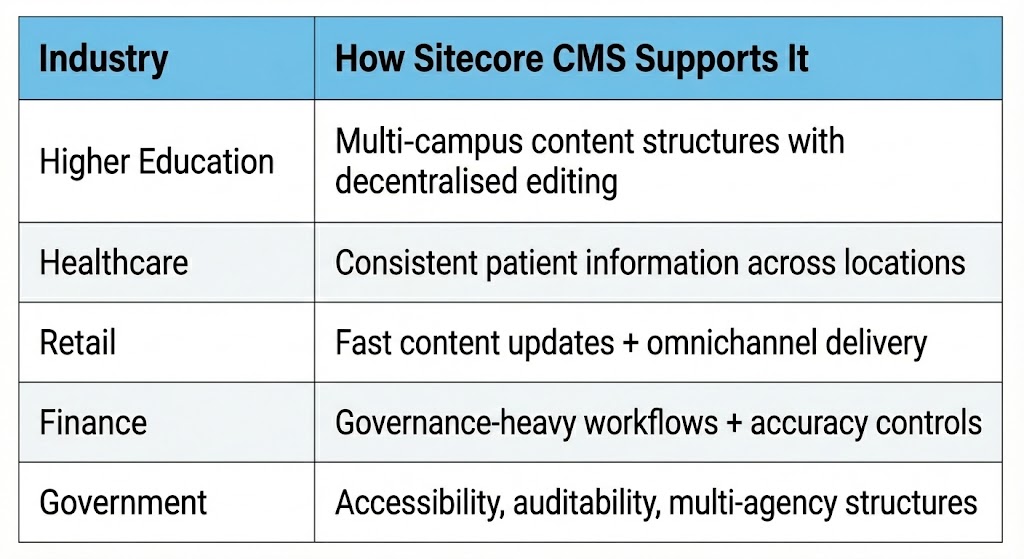
These scenarios reflect where Sitecore’s CMS is most aligned with real-world enterprise needs.
Sitecore CMS combines strong governance, global scalability, headless delivery, enterprise DAM integration and a modern cloud option through XM Cloud. While it is often argued that it is not designed for small or simple use cases, it obviously remains one of the most capable and structured CMS platforms for organisations managing large, complex, multi-brand digital ecosystems.
5. Sitecore DXP: deep dive into the experience platform
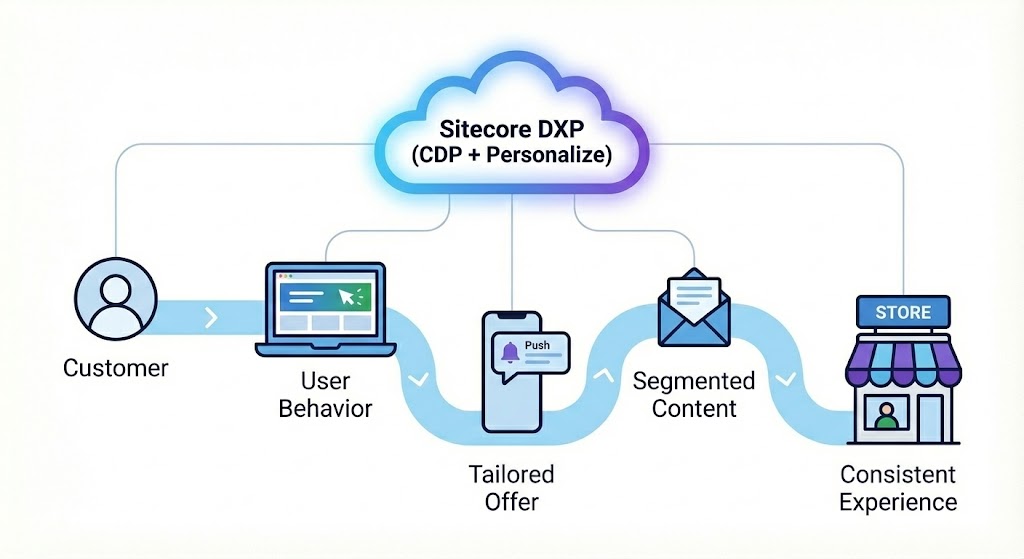
Sitecore’s Digital Experience Platform (DXP) extends the CMS beyond content management into personalisation, customer data, analytics, and experience orchestration. While the CMS powers content, the DXP powers engagement, the intelligence layer that adapts digital journeys in real time.
Below is a clear, concise breakdown of what Sitecore’s DXP actually offers and how its components work together.
Real-time personalisation capabilities
Personalisation is at the heart of the Sitecore DXP. Through Sitecore Personalize and CDP, the platform can tailor experiences based on:
- User behaviour
- Visit history
- Segment membership
- Location
- Device
- Purchase activity
- Predicted intent
This aligns with research from McKinsey, which shows that organisations using real-time personalisation achieve 5–15% revenue uplift and stronger customer loyalty.
Sitecore’s personalisation engine supports both rules-based and real-time decisioning, allowing marketers and product teams to deliver relevant, adaptive experiences at scale.
AI-powered recommendations and decisioning
Sitecore Personalize uses real-time data from the CDP to make automated decisions about:
- What content a visitor should see
- Which offer should be shown
- Which version of a page performs better
- When to trigger a specific journey step
- How users should be segmented
These decisions are powered by behavioural data, context signals and predictive modelling, enabling hyper-targeted experiences that improve both engagement and conversion.
Journey orchestration (experience optimisation)
Beyond individual interactions, Sitecore’s DXP supports cross-channel journey orchestration. This means teams can:
- Map customer journeys
- Trigger events across channels
- Optimise touchpoints in real time
- Coordinate email, web, app and in-store experiences
- Deliver consistent messaging across every interaction
This capability is especially important for organisations that manage multiple channels and require unified customer experiences with enterprise governance.
xDB and the shift away from monolithic data models
Previously, Sitecore XP’s xDB was the central repository for customer interaction data. It offered deep analytics and insight but required significant infrastructure overhead.
Today, Sitecore is shifting toward a more modern, composable approach through Sitecore CDP, which provides:
- Real-time data ingestion
- Event-level customer tracking
- Identity resolution and profile stitching
- Open APIs for integration
- High-performance cloud infrastructure
This shift reduces complexity while supporting more flexible data strategies.
It is important to note that the xDB is still supported, and continues to function well for XP customers.
XP’s xDB still provides:
- Customer interaction data
- Historical profiles
- Analytics
- Personalisation triggers
Marketing automation features
While Sitecore XP included built-in marketing automation, the modern composable stack offers more flexibility. Teams can still automate:
- Email journeys
- Behaviour-triggered campaigns
- Segmented content experiences
- Progressive profiling
- Multi-step engagement flows
For organisations using Sitecore Send or integrating with third-party marketing tools, the automation engine becomes even more powerful.
A/B/n testing and experimentation
Sitecore Personalize supports experimentation across:
- Page layouts
- Offers
- Content blocks
- CTAs
- Personalisation variants
- Entire experience flows
This allows stakeholders to test hypotheses and optimise experiences without needing developer intervention; a major advantage for marketing, product and UX teams.
Modern analytics dashboards & limitations
Sitecore’s analytics capabilities have improved through CDP and Personalize, offering:
- Real-time dashboards
- Behaviour analytics
- Funnel tracking
- Segment insights
- Attribution signals
However, many enterprise teams still complement Sitecore with tools like GA4, Snowflake or Databricks for deeper analytics and data science applications. This is often a common practice in composable architectures.
In brief summary;
Sitecore’s DXP extends the platform’s value far beyond content delivery. With strong personalisation, real-time decisioning, unified data, and journey optimisation capabilities, it supports organisations that need integrated, scalable digital experience management. While the data and activation layers have evolved from the traditional XP model, Sitecore’s modern composable stack offers more flexibility and performance, especially for enterprises with complex digital ecosystems.
6. XM cloud: Sitecore’s modern, cloud-native direction
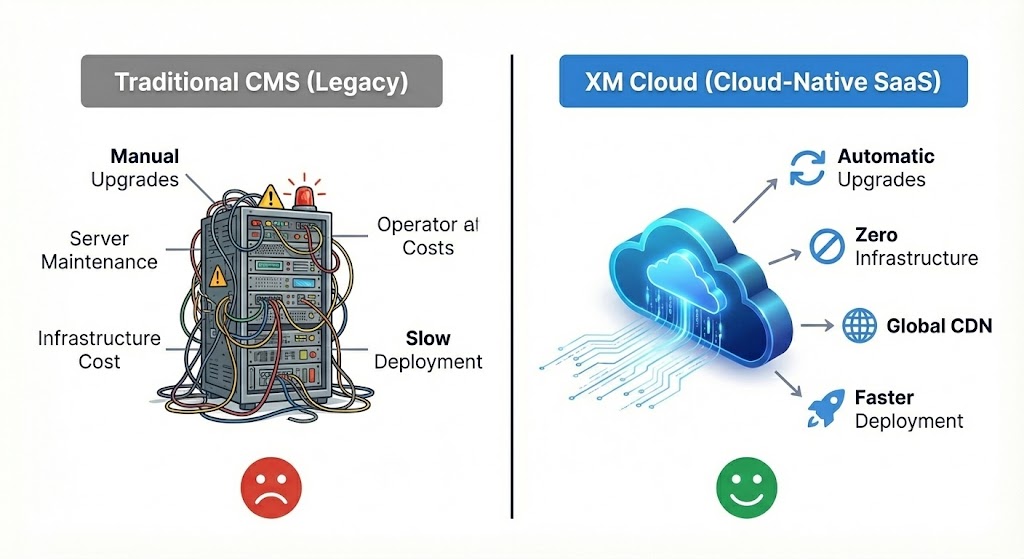
Sitecore XM Cloud represents the most significant evolution of the platform’s content management capabilities; a modern, cloud-native CMS built to remove infrastructure complexity, accelerate deployment, and support today’s composable and headless digital architectures.
To be clear, Sitecore XP remains supported, but XM Cloud is where Sitecore is concentrating its forward-looking innovation. This section focuses entirely on what XM Cloud is, how it works, and why it matters for modern digital teams.
What XM cloud actually is
XM Cloud is a fully managed SaaS CMS designed to deliver content through a headless, API-first architecture.
It modernises Sitecore’s traditional content engine by taking away all hosting, upgrades, patching and infrastructure responsibilities; allowing organisations to focus entirely on building and delivering digital experiences rather than maintaining systems.
Think of it as the “always-current” version of Sitecore’s CMS, delivered through a streamlined cloud environment with:
- Automatic version upgrades
- Continuous performance optimisation
- No server or database management
- Decoupled authoring and delivery
- Native global CDN delivery
This positions XM Cloud as a future-ready content foundation for enterprises adopting composable architecture.
Cloud-native architecture built for scale
XM Cloud is architected for high availability and global performance. Unlike traditional deployments that require manual scaling and infrastructure tuning, XM Cloud automatically handles:
- Traffic scaling
- Failover
- Content delivery acceleration
- Uptime management
- Distributed caching
This ensures consistent performance across regions, a core expectation for modern digital experience platforms.
Because hosting is fully managed, teams no longer need to plan server upgrades, patch cycles, or database maintenance.
Modern development experience
One of XM Cloud’s biggest advantages is its headless-first approach. It exposes content via REST and GraphQL APIs, allowing development teams to use modern frameworks such as:
- Next.js
- React
- Vue
- Vercel edge rendering
This decoupling enables:
- Faster development cycles
- Cleaner architecture separation
- Parallel work between devs and content teams
- Better performance through static and edge rendering
- A more agile experimentation environment
XM Cloud also provides official starter templates and tooling, reducing time-to-build significantly.
Integrated CI/CD, deployment pipelines and tooling
XM Cloud is built to support modern engineering workflows:
- Built-in continuous integration and delivery
- Container-friendly local development
- Automated environment provisioning
- Version-controlled content and component deployment
- Real-time preview and staging workflows
These capabilities reduce operational friction and make development more predictable aligning with how modern digital teams already work.
Zero-maintenance upgrades, security and compliance
XM Cloud receives rolling, automatic updates managed entirely by Sitecore.
This includes:
- Security patches
- Platform improvements
- Feature releases
- Infrastructure updates
With no downtime or upgrade projects required, teams avoid the significant cost and disruption associated with version upgrades in traditional CMS environments.
The hosting environment also aligns with enterprise security frameworks, including encryption standards, secure access protocols, and compliance-driven architecture suitable for regulated industries.
Where XM cloud delivers value
XM Cloud is most beneficial for organisations that:
- Manage multiple brands or high-volume content operations
- Need to simplify infrastructure management
- Require global performance and delivery reliability
- Prefer composable and headless architectures
- Want to reduce long-term operational cost and technical debt
- Need consistent, automatic upgrades without disruption
- Operate in industries requiring strong governance and compliance
In these scenarios, XM Cloud becomes the more strategic option due to its alignment with modern digital engineering practices.
When XM cloud may not be necessary
XM Cloud offers significant advantages, but it’s not a mandatory upgrade for every organisation.
Teams with stable infrastructure, low content volume, or minimal need for rapid deployment cycles may not experience the same level of ROI immediately.
The important takeaway:
XM Cloud is the modern, cloud-native path for organisations that want speed, scalability and reduced overhead; but it is not a compulsory replacement for existing implementations.
XM Cloud brings Sitecore’s content management capabilities into the cloud-native era offering automatic updates, global performance, modern composable architecture support, and reduced operational burden. It aligns strongly with where enterprise DXPs are heading, while still allowing organisations on traditional setups to proceed at their own pace.
7. Sitecore and composable architecture: understanding its mach alignment
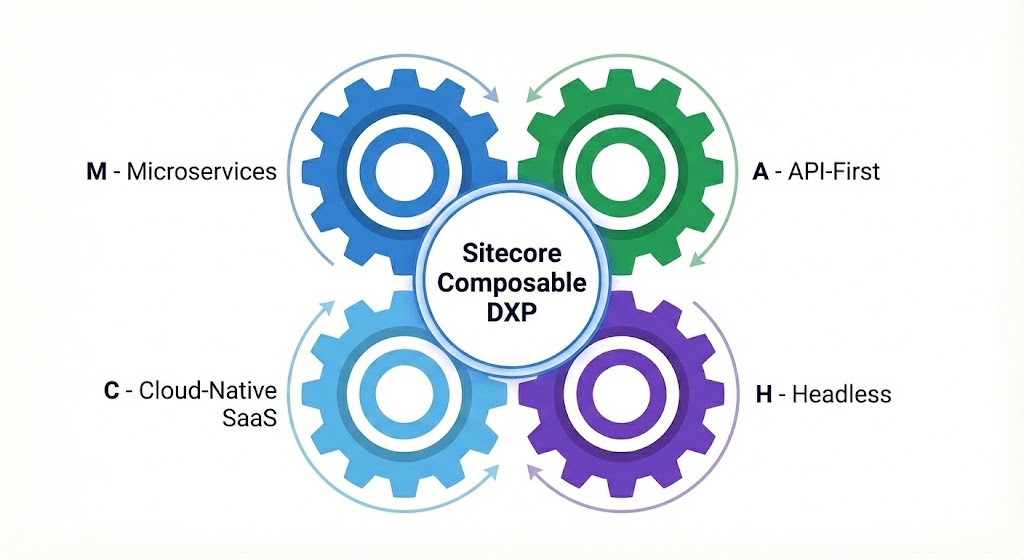
Over the past several years, the digital experience ecosystem has shifted away from monolithic platforms toward composable architecture. This is a modular approach that allows organisations to assemble best-in-class services through APIs rather than relying on one large suite to “do everything.” This movement is strongly aligned with the principles championed by the MACH Alliance (Microservices, API-first, Cloud-native SaaS, and Headless).
Sitecore’s modern product direction reflects this philosophy clearly. While it still supports traditional implementations, Sitecore has invested heavily in building a fully composable DXP; a modular, cloud-native ecosystem that pairs well with modern technology stacks and enterprise integration patterns.
Let’s break down how Sitecore fits into the composable landscape.
Moving from monolithic to modular sitecore’s transition
Historically, Sitecore XP functioned as a tightly unified, monolithic suite where content, analytics, personalisation and automation all lived in one platform. This approach worked well in its time, but it also meant:
- heavier infrastructure
- bigger upgrade projects
- less flexibility for teams wanting best-in-class integrations
- potential bloat when not all features were required
Sitecore’s acquisition strategy and roadmap signal a clear pivot away from this model. Today, its ecosystem is designed so that teams can adopt only the components they need.
This aligns with the broader enterprise reality:
Modern digital teams want modularity, integration flexibility, and technology that scales independently.
7.2 What Makes Sitecore a Composable DXP?
Sitecore’s composable DXP is built from independent cloud services that can function together or separately:
- Sitecore XM Cloud: cloud-native headless CMS
- Sitecore CDP: real-time customer data platform
- Sitecore Personalize: experience decisioning & optimisation
- Sitecore Send: email automation & communication
- Sitecore OrderCloud: API-first commerce engine
- Content Hub / Content Hub One: content operations & headless delivery
Each of these services:
- runs independently
- uses open APIs
- integrates with external stacks
- scales elastically
- supports headless architectures
- aligns with MACH principles
This means an organisation could pair XM Cloud with Adobe Commerce, or use CDP with Optimizely, or combine Personalize with Shopify; the architecture allows it.
7.3 Sitecore vs MACH principles (A quick matrix)
A clear look at how Sitecore’s modern stack aligns with MACH:
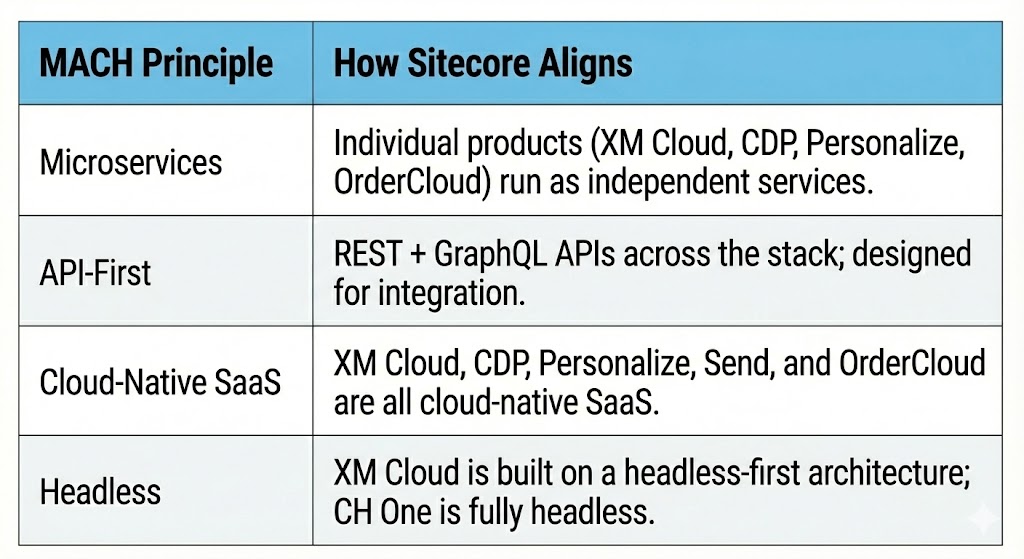
Sitecore’s modern stack adheres well to MACH expectations, however, XP, being monolithic, does not.
Why composable matters for modern digital teams
The shift toward composable DXPs is driven by real operational needs, not hype.
Enterprises today want:
- Faster deployment
- Easier upgrades
- Ability to “plug-and-play” new technologies
- Stable, specialised tools for each layer (CMS, CDP, automation, etc.)
- Reduced vendor lock-in
- Flexibility to evolve without replatforming
Composable architecture solves these problems by allowing each service to evolve independently.
Sitecore’s modern stack allows teams to:
- adopt XM Cloud without replacing analytics
- connect CDP to any CMS
- use Personalize with non-Sitecore sites
- integrate OrderCloud into existing commerce engines
- maintain only the services they actually need
This flexibility is one of the main reasons many enterprise teams exploring best Sitecore alternatives, sitecore Migration to XM Cloud, or sitecore composable DXP still keep Sitecore in their evaluation shortlist.
Composable vs traditional architecture, which is right for you?
Here is a simplified comparison:
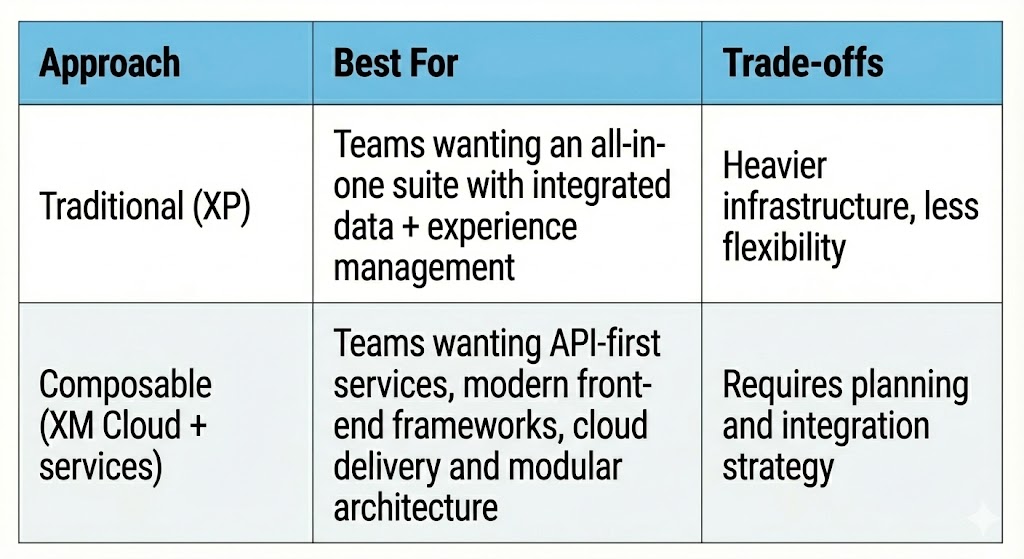
Neither is universally “better”.
The right choice depends on:
- team structure
- governance requirements
- long-term digital roadmap
- architecture preferences
- existing integrations
- appetite for cloud transformation
Composable architecture simply offers a more future-flexible path.
The practical realities of sitecore’s composable adoption
Sitecore’s composable stack performs strongly in:
- API-driven front-end delivery
- real-time personalisation
- modern CI/CD pipelines
- rapid deployments
- multi-cloud integrations
- global content delivery
- modular upgrades
It requires more upfront architectural planning, but the long-term benefit is reduced technical debt and more freedom.
This is particularly attractive for:
- large multi-brand enterprises
- global digital teams
- organisations preparing replatforming
- businesses considering sitecore xm cloud migration
- teams adopting MACH-standard architectures
8. Sitecore pricing
Sitecore does not publish fixed pricing. Costs change based on what you use. XM Cloud uses a subscription model. It covers hosting, upgrades, security and global delivery. The price depends on site count, traffic, API usage and any extras like CDP or Personalize.
The composable DXP products (CDP, Personalize, Send, OrderCloud) are priced separately. Each service has its own usage-based cost.
Traditional XP/XM licensing is still supported, but it comes with extra hosting and maintenance expenses.
Overall, Sitecore pricing is tailored. The final cost depends on your architecture, traffic, integrations and how much personalisation your business needs.
Sitecore strengths, weaknesses & limitations (honest evaluation)
This section gives a clear, unbiased view of where Sitecore performs well, where it struggles, and when it may not be the right choice. It also outlines alternatives teams commonly evaluate during platform selection.
1. Enterprise-grade content management: Sitecore is extremely strong for multi-brand and multi-region content operations. It handles complex governance, workflows and content structures better than most CMS platforms.
2. Personalisation capabilities: Through Sitecore Personalize and Sitecore CDP, teams get powerful real-time personalisation and decisioning tools. This is a major advantage for experience-driven businesses.
3. Composable and cloud-native options: XM Cloud + composable DXP services (CDP, Personalize, Send, OrderCloud) align well with modern MACH architecture. This gives teams flexibility and future scalability.
4. Strong globalisation support: Sitecore excels at multilingual content, regional variants, content fallback and global publishing trees.
5. Developer flexibility: The headless CMS model supports Next.js, React, Vercel and modern DevOps pipelines. XM Cloud improves delivery speed and reduces overhead.
6. Suitable for regulated industries: Banks, universities, governments and healthcare organisations rely on Sitecore due to its governance, security and compliance capabilities.
Weaknesses
1. Higher cost of ownership: Sitecore is an enterprise platform. Licensing and implementation tend to be more expensive than mid-market CMS options.
2. Steeper learning curve: Authors and developers often require more onboarding than with simpler platforms. Complexity grows with multiple brands and workflows.
3. Migration effort: Moving from XP/XM to XM Cloud can require planning, refactoring or full front-end rebuilds; depending on legacy setup.
4. Not ideal for small teams: For businesses needing only basic content publishing, Sitecore may be more platform than necessary.
5. Composable adoption requires maturity: The composable DXP is powerful, but requires clear architecture planning and product ownership.
When Sitecore is not the right solution
Sitecore might not be the best fit when:
- You only need a simple marketing website.
- You have a small team with no need for workflows or regional governance.
- You want the lowest-cost CMS option.
- You do not need personalisation, segmentation or advanced content operations.
- Your content operations are minimal and do not require multi-site or multi-language structure.
- Your team is not ready to manage composable architecture or DevOps processes.
In these cases, lighter SaaS or open-source CMS platforms may be more suitable.
Alternatives to Sitecore
Below are common alternatives organisations evaluate when comparing enterprise CMS and DXP options:
1. Adobe Experience Manager (AEM)
- Strong enterprise CMS
- Extensive feature set
- Very high cost
- Often compared directly with XM Cloud and XP
2. Optimizely (formerly Episerver)
- Excellent experimentation capabilities
- Strong CMS + DXP combo
- Good for composable architecture
- Often chosen for its balance of features and usability
3. Contentful
- Pure headless CMS
- Simple, fast, developer-friendly
- Lower cost
- Ideal for teams wanting a lightweight approach without deep personalisation
4. Kentico Xperience
- Mid-market CMS and DXP
- Lower cost than Sitecore
- Strong marketing features
- Best for teams that want an all-in-one suite but don’t need enterprise depth
5. Strapi
- Open-source headless CMS
- Fully API-first and developer-friendly
- Good for custom projects
- Lower cost, but limited enterprise workflow and governance features
Sitecore is powerful, flexible and enterprise-ready especially for organisations needing personalisation, multi-site management and composable architecture. However, it is not the simplest or cheapest CMS, and may not fit smaller teams or low-complexity websites. Alternatives like AEM, Optimizely, Contentful, Kentico and Strapi each offer strengths depending on business size, budget and digital maturity.
Conclusion: making the right choice for your digital future
Sitecore remains one of the most capable and flexible digital experience platforms available today. Its evolution into a modern, composable, cloud-native ecosystem; led by XM Cloud, Sitecore CDP, Personalize, and Content Hub, gives organisations more freedom than ever to build the digital architecture that fits their needs.
At the same time, Sitecore’s traditional platforms (XP and XM) remain supported, stable options for teams who aren’t ready for a cloud transformation. This dual-path approach allows organisations to modernise at their own pace, without pressure or forced timelines.
The most important takeaway is this:
Sitecore is not a one-size-fits-all platform. It is a powerful ecosystem that delivers exceptional value when matched with the right business model, digital maturity, and operational requirements.
It excels in environments where:
- content operations are complex
- governance and compliance matter
- personalisation drives growth
- multi-brand or multi-region scale is essential
- composable architecture aligns with long-term strategy
For smaller teams or simpler publishing needs, lighter CMS platforms may be more cost-effective. For enterprises aiming to unify content, data, personalisation and global delivery under one strategic platform, Sitecore remains a top-tier choice.
No platform is perfect, and no decision should be made in a vacuum but with the right strategy, the right roadmap and the right implementation partner, Sitecore can be one of the most transformative digital foundations an organisation can invest in.
If you need help evaluating your options or planning a move toward Sitecore XM Cloud or a composable DXP, Velacore’s experts are always here to guide you with clarity, data-driven reasoning and honest recommendations.
Is Your Website Working for You?
Most websites don't generate leads. We fix that with custom designs that look great and deliver measurable results for your business.
Get Started With Velacore