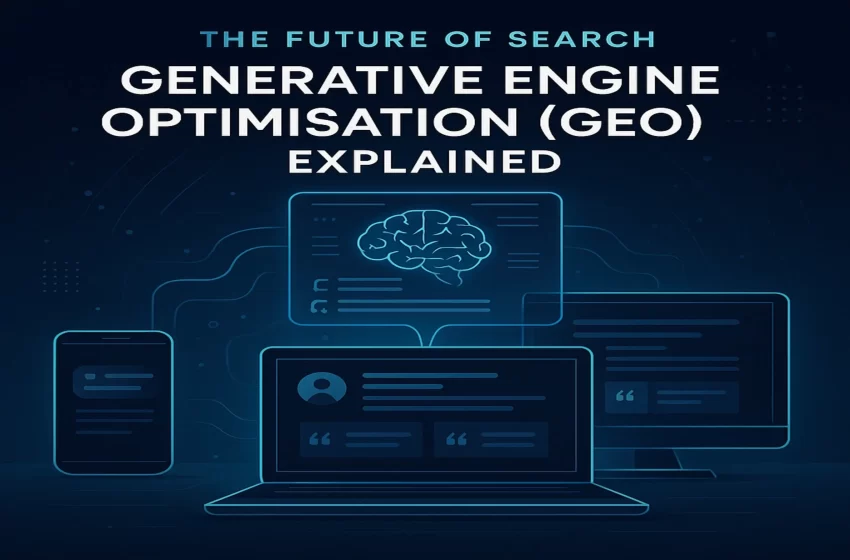
Generative Engine Optimisation (GEO) is rewriting the rules of online visibility. Traditional SEO which is the practice of optimising for search engines like Google, has met its next evolutionary phase. Now, it’s not just about ranking on a results page; it’s about being referenced, cited, and featured by AI-driven search assistants like Google’s Search Generative Experience (SGE), ChatGPT, and Perplexity AI.
Across Australia, marketers and brands are asking the same question:
“How do we stay visible when AI tools are now answering users directly?”
That’s where Generative Engine Optimisation comes in.
Generative Engine Optimisation (GEO) is the new frontier of visibility in the digital world. one where AI-driven generative engines and other large-language-model powered systems are increasingly shaping how information is discovered, consumed and acted upon.
If your content isn’t ready for this shift, it risks being invisible not just to human users, but to the very systems that are now delivering the answers.
The rise of generative search: why GEO matters
In Australia, the adoption of AI technologies is accelerating: a recent survey by Google Australia and Ipsos found that 74 % of Australian AI users report using AI at work, with major uses including writing (75 %), brainstorming (69 %), problem-solving (70 %) and digesting complex documents (68 %).
Further research from Adobe reveals that one in three Australians (around 33 %) now use AI assistants regularly, a 7 % rise since earlier in the year.
The implications for content creators and digital marketers? If your piece ranks well but isn’t structured or positioned in a way that generative engines can interpret, it may never be surfaced as the answer to a user’s query.
Defining GEO: more than just SEO
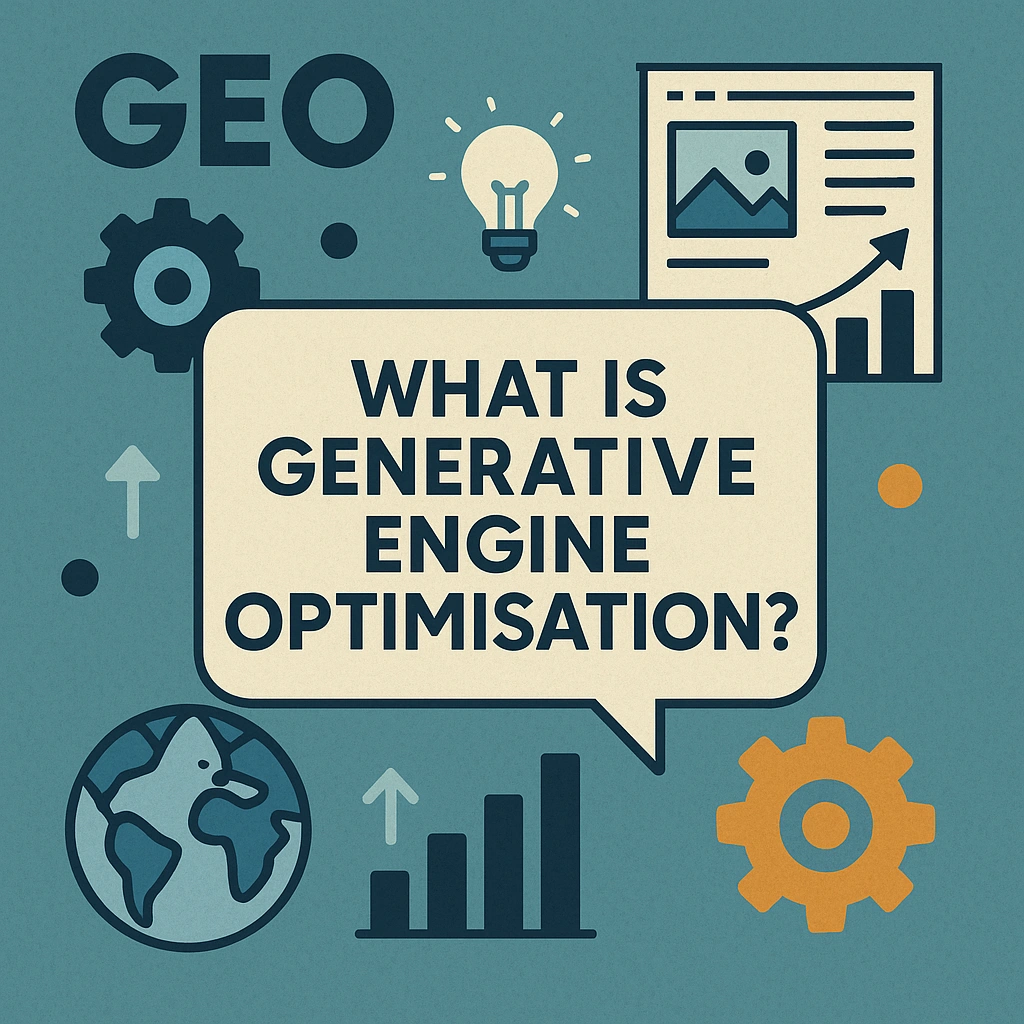
Generative Engine Optimisation (GEO) is the process of optimising your digital content and presence so that AI-powered generative search engines can find, understand, integrate, and cite you. Unlike traditional SEO which emphasises keywords, backlinks, meta tags and human search results, GEO emphasises attribution, context, structured data, and authority in ways that align with how generative models select and synthesize answers.
In other words: if SEO is about ranking on a results page, GEO is about being referenced in the answer the user receives.
Why businesses in Australia can’t ignore GEO
In this new environment:
- Your website is no longer competing only for clicks, it’s competing for inclusion in AI-generated responses.
- A piece of content may draw little “traditional” traffic but still exert considerable influence by being cited or summarised by a generative engine.
- Standing still means falling behind: the brands that actively optimise for generative answers gain visibility where others are invisible.
Remember; whether you’re a digital agency in Sydney, a local Australian SME, or an international brand targeting APAC; if you want sustained visibility in the era of AI-powered search, you need to master GEO.
From SEO to GEO; The evolution of search
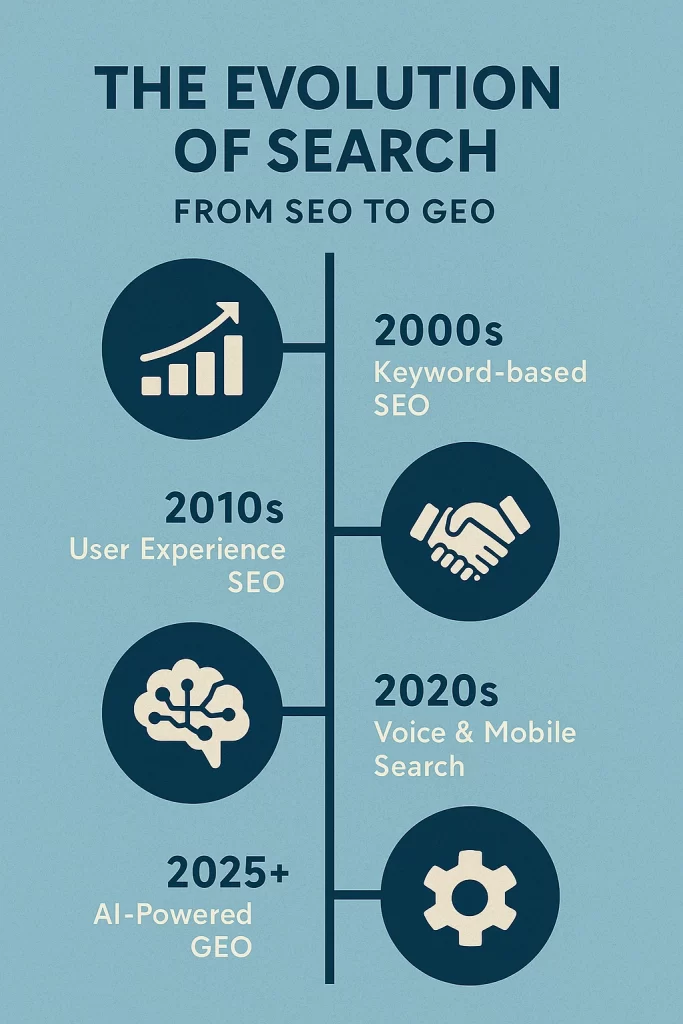
For over two decades, Search Engine Optimisation (SEO) has helped brands rise to prominence online guiding Google’s algorithms to understand which pages deserve the top spot. But with the rise of AI-powered search assistants, a new layer of discovery has emerged: Generative Engine Optimisation (GEO).
GEO doesn’t replace SEO; it enhances and extends it. Traditional SEO ensures your site appears in organic search results. GEO ensures your expertise is referenced, summarised, or cited when generative AI systems produce answers.
Together, they form a dual visibility strategy for the new search ecosystem.
How SEO paved the way
SEO has always been about relevance, authority, and accessibility. By optimising pages for target keywords, improving site structure, and earning backlinks, businesses ensured search engines could find and rank their content.
And it still works. In fact, Google commands 93 % of Australia’s search market as of 2025, proving that SEO remains the foundation of discoverability.
However, the way people consume those search results has changed. Voice search, featured snippets, and AI-generated summaries now dominate user experiences, compressing thousands of results into a few key takeaways.
The shift toward generative search
Generative engines such as Google’s Search Generative Experience (SGE), ChatGPT’s integrated search, and Perplexity AI, don’t just list answers. They create them.
These engines synthesise content from multiple sources to produce conversational, human-sounding responses, often citing brands, researchers, or credible publishers that demonstrate topical authority.
That’s where Generative Engine Optimisation steps in: it ensures your content is structured, factual, and context-rich enough for AI models to understand and trust.
SEO + GEO: Partners, not rivals
Rather than viewing GEO as a threat to SEO, smart marketers see it as an evolution of the same mission, helping people and machines find reliable, useful information.
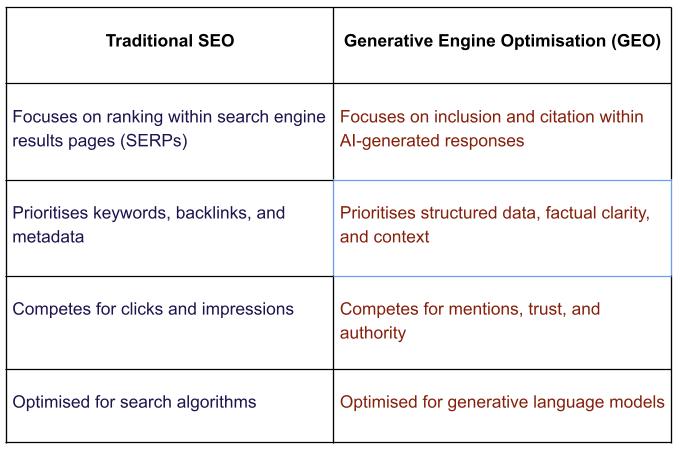
GEO amplifies what SEO achieves; moving from “ranking higher” to “being referenced more.
A research found that 84 % of marketers expect AI to significantly reshape how SEO content is created and optimised.
This doesn’t signal the death of SEO, rather, it highlights a strategic pivot. Businesses that continue investing in both SEO and GEO will maintain visibility across both traditional and generative search platforms.
Note: Generative Engine Optimisation isn’t here to replace SEO, it’s here to reinforce it. In the AI era, visibility doesn’t stop at Google’s results page; it extends to every place users get answers. And for Australian brands, mastering both SEO and GEO is the surest path to future-proof visibility.
How generative search engines work (Google SGE, ChatGPT, and Perplexity)
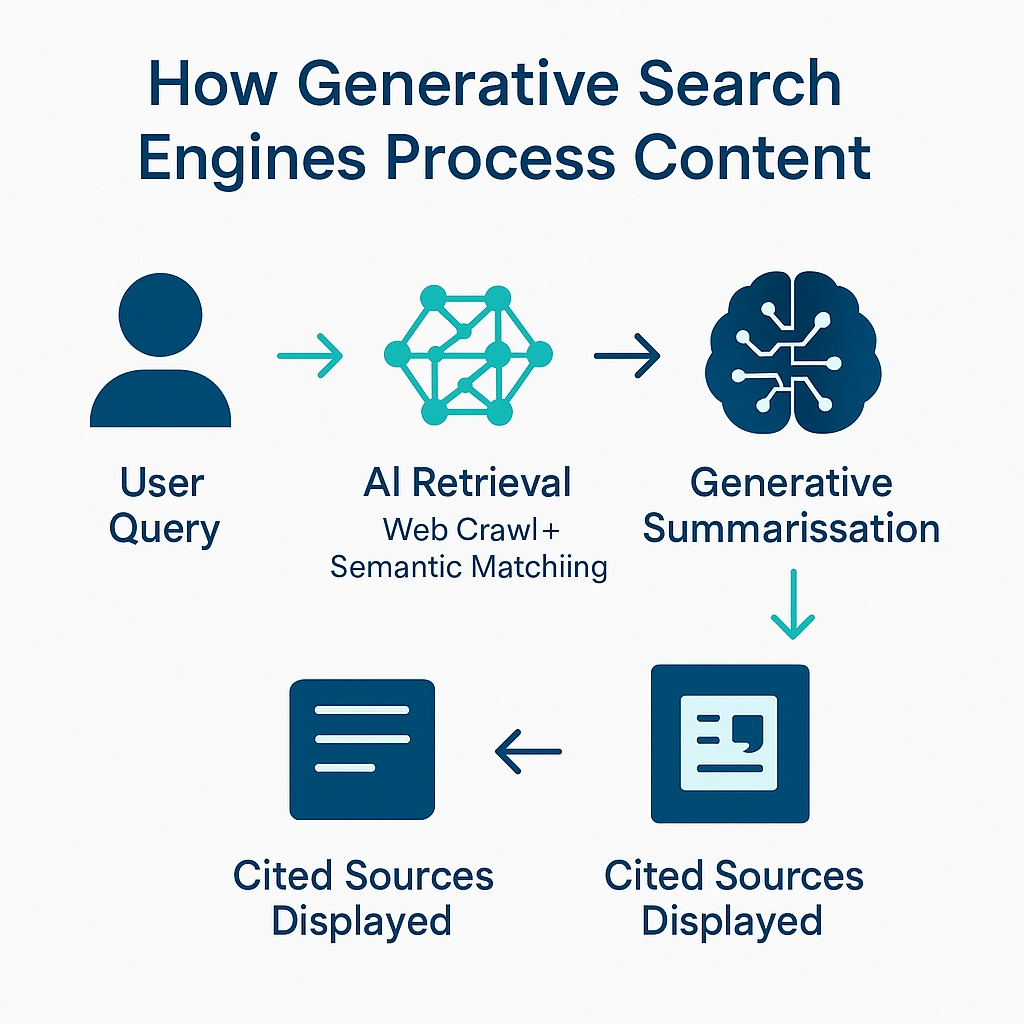
To understand Generative Engine Optimisation (GEO), you first need to know how generative search engines think, read, and respond.
Traditional search engines like Google crawl, index, and rank web pages using algorithms. Generative engines, on the other hand, understand and synthesise they use large language models (LLMs) to generate natural-language answers instead of displaying a list of links.
This means they interpret your content, assess its credibility, and decide whether it deserves to be referenced in their AI-generated responses.
Let’s explore how three key players; Google SGE, ChatGPT, and Perplexity AI work.
1. Google’s Search Generative Experience (SGE)
In 2024, Google began gradually rolling out its Search Generative Experience (SGE); an AI-powered enhancement to its core search product. According to Google’s official blog, SGE “helps users get the gist of a topic faster by generating quick overviews and follow-up prompts,” integrating content from multiple web sources (blog.google).
How SGE works:
- Query Understanding: SGE interprets the user’s intent using natural language processing.
- Contextual Retrieval: It fetches the most relevant web pages, not only based on keyword match but sematic depth.
- Generative Summarisation: The AI composes a conversational answer summarising those pages.
- Attribution and Citation: Credible sources are displayed as “cards” below the summary these are the brands successfully applying Generative Engine Optimisation.
Example: If an Australian user searches “best eco-friendly cleaning products,” SGE may generate a paragraph summarising top-rated options, citing trustworthy sources like CHOICE Australia, Better Homes & Gardens, or brand websites optimised for AI citation.
GEO Insight:
GEO helps content appear in those citation cards by:
- Writing with clear factual statements the AI can confidently use.
- Using schema markup (e.g., Product, Organisation, Review).
- Including author credentials and sources to boost trust signals.
2. ChatGPT (OpenAI’s Search Integration)
While ChatGPT began as a conversational assistant, it has evolved into a hybrid AI + web search tool. As of May 2024, OpenAI confirmed that ChatGPT with GPT-4o can “search the web and cite live sources” for pro and enterprise users.
How ChatGPT search works:
- User query parsing: The model interprets intent and reformulates the query.
- Web search retrieval: Integrated APIs fetch relevant, fresh data from indexed pages.
- Generative synthesis: ChatGPT combines model knowledge and retrieved data to produce an accurate, conversational response.
- Citation display: URLs appear as linked references at the end of responses.
GEO Insight:
To earn citations in ChatGPT’s responses, websites must:
- Offer unique, verifiable insights, not generic summaries.
- Include structured headlines, readable text, and credible outbound links.
- Maintain fast, accessible pages, since the AI prioritises indexable, high-quality domains.
In other words, ChatGPT trusts content that reads like it was written by an expert and verified by a human; which is exactly what Generative Engine Optimisation aims to achieve.
3. Perplexity AI
Perplexity AI represents the next wave of generative search engines, built entirely around conversational discovery.
According to Perplexity’s own statistics, the platform now handles over 10 million monthly users globally and focuses on “source transparency,” displaying citations beside every generated paragraph.
How perplexity works:
- Hybrid Search + Generation: Combines neural retrieval and generative summarisation.
- Real-Time Citations: Every statement is backed by a visible source.
- User Interaction Loop: Allows follow-up questions that refine context.
GEO Insight:
GEO strategies that work best on Perplexity include:
- Explicit referencing (linking data to primary sources).
- Using FAQs and Q&A structures, since Perplexity mirrors conversational intent.
- Publishing evergreen, authoritative insights on niche topics.
Quick comparison table
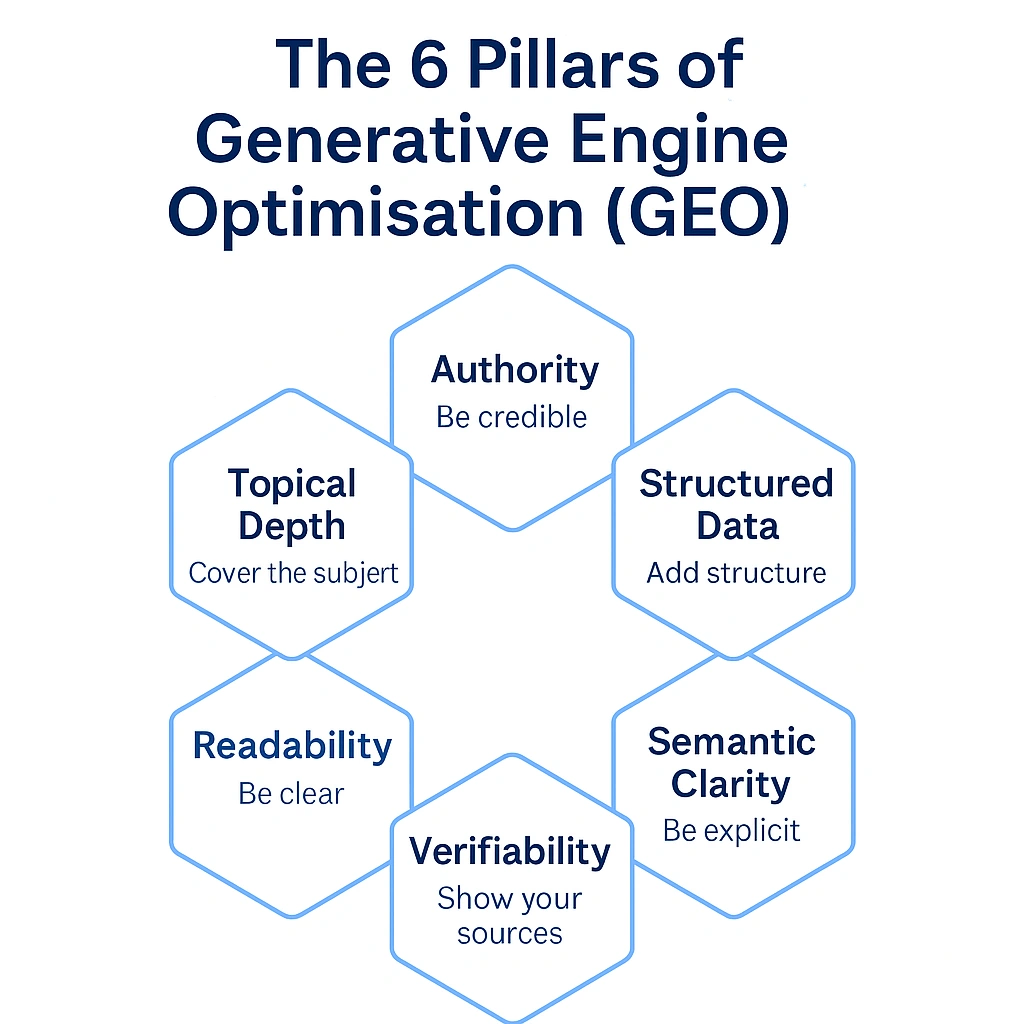
Key principles of Generative Engine Optimisation (GEO)
If SEO taught us how to speak to algorithms, then Generative Engine Optimisation (GEO) teaches us how to speak to artificial intelligence. It’s not just about inserting keywords or backlinks anymore; it’s about creating trustworthy, context-rich content that AI systems can confidently summarise, cite, and recommend.
To rank and be referenced in AI-driven search, every piece of content must demonstrate authority, accuracy, and interpretability. Let’s break down the key principles that define effective GEO.
1. Authority and expertise: Become a trustworthy source
Generative engines prioritise information from authoritative, verifiable, and transparent sources.
According to Google’s Search Quality Evaluator Guidelines (2023), pages with strong E-E-A-T — Experience, Expertise, Authoritativeness, and Trustworthiness, are more likely to be surfaced and cited by AI-driven systems.
GEO implementation tips:
- Include author bios, credentials, and real-world experience.
- Reference credible sources, government reports, or academic data.
- Use Australian statistics or region-specific insights to build local authority.
- Add external citations (with outbound links) to reinforce factual reliability.
Example: An NDIS provider writing about assistive technologies should cite the NDIS Commission or Australian Government Department of Social Services, signalling trustworthiness to generative systems.
2. Structured data and schema markup
AI engines like Google’s SGE, Perplexity, and ChatGPT Search rely on structured signals to understand and categorise content.
Structured data, also known as schema markup provides machine-readable context about your web pages.
GEO Implementation Tips:
- Add schema types such as Article, FAQ, Product, or Organization.
- Include “About” and “Mentions” schema to associate your brand with entities (people, places, concepts).
- Use JSON-LD format for all structured data.
- Ensure metadata (titles, alt text, canonical tags) align with your focus keyword.
Example: A GEO-optimised article about “NDIS Cybersecurity” could include an About schema linking to “Australian Cyber Security Centre (ACSC)” and “NDIS”, reinforcing topical alignment.
3. Context and semantic clarity
AI doesn’t read, it interprets meaning through relationships between entities, concepts, and context.
Generative engines depend on semantic clarity to determine how your content fits into broader knowledge graphs.
A report has suggested that semantically linked content (e.g., interlinked cluster pages) improved contextual discoverability across AI-driven platform.
GEO Implementation Tips:
- Use topic clusters; one pillar article supported by interlinked sub-articles.
- Include definitions and examples that connect related terms.
- Maintain consistent entity naming (e.g., always use “Generative Engine Optimisation (GEO)” rather than mixing terms).
- Write in clear, factual language that reduces ambiguity.
Example: Use “Generative Engine Optimisation (GEO)” instead of “AI SEO” unless explicitly comparing the two. Clarity helps engines map your content to the right topic cluster.
4. Data transparency and verifiability
Generative engines penalise unverifiable claims. AI systems such as Perplexity and ChatGPT prioritise answers with traceable data. Meaning they favour sources that cite their own sources.
AI models increasingly filter content based on verifiability density; the ratio of cited data points to total word count.
GEO implementation tips:
- Provide links to primary research ( Industry database, government portals).
- Include dates, metrics, and context for all statistics.
- Use visual data elements (infographics, charts, tables) that convey evidence.
- Avoid vague terms like “many experts say” without citation.
5. Readability and user-centric design
Even in an AI-first world, user experience remains a ranking factor for both humans and machines. Google’s Helpful Content Update (2023) emphasises content written “for people, not algorithms.”
Generative engines extract and summarise information more effectively from clear, structured, and scannable pages.
GEO implementation tips:
- Keep paragraphs under 100 words for readability.
- Use descriptive subheadings and bullet points.
- Integrate alt text, table of contents, and content summaries.
- Optimise site speed and accessibility..
6. Topical authority through consistent publishing
AI models are trained to detect consistency and topical depth. Publishing one GEO-optimised article won’t move the needle, but maintaining a consistent stream of related, high-quality content will.
GEO implementation tips:
- Build topic clusters around a central pillar page.
- Refresh old content with current data and links.
- Maintain internal link hygiene to signal relevance.
- Use GEO-oriented content calendars to plan updates quarterly.
Final thoughts: the next era of search belongs to the geo-ready
For years, Search Engine Optimisation (SEO) helped Australian businesses get found on Google. Today, GEO ensures those same businesses are understood and cited by the intelligent systems shaping how people now discover information. From Google’s Search Generative Experience (SGE) to ChatGPT Search and Perplexity AI, success now depends on how clearly, credibly, and contextually your content communicates.
Generative Engine Optimisation isn’t about replacing SEO, it’s about elevating it. It’s the bridge between your human expertise and the AI models learning to summarise the web.
Brands that invest early in GEO will not only survive this evolution, they’ll lead it.
At Velacore, we’re helping Australian brands step confidently into this AI-powered future. Our GEO-driven strategies combine:
- Proven SEO fundamentals with advanced AI-readiness techniques
- Structured data and entity optimisation that improve trust signals
- And content frameworks that make sure when AI answers, it references you
The future of search wouldn’t just be about who ranks highest, but also about who’s trusted most.
If you’re ready to future-proof your online visibility, it’s time to optimise beyond algorithms, and start optimising for understanding.
Partner with Velacore and let’s make your business discoverable, trusted, and AI-cited.
Frequently Asked Questions About Generative Engine Optimisation (GEO)
1. What is Generative Engine Optimisation (GEO)?
Generative Engine Optimisation (GEO) is the process of optimising your online content so it can be understood, cited, and summarised by AI-powered search systems like Google’s Search Generative Experience (SGE), ChatGPT, and Perplexity AI.
Unlike traditional SEO that focuses on ranking, GEO focuses on visibility within AI-generated responses helping brands appear as trusted sources in conversational answers.
2. How is GEO different from SEO?
SEO helps your website rank on search engine results pages (SERPs), while GEO ensures your information is referenced and trusted by AI-driven search engines.
Both work together; SEO gets you found; GEO gets you quoted.
| SEO Focus | GEO Focus |
| Ranking for keywords | Being cited by AI |
| Click-through rates | Content trust and verifiability |
| Human search results | AI-generated summaries |
3. Why does GEO matter for Australian businesses?
Australians are rapidly adopting AI tools. A survey revealed that 33 % of Australians use AI assistants daily, up 7 % from early 2024. This means potential customers may find answers through AI summaries rather than Google listings. GEO ensures your business remains visible, credible, and AI-mentionable.
4. How do I optimise my website for Generative Engine Optimisation?
To optimise for GEO, follow these essential steps:
- Add structured data (schema markup) to help AI read context.
- Include citations and verifiable statistics in your content.
- Maintain E-E-A-T (Experience, Expertise, Authoritativeness, Trustworthiness).
- Write clear, factual, and semantically rich content.
- Interlink related pages to build topical depth.
5. Is GEO replacing SEO?
No, GEO doesn’t replace SEO. It extends it. Think of it as SEO 3.0; a layer that helps your content interact with AI language models instead of only ranking on Google. Strong SEO remains vital; GEO ensures it remains relevant in the age of generative AI.
6. Can small businesses benefit from GEO?
Absolutely. GEO helps even small Australian businesses compete with larger brands by building trust and topical authority. If your content is credible, factual, and well-structured, AI engines can reference your expertise even if your site isn’t the biggest in your industry.
7. How will GEO affect future content marketing?
GEO is transforming content marketing from keyword-centric to context-centric. Future success will depend on:
- Factual storytelling backed by data.
- Multi-modal content (text, visuals, voice, video).
- Clear author attribution and verifiable claims.
Brands that prioritise quality, clarity, and authenticity will earn more visibility in AI search ecosystems.
Is Your Website Working for You?
Most websites don't generate leads. We fix that with custom designs that look great and deliver measurable results for your business.
Get Started With Velacore