
What a recognisable identity can change, how to measure the value and what belongs in the investment.
Your business has outgrown its presentation. The website looks like one company, the proposal looks like another and every new campaign starts with somebody asking for the logo again. A refresh might help. The harder question is whether it will change anything commercially.
The ROI of brand identity comes from the additional contribution and real cost savings an identity programme creates, compared with its full cost. Recognition, enquiry quality, realised prices and production efficiency can show where value is developing. They become a financial return only when you connect them to actual customer outcomes and costs.
A stronger identity makes the business easier to recognise. The offer and experience still have to make it worth choosing.
- In its 2023 distinctiveness research with Jones Knowles Ritchie and more than 26,000 respondents globally, Ipsos classified only 15% of tested brand assets as Gold standard. Having a logo and palette is not the same as owning recognisable cues.
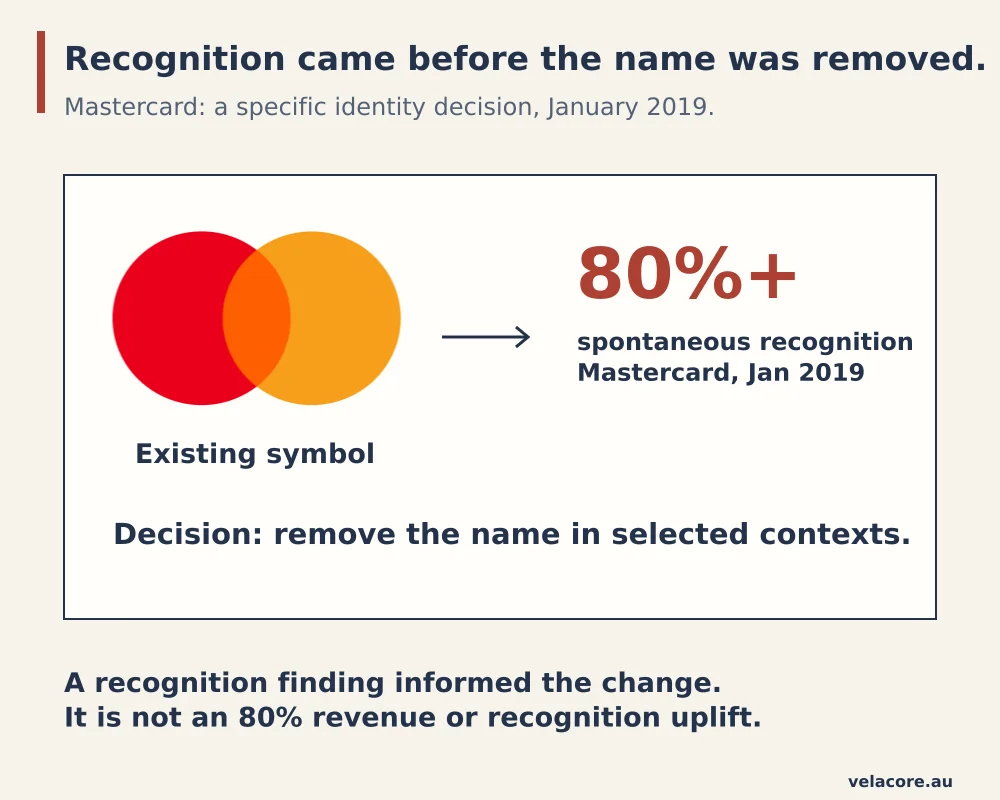
- Mastercard reported more than 80% spontaneous recognition of its symbol before removing the name in selected contexts in 2019. That was evidence for a specific decision, not a universal return from simplifying logos.
- Worked example: a 5% price reduction on an A$1,000 sale with A$600 in direct delivery costs reduces contribution from A$400 to A$350, a 12.5% reduction. Protecting the value buyers understand can matter more than another attractive mockup.
What does the ROI of brand identity actually include?
Brand identity is the system through which people recognise the business: its name, visual cues, typography, imagery, verbal style and how those elements appear together. Brand strategy determines the audience, position and promise. Customer experience supplies the evidence that the promise deserves belief.
These jobs interact, but they are not interchangeable. A business with the wrong offer cannot solve it by changing the typeface. A credible specialist that looks fragmented across its website and sales materials may have a different problem: people cannot easily connect the evidence to the same company.
The Ehrenberg-Bass Institute’s work distinguishes an asset’s fame, how widely it evokes the brand, from its uniqueness, how exclusively it evokes that brand. An attractive new symbol starts without the associations an established asset may already carry.
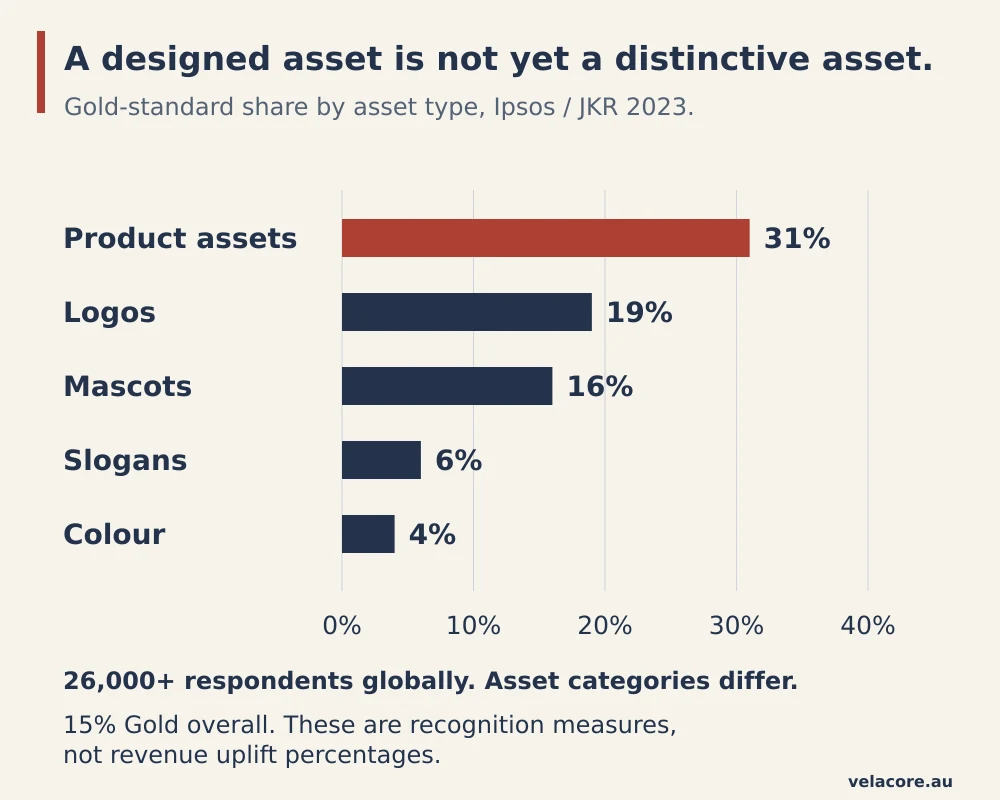
That distinction changes the brief. In the Ipsos and JKR study, the share receiving Gold classification differed by asset type:
| Asset type | Gold-standard share | How to read the figure |
|---|---|---|
| Product assets | 31% | A product’s recognisable form can carry identity |
| Logos | 19% | A designed mark still needs correct brand linkage |
| Mascots | 16% | A character needs learned associations |
| Slogans | 6% | Words are not automatically distinctive |
| Colour | 4% | Choosing a colour alone rarely creates ownership |
These are category-specific results from a global asset study, not percentages of sales generated or a forecast for your business. The useful question is whether buyers can connect your particular cues to you.
1. Measure brand recognition before replacing what people remember
Test which existing elements people associate with your business before approving a new identity. Preserve useful recognition and fix the elements that confuse or fail to identify you.
Start with customers and relevant category buyers, not just staff. Show one asset without the company name and ask, “Which business, if any, does this bring to mind?” Record the answer before showing options or explaining what you wanted them to see.
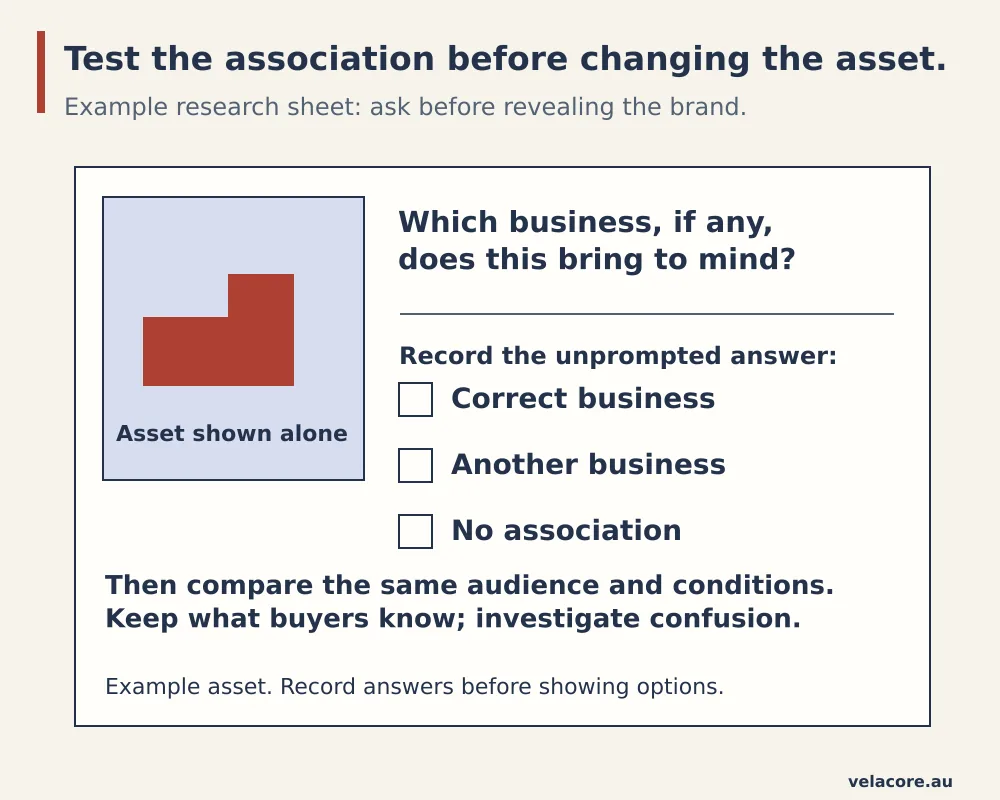
Separate three outcomes: your business named correctly, a different business named and no association. Then look at why the cue works: its shape, combination of colours, wording, image treatment or repeated context. An enthusiastic internal vote for the new design answers a different question.
Keep the exposure conditions and audience comparable when repeating the exercise. A handful of interviews can reveal confusion, but it cannot establish a precise market-wide recognition percentage. Use a properly designed research sample when the financial decision requires that level of confidence.
Good logo design also has to survive real use: a small website header, a proposal, a label and a reversed background. Test those applications, not just the large mockup on the presentation slide.
Use colour psychology as a research question. Is the palette recognisable, appropriate to the category and readable? “Blue means trust” is not a commercial strategy. A colour associated with a competitor may make you familiar for the wrong reason.
The Mastercard example is valuable because the sequence matters. In its January 2019 announcement, the company said more than 80% of people spontaneously recognised the symbol without its name. It then allowed the circles to stand alone in selected applications.
The announcement does not demonstrate that removing the word produced an 80% improvement, or that a new logo will lift your revenue. It shows a business using accumulated recognition to make an identity decision. That is a much better lesson than copying the visual outcome.
2. Check whether brand consistency improves the buying journey
Look for the points where inconsistent identity makes the business harder to understand or verify. The question is whether customers can recognise the same offer as they move from an advertisement or referral to the website, proposal and delivery.
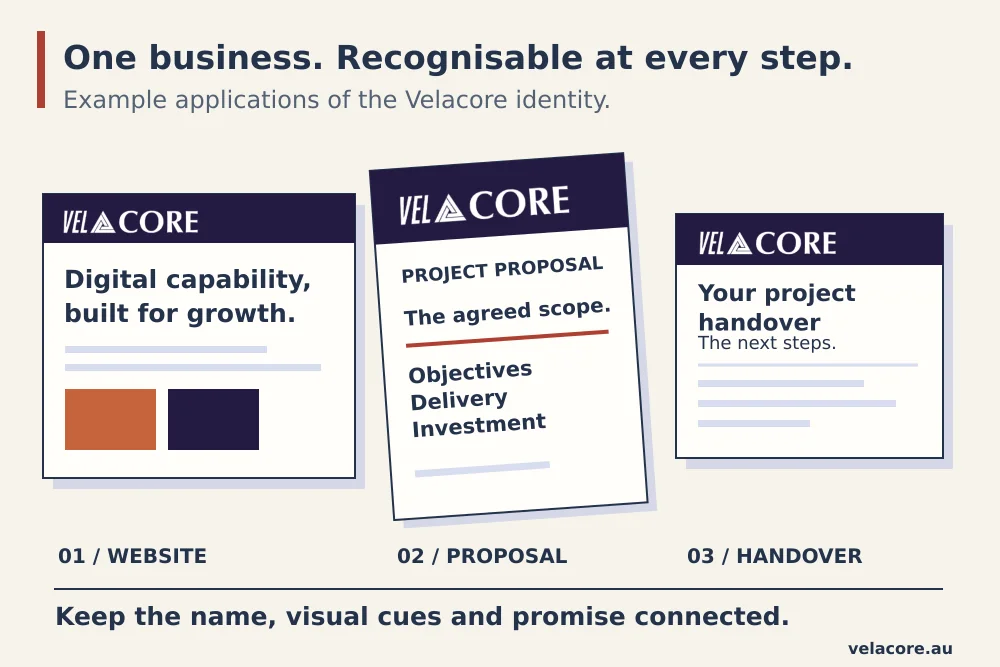
Keep the name, core service descriptions, relevant credentials, tone and visual cues coherent. A buyer should not have to work out whether the proposal belongs to the company whose website persuaded them to enquire.
Then test the practical journey. Can a first-time visitor explain what you do? Does the page show evidence that supports the promise? Is the next action clear? Does the quote describe the service the buyer thought they were requesting?
- Recognition problem: customers do not connect the materials with your company.
- Clarity problem: they recognise you but cannot understand the offer or next step.
- Delivery problem: the actual service contradicts the promise.
Each needs different work. Our web design psychology guide examines the interface and decision-making side; identity is one part of that experience.
Measure a relevant completed action, such as an accepted enquiry, booked consultation or purchase, rather than announcing success from a higher click rate alone. Where traffic and implementation allow it, a controlled test can isolate a narrower design question. If the whole website, offer and campaign change together, report the combined result instead of assigning all of it to the logo.
3. Track realised prices and contribution, not a promised premium
A credible identity can help communicate the value behind a price. The commercial test is whether customers understand that value and whether actual sales retain a healthier contribution, not whether the design looks expensive.
Compare realised selling prices, discount frequency, job mix and reasons for lost quotes. A higher average invoice might mean you sold larger projects, not that buyers paid more for the same scope.
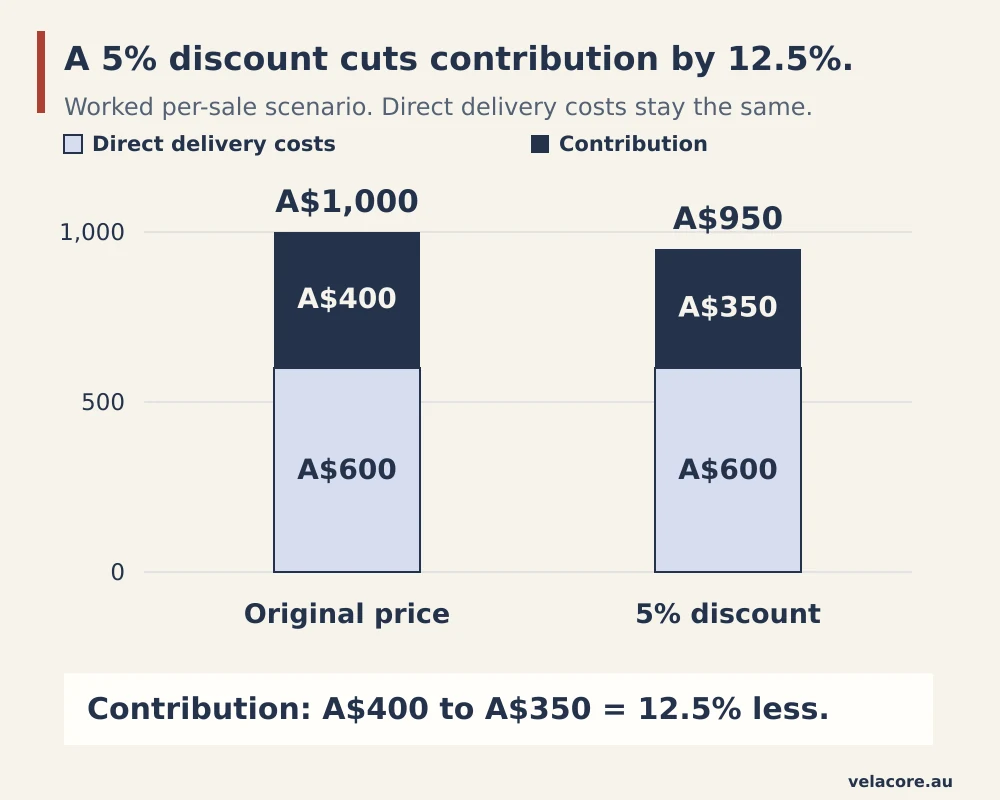
| Per sale | Original price | Discounted price |
|---|---|---|
| Selling price | A$1,000 | A$950 |
| Direct delivery costs | A$600 | A$600 |
| Contribution before programme and other overheads | A$400 | A$350 |
The A$50 discount is 5% of the original price and 12.5% of the original A$400 contribution. This is a worked scenario, not a client result or evidence that branding will prevent discounting. It shows why the quality of a sale belongs beside its revenue in your measurement plan.
Build the price story from real evidence: scope, expertise, reliability, useful differentiation and delivery. The identity should make those qualities recognisable. It cannot manufacture them.
4. Put brand consistency to work in everyday production
Measure the time and external cost of creating repeat materials. A useful identity system gives teams approved components and clear decisions so they stop rebuilding the same assets.
That might mean a proposal template, accessible website components, a small image library, email signatures and rules for adapting a campaign. Keep the rules specific enough to use: which logo version, which heading style, which approved service description and who can change it.
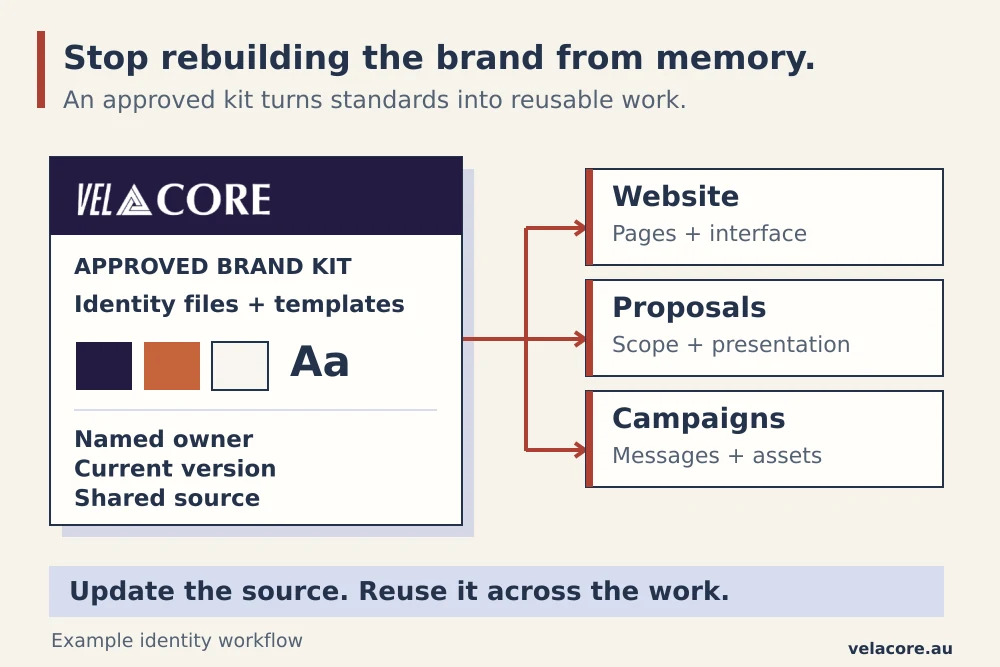
Record a simple baseline: how long a typical proposal or campaign takes, how often it needs correction and what external rework actually costs. Then compare like-for-like work after the rollout.
An hour released is useful capacity. It becomes a cash saving only when a real cost is avoided, or a commercial benefit when the capacity produces additional value. Do not count the same saved hour as both reduced payroll and extra sales unless both effects genuinely occurred.
Accessibility belongs in the system as well. WCAG’s minimum text contrast is 4.5:1 for ordinary text and 3:1 for qualifying large text, with stated exceptions. Plan accessible colour combinations and readable type, rather than flattening the visual identity or leaving each author to improvise.
5. Check repeat business and referrals against the actual experience
Track whether customers recognise, return to and recommend the same business over time. Keep the customer cohort and service context clear, because a new identity and better retention are not automatically cause and effect.
Look at repeat purchase or renewal rates for comparable cohorts, time between purchases, referral enquiries and reasons for leaving. Read those alongside service changes, price changes, availability and customer feedback.
A dependable identity makes the business easier to recall and find again. Continued loyalty also depends on whether the product or service earns it. If customers leave because deadlines are missed, changing the packaging will not repair the underlying experience.
The same discipline applies to recruitment. A clear careers page and consistent employer presentation help applicants understand the business. Track suitable applicants and accepted offers alongside the role, pay and hiring conditions, rather than assigning the whole hiring result to the new identity.
The IPA’s long- and short-term effectiveness work distinguishes brand-building from immediate activation and calls for measuring both time horizons. That supports a longer measurement view; it does not make the identity programme responsible for every subsequent sale.
Calculate brand identity ROI from contribution and real savings
Choose a defined period and compare attributable benefits with the full programme cost. For a financial estimate, a useful starting formula is:
ROI = (incremental contribution + realised cost savings – total programme cost) ÷ total programme cost × 100.
Contribution means sales revenue less the direct costs of delivering those sales. It is not the same as revenue or net profit.
Here is a twelve-month planning scenario in Australian dollars. Assume the measurement supports attributing twelve additional customers to the programme, with A$1,500 revenue and A$600 contribution per customer. The business also avoids A$3,000 of actual external production costs.
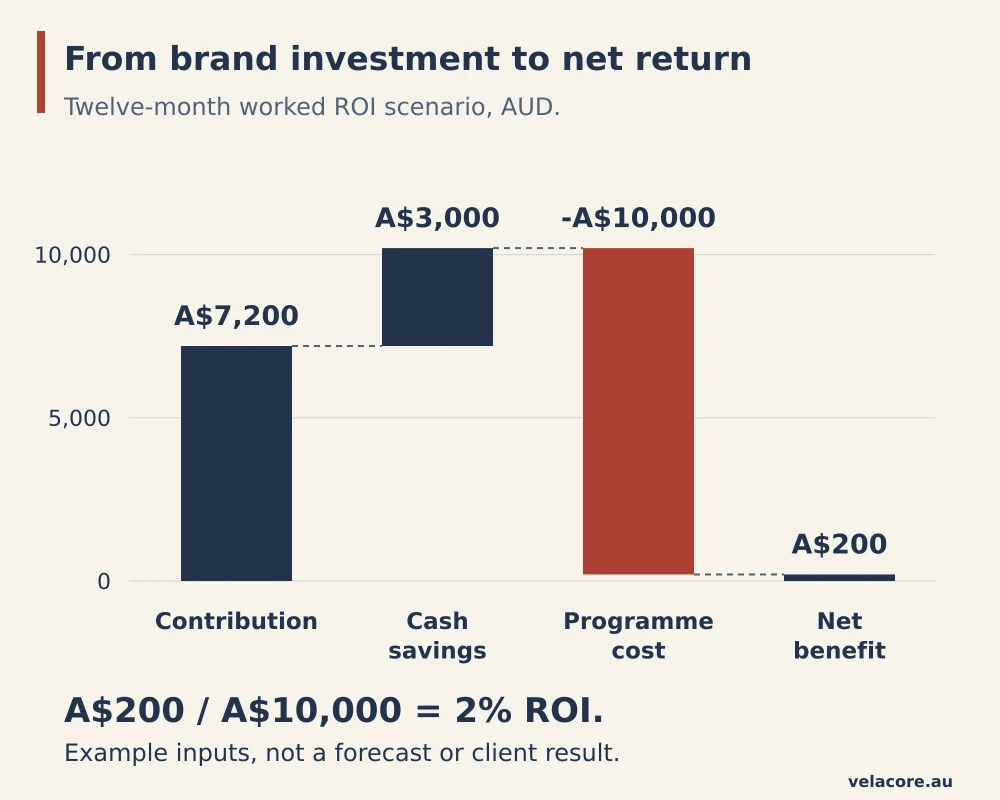
| Input or result | Amount | Basis |
|---|---|---|
| Additional sales revenue | A$18,000 | 12 additional customers × A$1,500 |
| Incremental contribution | A$7,200 | 12 × A$600 after direct delivery costs |
| Realised external cost savings | A$3,000 | Actual supplier costs avoided, not hypothetical staff hours |
| Programme cost | A$10,000 | A$6,000 identity work + A$2,000 rollout + A$2,000 ongoing implementation |
| Net benefit in this scenario | A$200 | A$7,200 + A$3,000 – A$10,000 |
| ROI | 2% | A$200 ÷ A$10,000 × 100 |
The numbers are hypothetical, not Velacore pricing or a promised return. They expose the difference between A$18,000 of sales and A$200 of net benefit after this programme’s costs.
With the same costs and confirmed savings, break-even requires A$7,000 of additional contribution. At A$600 per customer, that is 11.67, so twelve additional customers. Without the A$3,000 cash saving, it takes seventeen. That is a useful sensitivity check before approving the investment.
If attribution is uncertain, show a range of plausible outcomes and explain the basis rather than claiming a precise realised ROI. Keep recognition and customer-feedback evidence alongside the financial model. A last-click report does not capture every earlier encounter with a brand: Google’s attribution guidance describes how different models assign credit across recorded interactions.
Agree the rollout and baseline before the new identity launches
Specify what changes, what remains, where the system will be used and how you will judge it. A logo file without implementation is an unfinished programme.
| Question | Evidence | Owner and review |
|---|---|---|
| Do the right people recognise us? | Comparable asset-linkage research and customer language | Marketing or research owner, before and after sufficient exposure |
| Does the buying journey work better? | Accepted enquiries, purchases and observed confusion | Marketing and sales, using comparable periods or a suitable test |
| Are we retaining value at sale? | Realised price, discounting and contribution by service or product | Sales and finance, with scope and mix held in view |
| Is production less wasteful? | Time, corrections and actual external rework invoices | Content or operations owner, per repeatable task |
| Are customers returning and referring? | Cohort retention, repeat orders and recorded referrals | Customer or commercial owner, over the normal buying cycle |
Budget the website, templates, signage, packaging, platform assets, partner material and old-asset retirement that the chosen scope actually requires. Give the source files and usage rules a clear owner. Preserve working URLs and search metadata when visual changes reach the website.
Avoid the mistakes that turn a refresh into expensive decoration
- Replacing recognised assets because the internal team is tired of them.
- Calling a revenue increase a financial ROI without subtracting delivery and programme costs.
- Attributing an entire relaunch result to the identity when price, traffic and the offer changed too.
- Treating released staff capacity as an immediate reduction in cash costs.
- Launching a new logo while proposals, website pages and customer messages still contradict one another.
- Buying an elaborate guideline document without the reusable assets and ownership needed to apply it.
Before commissioning the work, write down the commercial problem, the assets worth retaining, the complete implementation scope and the evidence that would justify the investment. That is a stronger brief than “make us look more premium”.
Frequently asked questions about the ROI of brand identity
Is a logo the same thing as a brand identity?
No. A logo is one identifying asset. The identity is the wider system of visual and verbal cues, their consistent application and the rules that help people recognise the same business across different encounters.
Can a small business measure brand identity ROI?
Yes. Start with a clear baseline, complete costs and a small set of meaningful measures. Record accepted enquiries, realised prices, repeat business and actual rework costs. Use recognition interviews to identify confusion, while avoiding precise market-wide claims from tiny samples.
How long does it take to judge a rebrand?
Separate implementation checks from commercial outcomes. Broken pages and obsolete templates can be identified immediately. Recognition needs exposure, while sales and retention need the normal customer decision cycle. Agree review periods before launch instead of assuming a thirty-day revenue result.
Does changing colours increase recognition by 80%?
Do not use a universal uplift as a forecast. Recognition depends on learned associations, context, distinctiveness and use over time. Test whether relevant buyers connect your specific colours and other assets with your business, and keep the combinations readable.
Should we replace every existing asset during a refresh?
No. Identify what buyers already recognise, then improve the weak or inconsistent parts. A refresh can preserve a useful symbol, colour relationship or verbal cue while making the system easier to use. A complete replacement needs a clear business reason.
What costs belong in the ROI calculation?
Include research, strategy and identity design plus the implementation needed to use them: website changes, templates, packaging, signage, rollout labour and ongoing programme costs. Apply a consistent accounting period and avoid counting the same costs or benefits twice.
Can AI-generated assets replace a brand identity system?
AI can help produce variations, but it does not choose the business position, validate recognition or own the approved standard. Keep clear source assets, usage rules, rights checks and human review. Otherwise, faster production can simply create more inconsistency.
Make the identity serve a measurable business decision
The ROI of brand identity is most useful when it connects a recognisable business with a better customer journey, healthier sales and less avoidable production work. Keep the promise clear, protect the assets people know and measure the change against the full investment.
For help connecting the identity with your offer and digital experience, explore our digital strategy work and websites and platforms, or discuss your business priorities with Velacore.